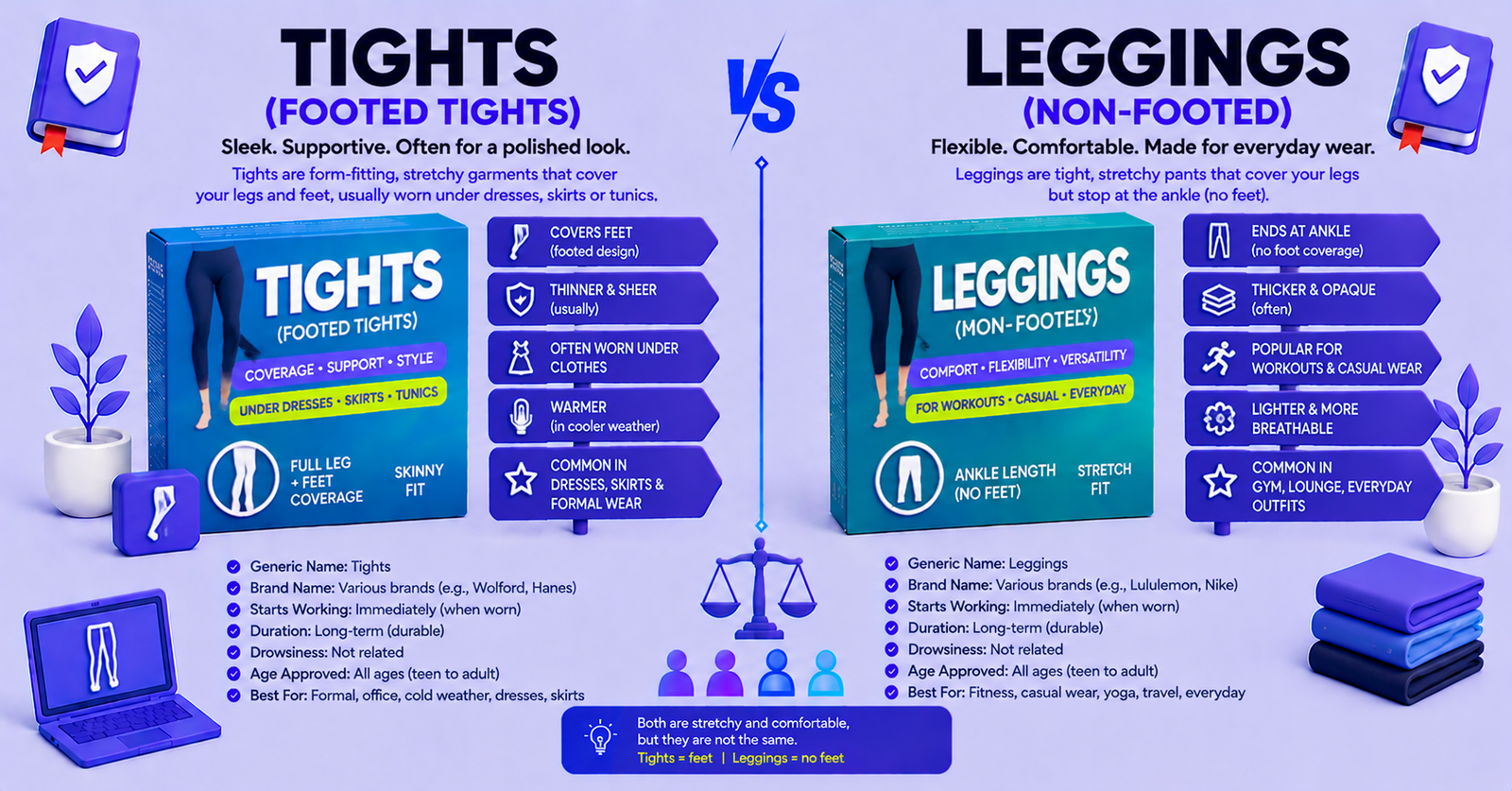

Tights and leggings are both close-fitting garments that stretch around the legs, so it is easy to treat the words as interchangeable. Traditionally, however, they serve different purposes. Tights are generally associated with hosiery or close-fitting legwear used for layering, while leggings are usually thicker, footless garments that can be worn as standalone bottoms.
The distinction becomes less obvious in sportswear. Athletic brands may use tights and leggings for garments with very similar materials, fits, and functions. That means thickness alone is not always enough to tell them apart.
Quick Answer
Tights are usually close-fitting legwear designed to cover the legs and, in the traditional hosiery sense, often the feet. They are commonly worn under dresses or skirts and may be sheer, semi-sheer, or opaque. Leggings are typically stretchy, footless trousers that are substantial enough to be worn on their own.
The simplest practical rule is:
Choose tights when you want hosiery or a layer under another garment; choose leggings when you want a substantial, usually opaque bottom that can be worn by itself.
There is an important exception: activewear tights and leggings can overlap considerably, so the fabric, construction, compression, and intended activity may matter more than the name on the label.
Tights vs Leggings at a Glance
| Feature | Tights | Leggings |
|---|---|---|
| Typical construction | Hosiery or close-fitting legwear | Stretchy, trouser-like garment |
| Thickness | Often thin, but can also be thicker | Usually substantial |
| Opacity | Sheer, semi-sheer, or opaque depending on style | Usually opaque |
| Feet | Traditional tights often cover the feet | Usually footless |
| Typical use | Layering, dresses, skirts, dance | Casual wear, activewear, everyday outfits |
| Standalone wear | Usually not appropriate when sheer | Common |
| Activewear | Common in sports and dance | Very common |
| Terminology | Varies by region and product category | Generally consistent, but overlaps with activewear tights |
Traditional dictionary definitions support this broad distinction, while also showing why it is not absolute: Cambridge and Oxford both recognize tights used for dancing or exercise, including thicker versions.
What Are Tights?
Tights are close-fitting garments that cover the lower body and legs. In the traditional British-English sense, they commonly cover the feet and are often worn underneath dresses or skirts. In American English, pantyhose is commonly used for this thin hosiery meaning.
Tights can vary considerably.
They may be:
- sheer
- semi-sheer
- opaque
- patterned
- thermal
- footed
- footless
- designed for dance
- designed for exercise
Oxford specifically distinguishes the thin hosiery sense from thicker tights worn especially by dancers.
Example
She wore black tights under her dress.
Here, tights refers to hosiery worn as a layer beneath another garment.
What Are Leggings?
Leggings are tight-fitting trousers made from stretchy material. They are normally footless and cover the legs from the waist or hips down toward the ankles. Cambridge and Oxford both define leggings as tight-fitting trousers made from stretchy fabric.
Modern leggings are available in many forms, including:
- cotton-blend leggings
- workout leggings
- running leggings
- fleece-lined leggings
- fashion leggings
- compression-style leggings
- seamless leggings
- full-length leggings
- cropped leggings
Unlike sheer hosiery, leggings are generally designed to function as a garment that can be worn on its own.
Example
She wore black leggings with a sweatshirt and sneakers.
Here, leggings function as the main lower-body garment rather than as hosiery underneath another item.
What Is the Difference Between Tights and Leggings?
The biggest difference is how the garments are constructed and intended to be worn.
Traditional tights are commonly associated with hosiery and layering. Leggings are generally more substantial and function more like trousers.
Four characteristics are especially useful:
1. Opacity
Traditional tights can be transparent or semi-transparent, although opaque tights also exist.
Leggings are generally designed to provide much more coverage.
2. Foot coverage
Traditional tights often extend over the feet.
Leggings normally stop around the ankle and leave the feet uncovered.
3. Intended use
Tights are frequently worn with dresses, skirts, dance costumes, or as an additional layer.
Leggings are commonly worn as standalone clothing for casual activities, exercise, travel, or everyday outfits.
4. Construction
Leggings generally have a more trouser-like construction, while traditional hosiery tights have a construction associated with close-fitting legwear.
These characteristics work together. No single feature should be treated as an absolute rule.
Thickness and Opacity
Thickness is one of the most noticeable differences, but it is not a perfect test.
Traditional hosiery tights are often made from relatively thin material and may allow the skin to show through.
Leggings are usually made from more substantial fabric and are intended to provide solid coverage.
For example:
She wore sheer black tights with a formal dress.
versus:
She wore opaque black leggings with a long sweater.
However, thick tights exist, particularly for dance, exercise, and colder weather. Cambridge and Oxford both recognize thicker tights in their definitions.
So remember:
Thickness is a clue, not the entire definition.
Foot Coverage
Foot coverage provides another useful distinction.
Traditional tights often extend from the waist or hips all the way down over the feet.
Leggings are normally footless and end around the ankle.
For example:
She put on tights before wearing her ballet shoes.
She wore leggings with running shoes.
However, product designs vary, so foot coverage alone cannot determine what a manufacturer will call a garment.
Intended Use
The intended use often provides the clearest practical distinction.
Tights are commonly used for:
- dresses
- skirts
- dance
- ballet
- costumes
- additional warmth
- fashion layering
Leggings are commonly used for:
- casual outfits
- exercise
- yoga
- running
- travel
- lounging
- everyday wear
Cambridge includes dancing and exercise among contexts for tights, while its definition of leggings describes them as tight trousers made from stretchy material.
Tights vs Leggings in Activewear
This is where the traditional distinction becomes less reliable.
In activewear, tights can mean close-fitting performance garments designed for running, training, cycling, dance, or other exercise. Leggings can also be made from technical stretch fabrics and used for exactly the same activities.
For example, adidas currently markets both tights and leggings and distinguishes some athletic tights by their more compressive fit, while describing leggings as a broader category that can provide a lighter or more relaxed feel.
Other current activewear sources explicitly note that workout leggings and training tights can be extremely similar and recommend looking at the actual garment rather than relying only on its name.
Therefore:
A pair of “running tights” may function much more like leggings than like traditional sheer hosiery.
When shopping for activewear, check:
- fabric
- opacity
- compression
- waistband
- seams
- stretch
- moisture management
- intended activity
- product specifications
The product label alone may not tell you everything.
When to Use Tights
Choose tights when you need close-fitting legwear that works as hosiery, layering, or specialized dance/exercise clothing.
For example:
She wore black tights under her winter dress.
The dancer wore pink tights for the performance.
I need opaque tights to wear with this skirt.
Traditional tights are particularly useful when you want the appearance or function of hosiery rather than the trouser-like coverage of leggings.
When to Use Leggings
Choose leggings when you want a stretchy, close-fitting bottom that can normally be worn independently.
For example:
I wore leggings to the gym.
She packed two pairs of leggings for the trip.
These leggings are thick enough to wear without another layer.
Leggings are particularly practical for casual wear and activities where you want freedom of movement without the transparency associated with traditional sheer tights.
Tights and Leggings in Sentences
Tights
She wore patterned tights with her black dress.
The garment is being used as a fashion layer.
The ballet students wore tights during class.
Here, tights refers to specialized dancewear.
Leggings
I wear leggings when I go hiking.
The garment functions as a substantial lower-body layer.
She bought a new pair of fleece-lined leggings for winter.
Here, leggings are being treated like everyday trousers or activewear.
Common Collocations With Tights and Leggings
Common collocations with tights
- black tights
- sheer tights
- opaque tights
- patterned tights
- thermal tights
- ballet tights
- dance tights
- a pair of tights
- tights under a dress
- tights under a skirt
Oxford’s collocation information includes combinations such as opaque tights, thick tights, ribbed tights, and common expressions involving a pair, holes, or ladders in tights.
Common collocations with leggings
- black leggings
- workout leggings
- yoga leggings
- running leggings
- fleece-lined leggings
- compression leggings
- full-length leggings
- cropped leggings
- leather leggings
- a pair of leggings
Common Mistakes With Tights and Leggings
Mistake 1: Treating all tights as sheer
Incorrect assumption:
Tights are always transparent.
Why:
Tights can be sheer, semi-sheer, or opaque. Thicker tights are also used for dance and exercise.
Mistake 2: Assuming all leggings are suitable for every activity
Incorrect assumption:
Any leggings are automatically good for running.
Why:
“Leggings” describes a broad category. The actual fabric, support, moisture management, fit, and construction determine whether a particular pair suits running or another activity.
Mistake 3: Assuming the words always have fixed meanings
Incorrect assumption:
A garment called tights must always be completely different from leggings.
Why:
Activewear terminology overlaps. A brand may call a close-fitting performance garment tights while another uses leggings for a very similar product.
Mistake 4: Wearing sheer tights as if they were opaque leggings
A thin pair of tights may become more transparent when stretched, particularly around the knees, hips, and seat.
If you need a standalone garment, check that the product is specifically designed to provide adequate coverage.
British vs American English
There is an important regional terminology difference.
In British English, tights commonly refers to the thin, close-fitting hosiery worn over the legs and feet.
In American English, that traditional hosiery is commonly called pantyhose. Cambridge explicitly lists “US pantyhose” alongside its British definition of tights.
However, American English also uses tights for garments worn by dancers and people exercising.
So the context matters.
Can Tights and Leggings Be Used Interchangeably?
Usually not, but sometimes the categories overlap.
If you mean traditional sheer hosiery, tights and leggings are not interchangeable.
For example:
She wore tights under her dress.
Replacing tights with leggings changes the expected garment and appearance.
But in activewear, the distinction can become much less precise. A pair of athletic tights may be practically similar to workout leggings.
The safest approach is to look at the garment’s:
- opacity
- foot coverage
- fabric
- compression
- construction
- intended use
How to Remember the Difference
Use this simple rule:
Tights = think hosiery or a close-fitting layer.
Leggings = think stretchy trousers or standalone bottoms.
Then remember the exception:
Sportswear can blur the line.
This two-part rule is more reliable than simply memorizing “tights are thin and leggings are thick.”
Which One Should I Use?
The right choice depends on how you plan to wear the garment.
Tights are usually the better option under a dress or skirt, especially when you want a traditional hosiery layer.
Leggings work well as standalone bottoms because they are generally thicker and more opaque.
For ballet, dance, and similar activities, tights are commonly used as specialized dancewear.
When choosing everyday casual clothing, leggings are generally a practical option for travel, lounging, and daily wear.
During exercise, pay attention to fabric, fit, compression, breathability, and intended activity instead of relying only on the label “tights” or “leggings.”
In American English, pantyhose is a common term for traditional sheer hosiery, although tights is also used for certain athletic and dance garments.
Tights or Leggings? Practice Examples
Choose tights or leggings.
- She wore black ___ under her dress.
- I usually wear ___ when I go to yoga.
- The ballet dancer put on her pink ___.
- These ___ are thick enough to wear by themselves.
- She wanted sheer ___ for the formal event.
- He bought technical running ___ for winter training.
- She wore fleece-lined ___ with a long sweater.
- The outfit included a skirt and patterned ___.
Answers
- tights
- leggings
- tights
- leggings
- tights
- tights — in the activewear sense
- leggings
- tights
Notice that number 6 demonstrates why the simple “tights are thin” rule does not always work.
Frequently Asked Questions
What is the main difference between tights and leggings?
Traditional tights are generally close-fitting hosiery used for layering and often cover the feet, while leggings are usually thicker, footless, stretchy trousers designed to be worn independently. Activewear creates some overlap between the two terms.
Are tights and leggings the same thing?
No, not traditionally. They are different categories of clothing, although modern activewear sometimes uses the terms for garments with very similar characteristics.
Are leggings thicker than tights?
Usually, but not always. Leggings are generally substantial and opaque, while many traditional tights are thin or sheer. However, thick tights exist, especially for dance, exercise, and cold weather.
Do tights cover your feet?
Traditional hosiery tights generally do. However, tights can also be footless depending on the style and context.
Can you wear tights as leggings?
If the tights are sheer or designed as hosiery, they are generally not a direct substitute for opaque leggings. Some thicker athletic tights, however, are designed to be worn as standalone activewear.
Can you wear leggings under a dress?
Yes. Leggings can be worn under dresses, and Cambridge explicitly gives examples of leggings being worn under dresses.
Are workout tights the same as leggings?
They can be very similar. In activewear, the names are not always used consistently, so examine the fabric, fit, compression, construction, and intended activity.
What are tights called in American English?
For the traditional thin hosiery meaning, pantyhose is the common American-English term. American English also uses tights for certain dance and exercise garments.
Which is better, tights or leggings?
Neither is universally better. Tights are more appropriate when you want hosiery or a layer, while leggings are generally more appropriate when you want substantial standalone coverage. For exercise, compare the specifications of the individual garment.
Conclusion
The difference between tights and leggings is mainly about construction, coverage, and intended use. Traditional tights are close-fitting hosiery or specialized legwear, often used under dresses and skirts and sometimes extending over the feet. Leggings are generally thicker, footless, stretchy trousers designed to be worn as standalone bottoms.
The distinction becomes less clear in activewear, where brands may use tights and leggings for similar performance garments. When the terminology overlaps, focus on the actual garment rather than its name: check its opacity, fabric, construction, foot coverage, fit, and intended activity.

Sajid Ali is an English language educator and content specialist with 7+ years of teaching experience. He holds master’s degrees in Information Technology and Education from the Virtual University of Pakistan and writes SEO-optimized, learner-friendly vocabulary content for diffari.com.