
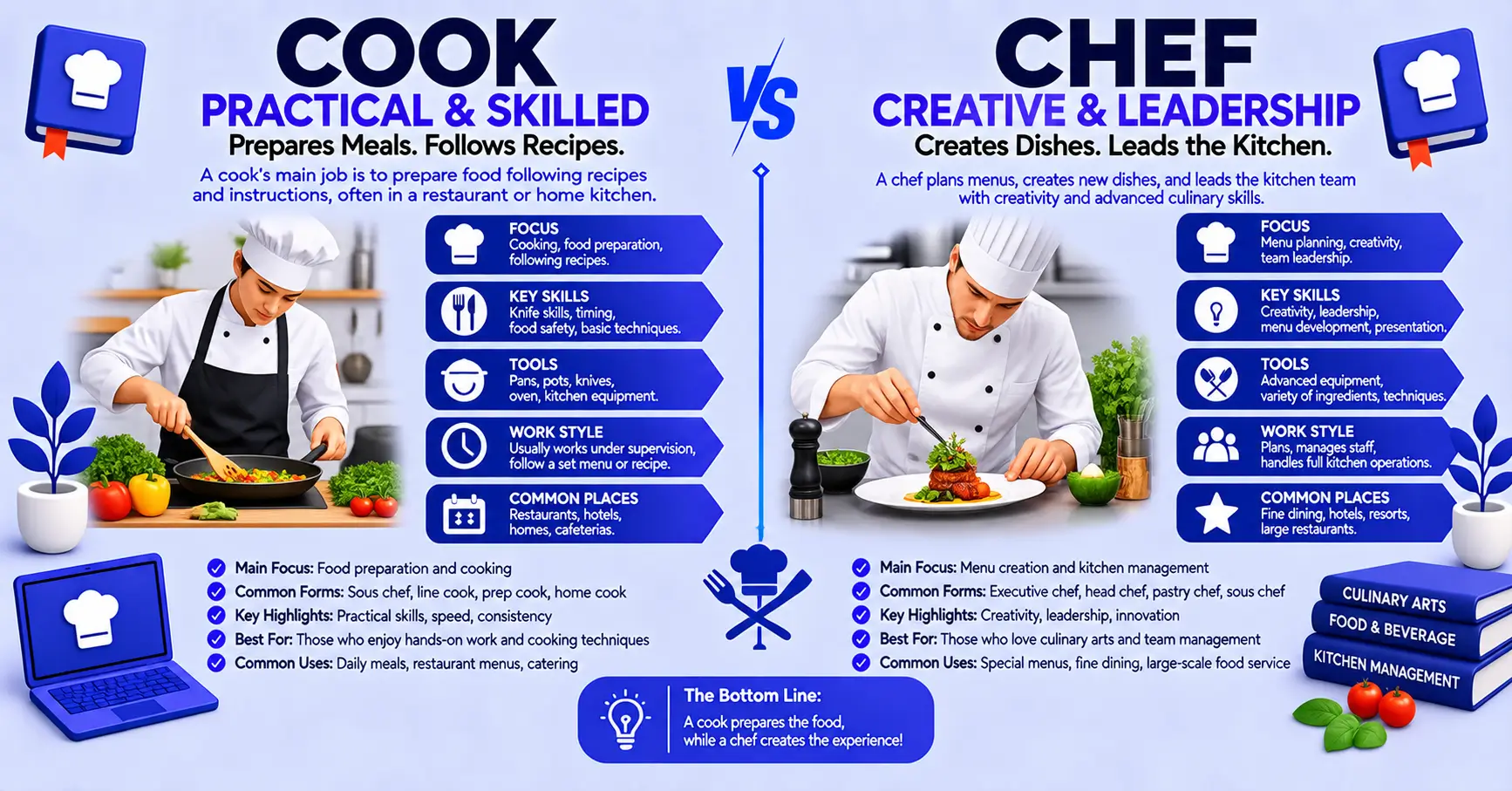

The words cook and chef both refer to people who prepare food, so they are often used as if they mean exactly the same thing. However, in professional culinary settings, there is an important distinction. A cook generally focuses on preparing and cooking food, while a chef is usually a professional culinary specialist whose role can include menu development, kitchen supervision, staff management, quality control, and broader responsibility for the food operation.
The distinction is not simply that a cook is inexperienced and a chef is highly skilled. Cooks can be extremely experienced, and chefs can spend much of their time cooking. The real difference is usually the scope of the role, level of responsibility, professional context, and authority in the kitchen.
Quick Answer
A cook is someone who prepares and cooks food. A chef is generally a professional cook, especially one who has a specialized culinary role or greater responsibility within a restaurant, hotel, catering operation, or other professional kitchen.
The simplest way to remember the difference is:
Cook = prepares and cooks food.
Chef = professional culinary role with broader expertise or responsibility.
However, these terms overlap. A chef is a cook in the broad sense, but not everyone who cooks—or even everyone who works professionally as a cook—is necessarily called a chef.
Cook vs Chef at a Glance
| Feature | Cook | Chef |
| Basic meaning | Person who prepares and cooks food | Professional cook, often with a specialized or senior role |
| Main focus | Food preparation and execution | Cooking plus broader culinary responsibility |
| Workplace | Home, restaurant, cafeteria, hospital, school, catering, etc. | Usually a professional kitchen |
| Responsibilities | Prepares ingredients and cooks dishes | May manage staff, menus, recipes, quality and kitchen operations |
| Training | May learn through experience or on-the-job training | Often has substantial professional experience and/or culinary training |
| Creativity | Can be creative and independent | Often has greater responsibility for recipes, menus or culinary direction |
| Authority | Usually depends on the specific job | Often has supervisory or leadership responsibility |
| Example | “She works as a line cook.” | “He is the restaurant’s head chef.” |
These are general distinctions rather than rigid rules. The exact responsibilities depend on the workplace and job title.
What Does “Cook” Mean?
Cook is the broader word.
As a noun, a cook is someone who prepares and cooks food. The word can describe a person cooking at home as well as someone employed in a professional kitchen. Cambridge defines the noun cook as someone who prepares and cooks food.
For example:
- My father is an excellent cook.
- We hired a cook to prepare meals for the family.
- She works as a cook in a hospital.
- The restaurant is looking for an experienced cook.
The word does not automatically tell you how much experience the person has.
A cook could be:
- a home cook
- a prep cook
- a line cook
- a short-order cook
- an institutional cook
- a highly experienced professional cook
So, cook is not necessarily a low-level job title. It is a broad term covering many people who prepare food.
What Does “Chef” Mean?
Chef is a more specialized professional term.
Cambridge defines a chef as a skilled and trained cook who works in a hotel or restaurant, particularly someone in an important culinary position. Oxford similarly defines chef as a professional cook, especially a senior cook in a restaurant or hotel.
Examples include:
- head chef
- executive chef
- sous chef
- pastry chef
- chef de partie
A chef may still spend considerable time cooking. However, depending on the position, they may also be responsible for:
- planning menus
- developing recipes
- supervising kitchen staff
- maintaining food quality
- controlling food costs
- ordering ingredients
- organizing kitchen operations
- training other staff
- maintaining food-safety standards
Therefore, chef usually tells you more about a person’s professional role than simply saying that the person cooks.
What Is the Main Difference Between a Cook and a Chef?
The biggest difference is scope of responsibility.
A cook is generally focused on preparing food and carrying out the tasks required to produce dishes. A chef may do those things too, but often has additional responsibility for the people, planning, standards, or overall operation surrounding the food.
For example, imagine a busy restaurant.
A line cook may be responsible for preparing food at the grill station. Their job could include cooking steaks to the required temperature, preparing ingredients, keeping the station organized, and sending dishes out consistently.
A head chef, meanwhile, may oversee the entire kitchen. They could decide what appears on the menu, supervise cooks, check food quality, manage kitchen workflow and solve problems during service.
Both people cook.
But their scope of responsibility is different.
Current culinary-career sources similarly identify responsibility and kitchen leadership as major distinctions between cooks and chefs.
Cook vs Chef: Responsibility and Kitchen Authority
One useful way to understand the distinction is to think about who is responsible for what.
A cook might be responsible for:
- preparing ingredients
- following recipes or specifications
- cooking assigned dishes
- maintaining a station
- meeting service times
- maintaining cleanliness and organization
A chef may have responsibility for those tasks plus:
- supervising cooks
- developing or modifying recipes
- planning menus
- managing kitchen workflow
- training staff
- monitoring food costs
- maintaining consistent quality
- making operational decisions
However, this does not mean every chef manages an entire restaurant.
A sous chef, for example, may have substantial management responsibilities while working under an executive or head chef. A pastry chef may lead the pastry section rather than the entire kitchen.
The title chef covers several different professional roles.
Does a Chef Have to Go to Culinary School?
No. Culinary school can be useful, but it is not an absolute requirement for becoming a chef.
This is an important point because many simplistic explanations claim that a person is a cook without formal education and automatically becomes a chef after attending culinary school.
Professional kitchens do not work that neatly.
A person can develop culinary expertise through:
- culinary school
- apprenticeships
- structured workplace training
- years of professional kitchen experience
- mentorship
- a combination of education and practical experience
Escoffier specifically notes that there is no single degree or certification that automatically changes a cook into a chef; experience, culinary ability and leadership all matter.
So the better rule is:
Training can help someone become a chef, but a culinary degree alone does not define the role.
When to Use “Cook”
Use cook when you are talking generally about someone who prepares food.
For example:
My sister is a very good cook.
We need a cook for the family.
He works as a cook at a local hospital.
The restaurant hired two new cooks.
Use cook when the person’s specific professional position does not require the title chef.
It is also the natural word for people who prepare food at home.
You would normally say:
She is a great cook.
You would not normally need to call her a chef simply because she makes excellent meals.
When to Use “Chef”
Use chef when referring to a professional culinary role, especially in a restaurant, hotel, catering company or other professional kitchen.
For example:
Maria is a chef at a five-star hotel.
The chef created a new seasonal menu.
The head chef spoke with the kitchen staff.
We asked the chef about the ingredients.
Use a more specific title when appropriate:
He is the executive chef.
She works as a pastry chef.
Daniel was promoted to sous chef.
The word chef is therefore particularly useful when the person’s professional position involves specialized culinary responsibility.
Cook and Chef in Sentences
Compare these examples:
Cook:
Ahmed is an excellent cook.
This simply tells us that Ahmed is skilled at preparing food.
Chef:
Ahmed is the head chef at a hotel.
This tells us that Ahmed holds a professional culinary position and has significant responsibility in the kitchen.
Another comparison:
Sarah works as a cook in a school cafeteria.
Here, the emphasis is on her food-preparation job.
Sarah is the chef at a popular restaurant.
Here, chef identifies her as a professional culinary specialist in a restaurant.
Common Collocations With “Cook” and “Chef”
Learning common combinations can make the distinction easier.
Common collocations with “cook”
- home cook
- professional cook
- line cook
- prep cook
- short-order cook
- cook food
- cook dinner
- experienced cook
- skilled cook
- excellent cook
Common collocations with “chef”
- head chef
- executive chef
- sous chef
- pastry chef
- professional chef
- celebrity chef
- private chef
- restaurant chef
- trained chef
- chef’s special
- chef’s knife
- chef’s menu
Notice that line cook and prep cook are established job titles, while head chef and executive chef indicate specific levels of culinary responsibility.
Common Mistakes With Cook and Chef
Mistake 1: Assuming every cook is a chef
Incorrect assumption:
Anyone who cooks professionally is automatically a chef.
Better understanding:
A person may work professionally as a cook without holding a chef position.
Why:
Cook is a broader term, while chef is generally a more specific professional culinary role.
Mistake 2: Thinking a chef must have a degree
Incorrect assumption:
You cannot become a chef unless you have a culinary degree.
Better understanding:
Professional experience, practical ability and leadership can also contribute to becoming a chef.
Why:
There is no single universal credential that automatically defines someone as a chef.
Mistake 3: Assuming chefs do not cook
Incorrect assumption:
A chef only manages people.
Better understanding:
Chefs can cook extensively, particularly in smaller kitchens or hands-on culinary roles.
Why:
Management is only one possible part of a chef’s job.
Mistake 4: Treating cooks as unskilled workers
Incorrect assumption:
A cook is always inexperienced.
Better understanding:
A cook can be highly skilled and experienced.
Why:
The title describes the role, not necessarily the person’s total level of ability.
Are “Cook” and “Chef” Interchangeable?
Sometimes in casual conversation, but not always in professional contexts.
If you simply say that someone is good at preparing food, cook is usually appropriate:
She’s an excellent cook.
If you are referring to someone’s professional culinary position, chef may be more appropriate:
She’s the head chef at the restaurant.
The two words overlap because a chef is, in the broadest sense, someone who cooks. However, replacing chef with cook can remove information about the person’s professional role or level of responsibility.
Similarly, calling every cook a chef can imply a professional position that the person may not actually hold.
Can a Cook Become a Chef?
Yes.
Many professional chefs begin their careers in cooking positions and progress through increasingly responsible roles.
A possible path might look like:
Kitchen assistant → Prep cook → Line cook → Chef de partie → Sous chef → Head/Executive chef
The exact path varies by restaurant, country and kitchen structure.
Experience is particularly important because a chef may need to understand not only how to cook but also how to manage time, people, ingredients, costs and quality.
Escoffier and other culinary sources emphasize that chefs can develop through combinations of hands-on experience, education and leadership rather than through one mandatory credential.
How to Remember the Difference
Use this simple rule:
Cook = the person who cooks.
Chef = the professional culinary role.
If you are talking about someone making food at home, cook is usually the natural word.
If you are talking about a professional culinary position in a restaurant or hotel, chef is often the better choice.
And remember: chef does not simply mean “better cook.” It usually carries information about professional role, expertise, specialization or responsibility.
Which One Should I Use?
Use cook if you mean:
- someone who prepares food
- someone who cooks at home
- a person employed specifically as a cook
- a line cook or prep cook
- a person whose professional title is cook
Use chef if you mean:
- a professional culinary specialist
- a restaurant or hotel chef
- a head chef
- an executive chef
- a sous chef
- a pastry chef
- someone with broader culinary responsibility
Quick decision rule
Someone prepares food → Cook
Professional culinary position → Chef
Head or senior person in a kitchen → Chef
Person who simply cooks well → Cook
Specific professional title such as sous chef or executive chef → Chef
X or Y? Practice Examples
Choose cook or chef in each sentence.
- My grandmother is an excellent ___.
- The restaurant’s ___ designed the new menu.
- We hired a ___ to prepare meals for the family.
- She works as a line ___ in a busy restaurant.
- The head ___ spoke to the kitchen staff.
- He is a talented home ___.
- The hotel is looking for an experienced pastry ___.
- The hospital hired a new ___ to prepare meals.
- The ___ supervised the kitchen during dinner service.
- My brother is a great ___, even though he has never worked in a restaurant.
Answers
- cook
- chef
- cook
- cook
- chef
- cook
- chef
- cook
- chef
- cook
The important point is that these answers depend on context and role, not simply on how skilled the person is.
Frequently Asked Questions
What is the main difference between a cook and a chef?
A cook generally focuses on preparing and cooking food, while a chef is usually a professional culinary specialist with broader expertise, responsibility or authority in a professional kitchen.
Is a chef a cook?
Yes, in the broad sense. A chef is a professional cook, but cook and chef are not always interchangeable job titles. Cambridge and Oxford both define a chef in terms of professional cooking.
Is every cook a chef?
No. Someone can be a cook without holding a chef position. For example, a prep cook or line cook may work in a professional kitchen without being the chef.
Does a chef need culinary school?
No. Culinary school can provide valuable training, but professional experience, practical culinary skills and leadership can also contribute to becoming a chef.
Can a cook become a chef?
Yes. Many culinary professionals begin as cooks and progress into positions with greater responsibility.
Is a line cook a chef?
Usually, line cook and chef are treated as different job titles, although the exact hierarchy varies between kitchens. A line cook normally works at a particular station, while chef titles can indicate broader culinary or supervisory responsibility.
Which is higher, a cook or a chef?
In a traditional professional kitchen hierarchy, chef positions generally carry greater responsibility than cook positions. However, not every chef manages an entire kitchen, and highly experienced cooks can have substantial skills and responsibilities.
Are cook and chef synonyms?
They overlap in meaning, but they are not perfect synonyms. Cook is broader, while chef usually refers to a professional culinary role.
What is the difference between a chef and a head chef?
A chef is a general professional culinary title. A head chef is specifically a senior chef responsible for leading or overseeing a kitchen.
Can you call someone a chef if they cook at home?
In casual speech, people sometimes use chef playfully to praise someone’s cooking. However, in standard professional usage, cook is the more accurate term for someone who simply cooks at home.
Conclusion
The main difference between a cook and a chef is not simply skill or education. A cook is broadly someone who prepares and cooks food, while a chef generally refers to a professional culinary specialist whose role may include cooking as well as menu planning, recipe development, supervision and kitchen management.
A cook can be highly skilled, and a chef can still spend much of the day cooking. The distinction comes mainly from professional context, role, authority and scope of responsibility.

Sajid Ali is an English language educator and content specialist with 7+ years of teaching experience. He holds master’s degrees in Information Technology and Education from the Virtual University of Pakistan and writes SEO-optimized, learner-friendly vocabulary content for diffari.com.