
Panko and breadcrumbs are often treated as two completely different ingredients, but there is an important distinction: panko is actually a type of breadcrumb. The real comparison is usually between panko and regular or traditional breadcrumbs.
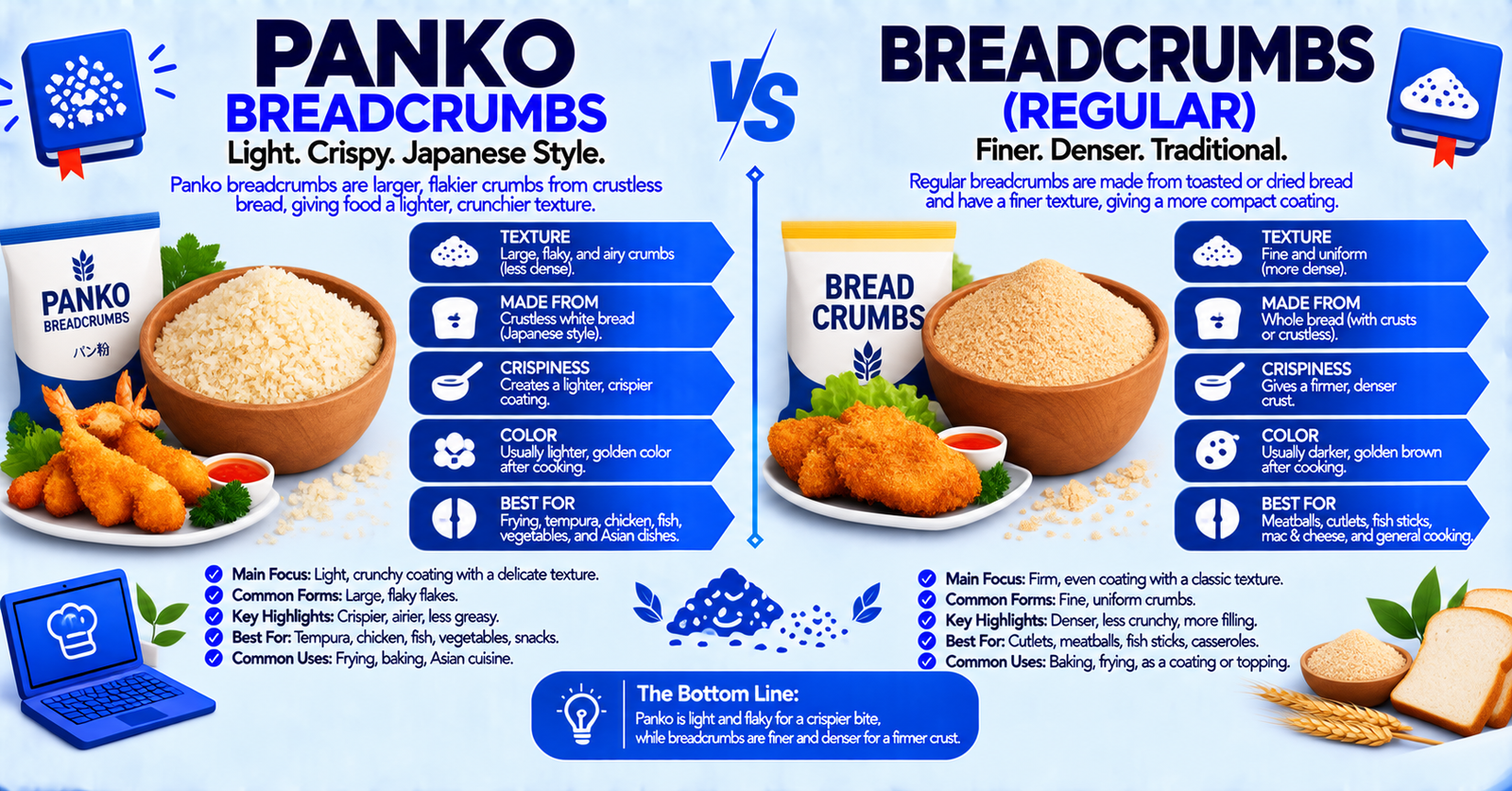
Panko consists of larger, flaky pieces that create a light, airy crunch when cooked. Regular breadcrumbs are generally finer and more compact, although their texture can vary depending on how they are made. Both can be used for breading, toppings, and binding, but they produce different results.
Knowing the difference helps you choose the right one when a recipe calls for a crispy coating, a casserole topping, or a binder for meatballs or meatloaf.
Quick Answer
Panko is a type of breadcrumb, but it is made and processed differently from many regular breadcrumbs. Panko typically consists of large, airy flakes made from crustless bread, while regular breadcrumbs are usually more finely ground and can be made from different types of bread.
The biggest practical difference is texture: panko usually produces a lighter, crunchier coating, while finer breadcrumbs create a more compact and uniform coating.
Panko vs Breadcrumbs at a Glance
| Feature | Panko | Regular Breadcrumbs |
|---|---|---|
| What it is | A type of breadcrumb | Broad category of dried or processed bread crumbs |
| Texture | Large, flaky, airy | Usually finer and more compact |
| Appearance | Irregular flakes | Fine or granular crumbs |
| Typical result | Light, crisp crunch | Denser, more uniform coating |
| Flavor | Usually mild and plain | May be plain or seasoned |
| Common use | Crispy coatings and toppings | Coatings, binders, toppings |
| Japanese cooking | Very common | Not specifically Japanese |
| Best known for | Crispiness | Versatility and binding |
The exact characteristics vary by product because “breadcrumbs” covers several varieties.
What Is Panko?
Panko is a Japanese-style breadcrumb made into larger, flaky pieces.
Traditional panko is associated with crustless white bread. The bread is processed into flakes rather than being ground into the fine particles commonly associated with regular breadcrumbs. This produces panko’s characteristic light and airy structure.
Panko is particularly common in Japanese dishes that require a crisp coating. Japanese tourism sources, for example, describe panko as part of the breading used for dishes such as miso katsu and kushikatsu.
It is also widely used outside Japanese cooking for:
- fried chicken
- fish
- shrimp
- vegetables
- casseroles
- pasta toppings
- meatballs
- meatloaf
- croquettes
Its main appeal is its texture rather than a strong flavor.
What Are Breadcrumbs?
Breadcrumbs are pieces of bread that have been dried, crumbled, or processed into smaller particles.
Unlike panko, “breadcrumbs” is a broad category rather than one specific texture or manufacturing method.
Breadcrumbs can be:
- fine
- coarse
- fresh
- dried
- plain
- seasoned
- homemade
- commercially produced
They can also be made from different kinds of bread.
This is why saying that all breadcrumbs are fine or dense would be inaccurate. The exact result depends on the type of breadcrumbs being used. Kikkoman, for example, distinguishes panko from Western-style breadcrumbs partly through differences in particle size and texture.
Regular breadcrumbs are commonly used as a coating, casserole topping, or binder in foods such as meatballs and meatloaf.
What Is the Difference Between Panko and Breadcrumbs?
The simplest answer is:
Panko is a specific type of breadcrumb, while breadcrumbs is the broader category.
When recipes compare “panko” with “breadcrumbs,” they usually mean panko versus regular or traditional breadcrumbs.
The main practical differences are particle size, texture, coating behavior, and the final crunch.
1. Texture
Panko has larger, irregular flakes. Regular breadcrumbs are commonly much finer.
The difference is noticeable as soon as you handle them. Panko looks more like thin flakes or shards, while fine breadcrumbs resemble small grains or powder.
2. Crispiness
Panko is particularly useful when you want a light, crunchy exterior.
Its larger flakes create a different surface texture when cooked. Food Network describes panko as producing large flaky breadcrumbs that help food remain crisp, while The Kitchn notes its light texture and crisping ability.
3. Coverage
Fine breadcrumbs can create a relatively even, compact coating because their smaller particles fill gaps easily.
Panko produces a more textured coating. That is useful when you want visible crunch, but it may not be ideal when a recipe requires a very fine or uniform crumb.
4. Flavor
Plain panko generally has a mild bread flavor.
Regular breadcrumbs can also be plain, but seasoned varieties may contain herbs, spices, cheese, or other flavorings.
5. Cooking result
If your goal is maximum crunch, panko is often the more appropriate choice.
If your goal is a compact coating or cohesive binding, finer breadcrumbs may be more suitable.
When to Use Panko
Choose panko when the texture you want is:
Light + crisp + crunchy
Panko works particularly well for:
- chicken cutlets
- fish
- shrimp
- tonkatsu
- croquettes
- fried vegetables
- baked vegetable toppings
- casserole toppings
- crispy pasta toppings
Japanese cuisine provides many classic examples. Panko is used in dishes such as tonkatsu and kushikatsu specifically as a crisp coating.
It is also useful when you want a crunchy topping without creating a very dense layer.
When to Use Regular Breadcrumbs
Choose regular breadcrumbs when you want:
Fine texture + even coverage + cohesive binding
They can be especially useful for:
- meatballs
- meatloaf
- stuffing
- fine breading
- casserole mixtures
- recipes requiring a compact crumb
- recipes specifically calling for seasoned breadcrumbs
A fine breadcrumb can integrate into a mixture more easily than large panko flakes.
For example, if you’re making meatballs and want the breadcrumb to blend smoothly into the meat mixture, fine breadcrumbs may be more appropriate than coarse panko.
Panko and Breadcrumbs in Real Sentences
Example 1: Fried chicken
I coated the chicken with panko before frying it.
Why: Panko is useful when a light, crunchy exterior is desired.
Example 2: Meatballs
Add breadcrumbs to the meat mixture before shaping the meatballs.
Why: Fine breadcrumbs can blend into the mixture and help provide structure.
Example 3: Casserole
Sprinkle panko over the casserole before baking.
Why: The flakes provide a crunchy surface.
Example 4: Seasoned coating
Mix the chicken with seasoned breadcrumbs before baking.
Why: Seasoned breadcrumbs can provide both coating and flavor.
Common Collocations With Panko and Breadcrumbs
Panko
- panko breadcrumbs
- panko coating
- panko crust
- panko topping
- panko crusted chicken
- panko crusted fish
- panko breading
- crispy panko
- Japanese panko
Breadcrumbs
- bread crumbs/breadcrumbs
- regular breadcrumbs
- seasoned breadcrumbs
- fresh breadcrumbs
- dry breadcrumbs
- fine breadcrumbs
- coarse breadcrumbs
- breadcrumb coating
- breadcrumb topping
- breadcrumb mixture
These combinations are useful because they reflect how the ingredients are commonly discussed in recipes and cooking instructions.
Can Panko and Breadcrumbs Be Used Interchangeably?
Often, yes—but not always with identical results.
Both can perform similar jobs as:
- coatings
- casserole toppings
- binders
- crunchy toppings
The Kitchn specifically notes that panko and breadcrumbs can be substituted for each other in many applications.
However, substitution changes the texture.
If a recipe calls for regular fine breadcrumbs and you use panko, the result may be noticeably coarser and crunchier.
If a recipe calls for panko and you use fine breadcrumbs, the finished coating may be denser and less flaky.
A useful rule
If the texture is important, don’t assume the substitution will produce the same result.
Can You Use Panko Instead of Breadcrumbs?
Yes, in many recipes.
Panko is often a practical substitute for regular breadcrumbs when the recipe uses breadcrumbs for:
- coating
- topping
- binding
But consider the desired texture first.
For a crispy fish fillet, panko can be an excellent choice.
For a recipe that requires very fine crumbs to disappear into a mixture, regular breadcrumbs may work better.
Some recipes specifically call for fine breadcrumbs and may even warn against panko because its coarse texture is unsuitable for the intended result.
Can You Use Breadcrumbs Instead of Panko?
Yes, but expect a different texture.
Regular breadcrumbs can replace panko in many recipes, especially when the breadcrumb is being used as a binder.
However, if the recipe’s main purpose is to create a distinctly crispy, flaky crust, fine breadcrumbs may not reproduce the same result.
For the closest substitute, use coarse breadcrumbs rather than very fine, powdery breadcrumbs.
Common Mistakes With Panko and Breadcrumbs
Mistake 1: Assuming panko and breadcrumbs are completely different ingredients
Incorrect idea:
Panko isn’t a breadcrumb.
Correct:
Panko is a type of breadcrumb.
The important comparison is usually panko versus regular breadcrumbs.
Mistake 2: Assuming every breadcrumb produces the same result
Breadcrumbs can vary significantly in size, moisture, seasoning, and texture.
A fine dry breadcrumb will not behave exactly like a coarse homemade breadcrumb.
Mistake 3: Using panko when a recipe needs fine crumbs
Large panko flakes may create too much texture for recipes that require fine crumbs.
Mistake 4: Expecting the same texture after substitution
Even when panko and breadcrumbs perform the same basic function, their particle sizes can change the finished dish.
How to Remember the Difference
Think of the relationship this way:
Breadcrumbs = the category
Panko = one specific type within that category
Then remember the texture:
Panko → bigger flakes → lighter crunch
Fine breadcrumbs → smaller particles → more compact texture
This is more useful than memorizing that one is “better” than the other.
Which One Should I Use?
Use this quick decision guide:
For a very crispy, flaky coating → Choose panko.
For a fine, compact coating → Regular breadcrumbs are a better fit.
When making meatballs → Fine breadcrumbs can provide a cohesive texture.
For a crunchy casserole topping → Panko is a good choice.
When you want a seasoned coating → Seasoned breadcrumbs can add both texture and flavor.
The recipe specifically calls for panko → Use it when its distinctive texture is important to the final result.
When the recipe calls for fine breadcrumbs → Avoid substituting large panko flakes unless you’re comfortable with a coarser texture.
X or Y? Practice Examples
Choose panko or regular breadcrumbs.
- You want a very crunchy coating for fried shrimp.
- You need a fine crumb to blend into meatballs.
- You want a crispy topping for baked macaroni and cheese.
- You need a compact coating for a recipe that specifies fine crumbs.
- You are making Japanese-style tonkatsu.
- You want a seasoned breadcrumb coating for baked chicken.
Answers
- Panko — its flaky structure is well suited to crispy coatings.
- Regular breadcrumbs — fine crumbs can blend smoothly into the mixture.
- Panko — it provides a noticeable crunchy topping.
- Regular breadcrumbs — their finer texture matches the requirement.
- Panko — it is traditionally associated with the crispy coating used for tonkatsu.
- Seasoned breadcrumbs — they provide both the coating and additional seasoning.
Frequently Asked Questions
Is panko the same as breadcrumbs?
Not exactly. Panko is a type of breadcrumb, while “breadcrumbs” is a broader category that includes many different varieties.
Which is crispier, panko or breadcrumbs?
Panko generally produces a lighter, crunchier texture than fine regular breadcrumbs because of its larger flaky structure.
Can I use panko instead of regular breadcrumbs?
Yes, in many recipes. However, panko will usually create a coarser and crunchier texture.
Can I use breadcrumbs instead of panko?
Yes, especially when breadcrumbs are being used as a binder or general coating. Fine breadcrumbs may produce a denser coating than panko.
Is panko healthier than breadcrumbs?
Not automatically. “Panko” and “breadcrumbs” describe types of bread-based ingredients, and nutritional values vary by product, ingredients, serving size, and preparation method. The choice should primarily be based on the texture and cooking result you need.
Why is panko so crunchy?
Panko is processed into relatively large, airy flakes. Its structure helps create a light, crisp coating when cooked.
Is panko only used in Japanese food?
No. Although panko is strongly associated with Japanese cuisine, it is now widely used in many Western dishes, including chicken, fish, casseroles, vegetables, and pasta toppings.
Can I make breadcrumbs from panko?
Yes. Because panko is already a breadcrumb, you can process it into smaller pieces when a recipe requires a finer texture.
Conclusion
The key difference between panko and breadcrumbs is that panko is itself a type of breadcrumb. The comparison usually means panko versus regular breadcrumbs. Panko’s larger, airy flakes generally produce a lighter and crunchier coating, while finer breadcrumbs create a more compact texture and can work especially well as binders.
Use panko when crispiness and texture are the priority. Choose regular breadcrumbs when you need a finer, more cohesive crumb. Both are useful, but the right choice depends on the result you want from the recipe.

Sajid Ali is an English language educator and content specialist with 7+ years of teaching experience. He holds master’s degrees in Information Technology and Education from the Virtual University of Pakistan and writes SEO-optimized, learner-friendly vocabulary content for diffari.com.