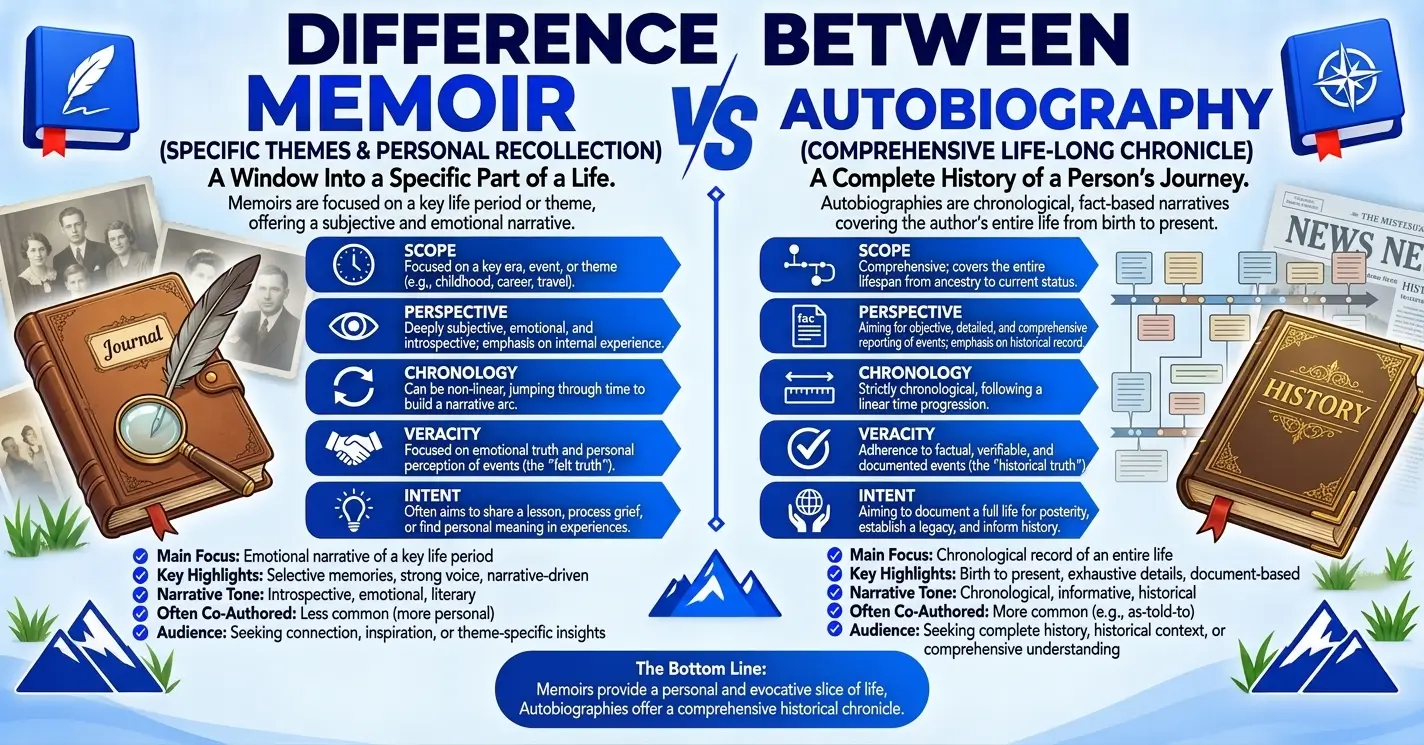
Memoir and autobiography are both forms of nonfiction about a person’s own life, so it is easy to use the terms interchangeably. The main distinction is scope and emphasis: an autobiography generally aims to give a broad account of the author’s life, while a memoir usually focuses on a particular period, theme, relationship, or set of experiences.
That distinction is useful, but it is not an absolute rule. Dictionaries, libraries, publishers, and literary scholars sometimes use the terms more broadly or differently. The clearest way to understand them is to look at what the writer chooses to cover and what the reader is being asked to focus on.
Quick Answer
An autobiography is a book about a person’s life written by that person, generally covering a broad span of their life.
A memoir is a personal account based on the writer’s experiences or memories, usually concentrating on a particular period, theme, relationship, or significant experience.
The simplest rule is:
Autobiography = the broader story of a life.
Memoir = a focused story from a life.
The two forms overlap, however, and a memoir can be considered autobiographical writing.
Memoir vs Autobiography at a Glance
| Feature | Memoir | Autobiography |
|---|---|---|
| Basic focus | Selected experiences, period, or theme | Broad account of the author’s life |
| Scope | Usually narrower | Usually broader |
| Structure | Often thematic or story-driven | Often broadly chronological |
| Perspective | Personal and reflective | Personal and retrospective |
| Coverage | Selective | More comprehensive |
| Main question | “What did this experience mean?” | “What happened throughout my life?” |
| Writer | The person whose experiences are described | The person whose life is described |
| Genre relationship | A form of autobiographical life writing | A major form of life writing |
This is a working distinction, not a rigid checklist. Literary works can cross these boundaries, and the terms have historically overlapped.
What Is a Memoir?
A memoir is a piece of writing based on the author’s personal knowledge, experiences, or memories. In modern publishing, the word commonly refers to a focused account of part of a person’s life rather than an attempt to document every major stage. Cambridge also records broader uses of memoir, including a person’s own life experiences and accounts based on personal knowledge of people or events.
A memoir might center on:
- a difficult childhood
- a particular relationship
- a career
- immigration
- military service
- illness or recovery
- grief
- addiction
- education
- a major personal transformation
- a particular historical period
For example, Educated by Tara Westover is published as a memoir and focuses on her unusual childhood, education, family relationships, and transformation rather than presenting a comprehensive account of every stage of her life.
A memoir therefore does not have to answer every question about the author’s life. It selects the experiences that serve its central subject.
What Is an Autobiography?
An autobiography is a book about a person’s life written by that person. Cambridge gives this as the basic definition, distinguishing it from a biography, which is written by someone else.
An autobiography commonly covers a substantial portion of the author’s life, potentially including:
- childhood
- family background
- education
- early adulthood
- career
- relationships
- achievements
- failures
- important historical events
- later life
It is often organized roughly chronologically, moving from earlier experiences toward later ones.
Benjamin Franklin’s Autobiography is a classic example of the form. The Library of Congress describes it as an important historical and literary work and notes its complicated publication history.
However, “autobiography” does not mean that every single event in a person’s life must be included. An autobiography is still a constructed narrative. The author chooses what to emphasize, what to omit, and how to interpret the past.
What Is the Main Difference Between a Memoir and an Autobiography?
The most useful distinction is breadth versus focus.
An autobiography generally attempts to tell a broad story of the author’s life. A memoir narrows the lens to experiences that form a particular story, theme, or period.
Imagine someone who spent 40 years as a doctor.
An autobiography might tell the story from childhood, through medical school, early employment, family life, medical career, major achievements, and retirement.
A memoir might focus only on:
“The ten years I spent working in an emergency department.”
Both books could contain childhood memories, family stories, professional experiences, and personal reflection. The difference is what the book is fundamentally trying to cover.
The Library of Congress uses a similar distinction: autobiography generally extends from birth to the present, whereas memoir usually concentrates on a particular section or theme within a person’s life.
1. Scope
This is usually the clearest difference.
Memoir: narrower and selective.
Autobiography: broader and more comprehensive.
A memoir may cover one year, one relationship, one career, or one transformation.
An autobiography may cover several decades.
2. Structure
Autobiographies often follow a roughly chronological structure.
A memoir has greater freedom to organize material around a theme.
For example, a memoir about grief might move between different years because each memory contributes to the same central theme.
That does not mean every autobiography must be strictly chronological or every memoir must jump around in time. These are common tendencies, not requirements.
3. Focus
An autobiography often emphasizes the development of the person’s life over time.
A memoir tends to emphasize the significance of particular experiences.
This is why a memoir often contains substantial reflection: the writer is not merely recounting what happened but exploring what those events meant.
4. Selectivity
A memoir is usually highly selective by design.
If a childhood event has nothing to do with the memoir’s central subject, it may be left out.
An autobiography can also be selective—no book can literally contain every event in a human life—but its intended coverage is generally broader.
5. Purpose
The purposes can overlap, but the emphasis may differ.
An autobiography may preserve a broad personal record or document a life and its historical context.
A memoir may use a specific experience to explore identity, relationships, memory, loss, change, or another larger theme.
Neither purpose makes one form inherently more factual or more emotional than the other.
When to Use “Memoir”
Use memoir when the work is primarily about a defined part of your life or a central experience.
For example:
- your childhood in a particular family
- your years as a professional athlete
- surviving a serious life-changing event
- moving to another country
- working in a particular profession
- a significant relationship
- a particular period of political or social change
A useful test is:
Can you describe the central subject of the book without simply saying “my whole life”?
If yes, memoir may be the more natural label.
When to Use “Autobiography”
Use autobiography when the project is intended as a broad account of your life.
For example, someone might write an autobiography to document:
- where they came from
- their childhood
- education
- career
- family
- major achievements
- setbacks
- later life
The aim is not necessarily to include every tiny detail. The important point is that the book’s scope is substantially broader than one isolated period or theme.
Memoir and Autobiography in Real Examples
Here are some simplified examples:
Memoir:
“My ten years working as a war correspondent and what those experiences taught me.”
The subject is a defined period and experience.
Autobiography:
“My life from childhood through my career and retirement.”
The subject is the author’s broader life story.
Another useful example is Educated, which is explicitly presented as a memoir. Its narrative concentrates on Westover’s upbringing, education, family relationships, and transformation rather than attempting to document her entire life.
Historical classification can also be complicated. The Library of Congress notes that some works have been described using different autobiographical labels at different points in their publication histories. Benjamin Franklin’s work, for example, was referred to as a “memoir” in parts of its publication history even though it is now widely known as The Autobiography of Benjamin Franklin.
That is a good reminder that genre labels are useful categories, not mathematical formulas.
Common Collocations With Memoir and Autobiography
Common with memoir
- write a memoir
- publish a memoir
- personal memoir
- bestselling memoir
- childhood memoir
- political memoir
- celebrity memoir
- memoir about
- memoir of
- memoir recounting
Examples:
She published a memoir about her childhood.
The former diplomat wrote a memoir of his years overseas.
Common with autobiography
- write an autobiography
- publish an autobiography
- complete an autobiography
- personal autobiography
- bestselling autobiography
- tell-all autobiography
- autobiography of
- autobiography recounting
Examples:
He published his autobiography after retiring.
The autobiography recounts her childhood and political career.
Common Mistakes With Memoir and Autobiography
Mistake 1: Treating “memoir” as simply a shorter autobiography
Incorrect idea:
A memoir is just an autobiography with fewer pages.
Why:
Length is not the essential distinction. A memoir can be long. Its defining characteristic in the common modern distinction is its selective focus, not simply its word count.
Mistake 2: Assuming autobiographies contain no personal reflection
Incorrect idea:
An autobiography only lists facts.
Why:
Autobiographies can contain extensive personal reflection, interpretation, emotion, and commentary. The broader scope does not make the writing impersonal.
Mistake 3: Assuming memoir means “fictionalized”
Incorrect idea:
A memoir is basically a novel based on someone’s life.
Why:
A memoir is nonfictional life writing. It may use literary storytelling techniques, but that does not make it fiction.
Mistake 4: Treating the scope rule as absolute
Incorrect idea:
If a book doesn’t cover every year of someone’s life, it cannot be an autobiography.
Why:
Genre boundaries are more flexible than that. The Library of Congress itself notes that the terms are sometimes used interchangeably, and literary scholarship has long debated the boundary.
Are Memoir and Autobiography Interchangeable?
Sometimes, in ordinary usage—but not always.
The terms belong to the same family of life-writing genres, and dictionaries and libraries acknowledge overlap.
The Library of Congress explicitly says the terms are often used interchangeably while still identifying a typical distinction between them.
In everyday conversation, calling a personal life story a “memoir” instead of an “autobiography” may not cause confusion.
In publishing, literary criticism, education, or a writing project where genre matters, the distinction becomes more useful.
A good practical rule is:
Use “autobiography” when the broad life story is the organizing principle. Use “memoir” when selected experiences, a period, or a theme is the organizing principle.
How to Remember the Difference
Think:
Autobiography = a life
Memoir = memories from a life
Or use the visual shortcut:
Autobiography → zoom out
Memoir → zoom in
An autobiography generally gives you a wider view of the person’s life. A memoir zooms in on the experiences that matter to its particular story.
Which One Should I Use?
When deciding how to describe a book or writing project, consider its main purpose and scope.
Choose “autobiography” when the book presents a broad account of the author’s life and experiences.
A “memoir” is usually more appropriate when the focus is on a particular period, theme, relationship, or significant experience.
Some books can reasonably fit both categories. In those cases, either label may be defensible depending on the book’s emphasis, as well as the conventions of its publisher or intended audience.
The most useful question is not:
“How many years does the book cover?”
Instead ask:
“What is this book really about?”
If the answer is “my life as a whole,” autobiography is the natural starting point.
If the answer is “this particular experience and what it meant,” memoir is usually the better fit.
Memoir or Autobiography? Practice Examples
Choose memoir or autobiography for each situation.
- A writer describes her entire life, from childhood through retirement.
- A former soldier writes about one deployment and its lasting effect on him.
- A musician documents his childhood, career, relationships, successes, and later life.
- A woman writes specifically about growing up in a remote community.
- A politician recounts the major stages of his life and career.
- A writer explores one decade of her life centered on a difficult family relationship.
- An author documents his life from childhood to the present, including major historical events.
- A doctor writes about several years working in an emergency department and how that changed his understanding of medicine.
Answers
- Autobiography — the scope is the whole life.
- Memoir — it focuses on a particular experience.
- Autobiography — the narrative covers the broad arc of a life.
- Memoir — the subject is a particular life period.
- Autobiography — the scope encompasses the person’s broader life and career.
- Memoir — a defined period and theme provide the focus.
- Autobiography — it aims for a broad life account.
- Memoir — the book concentrates on a particular professional period and its meaning.
Frequently Asked Questions
What is the main difference between a memoir and an autobiography?
A memoir generally focuses on a particular period, theme, relationship, or experience from the author’s life, while an autobiography generally provides a broader account of the author’s life.
Is a memoir an autobiography?
A memoir is a form of autobiographical life writing, but the terms are not always used as exact synonyms. In common modern usage, memoir usually implies a more selective focus.
Is an autobiography always chronological?
No. Autobiographies commonly follow a chronological or broadly chronological structure, but authors can use flashbacks, thematic sections, and other narrative techniques.
Is a memoir always about one event?
No. A memoir can cover multiple experiences as long as they are connected by a central period, theme, relationship, or narrative purpose.
Are memoirs and autobiographies nonfiction?
Yes. Both are forms of nonfictional life writing, although their treatment of memory, interpretation, and narrative structure can vary.
Is a memoir more emotional than an autobiography?
Not necessarily. Memoirs often emphasize reflection and personal meaning, but autobiographies can also be highly emotional and reflective. The difference is better understood through scope and emphasis than through emotion alone.
What is the difference between a memoir and a biography?
A memoir and an autobiography are written by the person whose life is being described. A biography is generally written by someone else about the subject’s life.
Can a book be both a memoir and an autobiography?
There can be substantial overlap, and some works are difficult to classify neatly. The two terms describe closely related forms of life writing, so genre boundaries can be flexible.
Conclusion
The simplest difference between a memoir and an autobiography is scope. An autobiography generally tells a broad story of the author’s life, often in roughly chronological order. A memoir focuses more selectively on a particular period, theme, relationship, or experience and explores its personal meaning.
The distinction is useful, but it is not absolute. Both are forms of autobiographical life writing, and some books sit between the categories.
Practical rule: if the book is mainly about your life as a whole, think autobiography; if it is mainly about a meaningful part of your life, think memoir.