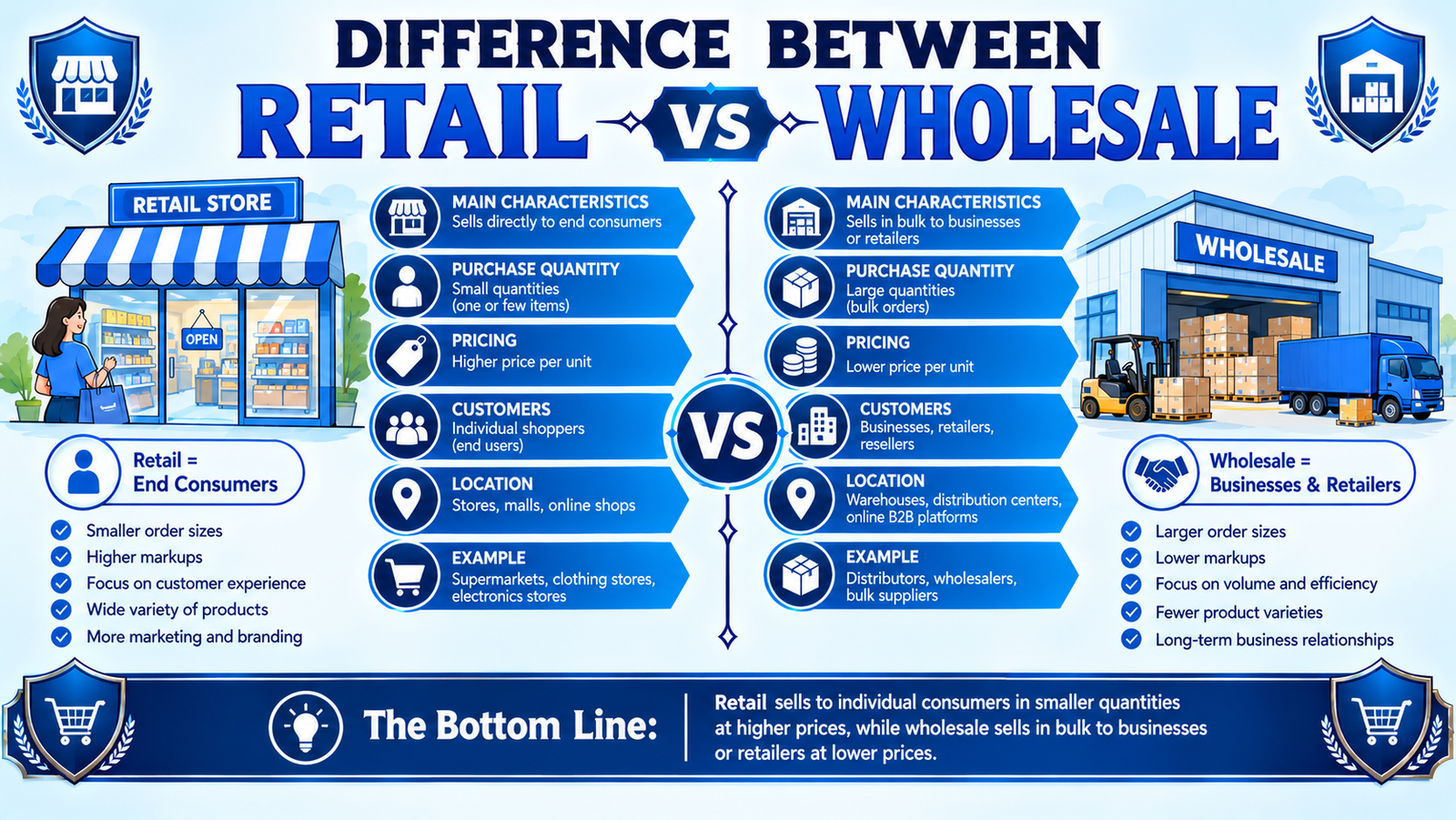

Retail and wholesale are two different ways products move from sellers to buyers. Wholesale generally involves selling goods to businesses or other organizations, often in larger quantities and at a lower price per unit. Retail involves selling goods to the final customer, usually in smaller quantities and at a higher selling price.
The distinction is not simply about buying 100 items versus buying one. The more important question is who is buying the product and what they intend to do with it. A retailer sells to the person who will ultimately use the product, while a wholesaler typically supplies businesses, resellers, or other organizational buyers.
Understanding this difference makes pricing, inventory, supply chains, and business models much easier to understand.
Quick Answer
Wholesale is the sale of goods to businesses or other organizational buyers, commonly in larger quantities and at a lower per-unit price.
Retail is the sale of goods directly to consumers or other end users, usually in smaller quantities at the final selling price.
The simplest distinction:
Wholesale = selling to businesses or organizational buyers, often in volume.
Retail = selling to the final customer for use or consumption.
There are exceptions. For example, a wholesaler may sell products to a business that uses them rather than resells them. Likewise, a retailer can operate entirely online rather than from a physical store.
Retail vs Wholesale at a Glance
| Feature | Wholesale | Retail |
|---|---|---|
| Main buyer | Businesses, resellers, organizations | Final consumers/end users |
| Typical quantity | Larger quantities | Smaller quantities |
| Typical price per unit | Lower | Higher |
| Main purpose | Resale or business use | Personal/final use |
| Position in supply chain | Usually an intermediate step | Usually the final selling stage |
| Typical sales relationship | Business-to-business | Business-to-consumer |
| Inventory | Often large-volume stock | Usually smaller quantities per product |
| Marketing | Often focused on business buyers | Often focused on consumers |
| Ordering | Purchase orders, accounts, contracts may be common | Checkout or direct purchase is common |
| Example | Supplier sells 500 shirts to a clothing store | Store sells one shirt to a shopper |
The U.S. Census Bureau defines wholesalers as businesses selling to retailers, contractors, and other businesses, while retailers sell goods in small quantities directly to consumers. BLS similarly describes wholesale as an intermediate distribution activity.
What Is Wholesale?
Wholesale is the business of selling goods to other businesses or organizational buyers rather than primarily to the general public.
A wholesaler may purchase products from manufacturers or other suppliers and then sell those products to:
- retailers
- other wholesalers
- contractors
- restaurants
- institutions
- farms
- other business customers
The products may be intended for resale, production, or business operations.
For example, imagine a manufacturer produces 10,000 water bottles.
Instead of selling every bottle individually to consumers, it could sell 2,000 bottles to a wholesaler. The wholesaler then supplies smaller business orders to stores, distributors, or other commercial buyers.
Wholesale transactions generally make economic sense through volume. The seller may earn less on each individual unit than a retailer does, but the transaction can involve many units at once.
Example of wholesale
A wholesaler sells:
500 T-shirts to a clothing retailer for $8 each.
The clothing retailer can then sell those shirts individually to customers for a higher retail price.
The wholesaler’s customer is the business, not the shopper who eventually wears the shirt.
What Is Retail?
Retail is the sale of products directly to the final consumer or end user.
A retailer may purchase products from:
- wholesalers
- manufacturers
- distributors
- brands
- other suppliers
The retailer then sells those products to consumers.
Retail does not require a physical shop. A clothing website, supermarket, electronics store, department store, and many direct-to-consumer ecommerce brands can all operate through retail.
Example of retail
A clothing store purchases a shirt for $8 from a supplier and sells it to a customer for $20.
The customer is buying the shirt for personal use rather than because they intend to resell it.
That transaction is retail.
What Is the Main Difference Between Retail and Wholesale?
The biggest difference is the type of buyer and the role the sale plays in the distribution chain.
Wholesale normally serves businesses or organizations. Retail normally serves the final customer.
Quantity and price usually follow from that relationship.
A wholesaler may sell hundreds of units to one business because that buyer needs inventory or supplies. A retailer may sell one or two units to an individual because that customer needs the product for personal use.
The supply chain can therefore look like this:
Manufacturer → Wholesaler → Retailer → Consumer
But not every product follows exactly that path.
Another common model is:
Manufacturer → Retailer → Consumer
And a brand may also sell:
Manufacturer/Brand → Consumer
through a direct-to-consumer retail channel.
So, wholesale and retail describe how products are sold, not necessarily a single fixed supply-chain structure.
Wholesale vs Retail Price
Price is one of the most noticeable differences.
A wholesale price is generally the amount a business buyer pays a supplier for goods.
A retail price is generally the amount the final customer pays the retailer.
Suppose a product costs a manufacturer $5 to produce.
A simplified example might look like this:
- Manufacturing cost: $5
- Wholesale price: $10
- Retail price: $20
The wholesaler or manufacturer earns money from selling at $10, while the retailer buys at $10 and may sell to the consumer at $20.
However, real pricing is more complicated. Businesses must account for labor, packaging, freight, storage, marketing, payment costs, returns, overhead, competition, and other expenses.
There is also an important distinction between markup and margin.
Markup vs Margin
Markup measures how much is added to cost.
Margin measures profit as a percentage of the selling price.
For example, if a retailer buys an item for $10 and sells it for $20:
- Profit before other expenses = $10
- Markup on cost = 100%
- Gross margin on the $20 selling price = 50%
This is why saying “the retailer makes 100%” can be misleading if you actually mean a 50% gross margin.
Keystone pricing—the practice of setting retail price at roughly twice wholesale cost—is a common traditional pricing approach, but it is not a universal rule. Actual pricing varies substantially by product category, competition, costs, and market conditions.
Wholesale vs Retail: Customers
Wholesale customers
It customers can include:
- retailers
- restaurants
- contractors
- resellers
- manufacturers
- institutions
- farms
- other organizations
The buyer may purchase products for resale or for use in its own operations.
Retail customers
Retail customers are generally the people or end users who ultimately use or consume the product.
For example:
Wholesale:
A restaurant buys 50 cases of bottled drinks from a supplier.
Retail:
A customer buys one bottle of that drink from a supermarket.
The important distinction is the role of the buyer in the transaction.
Wholesale vs Retail: Quantity
Wholesale transactions commonly involve larger quantities.
A business may purchase:
- a case
- a carton
- a pallet
- dozens of units
- hundreds of units
- thousands of units
Retail customers generally purchase much smaller quantities.
For example:
Wholesale: 100 pairs of shoes for a store.
Retail: 1 pair of shoes for an individual customer.
But quantity alone should not be treated as an absolute definition.
A wholesale transaction involving machinery or another durable business product can sometimes involve only one unit. Conversely, a consumer can purchase many units at retail.
So the better rule is:
Wholesale is generally associated with business/organizational buyers and commercial distribution; retail is generally associated with final consumers or end users.
Wholesale vs Retail: Inventory and Operations
Wholesalers generally need systems capable of handling larger inventories and larger shipments.
Their operations may emphasize:
- warehouses
- bulk storage
- pallet handling
- logistics
- commercial shipping
- purchase orders
- business accounts
- recurring orders
Retailers have a different operational focus.
They may emphasize:
- product displays
- ecommerce listings
- point-of-sale systems
- consumer marketing
- customer service
- individual orders
- returns
- promotions
- delivery to individual customers
BLS notes that wholesalers normally operate from warehouse or office environments with little emphasis on walk-in consumer traffic, while retail is the final step of merchandise distribution.
Wholesale vs Retail: Marketing
Wholesale marketing is generally aimed at business buyers.
A wholesaler may focus on:
- trade relationships
- product catalogs
- sales representatives
- wholesale marketplaces
- account management
- volume discounts
- repeat orders
Retail marketing is usually aimed directly at consumers.
Retailers may use:
- social media
- search advertising
- email marketing
- product photography
- promotions
- loyalty programs
- influencer marketing
- storefront displays
The goal is different.
A wholesaler needs to convince a business that the product is commercially useful and economically viable.
A retailer needs to convince an end customer that the product is worth purchasing.
Common Collocations With Wholesale and Retail
Wholesale phrases
- wholesale price
- wholesale supplier
- wholesale distributor
- wholesale business
- wholesale customer
- wholesale order
- wholesale market
- wholesale buyer
- wholesale products
- wholesale pricing
Retail phrases
- retail price
- retail store
- retail customer
- retail business
- retail sales
- retail market
- retail products
- retail outlet
- retail customer experience
- retail price tag
Useful contrast
wholesale price → price charged to a business buyer
retail price → price charged to the final customer
wholesale supplier → business supplying products to other businesses
retail store → business selling products to consumers
Common Mistakes With Wholesale and Retail
Mistake 1: Thinking wholesale always means “cheap”
Incorrect idea:
Wholesale means a product is cheap.
Better understanding:
Wholesale usually means the product is being sold through a business-oriented distribution channel, often at a lower per-unit price because of volume.
A wholesale price still has to cover the seller’s costs and profit requirements.
Mistake 2: Thinking retail means “physical store”
Incorrect idea:
An online store is not retail.
Correct:
An online business can operate as a retailer when it sells directly to consumers.
Retail is about the selling relationship and end customer, not whether the transaction happens in a physical shop.
Mistake 3: Assuming wholesale customers always resell
Incorrect idea:
Every wholesale buyer must resell the product.
Correct:
Many wholesale buyers do resell products, but wholesalers can also supply businesses and organizations that use goods in their own operations. Government classification of wholesale trade includes sales of capital goods and production materials as well as goods for resale.
Mistake 4: Confusing markup with margin
Incorrect:
A 100% markup means a 100% profit margin.
Correct:
A 100% markup on a $10 cost produces a $20 selling price. The gross margin on that $20 price is 50%.
Can Wholesale and Retail Be Used Together?
Yes.
A business does not necessarily have to choose only one channel.
For example, a clothing brand could:
- sell 500 shirts to retailers at wholesale prices;
- sell individual shirts through its own website at retail prices;
- sell through physical stores;
- supply selected business customers in larger quantities.
This is sometimes described as using both wholesale and direct-to-consumer/retail channels.
The important consideration is keeping pricing, inventory, customer relationships, and channel policies organized.
Are Wholesale and Retail Interchangeable?
No.
The words describe different selling relationships.
If a manufacturer sells 1,000 products to a clothing store, that is a wholesale transaction.
If the clothing store sells one of those products to a shopper, that is a retail transaction.
The same physical product can therefore move through both channels:
Wholesale transaction → Retail transaction → Final consumer
The product has not changed, but the buyer, transaction, quantity, price, and purpose have changed.
Real-World Examples
Example 1: Clothing
Wholesale:
A supplier sells 500 shirts to a clothing retailer.
Retail:
The retailer sells one shirt to a customer.
Example 2: Food
Wholesale:
A restaurant buys cases of ingredients from a commercial food supplier.
Retail:
A consumer buys a package of those ingredients from a supermarket.
Example 3: Electronics
Wholesale:
A distributor supplies 200 headphones to an electronics retailer.
Retail:
The electronics store sells one pair to a customer.
Example 4: Business equipment
A company buys equipment from a commercial supplier for use in its operations.
This can be a wholesale/business transaction even if the company does not intend to resell the equipment.
That is an important reason why “wholesale = bulk resale” is an oversimplification.
How to Remember the Difference
Use this simple rule:
Wholesale moves products into businesses. Retail moves products to the final user.
Think of the word wholesale as the larger commercial step in the supply chain.
Think of retail as the point where an individual shopper or final user purchases the product.
Simple memory formula
Wholesale → Business buyer
Retail → Final buyer
Quantity and price usually follow from this relationship.
Which One Should I Use?
If you are describing a business selling products to retailers, resellers, or other organizations, use wholesale.
If you are describing a business selling products directly to consumers, use retail.
Quick decision guide
Selling 500 products to a clothing store?
→ Wholesale
Selling one product to a shopper?
→ Retail
Supplying products to restaurants or contractors?
→ Usually wholesale/business distribution
Selling products through your ecommerce store to individual customers?
→ Retail
Selling products through both channels?
→ You can operate both wholesale and retail.
Wholesale or Retail? Practice Examples
Choose wholesale or retail for each situation.
- A distributor sells 1,000 phone cases to an electronics shop.
- A customer buys one phone case online.
- A restaurant purchases 20 boxes of ingredients from a supplier.
- A supermarket sells one box of cereal to a shopper.
- A clothing brand supplies 300 shirts to a boutique.
- A customer purchases two shirts from the boutique.
- A manufacturer sells machinery to a construction company.
- An online store sells one pair of shoes directly to a consumer.
Answers
- Wholesale
- Retail
- Wholesale
- Retail
- Wholesale
- Retail
- Wholesale/business sale
- Retail
Frequently Asked Questions
What is the main difference between retail and wholesale?
The main difference is the buyer and role of the transaction. Wholesale generally sells products to businesses or organizations, often in larger quantities, while retail generally sells products directly to final consumers.
Is wholesale cheaper than retail?
Wholesale prices are generally lower per unit than retail prices because wholesale transactions commonly involve business buyers and larger quantities. The exact price difference depends on the product, supplier, volume, costs, and market.
Is retail the same as selling directly to customers?
Generally, yes. Retail refers to selling merchandise to final consumers or end users. This can happen in a physical store, online store, marketplace, or another consumer-facing channel.
Do wholesalers only sell to retailers?
No. Wholesalers can sell to retailers, contractors, other businesses, farms, institutions, and other organizational buyers. Some wholesale transactions involve goods for resale, while others involve business-use equipment, materials, or supplies.
Can one company be both wholesale and retail?
Yes. A company can sell products to other businesses through a wholesale channel while also selling directly to consumers through retail or direct-to-consumer channels.
Is buying wholesale always better?
Not necessarily. Wholesale can provide a lower per-unit cost, but it may require more capital, storage space, and inventory management. Retail purchases generally provide more flexibility when only a small quantity is needed.
What is the difference between wholesale price and retail price?
The wholesale price is generally the amount a business buyer pays a supplier. The retail price is generally what the final customer pays the retailer. The difference helps the retailer cover operating costs and earn gross profit.
What is the difference between wholesale and retail margin?
Wholesale and retail businesses have different cost structures and pricing strategies. A wholesaler often relies more heavily on volume, while a retailer typically adds costs associated with reaching and serving individual consumers. There is no single margin that applies to every wholesale or retail business.
Can wholesale products be sold online?
Yes. Wholesale businesses can sell through websites, business marketplaces, online catalogs, sales portals, and other digital channels. Selling online does not automatically make a business retail.
Conclusion
Wholesale and retail describe two different positions in the selling process. Wholesale generally supplies businesses or organizations, often through larger orders and lower per-unit prices. Retail generally sells directly to final consumers in smaller quantities at the final selling price.
The easiest rule to remember is:
Wholesale serves business and organizational buyers; retail serves the final customer.
Quantity and price are important clues, but they are not the entire definition. A business can also operate both wholesale and retail channels, depending on who it serves and how its products reach the market.

Sajid Ali is an English language educator and content specialist with 7+ years of teaching experience. He holds master’s degrees in Information Technology and Education from the Virtual University of Pakistan and writes SEO-optimized, learner-friendly vocabulary content for diffari.com.