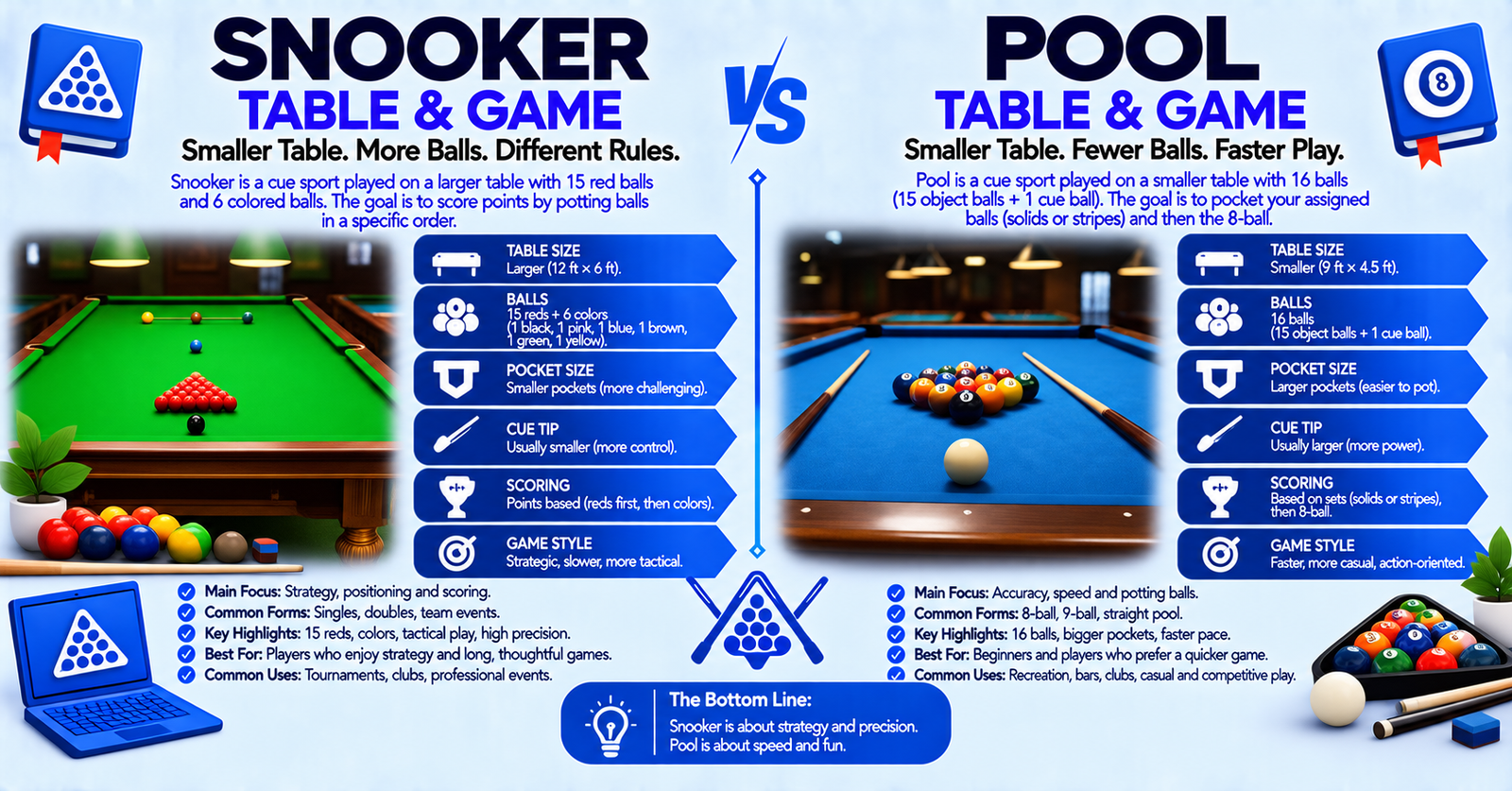

Snooker and pool are both cue sports played on tables with pockets, cues, and a white cue ball, so they can look almost identical to someone unfamiliar with either game. However, they are not the same sport. They differ in table size, ball setup, rules, scoring, equipment, and strategy.
The biggest distinction is that snooker has a specific standardized game structure, while pool is a broad category containing several games, including 8-ball, 9-ball, 10-ball, and blackball. The World Pool-Billiard Association’s current rules treat these as separate disciplines.
Quick Answer
Snooker and pool are different cue sports with different tables, balls, rules, and scoring systems. Snooker is normally played on a large 12-foot by 6-foot table with 15 red balls, six colored balls, and one cue ball. Players score by potting reds and colors in a prescribed sequence.
Pool refers to a family of pocket-billiard games. Depending on the discipline, players may use different ball arrangements and objectives. In 8-ball, for example, players use groups of colored balls and attempt to legally pocket the 8-ball after clearing their group. The WPA recognizes 8-ball, 9-ball, 10-ball, blackball, and other pool disciplines separately.
In simple terms: snooker emphasizes a large table, tight pockets, sequential scoring, and break building, while pool uses smaller tables and different rules depending on the particular pool game.
Snooker vs Pool at a Glance
| Feature | Snooker | Pool |
|---|---|---|
| Type | Specific cue sport | Family of cue sports |
| Typical full-size table | 12 ft × 6 ft | Common sizes include 7, 8, and 9 ft |
| Pockets | Relatively tight | Generally larger, depending on table/game |
| Balls | 15 reds + 6 colors + cue ball | Depends on discipline |
| Common pool format | — | 8-ball, 9-ball, 10-ball, blackball |
| Main scoring | Points from reds and colors | Depends on the game |
| Basic unit of play | Frame | Usually rack/game, depending on discipline |
| Strategy | Break building, safety, positioning | Varies by discipline; pattern play, break play, safety, etc. |
| Table markings | Baulk line, D, colored spots | Markings vary by discipline |
| Governing rules | WPBSA | WPA and other governing bodies/rulesets |
What Is Snooker?
Snooker is a cue sport played with one white cue ball and 21 object balls: 15 reds and six colors.
The colors have different point values:
- Yellow — 2
- Green — 3
- Brown — 4
- Blue — 5
- Pink — 6
- Black — 7
Under the standard rules, players initially alternate between potting a red and then a color. Once all reds have been removed, the colors are potted in ascending value order. The player with the higher score wins the frame.
A full-size snooker table is substantially larger than a typical pool table. Its large playing area, relatively tight pockets, and small balls make precise cue-ball positioning particularly important.
Snooker also places considerable emphasis on safety play. A player may deliberately leave the cue ball in a position that prevents the opponent from having a direct shot at a legal target.
What Is Pool?
Pool is not one single game. It is a broad category of pocket-billiard games.
Common forms include:
- 8-ball
- 9-ball
- 10-ball
- 14.1 continuous pool
- blackball
- one-pocket
The current WPA rulebook lists these and other disciplines separately.
This is an important distinction when comparing snooker with pool. Saying that “pool always uses 16 balls” is too broad. That description fits common forms of 8-ball pool, but other pool games use different ball arrangements and objectives.
For example, 9-ball is played with balls numbered 1 through 9, while blackball uses two groups of seven object balls plus a black ball.
So when someone says “pool,” the next question may be:
Which type of pool?
What Is the Main Difference Between Snooker and Pool?
The fundamental difference is how the games are structured and played.
Snooker uses a defined set of 15 reds and six colors. Players build their scores by potting reds and colors in sequence, followed by the colors in order after the reds are gone.
Pool, by contrast, contains several different games with different objectives.
In 8-ball, players normally play with two groups of object balls and the 8-ball. In 9-ball, the objective and legal-ball sequence are different. The WPA’s current rulebook has separate sections for 8-ball, 9-ball, 10-ball, blackball, and other disciplines.
Therefore, the comparison is not simply:
Snooker = difficult pool
Pool = easy snooker
They are different games with different rule systems.
Table Size and Design
One of the easiest differences to see is the table.
A full-size snooker table measures approximately 12 ft × 6 ft. Pool tables are available in several sizes, with 7-, 8-, and 9-foot tables commonly used depending on the environment and game.
The larger snooker table creates much more space between balls.
That affects gameplay because a player often needs to control:
- cue-ball speed
- position over long distances
- angles
- side spin
- positional routes
- safety positions
Snooker pockets are also designed differently from typical pool pockets. Their tighter geometry means a player generally needs greater accuracy when attempting pots.
Why table size matters
Imagine two balls sitting several feet apart.
On a smaller pool table, the distance between them may be manageable with a relatively short positional route. On a full-size snooker table, the same basic shot can require much more precise speed and cue-ball control.
That is one reason the two games feel so different even though both use cues and pockets.
Balls: Snooker vs Pool
Snooker uses:
- 1 white cue ball
- 15 red balls
- 6 colored balls
That gives 22 balls in total.
The 15 reds are each worth one point, while the colors range from two to seven points.
Pool does not have one universal ball set.
For example:
8-Ball
A standard 8-ball setup contains:
- 1 cue ball
- 7 solids
- 7 stripes
- 1 eight-ball
9-Ball
The game uses balls numbered 1 through 9 plus the cue ball.
Blackball
The WPA rules describe blackball as using 15 object balls: two groups of seven plus the black ball, together with the cue ball.
So “22 balls vs. 16 balls” is useful only when comparing standard snooker with a particular 8-ball pool setup, not every form of pool.
Rules and Objectives
Snooker
The objective is to finish the frame with more points than your opponent.
During the initial phase, players attempt to pot:
red → color → red → color
until all reds have been removed.
Then the colors are cleared in their prescribed ascending value order.
Pool
The objective depends on the discipline.
In 8-ball, players first establish their group and then attempt to clear that group before legally pocketing the 8-ball.
In 9-ball, the rules are different, with the numbered balls played according to the discipline’s requirements.
The WPA’s current rulebook separately defines these games rather than treating “pool” as one universal ruleset.
Scoring: Snooker vs Pool
Scoring is another major difference.
Snooker scoring
Every object ball has a fixed point value.
| Ball | Points |
|---|---|
| Red | 1 |
| Yellow | 2 |
| Green | 3 |
| Brown | 4 |
| Blue | 5 |
| Pink | 6 |
| Black | 7 |
A player’s score increases as balls are legally potted. Fouls can also award points to the opponent.
This scoring system allows players to construct long breaks, where multiple scoring shots are made during one visit to the table.
A perfect standard 147 break consists of potting 15 reds with 15 blacks and then clearing all six colors. WPBSA records describe this sequence as the basis of a maximum break.
Pool scoring
Pool scoring depends on the discipline.
In many pool formats, the goal is not to accumulate a running point total in the same way as snooker. Instead, the player wins a rack by completing the required objective.
This difference in scoring is one reason snooker and pool have different tactical structures.
Gameplay and Strategy
Snooker generally gives players a large amount of space to manage.
A strong snooker player must consider:
- the current pot
- cue-ball position
- the next color
- future reds
- safety options
- opponent’s possible response
- table layout
This makes break building and positional play central parts of the game.
Pool strategy varies considerably by discipline.
In 8-ball, players may plan a sequence for clearing their group while also considering blockers, clusters, safety shots, and the position of the 8-ball.
In 9-ball, players must account for the required ball sequence and positional routes.
The break is also different. Sporting News notes that pool breaks are commonly played with an attacking objective, while a snooker break-off is generally designed as a safety.
Common Collocations and Terminology
Snooker
Common terms include:
- snooker frame
- snooker break
- maximum break
- snooker table
- snooker cue
- snooker balls
- safety play
- pot a red
- pot the black
- snookered
Pool
Common terms include:
- pool table
- pool cue
- pool ball
- pool rack
- break shot
- 8-ball pool
- 9-ball pool
- 10-ball
- break and run
- cue ball
- object ball
- safety shot
One terminology difference is particularly useful:
Snooker is commonly described in terms of frames, while pool games commonly use the term rack for a complete setup/play sequence. The exact terminology can vary with the discipline.
Are Snooker and Pool Cues the Same?
They are similar in basic function, but equipment is designed around the particular game.
Snooker cues commonly have smaller tips suited to the smaller snooker balls and the precision required by the game. Pool cues vary according to the pool discipline and ball set.
The difference becomes especially noticeable when comparing a traditional snooker cue with an American pool cue. American pool equipment is generally designed around larger, heavier balls and different table characteristics.
So while you can recognize both as cue sticks, a cue optimized for one game is not automatically ideal for the other.
Are Snooker and Pool Balls the Same?
No.
Snooker balls are smaller than standard American pool balls, while the exact pool-ball specifications depend on the particular pool discipline and equipment standard.
More importantly, the number and arrangement of balls are different.
Snooker uses the distinctive combination of 15 reds and six colors.
Pool uses different configurations depending on whether the game is 8-ball, 9-ball, 10-ball, blackball, or another discipline.
Are Snooker and Pool Tables the Same?
No.
A full-size snooker table is substantially larger than common pool tables and has different pocket characteristics and playing-surface requirements.
The markings are also different. Snooker uses specific locations such as the baulk line, D, and colored-ball spots because the rules require particular starting and resting positions.
Pool tables use markings appropriate to the particular pool discipline. The WPA rules, for example, define features such as the head string, foot spot, center spot, and rack markings for pool play.
Can You Play Snooker on a Pool Table?
Technically, it can be possible, but a normal pool table is not equivalent to a regulation snooker table.
A player would need appropriate snooker balls and would have to account for differences in table dimensions, markings, cushions, cloth, and pockets.
A pool table may physically allow some forms of snooker practice, but the experience and playing characteristics will not necessarily match a regulation snooker table.
This is why a dedicated snooker table is normally used when the goal is to play standard snooker properly.
Can You Play Pool on a Snooker Table?
Some pool formats can be played on a snooker table in informal settings, but the table is not designed specifically for every pool discipline.
The larger surface and tighter pocket characteristics change how the game plays.
For competitive play, players normally use the equipment specified for the particular ruleset.
Is Snooker Harder Than Pool?
There is no single objective answer because pool covers multiple games and difficulty depends on the skill being measured.
Snooker demands long-distance cueing, precise positional control, tight-pocket potting, break construction, and safety play.
Pool also requires substantial technical skill, including:
- cue-ball control
- pattern planning
- break technique
- positional play
- safety play
- shot selection
The equipment and rules simply emphasize different combinations of those skills.
So instead of saying that one game is universally harder, it is more accurate to say that snooker and pool present different technical and strategic challenges.
Can Snooker and Pool Be Used Interchangeably?
No.
The names should not normally be treated as interchangeable.
If someone says they are playing snooker, that refers to the specific game with its distinctive 15-red-and-six-color structure.
If someone says they are playing pool, you may need to know which discipline they mean.
For example:
- “I play snooker.” → a specific cue sport
- “I play pool.” → could mean 8-ball, 9-ball, 10-ball, blackball, or another pool discipline
That distinction is particularly useful for beginners.
Common Mistakes With Snooker and Pool
Mistake 1: Treating pool as one game
Incorrect:
“Pool always uses 16 balls.”
Correct:
“Standard 8-ball pool uses 16 balls, but pool includes several different disciplines.”
Why:
The WPA rules recognize multiple pool disciplines with different ball configurations and objectives.
Mistake 2: Calling every cue sport “snooker”
Incorrect:
“They were playing snooker because the table had six pockets.”
Correct:
“They were playing a pocket cue sport; the rules and equipment determine whether it was snooker or a form of pool.”
Why:
Both sports use pocketed tables.
Mistake 3: Assuming billiards, pool, and snooker are identical
Incorrect:
“Billiards, pool, and snooker are just different names for the same game.”
Correct:
“They are related cue sports, but their rules and equipment differ.”
Why:
The terms can overlap in casual conversation, but the individual games have distinct rules and equipment.
Mistake 4: Comparing only ball counts
Incorrect:
“The only difference is that snooker has more balls.”
Correct:
“Snooker and pool differ in table design, equipment, rules, scoring, and gameplay as well as ball configuration.”
How to Remember the Difference
Use this simple rule:
Snooker = large table + 15 reds and 6 colors + points and sequences.
Pool = family of pocket games + smaller tables + rules depend on the specific discipline.
If you remember only one thing, remember that pool is a category, not a single universal game.
Which One Should I Use?
If you are talking about the game with 15 red balls and six colored balls:
→ Snooker
If you mean 8-ball, 9-ball, 10-ball, blackball, or another pocket-billiard discipline:
→ Pool
If you are buying equipment:
→ First identify the specific game you intend to play, because table size, pockets, balls, and cues are designed around different disciplines.
Snooker or Pool? Practice Examples
Choose snooker or pool.
- The game uses 15 red balls and six colored balls.
- The player is discussing 8-ball.
- The game uses reds and colors to build a point score.
- The player is talking about a 9-ball rack.
- The game is played on a full-size 12 × 6 ft table.
- The player says they need to know whether they are playing 8-ball or 9-ball.
- The game involves a maximum 147 break.
- The player is using a pool rack for a 9-ball game.
Answers
- Snooker
- Pool
- Snooker
- Pool
- Snooker
- Pool
- Snooker
- Pool
Frequently Asked Questions
What is the main difference between snooker and pool?
The main differences are the table, equipment, ball configuration, rules, scoring, and gameplay. Snooker uses 15 reds and six colors and follows a specific scoring sequence, while pool includes multiple different games with their own rules.
Is snooker the same as pool?
No. Snooker and pool are related pocket cue sports, but they are separate games with different equipment and rules.
How many balls are used in snooker?
Standard snooker uses 22 balls in total: 15 reds, six colors, and one white cue ball.
Does pool always use 16 balls?
No. A common 8-ball setup uses 16 balls, but other pool disciplines use different ball configurations. The WPA rules cover 8-ball, 9-ball, 10-ball, blackball, 14.1 and other disciplines.
Which table is bigger, snooker or pool?
A full-size snooker table is larger than common pool tables. A regulation-style full-size snooker table is approximately 12 × 6 feet, while pool tables commonly come in several smaller sizes.
Are snooker pockets smaller than pool pockets?
Generally, yes. Snooker tables are designed with tighter pockets, contributing to the precision required for successful potting.
Can you play snooker on a pool table?
You can use a pool table for informal snooker practice with appropriate equipment and markings, but it will not have the same playing characteristics as a regulation snooker table.
Why is pool sometimes called 8-ball?
“Pool” describes a family of games. 8-ball is one particular pool discipline, and it is one of the most widely recognized forms of pool.
Is snooker harder than pool?
It depends on the game and the skills being considered. Snooker emphasizes long-distance accuracy, tight-pocket potting, safety play, and break building, while different pool games emphasize their own combinations of break play, cue-ball control, pattern play, and strategy.
Conclusion
The difference between snooker and pool goes far beyond the appearance of their tables. Snooker uses a large table, 15 reds, six colors, and a specific point-based sequence, while pool is a broader category containing games such as 8-ball, 9-ball, 10-ball, and blackball.
The easiest rule to remember is:
If you mean the game with 15 reds and six colors, you mean snooker. If you mean a pocket game such as 8-ball or 9-ball, you mean pool.
Once you understand that pool represents several different disciplines, the differences in tables, balls, scoring, rules, and strategy become much easier to understand.

Sajid Ali is an English language educator and content specialist with 7+ years of teaching experience. He holds master’s degrees in Information Technology and Education from the Virtual University of Pakistan and writes SEO-optimized, learner-friendly vocabulary content for diffari.com.