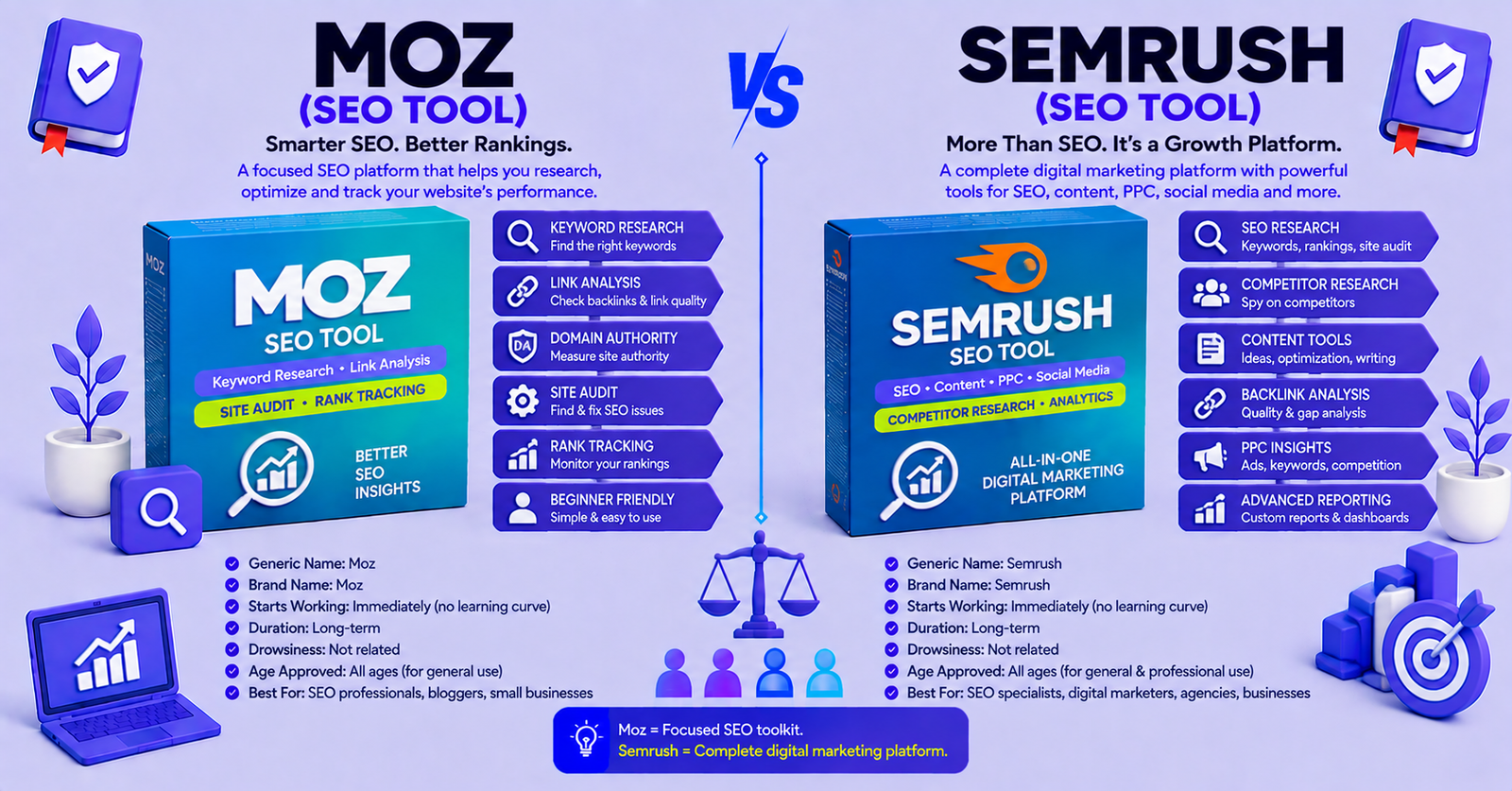
Moz and Semrush are both established SEO platforms, but they are not built around exactly the same approach. They overlap in important areas such as keyword research, backlink analysis, rank tracking, competitor research, and technical SEO audits.
The larger difference is in their overall scope and workflow.Moz Pro is centered more closely on core SEO activities, including keyword research, link analysis, rankings, and site auditing. Semrush has expanded from SEO into a broader digital marketing platform with tools for content, advertising, local marketing, competitive research, and AI-search visibility.
Understanding that distinction makes the comparison much more useful than simply asking which platform has more features.
Quick Answer
Moz and Semrush are both SEO platforms, but Semrush has a broader digital-marketing scope, while Moz Pro is more focused on core SEO workflows.
Moz is particularly associated with metrics such as Domain Authority, Link Explorer, Keyword Explorer, rank tracking, and site auditing.
Semrush combines SEO tools with broader competitive, content, advertising, local, and AI-search capabilities.
The practical difference is therefore less about whether either platform can perform basic SEO tasks and more about how much data, competitive intelligence, marketing functionality, and workflow complexity you need.
Moz vs Semrush at a Glance
| Feature | Moz Pro | Semrush |
|---|---|---|
| Primary focus | Core SEO | SEO plus broader digital marketing |
| Keyword research | Yes | Yes |
| Backlink analysis | Yes | Yes |
| Rank tracking | Yes | Yes |
| Technical site auditing | Yes | Yes |
| Competitor research | Yes | Yes |
| Domain authority metric | Domain Authority | Authority Score |
| PPC research | Limited compared with Semrush’s dedicated advertising tools | Yes |
| Content marketing tools | More focused | Broader ecosystem |
| AI-search visibility | Available through current Moz capabilities | Extensive AI visibility and prompt-tracking capabilities |
| Local SEO | Available through Moz products | Available through Semrush products |
| Learning curve | Generally more focused | Broader and potentially more complex |
| Overall scope | SEO-focused | Broader marketing platform |
What Is Moz?
Moz is an SEO software platform known particularly for its link and authority metrics.
Its ecosystem includes tools for:
- keyword research
- backlink analysis
- rank tracking
- website crawling
- technical SEO
- competitive research
- SEO reporting
One of Moz’s most recognizable metrics is Domain Authority (DA). DA is a Moz-created metric intended to estimate the ranking strength of a domain based on its link profile and other signals.
It is important to remember that Domain Authority is not a Google ranking factor. It is a third-party SEO metric that can be useful for comparing websites within an SEO workflow.
Moz is therefore closely associated with the traditional SEO process:
Research → optimize → build links → monitor rankings → improve the site.
What Is Semrush?
Semrush is a broader digital marketing platform whose SEO toolkit includes keyword research, competitor analysis, backlink analysis, rank tracking, technical auditing, and other search-focused tools.
Its current product ecosystem extends beyond traditional SEO into areas such as:
- content
- advertising
- local marketing
- traffic and market research
- social marketing
- AI-search visibility
- AI brand monitoring
This broader scope is one of the most important differences between the two platforms.
Semrush can therefore be used not only to research organic search but also to investigate how competitors acquire traffic, what they advertise, how brands appear in AI search, and how different marketing channels fit together.
What Is the Main Difference Between Moz and Semrush?
The central difference is scope.
Moz Pro is primarily organized around SEO.
Semrush has a broader marketing ecosystem surrounding SEO.
That does not mean Moz cannot perform serious SEO research or that Semrush is only useful for large companies. Both platforms overlap heavily in their core SEO functionality.
The distinction becomes clearer when you ask what happens beyond the basic SEO workflow.
For example:
- If you primarily need keyword research, backlinks, rankings, and site audits, both platforms address those needs.
- If you also need paid-search intelligence, broader competitor research, content tools, market research, and extensive AI-search monitoring, Semrush’s wider ecosystem becomes more relevant.
- If you prefer a more focused SEO environment built around familiar SEO concepts such as Domain Authority and link analysis, Moz may fit that workflow more naturally.
Keyword Research: Moz vs Semrush
Both platforms provide keyword research, but their approaches and data environments differ.
Moz Keyword Explorer can help identify keyword suggestions, search metrics, difficulty, and opportunities.
Semrush’s Keyword Magic Tool is designed for large-scale keyword discovery and includes tools for grouping related keywords, filtering results, identifying questions, and examining SERP features.
The important question is not simply:
Which tool has more keywords?
Instead ask:
How much keyword discovery and competitive analysis does my workflow require?
For a relatively small content project, a focused keyword workflow may be sufficient.
For a large site, agency, or content operation where hundreds or thousands of related queries need to be researched and grouped, a broader keyword research environment can become more useful.
Example
Suppose you are researching the topic:
“technical SEO.”
You might need to discover:
- technical SEO
- technical SEO checklist
- technical SEO audit
- technical SEO tools
- technical SEO for WordPress
- crawlability
- indexability
- Core Web Vitals
- canonical tags
- XML sitemaps
Both platforms can help with this type of research, but the workflow, data presentation, limits, and surrounding competitive tools differ.
Backlink Analysis
Backlink analysis is another major area where Moz and Semrush overlap.
Both can help you investigate:
- referring domains
- backlinks
- anchor text
- competitor links
- link opportunities
- authority-related metrics
Moz has a long association with link analysis and Domain Authority.
Semrush also provides backlink research and competitive link analysis as part of its SEO ecosystem.
The practical difference is therefore not simply whether a backlink database exists.
The better question is:
What do you want to do with the backlink data?
If your primary task is evaluating authority and identifying useful linking domains, either platform may form part of the workflow.
If backlink analysis needs to be combined with extensive competitor research, keyword data, traffic research, content research, and other marketing intelligence, Semrush provides more of those functions within the same broader ecosystem.
Site Audits
Both platforms can crawl websites and identify technical SEO problems.
Typical issues include:
- broken links
- crawlability problems
- indexing-related issues
- duplicate content
- missing metadata
- redirects
- HTTPS problems
- technical configuration issues
Semrush’s current Site Audit documentation describes more than 140 on-page and technical checks, with crawl limits varying by plan.
Moz also provides website crawling and technical SEO functionality.
For a small website, the difference may not be the existence of an audit tool at all.
Instead, consider:
- crawl limits
- issue prioritization
- reporting
- integrations
- frequency of crawling
- project management
- how the audit fits into your wider SEO workflow
Rank Tracking
Both platforms allow SEOs to monitor keyword rankings.
Rank tracking can help answer questions such as:
- Did a page move up or down?
- Which keywords are improving?
- Which competitors are gaining visibility?
- Which pages lost rankings?
- How does performance vary by location or device?
Semrush emphasizes daily position tracking and supports location and device-related tracking within its broader SEO system.
Moz also provides rank tracking, allowing users to monitor keyword performance and search visibility.
The most important consideration is therefore not simply whether either platform can track rankings.
It is whether the tracking frequency, keyword limits, locations, reporting, and competitive context match your workflow.
Competitor Research
Competitor research is one of the areas where Semrush’s broader platform becomes especially relevant.
SEO competitor research can involve:
- competitor keywords
- organic rankings
- backlink profiles
- content opportunities
- paid-search activity
- traffic patterns
- market research
- advertising data
Semrush has dedicated functionality for several of these areas.
Moz can also support competitor-oriented SEO research, especially around keywords, rankings, links, and authority.
If your definition of competitor analysis is primarily:
“Which sites rank for the same keywords?”
both can be useful.
If it means:
“How does this company acquire traffic across multiple marketing channels?”
Semrush covers a wider range of information.
AI Search and Visibility
AI search has become an increasingly important part of the SEO-tool landscape.
Semrush currently offers AI visibility functionality involving platforms and experiences such as ChatGPT, Gemini, Perplexity, and Google AI experiences. Its tools can track prompts, AI visibility, competitor performance, and brand-related AI information.
Moz has also added AI-related capabilities to its product ecosystem.
This means an old comparison based only on:
keywords + backlinks + rankings
is no longer enough.
A current comparison should also consider:
How does each platform help you understand visibility beyond traditional blue-link search results?
For organizations actively tracking AI-search visibility, this can be an important evaluation criterion.
Domain Authority vs Authority Score
One common source of confusion is the difference between Moz’s Domain Authority and Semrush’s Authority Score.
Both are proprietary third-party metrics.
Neither is a Google ranking score.
Domain Authority
Moz’s Domain Authority is designed to estimate the ranking strength of an entire domain.
Authority Score
Semrush’s Authority Score is its own proprietary measure used to evaluate domain-level authority using its methodology and data.
These numbers should not be treated as interchangeable.
For example, a website having:
DA 50
does not mean it should be compared numerically with:
Authority Score 50
as though the two metrics use the same scale and calculation.
The useful approach is to use each platform’s metric within its own system and compare websites consistently inside that system.
Pricing: Moz vs Semrush
Pricing changes regularly, so current prices should always be checked before purchasing.
At the time of this research, Semrush’s SEO Classic plans list monthly prices of $139.95 for Pro, $249.95 for Guru, and $499.95 for Business. Annual billing is lower.
Moz’s current pricing structure has historically offered a lower entry point, with current published comparisons showing plans ranging from roughly $49/month upward depending on the plan and billing arrangement.
However, headline price is only part of the comparison.
You should also examine:
- tracked keywords
- keyword research limits
- projects or websites
- crawl limits
- users
- reports
- historical data
- API access
- AI-search features
- add-ons
- annual vs monthly billing
A $50 difference in subscription price does not necessarily represent a $50 difference in actual value if the plans have substantially different limits.
When to Use Moz
Moz can make sense when your workflow is primarily focused on core SEO activities.
For example, you may prefer Moz when you want to:
- research keywords
- monitor rankings
- analyze backlinks
- evaluate Domain Authority
- audit a website
- perform straightforward SEO research
- work within a more focused SEO environment
The key point is not that Moz is only for beginners.
Experienced SEOs can use focused tools effectively when those tools provide the information required for their workflow.
When to Use Semrush
Semrush can be relevant when SEO research needs to connect with a broader marketing workflow.
For example, you may need:
- extensive keyword research
- competitor analysis
- organic research
- backlink analysis
- technical auditing
- rank tracking
- content research
- paid-search research
- market intelligence
- local marketing
- AI-search visibility
In that situation, having multiple marketing functions within one platform can reduce the need to move between separate systems.
Can You Use Moz and Semrush Together?
Yes.
There is no technical rule requiring an SEO professional to use only one platform.
For example, an SEO might use one platform for:
- Domain Authority
- backlink analysis
- rank tracking
and another for:
- keyword discovery
- competitor research
- paid-search intelligence
- content research
- AI visibility
The important consideration is whether the additional subscription provides information that actually changes your decisions.
If both platforms are being used to retrieve the same basic metrics without improving your workflow, maintaining both may add unnecessary cost and complexity.
Common Mistakes When Comparing Moz and Semrush
Mistake 1: Comparing only the monthly price
A cheaper subscription can have different limits and capabilities.
Better approach: compare the actual workflow and plan limits.
Mistake 2: Treating DA and Authority Score as the same metric
They are proprietary metrics from different platforms.
Better approach: use each metric within its own methodology.
Mistake 3: Assuming more features automatically means a better workflow
A large platform can contain tools you never use.
Better approach: identify the tasks you perform regularly.
Mistake 4: Comparing keyword database numbers without context
Database size does not automatically determine the usefulness of every keyword result.
Better approach: evaluate the queries, countries, metrics, filters, SERP information, and limits relevant to your work.
Mistake 5: Using outdated pricing
SEO platforms frequently change plans and pricing.
Better approach: verify prices immediately before making a purchasing decision.
Mistake 6: Treating “SEO tool” and “digital marketing platform” as synonyms
The products overlap, but their broader scopes are different.
Better approach: compare the entire ecosystem, not just the SEO dashboard.
Common Use-Case Comparison
| If your main task is… | What to examine |
|---|---|
| Keyword research | Database, filters, intent data, limits, SERP data |
| Backlink analysis | Link coverage, referring domains, competitor analysis |
| Technical SEO | Crawl limits, checks, prioritization, reporting |
| Rank tracking | Frequency, keyword limits, locations, devices |
| Competitor SEO | Organic keywords, rankings, backlinks, content |
| Paid-search research | Advertising and PPC functionality |
| AI-search monitoring | Prompt tracking and AI visibility capabilities |
| Simple SEO workflow | Interface, learning curve, required tools |
| Agency reporting | Reports, users, projects, automation, integrations |
| Large-scale marketing research | Breadth of the overall platform |
Which One Should I Use?
The right choice depends on the type of SEO work you need to do.
For focused SEO research, Moz Pro provides tools for keyword research, link analysis, rank tracking, and site audits.
Semrush may fit broader workflows that combine SEO with competitor research and other digital marketing activities.
When backlink authority metrics are important, consider how Moz’s link analysis and Domain Authority fit into your workflow.
For extensive keyword discovery and competitor research, Semrush offers a broader research environment.
Paid-search intelligence is another consideration. Semrush includes dedicated advertising research functionality.
AI-search visibility may also influence your decision. Compare the current AI visibility features and plan limits offered by both platforms.
Finally, look beyond the starting price. Compare the exact plan limits, features, and billing terms to determine which platform fits your needs.
Practice Scenarios
Scenario 1
You manage one website and mainly need:
- keyword research
- rank tracking
- backlink analysis
- site auditing
What should you compare first?
Look at the core SEO features, keyword limits, tracked keywords, crawl limits, and monthly cost.
Scenario 2
You manage SEO for several clients and also research competitors’ advertising strategies.
What matters most?
Look beyond traditional SEO features and examine competitor intelligence, advertising research, reporting, projects, users, and data limits.
Scenario 3
You want to measure how your brand appears in AI search.
What matters most?
Compare the platforms’ current AI visibility capabilities, supported AI systems, prompt limits, reporting, and plan requirements.
Scenario 4
You only care about Domain Authority and link analysis.
What matters most?
Examine Moz’s Link Explorer, Domain Authority, backlink data, query limits, and how those metrics fit your workflow.
Scenario 5
You are building a large content strategy around thousands of related keywords.
What matters most?
Examine keyword database coverage, keyword grouping, filtering, SERP data, search intent information, export limits, and competitor research.
Frequently Asked Questions
What is the main difference between Moz and Semrush?
Moz is more focused on core SEO functionality, while Semrush has expanded into a broader digital marketing ecosystem that includes SEO, content, advertising, competitive research, local marketing, and AI-search capabilities.
Is Moz the same as Semrush?
No. They overlap in many SEO functions, but their products, proprietary metrics, data systems, plan structures, and broader feature ecosystems are different.
Which is better for keyword research, Moz or Semrush?
Both provide keyword research. The relevant comparison is the depth of the database, filtering, search-intent information, SERP data, limits, and how the tool fits your research workflow.
What is the difference between Moz DA and Semrush Authority Score?
They are different proprietary metrics developed by different companies. They should not be treated as identical scores or compared as though they use the same methodology.
Can Moz and Semrush be used together?
Yes. An SEO professional can use both platforms if each provides useful information that is not efficiently available through the other.
Does Semrush include backlink analysis?
Yes. Backlink analysis is part of Semrush’s SEO functionality.
Does Moz have keyword research?
Yes. Moz provides keyword research through its SEO tools.
Which is cheaper, Moz or Semrush?
The answer depends on the specific plan and billing period. Moz has a lower entry price in current published pricing comparisons, while Semrush’s SEO plans start at a substantially higher monthly price. Always compare the limits and features of equivalent plans rather than only the entry price.
Is Semrush only an SEO tool?
No. Semrush has expanded well beyond traditional SEO and currently offers toolkits covering areas such as content, advertising, local, traffic and market research, social, and AI visibility.
Is Moz only for beginners?
No. Moz can be used by experienced SEO professionals. The important question is whether its feature set and limits match the user’s workflow.
Conclusion
The main difference between Moz and Semrush is their scope and approach to SEO work. Moz Pro is centered more closely on core SEO activities such as keyword research, backlinks, rankings, technical auditing, and authority analysis. Semrush combines those SEO functions with a broader ecosystem for competitor research, content, advertising, market intelligence, local marketing, and AI-search visibility.
The practical rule is simple: compare the platforms according to the work you actually need to perform, not simply according to price, database size, or feature count. The right comparison is the one that shows which platform provides the data and workflow required for your specific SEO goals.