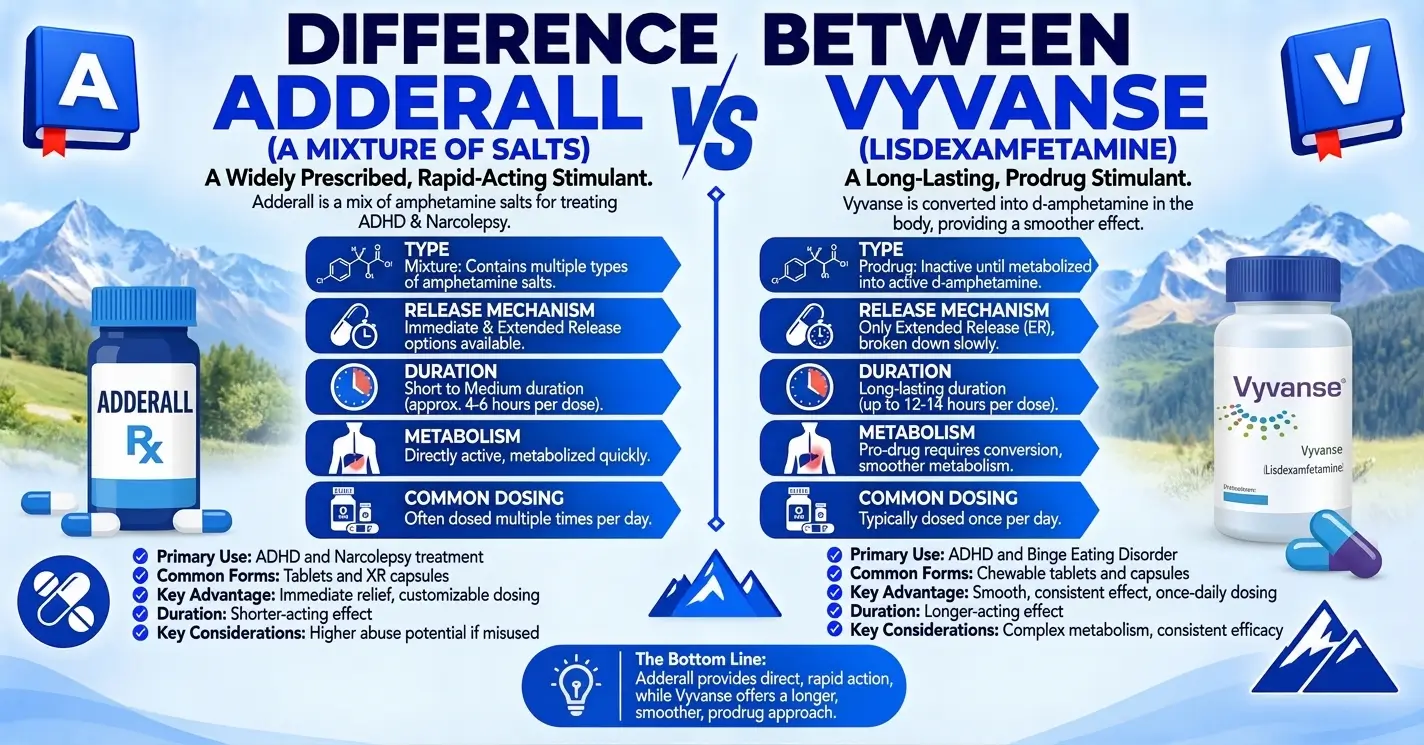

Adderall and Vyvanse are both prescription stimulant medications used to treat ADHD, but they are not the same drug. Their biggest difference is how the active medicine is formulated: Adderall contains mixed amphetamine salts, while Vyvanse contains lisdexamfetamine, a prodrug that the body converts into dextroamphetamine.
That difference affects how the medicines become active, how their formulations are designed, and how clinicians may use them in practice. Adderall is available in immediate-release and extended-release formulations, while Vyvanse is designed as a long-acting formulation.
Quick Answer
Adderall contains mixed amphetamine salts, including dextroamphetamine and amphetamine components.
Vyvanse contains lisdexamfetamine, which is converted in the body to the active drug dextroamphetamine.
The main difference is therefore formulation and activation: Adderall supplies active amphetamine salts directly, whereas Vyvanse is a prodrug that must be converted before producing its active stimulant effect.
Both are prescription CNS stimulants and both can be effective for ADHD, but they are not interchangeable milligram-for-milligram.
Adderall vs Vyvanse at a Glance
| Feature | Adderall | Vyvanse |
|---|---|---|
| Active ingredient | Mixed amphetamine salts | Lisdexamfetamine |
| Drug class | CNS stimulant | CNS stimulant |
| Main ADHD use | Yes | Yes |
| Formulation | Immediate-release and extended-release versions | Long-acting lisdexamfetamine |
| Prodrug? | No | Yes |
| Active amphetamine produced | Contains active amphetamine salts | Converted to dextroamphetamine |
| Other FDA-approved U.S. uses | Immediate-release Adderall is also indicated for narcolepsy | Moderate-to-severe binge-eating disorder in adults |
| Controlled substance | Schedule II | Schedule II |
| Abuse/misuse warning | Yes | Yes |
What Is Adderall?
Adderall is a prescription stimulant containing a combination of amphetamine salts. Its active ingredients include dextroamphetamine and amphetamine in different salt forms.
In the U.S., immediate-release Adderall is indicated for ADHD and narcolepsy. Adderall XR is an extended-release formulation indicated for ADHD.
One important point is that “Adderall” does not describe only one release profile. When comparing Adderall with Vyvanse, it is useful to specify whether the comparison involves immediate-release Adderall or Adderall XR.
Immediate-release Adderall can be prescribed in divided doses, while Adderall XR is designed for once-daily administration.
What Is Vyvanse?
Vyvanse is the brand name for lisdexamfetamine. Unlike Adderall, lisdexamfetamine is a prodrug.
A prodrug is a medication that is administered in a form that is converted by the body into its active form. In the case of Vyvanse, the body converts lisdexamfetamine into dextroamphetamine.
In the U.S., lisdexamfetamine is approved for ADHD in adults and children age 6 and older. It is also approved for moderate-to-severe binge-eating disorder in adults.
Vyvanse is not approved as a weight-loss medication.
What Is the Main Difference Between Adderall and Vyvanse?
The simplest way to remember the distinction is:
Adderall contains active mixed amphetamine salts, while Vyvanse contains lisdexamfetamine that is converted into dextroamphetamine by the body.
That difference is more important than simply saying that one drug is “stronger” or “smoother.”
Adderall comes in both immediate-release and extended-release forms, giving clinicians different formulation options. Vyvanse uses lisdexamfetamine as its active ingredient and relies on conversion to dextroamphetamine.
Because the drugs are formulated differently, their onset, duration, dosing schedules, and individual effects can differ.
How Their Formulations Differ
Adderall
Immediate-release Adderall contains mixed amphetamine salts and is designed to become pharmacologically active without first requiring conversion from a prodrug.
Adderall XR uses an extended-release formulation to provide longer coverage than immediate-release Adderall.
Vyvanse
Vyvanse contains lisdexamfetamine. The molecule is converted by the body into dextroamphetamine.
This does not mean that Vyvanse is simply “Adderall in slow motion.” They have different active ingredients and formulations.
The prodrug design is one of the defining characteristics of Vyvanse.
How Long Do Adderall and Vyvanse Last?
Duration depends on the specific formulation and the individual taking the medication.
Immediate-release Adderall is shorter-acting than Adderall XR. The prescribing information allows additional immediate-release doses at intervals of several hours when clinically appropriate.
Adderall XR is designed as an extended-release formulation.
Vyvanse is designed as a long-acting medication and is generally taken once in the morning.
It is better to avoid treating a number such as “8 hours,” “12 hours,” or “14 hours” as a guarantee for every person. Clinical duration can vary, and the time a medication remains detectable in the body is not the same thing as the period during which a person experiences useful symptom control.
Which Has a Faster Onset?
In general, immediate-release Adderall is designed to provide a more direct, shorter-acting formulation, whereas Vyvanse must first be converted from lisdexamfetamine to dextroamphetamine.
That does not mean everyone will subjectively experience one medication as faster or slower in exactly the same way.
Food, individual metabolism, dose, formulation, and other factors can affect the experience of a medication.
What Are Adderall and Vyvanse Used For?
Adderall
U.S. prescribing information lists:
- ADHD
- Narcolepsy for immediate-release Adderall
Adderall XR is indicated for ADHD.
Vyvanse
U.S. prescribing information lists:
- ADHD in adults and pediatric patients age 6 and older
- Moderate-to-severe binge-eating disorder in adults
These approved indications are one meaningful difference between the medications.
Adderall vs Vyvanse for ADHD
Both medications are amphetamine-based stimulants used to treat ADHD.
However, they are not identical treatments.
The relevant comparison includes:
- active ingredient
- formulation
- release characteristics
- expected duration
- side effects
- other medical conditions
- drug interactions
- previous treatment response
- risk of misuse
- practical scheduling needs
There is no single rule saying that Adderall is universally better than Vyvanse, or vice versa. The appropriate medication and formulation depend on the individual clinical situation and should be determined with a qualified prescriber.
Side Effects of Adderall and Vyvanse
Because both are amphetamine-based stimulants, they have overlapping potential adverse effects.
Depending on the medication and patient, reported effects can include:
- decreased appetite
- insomnia
- headache
- dry mouth
- nausea
- abdominal symptoms
- increased heart rate
- increased blood pressure
- anxiety or nervousness
- weight loss
The exact frequency of individual adverse reactions differs between products and study populations.
Both medications also carry important warnings about abuse, misuse, addiction, and potentially serious consequences from misuse.
They should therefore be taken only as prescribed and not shared with another person.
Is Vyvanse Safer Than Adderall?
This question needs more nuance than a simple yes or no.
Vyvanse’s prodrug formulation can affect how the medication is activated, but Vyvanse still carries a boxed warning for abuse, misuse, and addiction.
It would therefore be inaccurate to describe Vyvanse as non-addictive or risk-free.
Likewise, it is not appropriate to assume that every person has the same misuse risk with every stimulant.
Safety depends on the individual, the medication, the prescribed use, medical history, and whether the medication is taken as directed.
Are Adderall and Vyvanse Interchangeable?
No.
They are related medications, but they are not the same drug.
Most importantly, their milligram amounts should not be treated as equivalent.
For example, a particular number of milligrams of Vyvanse cannot simply be assumed to correspond to the same number of milligrams of Adderall.
Switching between them should be handled by a prescriber or pharmacist who can determine an appropriate regimen.
When Might the Formulation Matter?
The formulation can matter when a clinician is considering factors such as:
- how long symptom coverage is needed
- whether immediate-release or extended-release treatment is appropriate
- whether once-daily administration is practical
- whether insomnia or other adverse effects occur
- how the person responds to a particular stimulant
- whether the person has previously responded well or poorly to another formulation
These are clinical considerations rather than a simple “Adderall versus Vyvanse” ranking.
Common Mistakes About Adderall and Vyvanse
Mistake 1: “Vyvanse and Adderall are the same medication.”
Why it’s incorrect: They belong to the same broad stimulant family but contain different active ingredients.
Mistake 2: “Vyvanse is just extended-release Adderall.”
Why it’s incorrect: Vyvanse contains lisdexamfetamine, a prodrug converted into dextroamphetamine. Adderall contains mixed amphetamine salts.
Mistake 3: “A higher milligram number means a stronger medication.”
Why it’s incorrect: The milligram amounts of different stimulant medications are not directly interchangeable measures of potency.
Mistake 4: “Vyvanse cannot be abused because it is a prodrug.”
Why it’s incorrect: Vyvanse still carries a boxed warning concerning abuse, misuse, and addiction.
Mistake 5: “Adderall always lasts exactly four hours.”
Why it’s incorrect: Immediate-release Adderall is shorter-acting, but individual response varies, and Adderall XR is a different extended-release formulation.
Common Collocations and Search Phrases
Readers commonly encounter these combinations:
With Adderall
- Adderall IR
- Adderall XR
- Adderall for ADHD
- Adderall for narcolepsy
- Adderall side effects
- Adderall dosage
- Adderall prescription
With Vyvanse
- Vyvanse for ADHD
- Vyvanse for binge-eating disorder
- Vyvanse side effects
- Vyvanse duration
- Vyvanse dosage
- lisdexamfetamine
- Vyvanse prescription
Comparison phrases
- Adderall vs Vyvanse
- Adderall and Vyvanse
- Adderall vs Vyvanse duration
- Adderall vs Vyvanse side effects
- Adderall vs Vyvanse effectiveness
Can You Take Adderall and Vyvanse Together?
Do not assume that two prescription stimulants should be taken together simply because they belong to the same medication family.
Combining or changing stimulant medications requires medical supervision because both can affect the cardiovascular system and carry risks associated with misuse, interactions, and adverse effects.
If a clinician is changing someone from one medication to another, the transition should follow the prescribed plan.
How to Remember the Difference
Use this simple rule:
Adderall = mixed amphetamine salts.
Vyvanse = lisdexamfetamine → dextroamphetamine.
The word “prodrug” is the key memory point for Vyvanse.
Think:
Vyvanse needs conversion.
That single concept helps explain why its formulation differs from Adderall.
Which One Should I Use?
There is no universal answer because the appropriate treatment can depend on the individual’s medical circumstances.
When comparing formulations, the patient and prescriber can discuss immediate-release versus extended-release options and how each is intended to be used.
The required duration of symptom coverage is another important consideration, particularly when symptoms need to be managed throughout the day.
For anyone concerned about side effects, reviewing the specific adverse effects experienced with current or previous treatment can help guide the discussion.
Other medications and medical conditions may also affect treatment decisions. A healthcare professional can review potential contraindications and drug interactions before making a change.
If switching medications is being considered, avoid calculating an equivalent dose independently. The prescriber or pharmacist can determine an appropriate approach based on the specific medications and circumstances.
The goal is not to identify a universal winner. Instead, the aim is to determine which prescribed treatment and formulation best fits the individual’s clinical needs.
Adderall or Vyvanse? Practice Examples
Test yourself:
- Which medication contains mixed amphetamine salts?
- Which medication contains lisdexamfetamine?
- Which one is a prodrug?
- Which immediate-release medication is also indicated for narcolepsy in the U.S.?
- Which medication is approved for moderate-to-severe binge-eating disorder in adults?
- Are the milligram amounts of Adderall and Vyvanse directly interchangeable?
- Do both medications carry important misuse and addiction warnings?
Answers
- Adderall
- Vyvanse
- Vyvanse
- Adderall
- Vyvanse
- No
- Yes
Frequently Asked Questions
What is the main difference between Adderall and Vyvanse?
Adderall contains mixed amphetamine salts, while Vyvanse contains lisdexamfetamine, which the body converts into dextroamphetamine. Their different formulations affect how the medications become active and how they are delivered.
Is Vyvanse the same as Adderall?
No. They are both amphetamine-based stimulant medications, but they contain different active ingredients and are formulated differently.
Is Vyvanse stronger than Adderall?
“Stronger” is not a reliable way to compare them because their active ingredients and doses are not directly equivalent. Individual response also varies.
Which lasts longer, Adderall or Vyvanse?
Vyvanse is designed as a long-acting formulation. Adderall has both immediate-release and extended-release formulations, so the answer depends on which Adderall formulation is being compared.
Can Adderall replace Vyvanse?
They are not automatically interchangeable. A clinician needs to determine the appropriate medication and dosing strategy if treatment is changed.
Is Vyvanse less addictive than Adderall?
Vyvanse is not addiction-free. Its current prescribing information carries a boxed warning about abuse, misuse, and addiction, as does Adderall’s prescribing information.
Does Adderall work faster than Vyvanse?
Immediate-release Adderall does not require the same prodrug conversion step as Vyvanse. However, individual experiences vary, so onset should not be treated as identical for every patient.
Are Adderall and Vyvanse both used for ADHD?
Yes. Both are indicated for ADHD in the United States, subject to their respective prescribing information and age requirements.
What is Vyvanse called generically?
The generic name is lisdexamfetamine or, more precisely, lisdexamfetamine dimesylate for the drug substance used in U.S. products.
Conclusion
The difference between Adderall and Vyvanse starts with their formulation. Adderall contains mixed amphetamine salts, while Vyvanse contains lisdexamfetamine, a prodrug converted into dextroamphetamine by the body. Adderall is available in immediate-release and extended-release forms, whereas Vyvanse is designed as a long-acting formulation.
Both are prescription stimulants used for ADHD, but their approved uses, formulations, timing, and individual effects differ. The practical rule is simple: Adderall and Vyvanse are related medications, not interchangeable versions of the same drug.

Sajid Ali is an English language educator and content specialist with 7+ years of teaching experience. He holds master’s degrees in Information Technology and Education from the Virtual University of Pakistan and writes SEO-optimized, learner-friendly vocabulary content for diffari.com.