
Macaron and macaroon are two dessert names that differ by only one letter, but they usually refer to two different kinds of cookies.
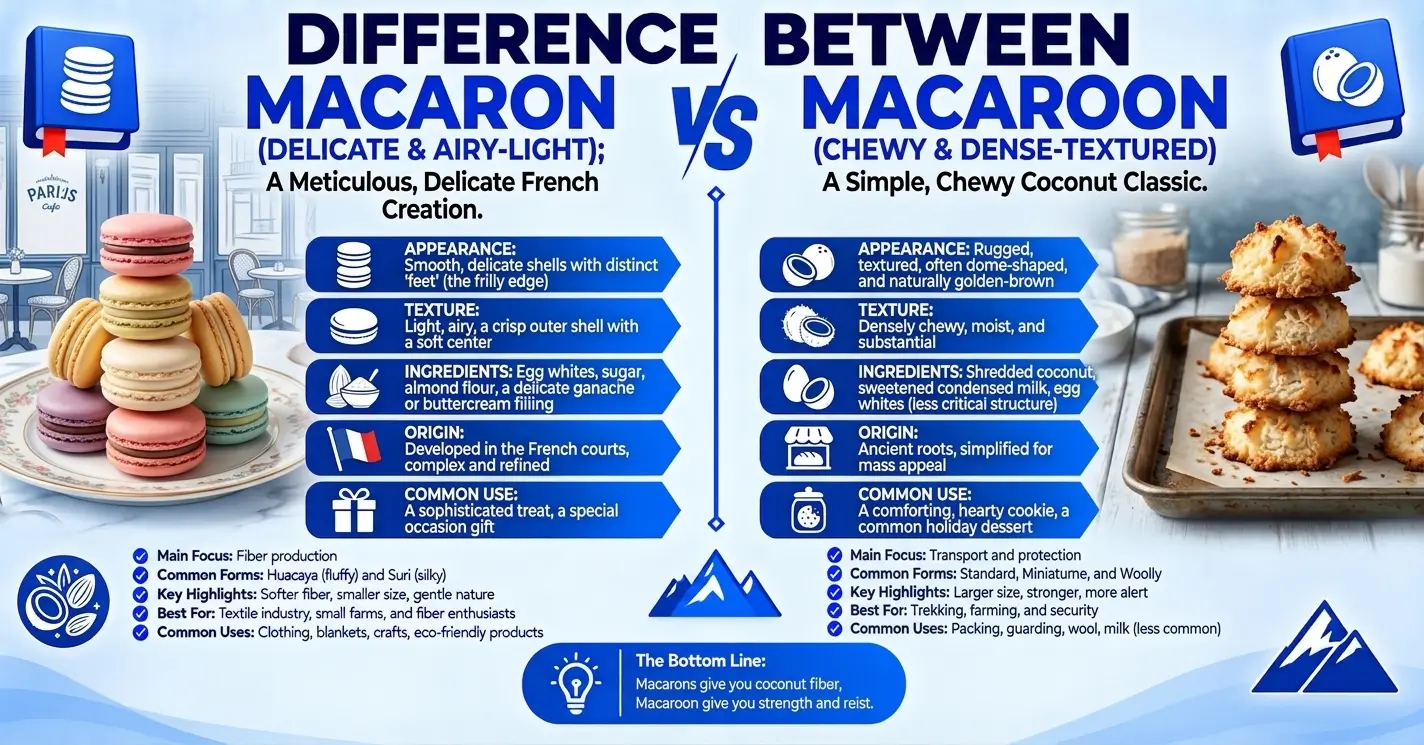
A macaron is the delicate, round sandwich pastry associated with French patisserie: two almond-based shells are baked separately and joined with a filling such as buttercream, ganache, or jam. A macaroon is usually a rougher, denser cookie, most commonly made with shredded coconut, egg whites, and sugar.
The confusion is understandable because the words are historically related, and macaroon has also been used for the almond-based pastry in some English varieties. So the simplest rule is useful, but it is not absolute.
Quick Answer
A macaron is usually a light, almond-based sandwich cookie made from two shells with a filling between them.
A macaroon usually means a dense, chewy cookie made with coconut, although almond-based macaroons and broader uses of macaroon also exist.
The easiest modern distinction is:
Macaron = smooth almond sandwich pastry.
Macaroon = usually a rough, chewy coconut cookie.
The pronunciation also helps: macaron ends with a sound like ron, while macaroon ends with a sound like roon.
Macaron vs. Macaroon at a Glance
| Feature | Macaron | Macaroon |
|---|---|---|
| Typical meaning | Almond-based sandwich pastry | Usually a coconut-based cookie |
| Main ingredients | Almonds/almond flour, egg whites, sugar | Coconut, egg whites, sugar |
| Shape | Two round shells | Usually a single mound or cluster |
| Filling | Usually yes | Usually no |
| Texture | Crisp or delicate outside, chewy interior | Dense and chewy |
| Appearance | Smooth, often colorful, with a ruffled “foot” | Rough, craggy, often golden |
| Pronunciation | mak-uh-RON | mak-uh-ROON |
| Common modern usage | French-style pastry | Coconut cookie |
What Is a Macaron?
A macaron is a small, round pastry made from a meringue-like mixture containing egg whites, sugar, and finely ground almonds or almond flour. Two baked shells are normally joined with a filling such as buttercream, ganache, or jam.
The finished pastry is usually smooth and colorful. A well-made macaron may also have a characteristic ruffled edge, commonly called its “foot” or pied.
Macarons come in many flavors, including chocolate, pistachio, vanilla, raspberry, coffee, and salted caramel.
Example
She bought a box of pistachio macarons from the French bakery.
Here, macarons is the appropriate word because the speaker means the small almond-based sandwich pastries.
What Is a Macaroon?
A macaroon is usually a small, dense, chewy cookie made with coconut, egg whites, and sugar. Instead of being constructed from two smooth shells and a filling, it is generally formed as a single mound or cluster.
Coconut is the ingredient most strongly associated with the modern American meaning of macaroon. Some versions are dipped or drizzled with chocolate.
However, macaroon is not restricted to coconut in every variety of English. Dictionaries also record almond-based meanings, which is one reason the terminology can be confusing.
Example
She made coconut macaroons and dipped them in dark chocolate.
Here, macaroons clearly refers to the chewy coconut cookies.
What Is the Difference Between Macaron and Macaroon?
The main difference is what kind of dessert the word normally identifies.
A macaron is generally a delicate sandwich pastry made from almond-based meringue shells with a filling.
A macaroon is generally a rougher, chewy cookie, especially one made with shredded coconut.
There are several useful ways to tell them apart.
1. Ingredients
Macarons typically use finely ground almonds or almond flour, egg whites, and sugar.
Macaroons commonly use shredded coconut, egg whites, and sugar. Almond-based versions also exist.
2. Structure
A macaron normally consists of two shells plus a filling.
A typical macaroon is one baked mound or cluster.
3. Texture
Macarons tend to have a delicate shell and a softer or chewy center.
Macaroons tend to be more substantial, moist, and chewy throughout.
4. Appearance
Macarons are usually smooth, symmetrical, colorful, and sandwich-like.
Macaroons generally have a rough or craggy surface because of the coconut.
5. Pronunciation
The final syllable is the clearest pronunciation difference:
- macaron: mak-uh-RON
- macaroon: mak-uh-ROON
When to Use “Macaron”
Use macaron when you mean the modern French-style almond sandwich pastry.
For example:
The bakery sells chocolate macarons.
I ordered a raspberry macaron with my coffee.
She decorated the cake with pastel macarons.
If the dessert has two smooth almond-based shells surrounding a filling, macaron is normally the clearest word in contemporary English.
When to Use “Macaroon”
Use macaroon when you mean the traditional rough, chewy cookie, especially a coconut-based one.
For example:
My grandmother makes coconut macaroons every Easter.
The chocolate-dipped macaroons were made with shredded coconut.
I bought three almond macaroons from the bakery.
The final example also illustrates why the distinction is not simply “almond versus coconut.” Almond macaroons exist, so the shape and construction of the dessert can be more informative than one ingredient alone.
Macaron and Macaroon in Sentences
Macaron
The pastry shop displayed colorful macarons in the window.
The word macarons refers to the small sandwich pastries.
I chose a pistachio macaron filled with buttercream.
The filling and two-shell structure are typical of a macaron.
Macaroon
The coconut macaroons were chewy and lightly toasted.
The coconut and chewy texture identify the typical macaroon.
He dipped the macaroons in melted chocolate.
Chocolate-dipped coconut macaroons are a common variation.
Macaron vs. Macaroon Pronunciation
The words are pronounced differently in English.
Macaron:
- British: /ˌmæk.əˈrɒn/
- American: /ˌmæk.əˈrɑːn/
Think:
mak-uh-RON
Macaroon:
- /ˌmæk.əˈruːn/
Think:
mak-uh-ROON
A simple memory cue is:
MacarON → ends like “on.”
MacarOON → ends like “moon.”
The pronunciation difference is especially useful when ordering one in a bakery or talking about recipes.
Why Are the Names So Similar?
The similarity is not accidental.
The two words belong to the same historical word family. Dictionaries trace macaroon through French macaron and Italian maccarone, with older forms ultimately connected with terms for food or almond-based preparations.
Over time, different versions of the confection developed in different places. The French-style almond pastry became the modern macaron, while the word macaroon became strongly associated in English, particularly in American usage, with the coconut-based cookie.
That history explains why the names look so similar even though the modern desserts can look completely different.
Collocations With Macaron and Macaroon
Common with “macaron”
- French macaron
- almond macaron
- chocolate macaron
- pistachio macaron
- raspberry macaron
- vanilla macaron
- macaron shell
- macaron filling
- macaron box
- assorted macarons
Common with “macaroon”
- coconut macaroon
- chocolate macaroon
- almond macaroon
- coconut macaroons
- chewy macaroon
- homemade macaroons
- chocolate-dipped macaroon
- macaroon cookie
These combinations are useful because they show how the words normally appear in real food-related contexts.
Common Mistakes With Macaron and Macaroon
Mistake 1: Calling a coconut cookie a “macaron”
Incorrect:
I made coconut macarons for the party.
Usually correct:
I made coconut macaroons for the party.
Why: In contemporary English, macaroon is the usual term for the coconut-based cookie.
Mistake 2: Calling the French sandwich pastry a “macaroon”
Usually preferred:
She bought six French macarons.
Why: Macaron is the clearest modern English term for the colorful almond-based sandwich pastry.
However, this is not always an absolute grammatical error. Some dictionaries recognize macaroon as a term that can also refer to the almond sandwich pastry, particularly in British usage.
Mistake 3: Assuming the extra “o” is only a spelling variant
Incorrect assumption:
Macaron and macaroon are just two spellings for exactly the same cookie.
Better understanding:
They are related words, but in modern everyday usage they normally distinguish different types of desserts.
Mistake 4: Using ingredients as the only rule
It is tempting to remember:
Almond = macaron; coconut = macaroon.
That is helpful, but incomplete.
Some macaroons are almond-based, so the better rule is to consider the whole dessert:
Two smooth shells + filling → macaron.
Single rough/chewy mound, especially coconut → macaroon.
Can Macaron and Macaroon Be Used Interchangeably?
Usually, no—but there is an important language-use exception.
In contemporary food writing, especially in American English, the words normally distinguish two different desserts.
If you say macaron, most readers will understand that you mean the French-style almond sandwich pastry.
If you say macaroon, many readers will expect a coconut-based cookie.
However, dictionaries show that macaroon can also be used for the almond-based sandwich pastry in some English usage. Cambridge, for example, includes both the coconut/almond cookie sense and the filled almond-pastry sense.
So the safest practical rule is:
Use “macaron” for the French-style sandwich pastry and “macaroon” for the coconut cookie.
This minimizes ambiguity for a modern international English audience.
How to Remember the Difference
Use the extra O as a memory aid.
Macaroon → “OO”
Think of the two O’s as a reminder of the round, chewy coconut macaroon.
Macaron → “ON”
Think:
macarON → French-style pastry
An even better visual rule is:
Macaron = two shells + filling.
Macaroon = one coconut mound.
The visual distinction is more reliable than spelling alone.
Which One Should I Use?
The easiest way to choose between macaron and macaroon is to focus on the type of pastry you mean. Although the words look and sound similar, they usually refer to two different kinds of sweets.
If you mean a colorful French-style sandwich pastry with two smooth shells and a filling, use “macaron.” This is the familiar French macaron, typically made with almond flour and a meringue-based mixture.
If you mean a rough, chewy coconut cookie, use “macaroon.” Coconut is the defining ingredient in the most common modern use of “macaroon,” and these cookies are usually denser and more textured than macarons.
If the cookie is almond-based but appears as a single mound rather than a filled sandwich, “macaroon” may also be appropriate. The word has historically been used for several types of almond-based confections, so the exact context can matter.
In British or historical writing, you may also encounter “macaroon” used for an almond-based pastry similar to what modern readers might call a macaron. In those cases, the surrounding context helps determine which meaning is intended.
For general modern writing, the clearest choice is:
Macaron = the smooth, filled French sandwich pastry.
Macaroon = the rough, usually coconut-based cookie.
When in doubt, think “macaron” for the French sandwich pastry and “macaroon” for the coconut cookie.
French sandwich pastry = macaron
Coconut cookie = macaroon
Macaron or Macaroon? Practice Examples
Choose macaron or macaroon in each sentence.
- The bakery sells pistachio ________ with vanilla buttercream.
- My aunt makes coconut ________ every Christmas.
- The chocolate ________ had two smooth shells.
- She dipped the coconut ________ in dark chocolate.
- The pastry chef carefully piped the ________ shells onto the tray.
- We bought a box of assorted French ________.
- The chewy coconut ________ had a golden surface.
- He ordered a raspberry ________ with his coffee.
Answers
- macarons
- macaroons
- macaron
- macaroon
- macaron
- macarons
- macaroon
- macaron
The easiest way to check your choice is to ask whether the dessert is a filled sandwich pastry or a single chewy cookie.
Frequently Asked Questions
What is the difference between a macaron and a macaroon?
A macaron is usually an almond-based sandwich pastry made from two meringue-like shells with a filling. A macaroon is usually a denser, chewy cookie, particularly a coconut-based one.
Are macarons and macaroons the same?
Usually, no. In modern English they generally refer to different desserts. However, macaroon has also been used as a broader term for the almond-based pastry in some English usage.
Is a macaron made with coconut?
A traditional French-style macaron is generally associated with almonds rather than shredded coconut. Coconut can appear in modern flavor variations, but coconut is not what normally defines the pastry.
Is a macaroon made with almonds?
It can be. Macaroons can be made with almonds as well as coconut. The typical American macaroon is strongly associated with coconut, but almond-based macaroons also exist.
How do you pronounce macaron?
In English, macaron is commonly pronounced approximately mak-uh-RON, with the stress on the final syllable.
How do you pronounce macaroon?
Macaroon is pronounced approximately mak-uh-ROON, with the final syllable sounding like roon.
Why do macaron and macaroon sound so similar?
The words are historically related. Their similar forms developed from an older word family associated with the almond-based confection, even though the modern desserts developed different characteristics.
Is macaron or macaroon the correct spelling?
Both are correct words, but they normally refer to different things in modern English. Macaron is the clearest spelling for the French-style filled almond pastry, while macaroon commonly refers to the coconut-based cookie.
Conclusion
The simplest distinction is this: a macaron is usually the delicate, almond-based sandwich pastry made from two shells and a filling, while a macaroon is usually a dense, chewy cookie, especially one made with coconut.
The words are historically related, which explains their similar spelling, and macaroon can have broader meanings in some English usage. For everyday modern writing, however, the practical rule is straightforward:
Two almond-based shells with a filling = macaron.
A rough, chewy cookie, especially coconut-based = macaroon.
Remember the final sound too: macarON versus macarOON.

Sajid Ali is an English language educator and content specialist with 7+ years of teaching experience. He holds master’s degrees in Information Technology and Education from the Virtual University of Pakistan and writes SEO-optimized, learner-friendly vocabulary content for diffari.com.