If you’re planning work on a house, the words renovation and remodel can seem interchangeable. They are closely related, but they often describe different types of home-improvement work.
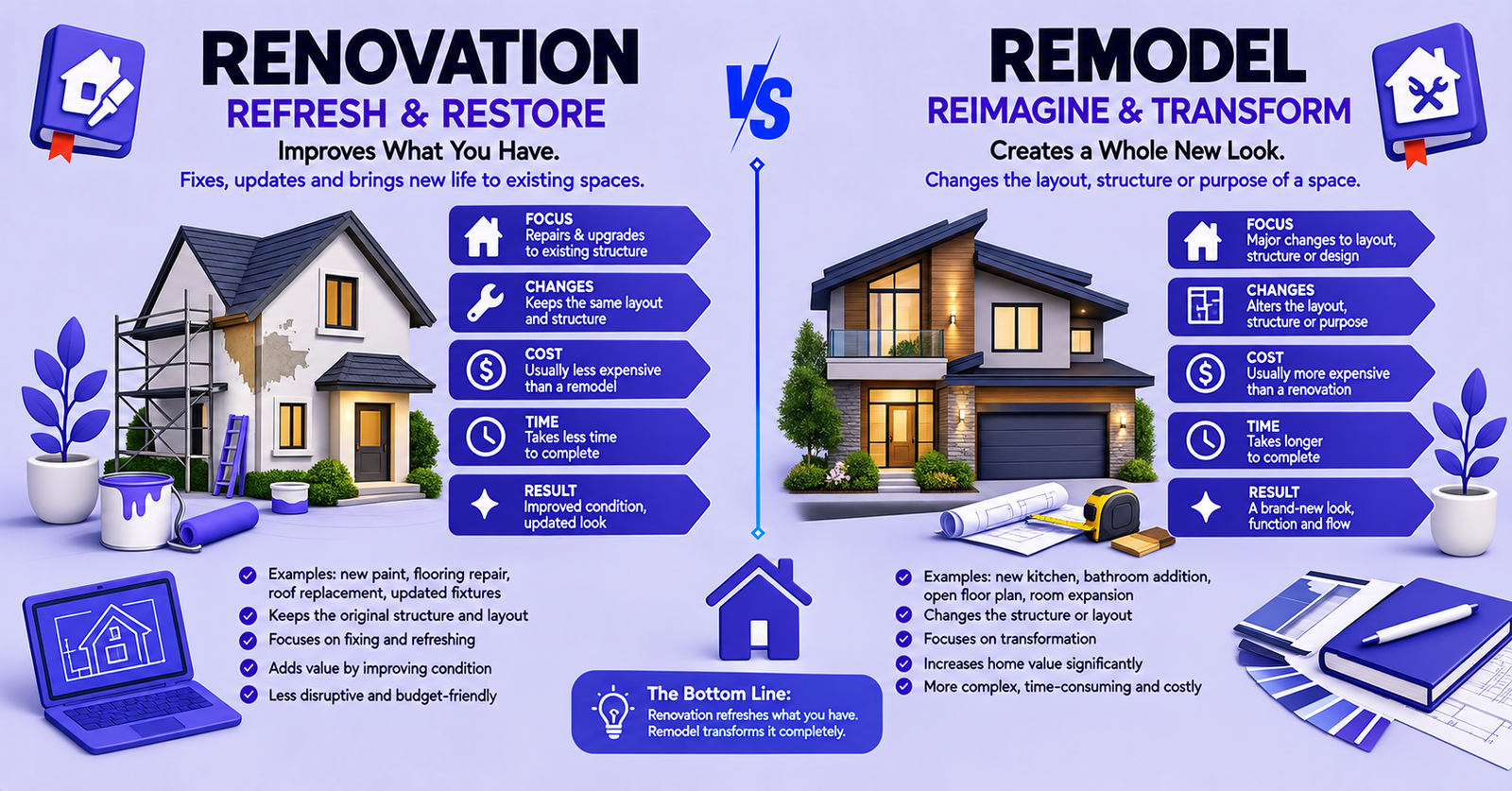
In general, a renovation renews, repairs, restores, or updates an existing space, while a remodel changes the shape, layout, structure, design, or function of that space. However, the boundary is not absolute. Contractors, homeowners, and real-estate professionals sometimes use the terms interchangeably.
The easiest way to remember the distinction is this: renovation improves what is already there; remodeling changes what it is like or how it works.
Quick Answer
Renovation means repairing, restoring, refreshing, or improving an existing building or space.
Remodel means changing the shape, form, layout, structure, or function of an existing space.
So, if you repaint a kitchen, replace its flooring, or update its fixtures while keeping the basic layout, you would normally call that a renovation. If you remove a wall, move plumbing, change the floor plan, or convert a room into a different type of space, remodel is usually the more precise term.
There is some overlap, though. In everyday home-improvement language, people frequently use renovation and remodel as synonyms.
Renovation vs Remodel at a Glance
| Feature | Renovation | Remodel |
| Basic meaning | Renew, repair, restore, or update | Change the form, layout, structure, or function |
| Main goal | Improve an existing space | Transform or reconfigure a space |
| Layout | Usually stays substantially the same | May be changed |
| Typical work | Painting, flooring, fixtures, repairs | Moving walls, plumbing, rooms, or major layouts |
| Structural changes | Not usually the defining feature | More likely |
| Cost | Often lower, depending on scope | Often higher because of greater complexity |
| Timeline | Often shorter | Often longer |
| Permits | Less likely for minor work, but project-specific | More likely when structural or major systems change |
| DIY potential | Many small projects are DIY-friendly | Major projects usually need professionals |
The table describes common home-improvement usage rather than a universal legal definition. Permit requirements, for example, depend on the project and local rules.
What Does Renovation Mean?
Renovation is the process of repairing, improving, restoring, or updating something that already exists.
Cambridge defines renovate as repairing and improving something, especially a building, while Oxford describes it as repairing and painting an old building or other object so that it is in good condition again.
In home improvement, renovation commonly includes work such as:
- repainting walls
- replacing flooring
- updating light fixtures
- replacing faucets
- refinishing cabinets
- repairing worn surfaces
- replacing outdated appliances
- improving finishes
- updating windows or other existing features
For example:
We renovated the kitchen by repainting the cabinets, replacing the flooring, and installing new lighting.
The important idea is that the existing space remains fundamentally recognizable. You are improving it rather than fundamentally reconfiguring it.
Grammar of renovation
Renovation is a noun.
- The renovation took three months.
- The house needs a major renovation.
- They are planning a kitchen renovation.
The corresponding verb is renovate:
- They plan to renovate the kitchen.
- We renovated the old house.
What Does Remodel Mean?
Remodel means to change something’s shape, form, structure, or design.
Cambridge defines remodel as giving something a new shape or form. Merriam-Webster similarly defines it as altering the structure of something or remaking it.
In home improvement, remodeling commonly involves more substantial changes, such as:
- removing a wall
- changing a floor plan
- moving plumbing
- reconfiguring a kitchen
- expanding a bathroom
- converting a garage into living space
- adding a room
- changing the function of a room
- substantially restructuring an existing space
For example:
We remodeled the kitchen by removing the wall between the kitchen and dining room.
Here, the project changes how the space is organized, not merely how it looks.
Grammar of remodel
Remodel can be both a noun and a verb.
As a verb:
They plan to remodel the bathroom.
As a noun:
The bathroom remodel took four months.
In American English, remodeled and remodeling are common spellings. British English may use remodelled and remodelling. Dictionary.com also records these British forms.
What Is the Main Difference Between Renovation and Remodel?
The clearest practical distinction is whether the project primarily renews the existing space or changes its form or function.
A renovation generally works with the existing structure and updates it.
A remodel goes further by changing the shape, configuration, layout, or function of the space.
Consider a bathroom.
Renovation
You:
- replace the tiles
- repaint the walls
- install a new vanity
- replace the faucet
- update the lighting
The bathroom remains a bathroom with essentially the same layout.
Remodel
You:
- move the shower to another part of the room
- relocate plumbing
- remove a wall
- expand the bathroom into another room
- change the room’s configuration
Now the project is changing how the space is organized or functions.
Real-estate and home-improvement sources repeatedly use this type of distinction: updating existing surfaces tends to be described as renovation, while changing layouts, walls, plumbing, or other structural elements tends to be described as remodeling.
Renovation vs Remodel: Examples
Here are some practical examples:
| Project | More likely term | Why |
| Painting a bedroom | Renovation | Updates the existing space |
| Replacing old flooring | Renovation | Improves an existing finish |
| Replacing bathroom fixtures | Renovation | Updates existing features |
| Refinishing kitchen cabinets | Renovation | Renews rather than reconfigures |
| Removing a wall | Remodel | Changes the layout |
| Moving plumbing | Remodel | Changes the configuration of the space |
| Adding a new room | Remodel | Expands or changes the structure |
| Converting a garage into a bedroom | Remodel | Changes the space’s function |
| Reconfiguring a kitchen | Remodel | Changes the layout and functionality |
| Replacing an old roof | Usually renovation/repair | Improves an existing component rather than necessarily changing the building’s form |
The last example shows why the terms should not be treated as rigid categories. A large or technically complex renovation does not automatically become a remodel simply because the work is expensive or extensive.
When to Use Renovation
Use renovation when the main purpose is to renew, repair, restore, refresh, or improve an existing space.
Typical examples include:
We renovated the old kitchen.
The hotel is undergoing renovation.
They renovated the bathroom without changing its layout.
The company renovated the historic building.
Renovation is especially appropriate when the underlying space remains substantially the same but its condition, appearance, or features are being improved.
However, renovation does not necessarily mean “painting and decorating.” The word has a broader meaning in general English: it can include substantial repair and improvement work.
When to Use Remodel
Use remodel when the project changes the shape, layout, structure, design, or function of a space.
For example:
They remodeled the kitchen to create an open floor plan.
We are remodeling the bathroom.
The owners remodeled the garage into an office.
They completely remodeled the house.
A remodel is particularly useful when the existing configuration no longer works for the owner’s needs.
Cost, Timeline, and Permits
The distinction also affects practical project planning.
Cost
Renovations are often less expensive than major remodels because smaller renovation projects can involve fewer structural changes, fewer specialists, and less extensive construction.
Remodels can cost more because they may involve demolition, new construction, plumbing, electrical work, structural engineering, design work, and other professional services. Current home-improvement sources consistently describe remodeling as the more expensive option in typical like-for-like comparisons.
Still, scope matters more than the label. A major renovation can cost more than a small remodel.
Timeline
A simple renovation, such as painting or replacing flooring, may be completed relatively quickly.
A remodel involving demolition, structural changes, plumbing, electrical work, inspections, and multiple contractors can take considerably longer.
Permits
Minor renovation work may not require a building permit, but this depends on the project and location.
Remodels involving structural changes, major plumbing or electrical work, additions, or changes to a building’s structure are more likely to involve permits and professional oversight. Requirements vary by jurisdiction, so homeowners should check local regulations rather than assuming that every renovation is permit-free or every remodel automatically requires one.
Common Mistakes With Renovation and Remodel
Mistake 1: Treating them as exact synonyms
Incorrect assumption:
Renovation and remodel always mean exactly the same thing.
Better understanding:
The words overlap, but renovation usually emphasizes renewing or improving an existing space, while remodel emphasizes changing its form, layout, structure, or function.
Mistake 2: Assuming every renovation is cosmetic
Incorrect:
Renovation only means painting and decorating.
Correct:
Renovation can include broader repair and improvement work. The dictionary meaning is not restricted to cosmetic changes.
Mistake 3: Assuming every remodel must add square footage
Incorrect:
It is only a remodel if you make the house bigger.
Correct:
A remodel can change an existing interior without adding any square footage. Reconfiguring a kitchen or removing a wall can be enough to make remodel the more natural term.
Mistake 4: Choosing the word based only on price
A $50,000 project is not automatically a remodel, and a $5,000 project is not automatically a renovation.
Scope and purpose matter more than the price tag.
Common Collocations With Renovation and Remodel
Collocations with renovation
- home renovation
- kitchen renovation
- bathroom renovation
- renovation project
- renovation work
- major renovation
- complete renovation
- extensive renovation
- renovation costs
- renovation plans
Collocations with remodel
- home remodel
- kitchen remodel
- bathroom remodel
- complete remodel
- major remodel
- full remodel
- remodel project
- remodel costs
- remodel the kitchen
- remodel the bathroom
Oxford specifically lists common home-improvement combinations around renovate, including renovating buildings and houses.
Are Renovation and Remodel Interchangeable?
Sometimes, but not always.
In everyday conversation, people frequently use the terms interchangeably. Dictionary.com explicitly notes this overlap.
For precise home-improvement communication, however, the distinction is useful:
- Renovation → renew, repair, restore, or update an existing space.
- Remodel → change the form, layout, structure, or function of an existing space.
There can also be projects that reasonably fit both descriptions.
For example, a kitchen project might involve refinishing cabinets and removing a wall. You could describe the overall work as a kitchen remodel, while individual parts of the project could be described as renovations or updates.
How to Remember the Difference
Use this simple memory rule:
Renovate = make it new again.
Remodel = change its model or form.
Think about the question:
“Am I mainly improving what is already there?”
If yes, renovation is probably the better term.
Ask:
“Am I changing how the space is shaped, arranged, or used?”
If yes, remodel is probably more precise.
Which One Should I Use?
Use this practical decision guide:
Choose renovation when you’re repairing, restoring, refreshing, or updating an existing space.
Go with remodel when you’re changing the layout, shape, structure, or function of a space.
For projects that replace finishes or fixtures while keeping the basic layout intact, renovation is usually the better term.
Removing walls or moving plumbing to create a different layout is generally considered a remodel.
When you’re expanding or significantly reconfiguring the space, remodel is also the more appropriate choice.
Some projects involve both renovation and remodeling. In those cases, either term may appear, but remodel often describes the broader transformation.
The key is not the project’s price or size alone. Look at what the project changes.
Renovation or Remodel? Practice Examples
Choose renovation or remodel.
- They painted the entire living room.
- The owners removed the wall between the kitchen and dining room.
- We replaced the old bathroom fixtures.
- They converted the garage into a bedroom.
- The hotel is updating its existing rooms.
- She moved the kitchen plumbing to a different wall.
- They refinished the kitchen cabinets.
- The family changed the floor plan to create an open-concept home.
Answers
- Renovation — the room is being refreshed without changing its basic form.
- Remodel — removing a wall changes the layout.
- Renovation — the existing bathroom is being updated.
- Remodel — the garage’s function is being changed.
- Renovation — the rooms are being updated.
- Remodel — relocating plumbing changes the configuration.
- Renovation — refinishing renews an existing feature.
- Remodel — the floor plan is being substantially changed.
Frequently Asked Questions
What is the difference between renovation and remodel?
A renovation generally repairs, restores, refreshes, or updates an existing space. A remodel generally changes the space’s form, layout, structure, design, or function. The terms overlap in everyday usage.
Is a renovation the same as a remodel?
Not exactly. They can overlap, and people often use them interchangeably, but renovation emphasizes renewal or improvement, while remodel emphasizes changing form or structure.
Is remodeling more expensive than renovating?
A major remodel is often more expensive because it can involve structural work, demolition, plumbing, electrical work, permits, and multiple professionals. However, the actual cost depends on the project’s scope.
Does a renovation change the layout?
It can, depending on how the word is being used. In common home-improvement terminology, a project that substantially changes the layout is more often called a remodel. The word renovation itself has a broader meaning and does not universally prohibit structural changes.
Does a remodel always involve structural changes?
No. A remodel can involve changing the design, form, or configuration of a space without necessarily changing its entire structural system. Cambridge defines remodel broadly as giving something a new shape or form.
Which term is better for a kitchen?
Use kitchen renovation when you are mainly updating existing features, such as cabinets, flooring, lighting, fixtures, or finishes.
Use kitchen remodel when you are substantially changing the kitchen’s layout, configuration, or functionality.
What is the difference between renovate and renovation?
Renovate is a verb:
They plan to renovate the house.
Renovation is a noun:
The house needs a renovation.
What is the difference between remodel and remodeling?
Remodel can be a verb or noun:
They will remodel the kitchen.
The kitchen remodel begins next month.
Remodeling is the -ing form used for the activity or process:
The kitchen is undergoing remodeling.
Is remodeling the same as renovating?
Not always. Both involve improving an existing property, but remodeling more strongly suggests changing its form, layout, or function, while renovating emphasizes renewal, repair, or improvement.
Conclusion
The simplest distinction is that renovation focuses on renewing, repairing, restoring, or updating an existing space, while remodeling focuses on changing its form, layout, structure, or function. The terms are not perfectly separated, though, and everyday home-improvement language often uses them interchangeably.
If you’re mainly improving what is already there, renovation is usually the better choice. If you’re changing how the space is arranged or works, remodel is usually more precise.