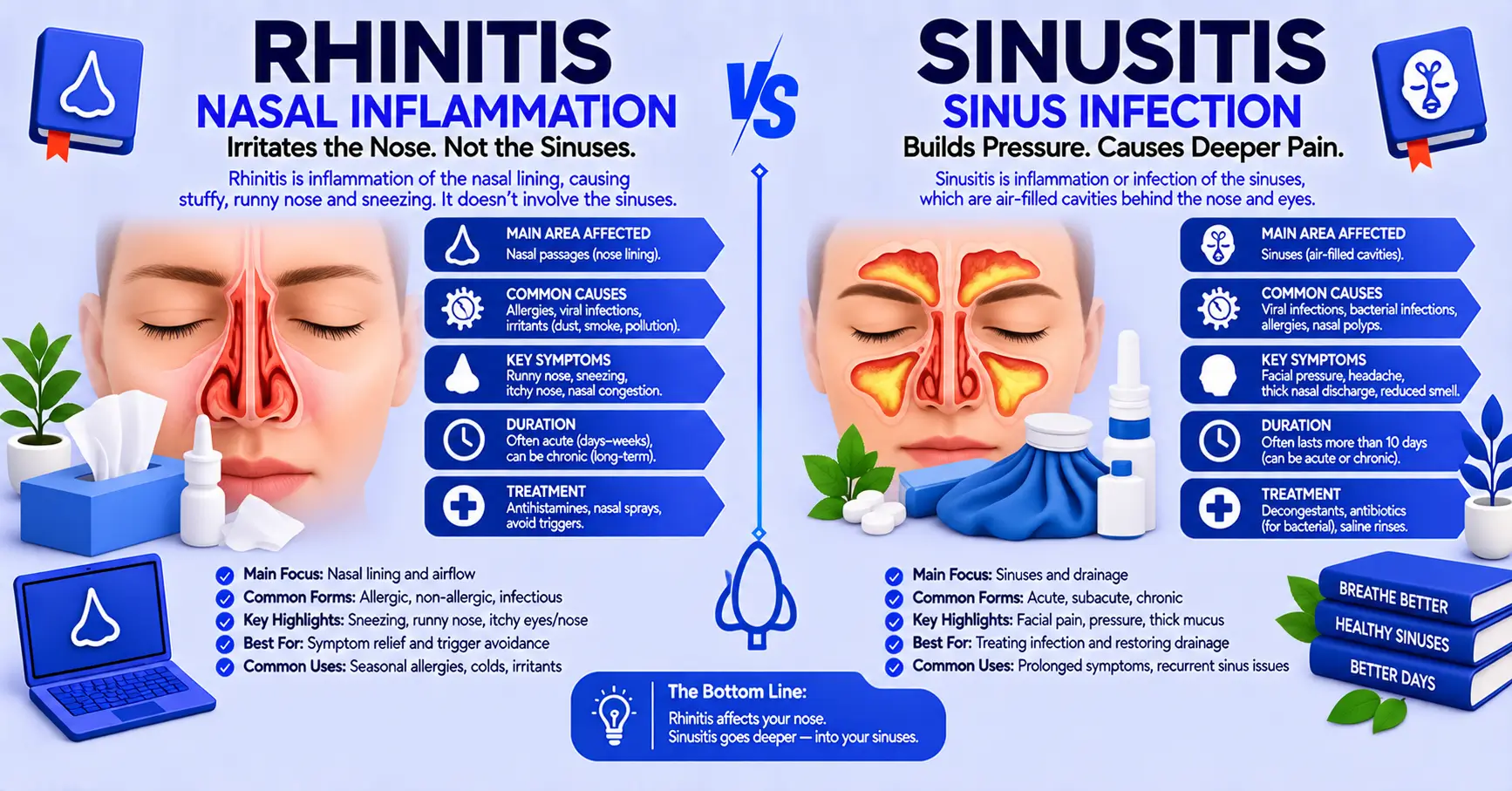
Rhinitis and sinusitis can both cause a blocked or runny nose, congestion, postnasal drip, and discomfort around the face, so it is easy to confuse them. However, they are not exactly the same condition. Rhinitis primarily involves inflammation of the lining of the nose, while sinusitis involves inflammation of the paranasal sinuses.
The distinction becomes more complicated because the two conditions can occur together. Allergic rhinitis, for example, can contribute to problems with sinus drainage, while sinus inflammation commonly occurs alongside inflammation in the nasal passages. Medical professionals may therefore use the broader term rhinosinusitis in many situations.
Understanding the difference is useful because the likely causes, symptoms, evaluation, and treatment can vary.
Quick Answer
Rhinitis is inflammation of the nasal lining, while sinusitis is inflammation of the sinuses around the nose, eyes, forehead, and cheeks.
Rhinitis commonly causes sneezing, itching, a runny nose, and nasal congestion, especially when allergies are involved. Sinusitis is more likely to involve facial pressure or pain, reduced sense of smell, nasal blockage, and thick nasal drainage.
The two conditions can overlap, and having rhinitis does not automatically mean you have sinusitis.
Rhinitis vs. Sinusitis at a Glance
| Feature | Rhinitis | Sinusitis |
| Main area affected | Nasal lining | Paranasal sinuses, often with the nose involved |
| Basic problem | Inflammation of the nose | Inflammation of the sinuses |
| Common causes | Allergies, irritants, infections and other triggers | Viral illness, bacterial infection, inflammation, impaired drainage and other causes |
| Common symptoms | Sneezing, runny nose, congestion, itching | Congestion, facial pressure/pain, thick drainage, reduced smell |
| Itchy eyes/nose | Common in allergic rhinitis | Less characteristic |
| Facial pressure | May occur, but less characteristic | Common |
| Reduced smell | Can occur | Common in rhinosinusitis |
| Can occur together? | Yes | Yes |
The table is a practical guide rather than a diagnostic test. Symptoms can overlap substantially, and a healthcare professional may need to evaluate persistent or severe symptoms.
What Is Rhinitis?
Rhinitis is inflammation of the lining of the nose.
There are two broad categories: allergic rhinitis and non-allergic rhinitis.
Allergic rhinitis occurs when the immune system reacts to normally harmless substances such as pollen, dust mites, pet allergens, or mold. Symptoms commonly include sneezing, nasal itching, runny nose, congestion, and itchy or watery eyes.
Non-allergic rhinitis can produce similar nasal symptoms without an allergic immune response. Triggers can include smoke, strong odors, changes in temperature, pollution, and certain other irritants.
Common symptoms of rhinitis
- Sneezing
- Runny nose
- Stuffy or blocked nose
- Itchy nose
- Itchy or watery eyes, particularly with allergic rhinitis
- Postnasal drip
- Nasal irritation
A useful clue is itching. Itchy eyes, nose, or throat combined with repeated sneezing often fits allergic rhinitis better than a typical sinus infection.
What Is Sinusitis?
Sinusitis is inflammation of one or more of the paranasal sinuses. These are air-filled spaces located around the nose, including areas behind the nose, between the eyes, in the forehead, and in the cheekbones.
When sinus openings become blocked or mucus cannot drain normally, inflammation and mucus buildup can develop. Sinusitis may occur after a viral upper-respiratory infection, but not every case is bacterial. Allergies, nasal polyps, structural problems, and other factors can also contribute.
Common symptoms of sinusitis
- Nasal congestion
- Thick nasal drainage
- Facial pressure or pain
- Reduced sense of smell
- Postnasal drip
- Cough
- Toothache
- Headache or facial discomfort
- Fever in some acute cases
Facial pressure or pain around the cheeks, forehead, or eyes is a particularly useful clue when distinguishing sinusitis from uncomplicated rhinitis, although no single symptom can establish the diagnosis.
What Is the Main Difference Between Rhinitis and Sinusitis?
The simplest distinction is where the inflammation is primarily occurring.
Rhinitis → the nasal lining
Sinusitis → the paranasal sinuses
However, real-world medicine is not always that neatly separated. The nose and sinuses are connected, and inflammation can involve both areas.
That is why the term rhinosinusitis is commonly used. Modern clinical literature recognizes that nasal and sinus inflammation frequently overlap, although rhinitis and sinusitis are still useful terms for describing different clinical problems.
A practical symptom distinction
If the dominant symptoms are:
- repeated sneezing
- itchy nose
- itchy or watery eyes
- clear runny nose
- symptoms associated with pollen, dust, pets, or another allergen
then allergic rhinitis may be more likely.
If the dominant symptoms include:
- facial pressure or pain
- nasal obstruction
- reduced smell
- thick nasal drainage
- symptoms that persist or worsen in a pattern suggestive of acute rhinosinusitis
then sinusitis/rhinosinusitis becomes more relevant.
These clues are not a substitute for diagnosis.
Rhinitis vs. Sinusitis Symptoms
The two conditions share several symptoms, which is why people frequently confuse them.
Symptoms more characteristic of rhinitis
Sneezing and itching are particularly useful clues, especially when they occur with watery eyes and a clear relationship to allergens. Allergic rhinitis can be seasonal or occur year-round.
Symptoms more characteristic of sinusitis
Facial pressure or pain, reduced smell, and thick nasal drainage can be more suggestive of rhinosinusitis. Cough and toothache may also occur.
Importantly, yellow or green mucus by itself does not prove that a sinus infection is bacterial. Clinical diagnosis considers the overall symptom pattern and its duration. The AAO-HNS guideline uses persistent symptoms without improvement for at least 10 days or a “double-worsening” pattern as important criteria for presumed acute bacterial rhinosinusitis.
Causes of Rhinitis vs. Causes of Sinusitis
Common rhinitis triggers
Rhinitis can result from:
- pollen
- dust mites
- pet allergens
- mold
- smoke
- strong odors
- pollution
- temperature changes
- viral illnesses
- other irritants
Allergic rhinitis involves an immune response to allergens, while non-allergic rhinitis does not.
Common sinusitis causes or contributors
Sinusitis can occur because of:
- viral respiratory infections
- bacterial infection in some cases
- persistent inflammation
- impaired sinus drainage
- nasal polyps
- structural abnormalities
- allergic inflammation
- certain less common conditions
Acute sinusitis frequently begins after a cold, while chronic rhinosinusitis can involve longer-lasting inflammation and may occur alongside allergic rhinitis or asthma.
Can You Have Rhinitis and Sinusitis at the Same Time?
Yes.
This is one of the most important points in understanding the difference between the two.
A person can have allergic rhinitis and also develop rhinosinusitis. The conditions are not mutually exclusive. Chronic rhinosinusitis and allergic rhinitis may coexist, and one condition can complicate the symptoms of the other.
For example, someone with seasonal allergies may develop substantial nasal swelling and congestion. If sinus drainage becomes impaired, sinus inflammation can occur as well.
Therefore, treating every case as either “rhinitis” or “sinusitis” can be an oversimplification.
Acute vs. Chronic Sinusitis
Duration matters when discussing sinusitis.
Acute rhinosinusitis generally describes symptoms lasting less than 12 weeks, while chronic rhinosinusitis requires symptoms lasting 12 weeks or longer along with appropriate objective evidence of sinonasal inflammation.
For acute bacterial rhinosinusitis, clinicians pay particular attention to whether symptoms fail to improve for at least 10 days or initially improve and then become worse again.
This is why the number of days a person has been sick can be clinically useful.
Common Collocations With Rhinitis and Sinusitis
Common phrases with rhinitis
- allergic rhinitis
- seasonal rhinitis
- non-allergic rhinitis
- chronic rhinitis
- rhinitis symptoms
- rhinitis treatment
- nasal congestion from rhinitis
Common phrases with sinusitis
- acute sinusitis
- chronic sinusitis
- acute rhinosinusitis
- chronic rhinosinusitis
- sinus infection
- sinus pressure
- sinus pain
- sinus drainage
These phrases reflect common medical usage rather than interchangeable definitions.
Common Mistakes About Rhinitis and Sinusitis
Mistake 1: “Rhinitis always means allergies.”
Incorrect:
“Rhinitis is just another word for allergies.”
Correct:
Rhinitis can be allergic or non-allergic.
Why:
Allergic rhinitis is one form of rhinitis, but irritants and other triggers can also produce rhinitis symptoms.
Mistake 2: “Sinusitis always means a bacterial infection.”
Incorrect:
“If I have sinusitis, I need antibiotics.”
Correct:
Sinusitis has multiple causes, and many acute cases resolve without antibiotics.
Why:
Viral rhinosinusitis is common, and clinical guidelines recommend distinguishing it from presumed bacterial rhinosinusitis before deciding on antibiotic treatment.
Mistake 3: “Green mucus proves bacterial sinusitis.”
Incorrect:
“Green mucus means I definitely have a bacterial sinus infection.”
Correct:
Mucus color alone does not establish a bacterial diagnosis.
Why:
Clinicians consider the complete symptom pattern, duration, severity, and progression rather than relying on mucus color alone.
Mistake 4: “You can only have one.”
Incorrect:
“You either have rhinitis or sinusitis.”
Correct:
The conditions can occur together.
Why:
Nasal and sinus inflammation frequently overlap, which is one reason the term rhinosinusitis is commonly used.
Pronunciation
The words are pronounced differently:
- Rhinitis: roughly “rye-NY-tis” or “rye-NYE-tis,” depending on pronunciation convention.
- Sinusitis: roughly “sigh-nuh-SY-tis.”
Neither is a homophone of the other.
The terms are also not synonyms, although sinusitis and rhinosinusitis are frequently used closely together in medical contexts.
Can Rhinitis and Sinusitis Be Used Interchangeably?
No, not generally.
Rhinitis specifically refers to inflammation involving the nasal lining, while sinusitis refers to inflammation involving the sinuses.
However, the distinction becomes less absolute in actual clinical disease because nasal and sinus inflammation frequently occur together. That is why rhinosinusitis can be a more appropriate term for many cases involving both regions.
How to Remember the Difference
Use the location rule:
Rhinitis = nose
Sinusitis = sinuses
Then add the symptom rule:
Itching + sneezing + watery eyes → think allergic rhinitis
Facial pressure + congestion + reduced smell/thick drainage → think rhinosinusitis
These are memory aids, not diagnostic rules.
Which One Should I Use?
If you are choosing the correct medical term:
If you mean inflammation of the nasal lining → rhinitis
If you mean inflammation involving the paranasal sinuses → sinusitis
If both the nose and sinuses are involved → rhinosinusitis may be the more precise term
If you are trying to understand your own symptoms rather than simply choosing terminology, do not diagnose yourself from one symptom. The overlap is substantial.
X or Y? Practice Examples
Choose rhinitis, sinusitis, or both/overlap.
- Repeated sneezing after exposure to pollen.
- Itchy, watery eyes and a runny nose during allergy season.
- Facial pressure with nasal blockage.
- Symptoms involving both allergic nasal inflammation and sinus inflammation.
- A cold followed by persistent symptoms that fail to improve for more than 10 days.
- A runny nose triggered by strong perfume without evidence of an allergy.
- Reduced sense of smell together with nasal obstruction and facial pressure.
- Nasal symptoms caused by dust-mite allergy.
Answers
- Rhinitis, especially allergic rhinitis.
- Allergic rhinitis.
- Sinusitis/rhinosinusitis may be involved.
- Both/overlap.
- Possible acute bacterial rhinosinusitis, depending on the full clinical picture.
- Non-allergic rhinitis may be involved.
- Rhinosinusitis is a possibility.
- Allergic rhinitis.
These examples illustrate patterns rather than providing a personal diagnosis.
Frequently Asked Questions
What is the main difference between rhinitis and sinusitis?
Rhinitis primarily affects the lining of the nose, whereas sinusitis affects the paranasal sinuses. They can occur together.
Is rhinitis the same as sinusitis?
No. They describe inflammation in different but connected areas. Rhinitis affects the nasal lining; sinusitis affects the sinuses.
Is allergic rhinitis the same as a sinus infection?
No. Allergic rhinitis results from an allergic response, whereas a sinus infection is a type of sinusitis associated with infection. Sinusitis itself can also occur without a bacterial infection.
Can rhinitis turn into sinusitis?
Rhinitis can coexist with or contribute to conditions affecting sinus drainage, but it is not accurate to say that every case of rhinitis “turns into” sinusitis. The relationship is more complicated, and the two conditions can occur together.
Can you have rhinitis and sinusitis at the same time?
Yes. Allergic rhinitis and rhinosinusitis can coexist.
Does yellow or green mucus mean I have sinusitis?
Not by itself. Mucus color should not be used alone to determine whether a person has bacterial sinusitis. Symptom duration, progression, congestion, facial symptoms and other clinical findings matter.
When should I see a doctor for possible sinusitis?
Seek medical evaluation when symptoms are severe, persistent, repeatedly returning, or worsening. Urgent assessment is particularly important for symptoms such as significant swelling or redness around the eye, severe headache, confusion, stiff neck, or other serious symptoms.
Does sinusitis always require antibiotics?
No. Many cases are viral or otherwise non-bacterial. Clinical guidelines recommend distinguishing presumed bacterial rhinosinusitis from viral or noninfectious conditions before deciding whether antibiotics are appropriate.
Conclusion
The key difference between rhinitis and sinusitis is the area primarily affected: rhinitis involves inflammation of the nasal lining, while sinusitis involves inflammation of the paranasal sinuses. Rhinitis—especially allergic rhinitis—often features sneezing, itching, runny nose and watery eyes. Sinusitis is more commonly associated with facial pressure, nasal blockage, reduced smell and thicker nasal drainage.