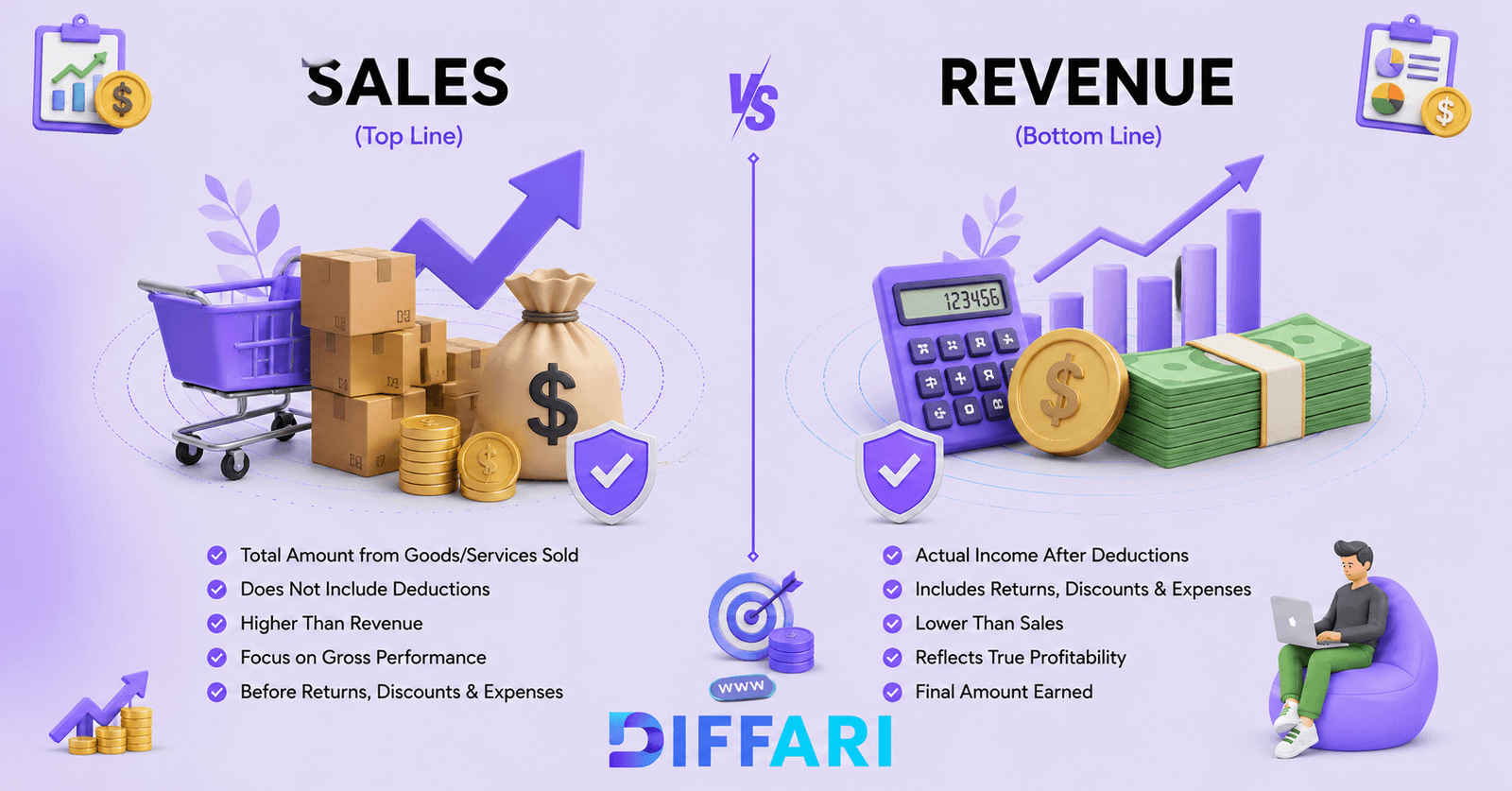

The terms sales and revenue are often used as if they mean exactly the same thing, especially in everyday business conversations. In many companies, that is close enough because sales from products or services make up most or all of the company’s reported revenue. However, the terms can have different meanings when used more precisely in accounting and financial analysis.
The simplest distinction is this: sales usually refers to income generated from selling a company’s goods or services, while revenue is the broader financial concept used to describe income recognized by a business. In some businesses, the sales figure and revenue figure may be the same; in others, they may differ.
Understanding that distinction helps you read income statements, interpret business performance, and avoid confusing revenue with profit or cash received.
Quick Answer
Sales usually refers to the amount generated from selling a company’s products or services. Revenue is a broader financial term and may encompass sales revenue along with other revenue recognized by the business, depending on the business and accounting framework.
However, sales and revenue are often used interchangeably when a company’s primary or only significant source of revenue is selling goods or services.
For example, if a retailer generates $500,000 entirely from selling merchandise and has no separately reported revenue streams, its sales revenue and reported revenue may both be $500,000.
The key is to look at what the business means by “sales” and “revenue” in its financial reporting.
Sales vs Revenue at a Glance
| Sales | Revenue | |
| Basic meaning | Income generated from selling goods or services | Broader income recognized by a business |
| Main focus | Customer sales activity | Overall revenue-generating activities |
| Can include product sales? | Yes | Yes |
| Can include service revenue? | Yes, depending on terminology | Yes |
| Can equal the revenue figure? | Yes | Yes |
| Always broader than sales? | No | Often broader, but terminology depends on context |
| Related terms | Gross sales, net sales, sales revenue | Operating revenue, total revenue |
| Profit? | No | No |
What Does Sales Mean?
Sales generally refers to the business activity of selling goods or services to customers and, in financial contexts, the amount generated from those sales.
For example:
- A clothing store sells $80,000 of clothing in one month.
- A software company sells $50,000 of subscriptions.
- A consulting firm bills $30,000 for consulting services.
In each case, the business has generated sales.
In accounting, you may also encounter gross sales and net sales. Gross sales represent the original sales amount before deductions such as returns, allowances, and discounts. Net sales reflect those reductions. OpenStax describes net sales as gross sales less sales discounts, sales returns, and sales allowances.
Example
Suppose a retailer makes:
- Gross sales: $100,000
- Returns: $4,000
- Discounts and allowances: $2,000
Its net sales would be:
$100,000 − $4,000 − $2,000 = $94,000
So “sales” itself can require context. A person may be talking about gross sales, net sales, sales revenue, or the general sales activity.
What Does Revenue Mean?
Revenue is the income a business recognizes from its revenue-generating activities.
The exact scope depends on the business and accounting framework. In financial reporting, revenue is not simply a synonym for “cash that entered the bank.” For example, IFRS 15 establishes principles for recognizing revenue from contracts with customers based on the transfer of promised goods or services and the consideration the entity expects to receive.
This distinction matters because a company can recognize revenue without receiving the customer’s cash immediately. A credit sale, for example, may create an accounts receivable balance.
Revenue also should not be confused with profit. Revenue is a top-line measure; profit is calculated after relevant costs and expenses are deducted.
What Is the Main Difference Between Sales and Revenue?
The main difference is scope and context.
Sales normally focuses on the value generated through selling a company’s goods or services.
Revenue is the broader financial concept and can encompass the revenue recognized from customer contracts and, depending on the company’s activities and reporting presentation, other revenue categories.
However, this does not mean that sales and revenue always appear as two different numbers.
For many businesses, sales are the primary source of revenue. Consequently, “sales,” “sales revenue,” and “revenue” may be used to describe the same top-line amount. CFI specifically notes that sales and revenue are often used interchangeably when referring to sales revenue.
The practical rule
Sales tells you about selling activity; revenue tells you about the income recognized by the business. In many companies, the two overlap substantially or are the same reported figure.
When Are Sales and Revenue the Same?
Sales and revenue can be the same when the company’s reported revenue consists essentially of its sales of goods or services.
Example
A small online store has:
- Product sales: $200,000
- Other separately reported revenue: $0
If its accounting presentation uses sales revenue as its revenue figure, the business may report:
Sales = $200,000
Revenue = $200,000
There is no contradiction here.
This is why saying that “sales and revenue are completely different” is also misleading. In real-world business reporting, the terminology often overlaps.
When Can Revenue Differ From Sales?
Revenue can differ from a sales figure when the business has revenue streams or reporting categories that are not captured by the particular “sales” figure being discussed.
For example, a business might report:
- Net sales: $900,000
- Other recognized revenue: $50,000
- Total revenue: $950,000
In that situation, revenue is broader than the specific net-sales figure.
The exact classification depends on the company’s activities and applicable accounting rules. IFRS 15, for example, specifically addresses revenue from contracts with customers and requires companies to consider the nature, timing, amount, and uncertainty of revenue and related cash flows.
Therefore, avoid the overly broad rule that “all money other than sales is revenue.” Not every cash inflow is revenue. Loans, capital contributions, and certain other transactions are not simply revenue because cash entered the business.
Gross Sales vs Net Sales
This is one of the most important distinctions to understand when discussing sales.
Gross Sales
Gross sales are the total sales before reductions such as returns, allowances, and discounts.
Net Sales
Net sales are sales after applicable sales reductions.
A simplified formula is:
Net Sales = Gross Sales − Returns − Allowances − Discounts
Example
A company has:
- Gross sales: $250,000
- Returns: $10,000
- Discounts: $5,000
Therefore:
Net sales = $250,000 − $10,000 − $5,000 = $235,000
This distinction is important because comparing a company’s gross sales with another company’s net revenue can produce a misleading analysis.
Sales Revenue vs Total Revenue
Sales revenue is revenue generated from selling goods or services.
Total revenue can be a broader figure depending on how the business classifies and presents its revenue.
For example, consider a hypothetical business with:
- Product sales: $700,000
- Service revenue: $200,000
- Other separately reported revenue: $25,000
The precise relationship between these figures depends on the company’s accounting presentation, but the important idea is that sales revenue describes revenue associated with sales, while a broader revenue figure may contain additional categories.
This is also why readers should check the labels and notes in a company’s financial statements instead of assuming that “sales” and “revenue” always have identical technical meanings.
Sales and Revenue on an Income Statement
Sales and revenue are generally associated with the top portion of an income statement.
A simplified income statement might look like this:
| Item | Amount |
| Revenue / Net Sales | $1,000,000 |
| Cost of Goods Sold | $600,000 |
| Gross Profit | $400,000 |
| Operating Expenses | $250,000 |
| Operating Income | $150,000 |
| Taxes and other items | $40,000 |
| Net Income | $110,000 |
The important point is that revenue is not profit.
Revenue represents the top-line amount before expenses are deducted. Net income is what remains after the relevant expenses and other items have been accounted for.
Sales vs Revenue vs Profit
These three terms answer different questions:
Sales
How much did the business sell?
Revenue
How much revenue did the business recognize?
Profit
How much remained after the relevant costs and expenses?
For example:
- Sales: $1,000,000
- Revenue: $1,000,000
- Expenses: $850,000
- Profit: $150,000
A company can therefore have high sales and revenue but relatively low profit if its costs are high.
Revenue growth alone does not prove that a business is profitable.
Sales and Revenue in Real-World Examples
Example 1: Retail Store
A clothing retailer sells $500,000 of merchandise during the year.
In a simple business where merchandise sales are essentially its revenue-generating activity:
Sales = $500,000
Sales revenue = $500,000
Revenue may also be reported as $500,000
The terms overlap heavily here.
Example 2: Sales With Returns
A retailer records $600,000 in gross sales but customers return $30,000 of merchandise.
Its net sales become:
$600,000 − $30,000 = $570,000
The word “sales” therefore needs context.
Example 3: Subscription Business
A software company provides subscription services to customers.
It may describe the income generated from subscriptions as sales, subscription revenue, or simply revenue, depending on the company’s terminology and reporting context.
This is one reason the terms cannot always be separated into rigid categories.
Example 4: Revenue Recognition
A company signs a customer contract for services that will be delivered over time.
The accounting treatment does not necessarily mean that the entire contract amount becomes revenue immediately. Under IFRS 15, revenue recognition is tied to satisfaction of performance obligations.
This is an important reason why revenue is not simply the same thing as cash received.
Common Mistakes With Sales and Revenue
Incorrect:
“Revenue always means money from selling products.”
Correct:
Revenue is a broader financial concept, and the exact scope depends on the business and accounting context.
Incorrect:
“Sales and revenue can never be the same.”
Correct:
They can be the same reported amount when sales constitute the relevant revenue of the business.
Incorrect:
“Revenue means all cash received.”
Correct:
Revenue recognition follows applicable accounting principles. Cash received and revenue recognized are not necessarily identical.
Incorrect:
“Revenue equals profit.”
Correct:
Revenue is a top-line measure. Profit is calculated after relevant costs and expenses.
Incorrect:
“Gross sales are always the same as net sales.”
Correct:
Returns, allowances, and discounts can reduce gross sales to net sales.
Key Collocations With Sales and Revenue
Key Sales Phrases
When discussing selling activity, these phrases are widely used:
- increase sales
- generate sales
- sales growth
- sales volume
- sales target
- sales forecast
- gross sales
- net sales
- sales revenue
- sales figures
Key Revenue Phrases
For broader financial and business contexts, these expressions are useful:
revenue targetCommon Collocations With Sales and Revenue
generate revenue
increase revenue
revenue growth
annual revenue
total revenue
revenue stream
revenue recognition
recurring revenue
revenue forecast
Common sales phrases
- increase sales
- generate sales
- sales growth
- sales volume
- sales target
- sales forecast
- gross sales
- net sales
- sales revenue
- sales figures
Common revenue phrases
- generate revenue
- increase revenue
- revenue growth
- annual revenue
- total revenue
- revenue stream
- revenue recognition
- recurring revenue
- revenue forecast
- revenue target
These combinations can help you recognize how the terms are normally used in business writing.
Are Sales and Revenue Interchangeable?
Sometimes, but not always.
In everyday business language, people often use sales and revenue interchangeably, particularly when sales are the company’s main source of income. Financial resources also acknowledge that “sales” and “revenue” can be used interchangeably when referring specifically to sales revenue.
In more precise financial reporting, however, the terms can carry different scopes.
So the safest rule is:
Treat sales as the sales-related amount and revenue as the broader financial concept unless the company’s reporting clearly uses the terms interchangeably.
Which One Should I Use?
Use sales when you are specifically talking about selling goods or services, sales activity, sales volume, or sales performance.
Use revenue when you are discussing the broader income figure reported by the business or the accounting concept of recognized revenue.
Quick decision guide
Talking about customers buying your products or services? → Sales
Talking about the company’s broader top-line financial figure? → Revenue
Talking specifically about income from selling goods or services? → Sales revenue
Talking about the amount after returns, allowances, and discounts? → Net sales
Talking about what remains after costs and expenses? → Profit
How to Remember the Difference
Use this simple rule:
Sales = selling. Revenue = the broader financial result of revenue-generating activities.
If you are describing the act or performance of selling products or services, sales is usually the natural term.
If you are analyzing the company’s reported top line or revenue recognition, revenue is usually the better term.
X or Y? Practice Examples
Choose sales or revenue in each sentence.
- The company increased its ___ by 15% after launching the new product.
- The retailer reported $2 million in net ___ after returns and discounts.
- The company’s annual ___ exceeded $10 million.
- The sales team is responsible for generating new ___.
- The company recognized ___ from its customer contracts during the reporting period.
- Gross ___ were reduced by customer returns.
- The company wants to improve its recurring ___.
- Higher sales do not necessarily mean higher ___.
Answers
- sales/revenue — either can be appropriate depending on what the company is measuring.
- sales — specifically net sales.
- revenue — the broader financial figure is usually described this way.
- sales — the sales team generates sales.
- revenue — this is accounting/reporting language.
- sales — gross sales can be reduced by returns.
- revenue — “recurring revenue” is the established business term.
- profit — the sentence is contrasting sales with profitability.
Frequently Asked Questions
What is the difference between sales and revenue?
Sales generally refers to income generated from selling goods or services, while revenue is the broader financial concept. However, the two terms are often used interchangeably when sales constitute the company’s relevant revenue.
Are sales and revenue the same?
They can be. In many businesses, sales revenue makes up essentially all of the company’s revenue, so the reported figures may be the same. The terms can nevertheless have different meanings depending on context.
Can revenue be higher than sales?
Yes, if the revenue figure includes revenue categories that are not represented by the specific sales figure being compared. The exact relationship depends on the business and its accounting presentation.
Is sales revenue the same as revenue?
Often, yes, particularly when a company’s revenue comes primarily from selling goods or services. But “revenue” can be a broader reporting term.
What is the difference between gross sales and net sales?
Gross sales are sales before reductions. Net sales reflect reductions such as returns, allowances, and discounts.
Is revenue the same as profit?
No. Revenue is a top-line figure. Profit is what remains after the relevant costs and expenses are deducted.
Is revenue the same as cash received?
No. Revenue recognition and cash collection can occur at different times. Accounting standards determine when revenue is recognized.
Which is more important, sales or revenue?
Neither is universally more important. Sales can show how effectively a company sells its core products or services, while revenue provides a broader view of the income recognized by the business. The right metric depends on the question being analyzed.
Conclusion
The difference between sales and revenue is mainly a matter of scope and context. Sales generally focuses on income generated from selling goods or services, while revenue is the broader financial concept used in reporting. In many businesses, however, sales revenue makes up the company’s relevant revenue, so the two terms may refer to the same reported amount.

Sajid Ali is an English language educator and content specialist with 7+ years of teaching experience. He holds master’s degrees in Information Technology and Education from the Virtual University of Pakistan and writes SEO-optimized, learner-friendly vocabulary content for diffari.com.