
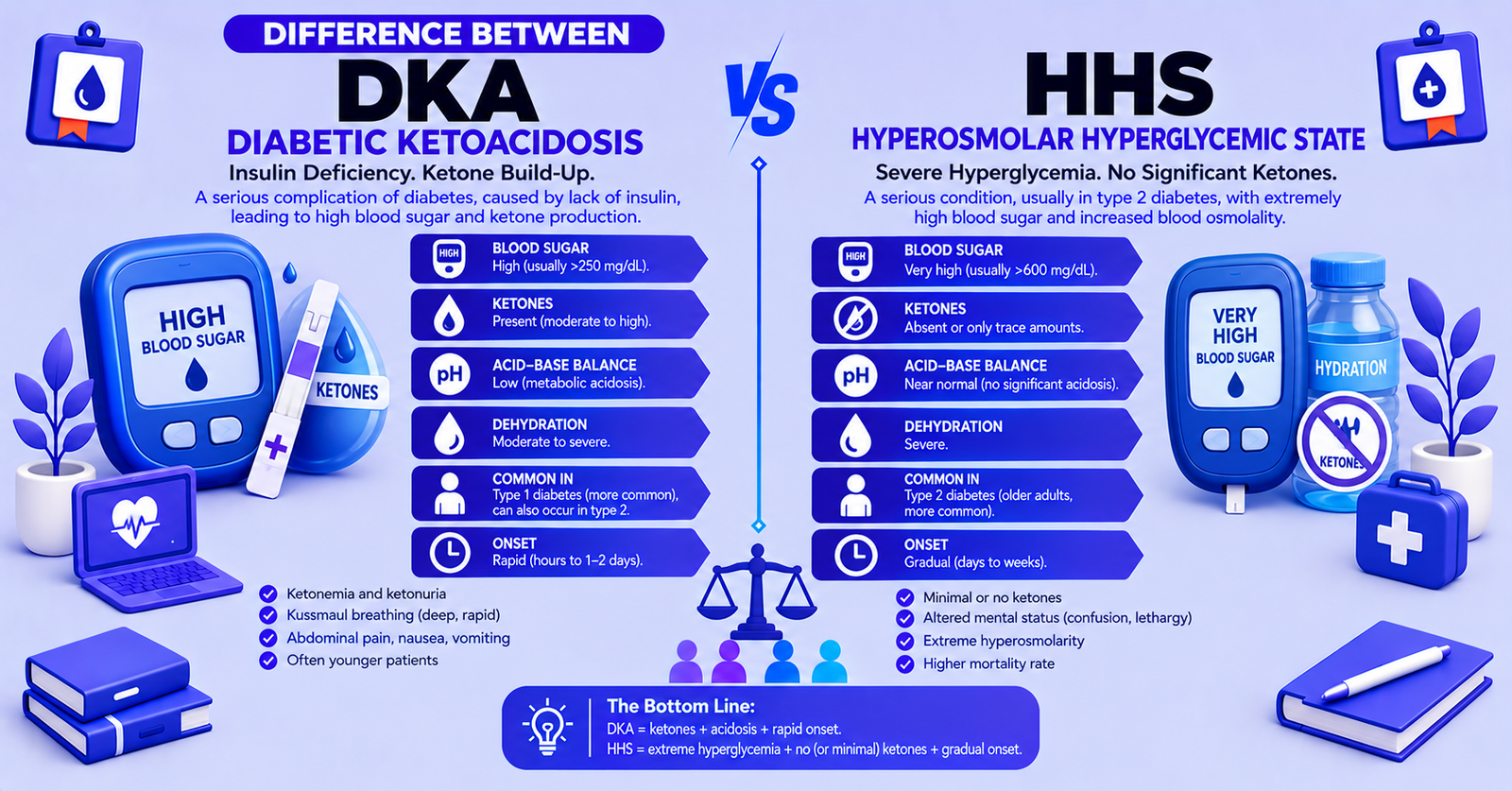

Diabetic ketoacidosis (DKA) and hyperosmolar hyperglycemic state (HHS) are two serious hyperglycemic emergencies associated with diabetes. Both can cause very high blood glucose, dehydration, frequent urination, excessive thirst, weakness, and changes in mental status. However, they develop through different metabolic patterns.
The main difference between DKA and HHS is that DKA is defined by significant ketone production and metabolic acidosis, whereas HHS is characterized by extreme hyperglycemia and hyperosmolarity without significant ketonemia or acidosis.
The distinction is not simply “type 1 diabetes versus type 2 diabetes.” DKA can occur in type 2 diabetes, and HHS can occur in people with other forms of diabetes. In addition, some patients develop features of both conditions at the same time.
Medical note: DKA and HHS are medical emergencies. Suspected DKA or HHS requires urgent medical evaluation rather than home treatment.
Quick Answer
DKA (diabetic ketoacidosis) occurs when insulin deficiency is severe enough to cause substantial ketone production and metabolic acidosis.
HHS (hyperosmolar hyperglycemic state) occurs when blood glucose becomes extremely high, causing severe dehydration and hyperosmolarity, while significant ketone production and acidosis are absent.
In simple terms:
DKA → ketones + acidosis
HHS → extreme hyperglycemia + hyperosmolarity
Both are dangerous, and they can overlap in the same patient.
DKA vs HHS at a Glance
| Feature | DKA | HHS |
|---|---|---|
| Full name | Diabetic ketoacidosis | Hyperosmolar hyperglycemic state |
| Main problem | Ketosis and metabolic acidosis | Severe hyperglycemia and hyperosmolarity |
| Insulin deficiency | More severe | Usually less severe |
| Glucose | ≥200 mg/dL or prior diabetes, with ketosis and acidosis | ≥600 mg/dL |
| Significant ketones | Present | Absent or not significant |
| β-hydroxybutyrate | ≥3.0 mmol/L | <3.0 mmol/L |
| Acidosis | Present | Absent |
| pH | <7.3 | ≥7.3 |
| Bicarbonate | <18 mmol/L | ≥15 mmol/L |
| Hyperosmolarity | May occur, but not the defining feature | Defining feature |
| Typical development | Hours to days | Days to about a week |
| Common association | More common with type 1 diabetes | More common with type 2 diabetes |
| Common clues | Nausea, vomiting, abdominal pain, Kussmaul breathing | Severe dehydration and cognitive changes |
| Can occur together? | Yes | Yes |
The diagnostic thresholds above reflect the current ADA diagnostic framework rather than older DKA/HHS criteria.
What Is DKA?
Diabetic ketoacidosis, or DKA, is a serious diabetes complication caused by insufficient effective insulin.
When insulin is severely deficient, glucose cannot be adequately used by cells for energy. The body responds by breaking down fat. This process produces ketone bodies. When ketones accumulate, they cause metabolic acidosis.
The current diagnostic framework requires three components:
- Diabetes or hyperglycemia
- Significant ketosis
- Metabolic acidosis
For adults, current criteria include glucose of at least 200 mg/dL or a prior history of diabetes, β-hydroxybutyrate of at least 3.0 mmol/L or urine ketones of 2+ or greater, and pH below 7.3 and/or bicarbonate below 18 mmol/L.
Importantly, DKA does not always mean extremely high glucose. About 10% of DKA presentations are classified as euglycemic DKA, in which glucose is below 200 mg/dL despite ketosis and metabolic acidosis. SGLT2 inhibitor use is one recognized association.
Common DKA Symptoms
DKA can develop relatively quickly. Common features include:
- excessive thirst
- frequent urination
- dehydration
- nausea
- vomiting
- abdominal pain
- weakness
- weight loss
- rapid or deep breathing
- fruity-smelling breath
- altered mental status in severe cases
Kussmaul breathing—deep breathing associated with metabolic acidosis—is particularly characteristic of DKA.
What Is HHS?
Hyperosmolar hyperglycemic state, or HHS, is another potentially life-threatening diabetes emergency.
In HHS, there is generally enough residual insulin activity to suppress major ketone production, but not enough to prevent severe hyperglycemia. The extremely high glucose concentration causes osmotic fluid loss through the kidneys, producing profound dehydration and increased serum osmolality.
Current diagnostic criteria include:
- plasma glucose ≥600 mg/dL
- effective serum osmolality >300 mOsm/kg or total serum osmolality >320 mOsm/kg
- absence of significant ketonemia
- absence of significant acidosis, with pH ≥7.3 and bicarbonate ≥15 mmol/L
HHS usually develops more gradually than DKA, often over several days. Cognitive changes are common, although altered mental status is not itself required to diagnose HHS under current criteria.
Common HHS Symptoms
Symptoms can include:
- extreme thirst
- frequent urination
- severe dehydration
- weakness
- dry mouth
- blurred vision
- confusion or other cognitive changes
- seizures or coma in severe cases
HHS often occurs alongside an acute illness or other stressor, particularly in older adults with type 2 diabetes.
What Is the Main Difference Between DKA and HHS?
The most important distinction is what the insulin deficiency causes metabolically.
In DKA
Severe insulin deficiency allows the body to break down fat rapidly.
Fat breakdown → ketones → metabolic acidosis
In HHS
Some insulin activity remains, which usually suppresses major ketone production. However, it is insufficient to control blood glucose.
Insufficient insulin → extreme hyperglycemia → osmotic diuresis → severe dehydration → hyperosmolarity
The ADA-led consensus report identifies the degree of insulin insufficiency as the key pathophysiological difference between the two conditions.
DKA vs HHS: Blood Glucose
Blood glucose is usually much higher in HHS than in DKA.
Under current criteria:
- DKA: glucose ≥200 mg/dL or a prior history of diabetes, together with ketosis and acidosis
- HHS: glucose ≥600 mg/dL plus hyperosmolarity and absence of significant ketonemia/acidosis
However, glucose alone cannot diagnose DKA.
A person can have DKA with relatively modest glucose levels, particularly with euglycemic DKA. Therefore, a clinician must consider ketones and acid-base status rather than looking only at the glucose number.
DKA vs HHS: Ketones
This is one of the clearest distinctions.
DKA: significant ketonemia is present.
HHS: significant ketonemia is absent.
The current diagnostic threshold for DKA is a β-hydroxybutyrate concentration of ≥3.0 mmol/L. For HHS, β-hydroxybutyrate should generally be <3.0 mmol/L.
HHS does not necessarily mean that there are absolutely no ketones. Mild ketonemia can occur. The important distinction is the absence of significant ketonemia and acidosis required by the HHS diagnostic framework.
DKA vs HHS: pH and Bicarbonate
Another major difference is acid-base status.
DKA
DKA involves metabolic acidosis:
- pH <7.3 and/or
- bicarbonate <18 mmol/L
HHS
HHS is defined without significant metabolic acidosis:
- pH ≥7.3
- bicarbonate ≥15 mmol/L
Therefore, if a patient has severe hyperglycemia but significant ketones and metabolic acidosis, the clinical picture points toward DKA or a mixed DKA/HHS presentation, rather than uncomplicated HHS.
DKA vs HHS: Onset
The speed of development can also help distinguish the two.
DKA usually develops over hours to days.
HHS usually develops over days to about a week.
That difference makes sense physiologically. DKA involves rapid ketone production and acidosis, while HHS can develop progressively as hyperglycemia causes continuing fluid loss and increasing hyperosmolarity.
DKA vs HHS: Type 1 vs Type 2 Diabetes
A common shortcut is:
DKA = type 1 diabetes
HHS = type 2 diabetes
This is useful as a general association but not a diagnostic rule.
DKA is more common in people with type 1 diabetes, while HHS is more frequently seen in older adults with type 2 diabetes. Nevertheless, both conditions can occur in either type of diabetes.
So the better rule is:
Do not diagnose DKA or HHS from diabetes type alone. Look at ketones, acid-base status, glucose, and osmolality.
DKA and HHS Symptoms Compared
Both conditions can cause:
- excessive thirst
- frequent urination
- dehydration
- weakness
- weight loss
- hyperglycemia
- changes in mental status
DKA is more strongly associated with:
- nausea
- vomiting
- abdominal pain
- Kussmaul breathing
- fruity breath
HHS is more strongly associated with:
- profound dehydration
- very high glucose
- hyperosmolarity
- cognitive changes
- severe neurologic manifestations in advanced cases
There is substantial clinical overlap, so symptoms alone are not enough to reliably distinguish the conditions.
Common Causes and Triggers
DKA and HHS can both be triggered by acute physiological stress.
Common precipitating factors include:
- infection
- acute illness
- inadequate insulin
- insulin omission
- myocardial infarction
- stroke
- pancreatitis
- trauma
- certain medications
- psychological or physiological stress
In DKA, infection and insufficient or omitted insulin are particularly important triggers.
HHS is also commonly associated with an acute illness, especially in older adults. Infection, cardiovascular events, dehydration, and medication-related hyperglycemia can contribute.
How Are DKA and HHS Diagnosed?
Diagnosis requires laboratory testing rather than symptoms alone.
DKA is identified through:
- glucose or diabetes history
- blood or urine ketones
- β-hydroxybutyrate
- pH
- bicarbonate
- other electrolyte and metabolic measurements
HHS is identified through:
- very high plasma glucose
- serum osmolality
- ketone assessment
- pH
- bicarbonate
- electrolyte and renal assessment
The 2024 consensus introduced updated HHS diagnostic criteria, including effective or total serum osmolality thresholds.
Treatment of DKA and HHS
Both DKA and HHS require urgent hospital-based medical treatment.
The fundamental treatment principles for both include:
- fluid replacement
- insulin therapy
- electrolyte management
- treatment of the underlying precipitating cause
- close monitoring
The precise treatment plan depends on the person’s clinical condition, kidney and heart function, electrolyte levels, severity, and other factors.
One important practical difference is that HHS often involves particularly profound dehydration, so fluid management is a major component of treatment. DKA requires treatment of the ketone-driven metabolic acidosis as well as the underlying hyperglycemia.
Potassium also requires careful monitoring during treatment because insulin shifts potassium into cells and can produce clinically significant hypokalemia.
This is not a condition where a person should attempt to calculate an insulin dose or manage the crisis independently.
Common Mistakes About DKA and HHS
Mistake 1: “DKA only happens in type 1 diabetes.”
Why it’s wrong: DKA is more common in type 1 diabetes, but it can occur in type 2 diabetes as well.
Mistake 2: “HHS never has ketones.”
Why it’s misleading: HHS is characterized by the absence of significant ketonemia and acidosis. Mild ketonemia can occur.
Mistake 3: “A glucose level below 250 rules out DKA.”
Why it’s wrong: Current criteria recognize euglycemic DKA, including cases with glucose below 200 mg/dL.
Mistake 4: “HHS is simply very high blood sugar.”
Why it’s incomplete: HHS requires hyperosmolarity as well as severe hyperglycemia and the absence of significant ketonemia and acidosis.
Mistake 5: “DKA and HHS are completely separate conditions.”
Why it’s wrong: Some patients have overlapping features of both. Current evidence indicates that mixed DKA/HHS presentations are clinically important.
Can DKA and HHS Occur Together?
Yes.
A patient can have both significant ketosis/acidosis and severe hyperglycemia/hyperosmolarity.
This is often called mixed DKA/HHS or a hybrid presentation.
The distinction matters because mixed cases can be particularly severe. The 2024 consensus report notes that mixed DKA/HHS presentations occur and have been associated with higher hospital mortality than either condition alone in some datasets.
Therefore, DKA and HHS should not always be viewed as two completely separate boxes.
Which Is More Dangerous: DKA or HHS?
There is no safe rule that one condition is simply “the dangerous one” and the other is not.
Both DKA and HHS are medical emergencies.
HHS has historically been associated with higher mortality, partly because it often affects older, medically complex patients and can produce profound dehydration and hyperosmolarity. However, outcomes vary substantially by patient characteristics, underlying illness, timing of treatment, and healthcare setting.
Mixed DKA/HHS can also be particularly serious.
The practical takeaway is more important than ranking them:
Suspected DKA or HHS requires urgent medical evaluation.
Can DKA and HHS Be Used Interchangeably?
No.
DKA and HHS are related hyperglycemic emergencies, but they describe different metabolic patterns.
Use DKA when the defining picture includes significant ketones and metabolic acidosis.
Use HHS when the defining picture includes severe hyperglycemia and hyperosmolarity without significant ketonemia or acidosis.
If features of both are present, a mixed DKA/HHS presentation may be considered.
How to Remember the Difference
A simple memory aid is:
DKA = K + A
K = Ketones
A = Acidosis
HHS = H + H
H = High glucose
H = High osmolality
This is only a memory tool, not a substitute for the formal diagnostic criteria.
Which One Should I Use?
Think of the distinction this way:
DKA is more likely when significant ketone production and metabolic acidosis are the central problems.
In contrast, HHS is characterized mainly by extreme hyperglycemia and hyperosmolarity without significant ketoacidosis.
When substantial features of both conditions are present, a mixed DKA/HHS presentation may be considered.
And remember: the distinction is based on the overall clinical picture and laboratory findings, not on a single feature alone..
And remember:
Do not use diabetes type or glucose level alone to make the distinction.
DKA or HHS? Practice Examples
1. A patient has glucose 300 mg/dL, β-hydroxybutyrate 5 mmol/L, and metabolic acidosis.
Answer: DKA
The significant ketosis and acidosis are the key findings.
2. A patient has glucose 750 mg/dL, very high serum osmolality, minimal ketones, and no significant acidosis.
Answer: HHS
The combination of extreme hyperglycemia and hyperosmolarity without significant ketoacidosis fits HHS.
3. A patient with diabetes has glucose below 200 mg/dL but significant ketones and metabolic acidosis.
Answer: Possible euglycemic DKA
A glucose level below 200 mg/dL does not automatically exclude DKA.
4. A patient has severe hyperglycemia, high osmolality, substantial ketones, and metabolic acidosis.
Answer: Possible mixed DKA/HHS
The patient has important features of both conditions.
5. A patient with type 2 diabetes develops glucose above 600 mg/dL and profound dehydration.
Answer: HHS is a major consideration
However, diagnosis still requires assessment of osmolality, ketones, pH, bicarbonate, and the overall clinical picture.
6. A patient with type 1 diabetes has severe hyperglycemia but no significant ketones or acidosis.
Answer: Do not automatically call it DKA
The diabetes type alone does not establish DKA.
Frequently Asked Questions
What is the main difference between DKA and HHS?
DKA is characterized by significant ketone production and metabolic acidosis, while HHS is characterized by severe hyperglycemia and hyperosmolarity without significant ketonemia or acidosis.
Which has higher blood sugar, DKA or HHS?
HHS generally has much higher glucose. Current HHS diagnostic criteria require plasma glucose of at least 600 mg/dL, whereas DKA can occur at substantially lower glucose levels, including euglycemic DKA.
Does DKA always occur in type 1 diabetes?
No. DKA is more common in type 1 diabetes but can also occur in type 2 diabetes.
Does HHS cause ketoacidosis?
Typically, no. HHS is defined by the absence of significant ketonemia and acidosis, although mild ketonemia can occur.
Can DKA and HHS happen at the same time?
Yes. Mixed DKA/HHS presentations occur and can be particularly serious.
Which develops faster, DKA or HHS?
DKA generally develops over hours to days, whereas HHS usually develops over days to about a week.
Is HHS more dangerous than DKA?
Both are life-threatening emergencies. HHS has generally been associated with higher mortality, although individual risk depends on severity, underlying illness, age, complications, and how quickly treatment begins.
What are the main symptoms of DKA?
Common symptoms include excessive thirst, frequent urination, dehydration, nausea, vomiting, abdominal pain, weakness, and abnormal deep breathing.
What are the main symptoms of HHS?
HHS commonly causes extreme thirst, frequent urination, profound dehydration, weakness, and changes in cognitive function.
Are DKA and HHS medical emergencies?
Yes. Both require urgent medical assessment and treatment. Current ADA guidance specifically recommends immediate medical evaluation for suspected HHS and urgent evaluation for worsening hyperglycemic crises.
Conclusion
The difference between DKA and HHS comes down primarily to the metabolic problem each condition produces. DKA is characterized by significant ketones and metabolic acidosis, while HHS is characterized by extreme hyperglycemia, hyperosmolarity, and severe dehydration without significant ketoacidosis. DKA tends to develop more quickly, while HHS generally develops more gradually. Although DKA is more common with type 1 diabetes and HHS with type 2 diabetes, either condition can occur in different types of diabetes, and the two can overlap.