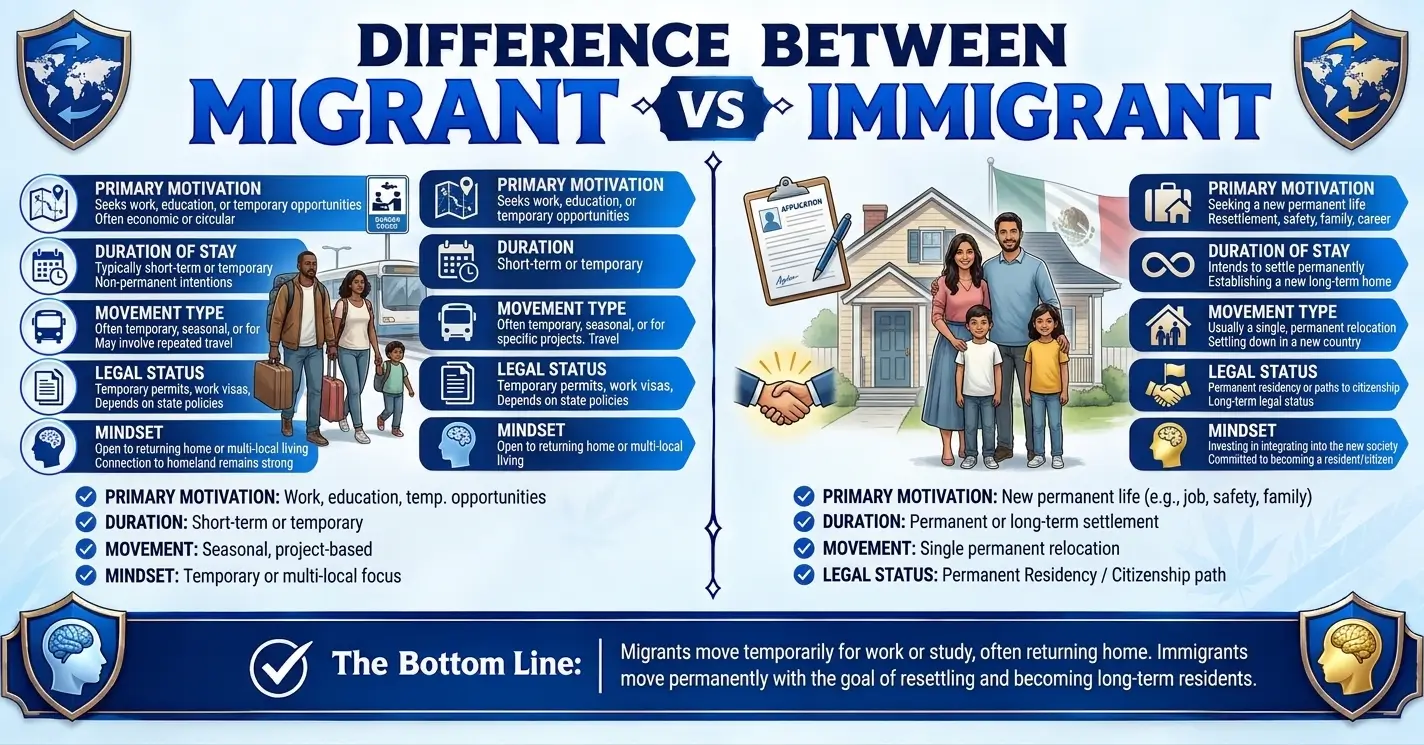
People often use migrant and immigrant as if they mean exactly the same thing, but there is an important difference in how the words are normally used. Migrant is the broader term for a person who moves from one place to another, while immigrant usually refers specifically to someone who moves to another country to live there, generally with long-term or permanent settlement in mind.
The distinction is not always as simple as “migrant means temporary and immigrant means permanent.” Migrant can include both temporary and permanent movement, and its meaning varies across ordinary English, statistics, institutions and legal contexts. Understanding that wider meaning makes it much easier to choose the right word.
Quick Answer
A migrant is a person who moves from one place to another, while an immigrant is a person who moves into another country to live there, usually on a long-term or permanent basis.
The key difference is scope and emphasis. Migrant focuses broadly on movement, whereas immigrant focuses on moving into another country and establishing a life there.
For example:
- A farm worker who travels to another region for the harvest may be a migrant worker.
- A person who moves from India to Canada intending to settle there may be an immigrant.
An immigrant can therefore also be described as a migrant in a broader sense, but migrant does not necessarily mean immigrant.
Migrant vs Immigrant at a Glance
| Migrant | Immigrant | |
|---|---|---|
| Basic meaning | A person who moves from one place to another | A person who moves to another country to live there |
| Scope | Broad | More specific |
| Can involve internal movement? | Yes | Normally refers to international movement |
| Can be temporary? | Yes | Usually associated with long-term or permanent residence |
| Main emphasis | Movement or relocation | Arrival and settlement in another country |
| Common expressions | migrant worker, seasonal migrant, international migrant | immigrant community, immigrant family, immigrant population |
| Related verb | migrate | immigrate |
The words overlap, but they are not always interchangeable.
What Does “Migrant” Mean?
A migrant is someone who moves from one place to another.
The word can describe movement within the same country or across an international border, and it can be used for different reasons, including work, family, education or other circumstances.
For example:
- Seasonal farm workers may be migrants because they move for temporary employment.
- Someone who moves from one city to another for work can be described as a migrant in an appropriate context.
- A person who moves from one country to another may also be called an international migrant.
The word is therefore broader than immigrant.
Common expressions include:
- migrant worker
- seasonal migrant
- economic migrant
- international migrant
- migrant population
- migrant community
One important point is that migrant does not universally mean “temporary.” Some definitions and contexts include people who move permanently as well as those who move temporarily.
What Does “Immigrant” Mean?
An immigrant is a person who comes to another country to live there, normally with the intention of establishing long-term or permanent residence.
For example:
Maria moved from Brazil to Portugal and plans to build her life there. She is an immigrant in Portugal.
The word focuses on the person’s relationship with the destination country.
Common expressions include:
- immigrant family
- immigrant community
- immigrant population
- immigrant workers
- new immigrants
- immigrant experience
The related verb is immigrate:
Her grandparents immigrated to the United States.
The noun is immigrant:
Her grandparents were immigrants.
What Is the Difference Between Migrant and Immigrant?
The simplest way to understand the difference is to think about breadth and destination.
1. “Migrant” is broader
Migrant can describe a person who moves from one place to another without necessarily saying that the move is permanent or international.
2. “Immigrant” is more specific
Immigrant normally describes someone who moves into another country to live there, particularly when the move is intended to be long-term.
3. The words emphasize different things
Migrant emphasizes movement.
Immigrant emphasizes arrival in another country and settlement.
4. “Migrant” does not automatically mean temporary
This is an important qualification. In everyday explanations, people sometimes say:
Migrant = temporary
Immigrant = permanent
That is a useful shortcut, but it is too absolute.
International organizations use broader definitions of migrant, and migration statistics can use specific time-based definitions. In other words, the exact classification can depend on the context.
When to Use “Migrant”
Use migrant when the main idea is that someone is moving or has moved from one place to another.
It is particularly natural when talking about:
- temporary work
- seasonal work
- movement between regions
- population movement
- migration generally
- people whose long-term settlement status is not the main point
Examples
Thousands of migrant workers travel to the region during harvest season.
The city has received many migrants from rural areas.
Seasonal migrants often return home after the harvest.
The study examines patterns of international migration.
In these examples, the emphasis is on movement rather than permanent settlement.
When to Use “Immigrant”
Use immigrant when you are talking about someone who has moved into another country to live there, particularly when the focus is on long-term settlement.
Examples
Her parents were immigrants who settled in Australia.
The city has a large immigrant population.
He became an immigrant after moving to Canada permanently.
The museum tells the stories of early immigrants to the region.
Here, the important fact is that the people moved to another country and established residence there.
Migrant and Immigrant in Sentences
Compare these examples:
Example 1
The company employs many migrant workers during the summer.
Why “migrant”?
The sentence focuses on workers who move for employment, and their work may be temporary or seasonal.
Example 2
Her family were immigrants who settled in Chicago.
Why “immigrants”?
The sentence focuses on people who moved into the United States and established a life there.
Example 3
Thousands of people migrate to the region every year for work.
Why “migrate”?
The sentence describes the process of movement.
Example 4
His grandparents immigrated to the United Kingdom in the 1950s.
Why “immigrated”?
The sentence describes moving into another country to live there.
Example 5
Some international migrants remain in their destination countries permanently.
Why “migrants”?
The broader term can still be appropriate even when the eventual stay is permanent.
Common Collocations With “Migrant” and “Immigrant”
Learning common word combinations makes the distinction easier to recognize.
Common collocations with “migrant”
- migrant worker
- migrant workers
- seasonal migrant
- migrant population
- migrant community
- international migrant
- economic migrant
- migrant labor
- migrant families
Common collocations with “immigrant”
- immigrant family
- immigrant community
- immigrant population
- immigrant workers
- immigrant children
- new immigrant
- immigrant experience
- immigrant background
- immigrant community
Notice that migrant worker is especially common when the person’s movement is connected with employment.
Common Mistakes With Migrant and Immigrant
Incorrect as an absolute rule:
A migrant is always someone who moves temporarily.
Better:
A migrant can be someone who moves temporarily or permanently, depending on the definition and context.
Why?
Migrant is a broad term. Some institutional definitions explicitly include both temporary and permanent movement.
Oversimplified:
Every migrant is an immigrant.
Better:
An immigrant is a more specific type of person who has moved to another country to live there.
Why?
Someone can migrate within their own country, or move temporarily for work, without being described as an immigrant.
Confusing migrant with emigrant:
She was an immigrant from France when she left France.
Better:
She was an emigrant from France and an immigrant in Canada.
Why?
The perspective changes the word:
- emigrant = someone viewed as leaving a country
- immigrant = someone viewed as entering another country
The same person can therefore be an emigrant from one country’s perspective and an immigrant from another’s.
Migrant vs Emigrant
These three words are closely related:
Migrant = a broad term for someone who moves.
Emigrant = someone who leaves their country to settle elsewhere.
Immigrant = someone who comes into another country to settle there.
A useful example is:
Ahmed left Pakistan to settle in Germany.
From Pakistan’s perspective, Ahmed is an emigrant.
From Germany’s perspective, Ahmed is an immigrant.
In the broader sense, Ahmed may also be described as a migrant.
The prefix can help:
- im- → think in
- e- → think exit/out
Migrant vs Refugee
Migrant and refugee should not automatically be treated as synonyms.
A refugee is a specific legal and protection category under international law. The term generally applies to people who are outside their country because of persecution, conflict or other circumstances that create a need for international protection.
Migrant is a broader term whose use varies by context and does not itself establish refugee status.
This distinction matters because calling someone a refugee or migrant can communicate different information about their circumstances and legal protection.
Can Migrant and Immigrant Be Used Interchangeably?
Sometimes, but not always.
In casual conversation, the words may overlap. A person who has moved from one country to another may reasonably be described as both a migrant and an immigrant in different contexts.
However, they do not communicate exactly the same information.
Use migrant when the broader fact of movement is important.
Use immigrant when the person’s move into another country and their settlement there are important.
For precise writing, choose the term that matches the context rather than automatically replacing one with the other.
How to Remember the Difference
Use this simple rule:
Migrant = movement.
Immigrant = moving in to another country.
You can also remember the related pair:
Emigrant = moves out.
Immigrant = moves in.
So:
migrate → movement
emigrate → move out
immigrate → move in
Which One Should I Use?
Use migrant if you mean:
“A person who moves from one place to another.”
Use immigrant if you mean:
“A person who has moved into another country to live there, usually long term.”
Use emigrant if you mean:
“A person viewed from the country they have left.”
For example:
A seasonal worker who travels to another region for three months → migrant
A person who moves permanently from Mexico to Canada → immigrant in Canada
That same person viewed from Mexico → emigrant from Mexico
The important point is that the words describe different aspects of movement.
Migrant or Immigrant? Practice Examples
Choose migrant or immigrant in each sentence.
- The company hires many ______ workers during harvest season.
- Her grandparents were ______ who settled in the United States.
- Thousands of people ______ to the city every year for work.
- The country has a large ______ population.
- Seasonal ______ usually return home after the harvest.
- His family ______ to Australia in the 1980s.
- The report examines international ______ and population movement.
- She became an ______ after moving to France permanently.
Answers
- migrant
- immigrants
- migrate
- immigrant or migrant, depending on the intended meaning
- migrants
- immigrated
- migration
- immigrant
The fourth example shows why context matters. If the sentence is about people who have settled in the country, immigrant population is natural. If it is discussing movement more generally, migrant population may be appropriate.
Frequently Asked Questions
What is the main difference between migrant and immigrant?
A migrant is a broad term for someone who moves from one place to another. An immigrant is someone who moves into another country to live there, usually on a long-term or permanent basis.
Is an immigrant a migrant?
In the broad sense, yes. An immigrant is someone who has moved, so the broader word migrant can apply. However, not every migrant is an immigrant.
Does migrant mean temporary?
Not necessarily. Temporary movement is a common use of the word, but migrant can also cover permanent movement depending on the definition and context.
Does immigrant always mean permanent?
Usually, in ordinary English, it implies long-term or permanent residence. However, exact classifications can differ between ordinary language, statistics and legal systems.
What is the difference between migrant and emigrant?
A migrant is a broad term for someone who moves. An emigrant is someone who leaves their country to settle elsewhere. The same person can be an emigrant from one country and an immigrant in another.
Are migrant and immigrant synonyms?
They can overlap, but they are not exact synonyms in every context. Migrant is broader, while immigrant more specifically focuses on moving into another country to live there.
What is the difference between migrant and refugee?
A migrant is a broad migration term. A refugee is a specific legal and protection category for people who meet the relevant international or national criteria.
Which word should I use in formal writing?
Use the word that accurately describes the situation. Migrant is appropriate when discussing movement broadly; immigrant is appropriate when discussing people who have moved into another country to live there.
Conclusion
The main difference between migrant and immigrant is their scope. Migrant is the broader term for a person who moves from one place to another, while immigrant normally refers to someone who moves into another country to live there, usually long term.
Remember the simplest rule: migrant focuses on movement; immigrant focuses on moving into another country. If you are talking about someone leaving their country, emigrant may be the more precise term. When the exact context matters, avoid treating “temporary migrant” and “permanent immigrant” as rigid definitions—the terminology can vary between everyday English, statistical systems and institutional contexts.