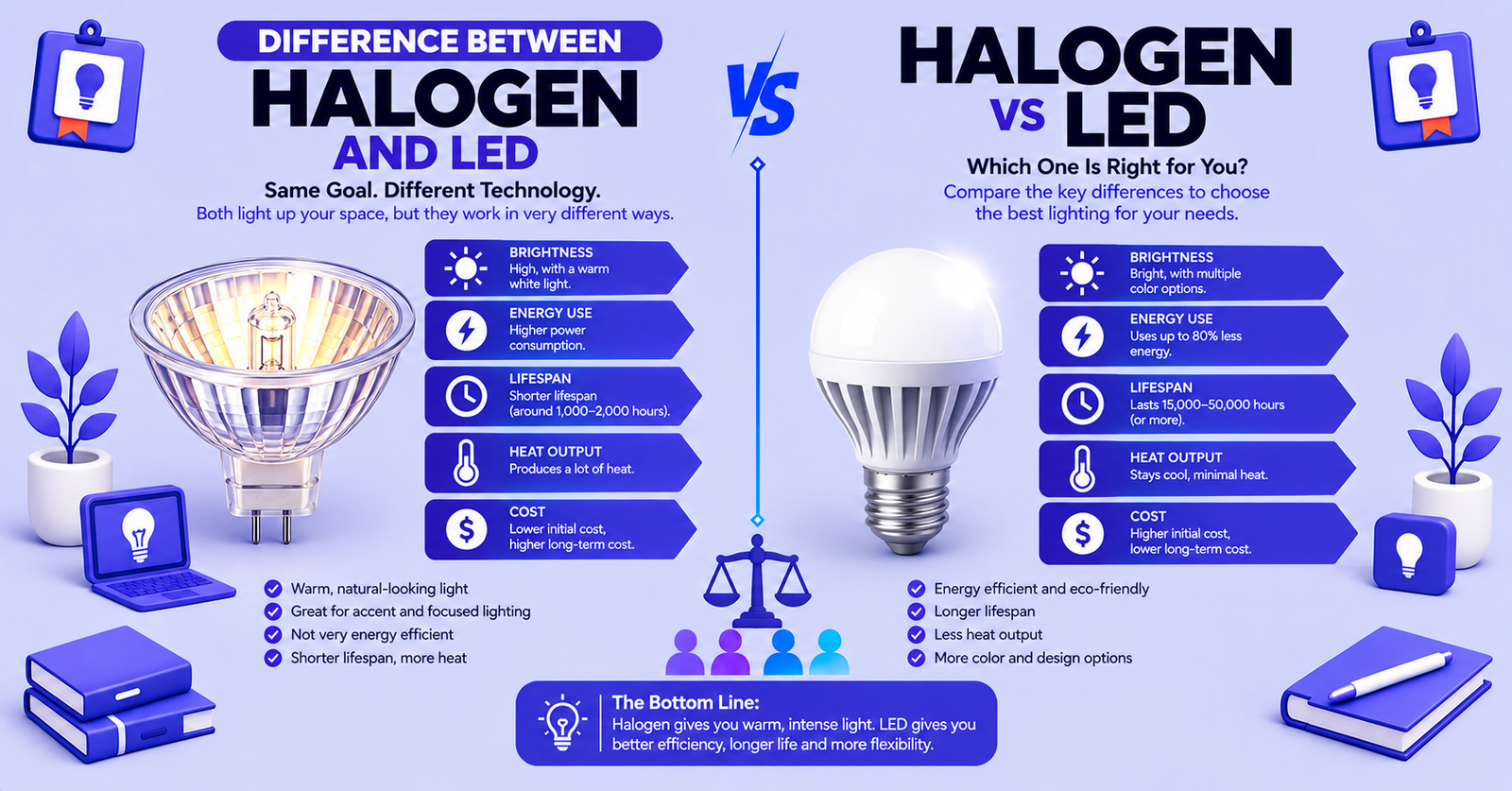

Halogen and LED are both widely used lighting technologies, but they produce light in very different ways. Halogen bulbs use a heated tungsten filament, while LEDs produce light through semiconductor technology. That difference affects energy consumption, heat, lifespan, light characteristics, and long-term cost.
For most everyday lighting applications, LED is more energy-efficient and lasts much longer than halogen. However, halogen can still make sense when you want a familiar warm light, a low initial purchase price, or compatibility with an existing fixture. For automotive headlights, the decision requires extra care because beam pattern and housing compatibility matter as much as brightness.
Quick Answer
The main difference between halogen and LED is how they produce light. A halogen bulb heats a tungsten filament until it glows, while an LED uses a semiconductor to generate light.
In practical terms, LEDs generally use much less electricity, produce less heat, and last much longer than halogen bulbs. The International Energy Agency estimates a typical halogen lamp at about 20 lumens per watt, compared with close to 100 lumens per watt for LEDs sold today.
Halogen may still be useful when upfront price, familiar warm light, or existing fixture compatibility is more important than maximum efficiency.
Halogen vs LED at a Glance
| Feature | Halogen | LED |
|---|---|---|
| How it produces light | Heats a tungsten filament | Uses a semiconductor |
| Energy efficiency | Lower | Much higher |
| Heat output | High | Generally much lower at the light source |
| Lifespan | Relatively short | Generally much longer |
| Upfront cost | Usually lower | Usually higher |
| Operating cost | Higher | Lower |
| Light appearance | Typically warm | Available in many color temperatures |
| Dimming | Usually straightforward | Depends on the LED and dimmer |
| Durability | More sensitive to filament damage | Generally more resistant to vibration |
| Best suited to | Low-cost, familiar lighting | Efficient everyday lighting |
What Is a Halogen Bulb?
A halogen bulb is a type of incandescent lamp. It contains a tungsten filament inside a glass capsule filled with an inert gas and a small amount of halogen gas, such as iodine or bromine. When electricity passes through the filament, it becomes extremely hot and produces visible light.
The halogen cycle helps return evaporated tungsten to the filament, allowing the lamp to operate at a higher temperature than a traditional incandescent bulb.
Halogen lighting is known for its:
- Warm appearance
- Familiar incandescent-like light
- Simple construction
- Relatively low purchase price
- Good compatibility with many traditional fixtures
- Straightforward dimming
Its major disadvantage is efficiency. A significant portion of the electrical energy used by a halogen lamp ends up as heat rather than visible light.
Example
A halogen spotlight can provide attractive, warm accent lighting, but it may consume substantially more electricity than an LED designed to provide a comparable amount of useful light.
What Is an LED?
LED stands for light-emitting diode.
Unlike a halogen lamp, an LED does not produce light by heating a filament. It uses a semiconductor device that emits light when electrical current passes through it.
LED lighting has become popular because it can produce substantial amounts of light using comparatively little electricity. The IEA identifies LEDs as one of the major efficiency improvements in modern lighting and reports that LEDs sold today average close to 100 lumens per watt, although performance varies between products.
LEDs are available in many forms, including:
- Standard household bulbs
- Downlights
- Spotlights
- Strip lighting
- Outdoor lighting
- Commercial fixtures
- Automotive lighting
They can also offer different color temperatures, dimming options, and smart-lighting features depending on the product.
What Is the Main Difference Between Halogen and LED?
The fundamental difference is the method used to create light.
A halogen lamp creates light by heating a tungsten filament until it glows. An LED creates light using a semiconductor.
That technological difference leads to several practical differences.
1. Energy Efficiency
This is one of the biggest differences.
Halogen lamps are much less efficient because their operation involves heating a filament. LEDs convert a much larger share of the electrical input into useful light.
The IEA estimates approximately 20 lumens per watt for a typical halogen lamp compared with close to 100 lumens per watt for LEDs sold today. Actual efficiency varies by lamp design.
So, if two lamps provide a similar amount of useful light, the LED generally requires considerably less electricity.
Winner for efficiency: LED
2. Lifespan
LEDs generally have a substantially longer useful life than halogen bulbs.
A halogen filament gradually deteriorates as it operates. Eventually, the filament fails.
LED products do not have a traditional tungsten filament, so they can operate for much longer. Their useful life can still depend on temperature, electronics, construction quality, and operating conditions.
Winner for lifespan: LED
3. Heat Output
Halogen bulbs become extremely hot during operation because their light comes from a heated filament.
LEDs generally produce much less heat at the light-producing source, although the electronics inside an LED product still generate heat and often require thermal management.
This difference can matter in enclosed fixtures, display lighting, cabinets, and other areas where excessive heat is undesirable.
Winner for lower heat: LED
4. Light Appearance
Halogen lighting is associated with a warm, incandescent-like appearance.
LEDs are more flexible. Depending on the product, they can produce warm white, neutral white, cool white, or daylight-like light.
This means LED does not automatically mean “cold blue light.” Warm-white LEDs can closely suit spaces where people prefer a traditional warm atmosphere.
Winner for flexibility: LED
5. Initial Cost
Halogen bulbs are often cheaper to purchase initially.
LED bulbs can cost more upfront, although the price difference varies by product and market.
The important distinction is between purchase price and total cost of ownership. An inexpensive halogen bulb can require more electricity and more frequent replacement over its useful life.
Winner for lowest upfront price: often halogen
Winner for long-term operating efficiency: LED
When to Use Halogen
Halogen can still be a sensible choice when:
- You want a warm, familiar light
- The initial bulb price is your main concern
- Your existing fixture is designed for halogen
- You want straightforward traditional dimming
- You are replacing an existing halogen bulb and do not need an upgrade
- A particular application specifically benefits from halogen’s optical or lighting characteristics
Halogen is not automatically the wrong choice simply because LED technology is more efficient.
For example, the U.S. Department of Energy notes that incandescent/halogen-like dimming is valued in settings where light becomes warmer as it is dimmed.
When to Use LED
LED is usually the better choice when you want:
- Lower electricity consumption
- Longer service life
- Less heat
- Lower ongoing operating costs
- More choices in color temperature
- Modern lighting controls
- Smart-lighting compatibility
- Frequent or long-duration use
For general household and commercial lighting, the efficiency advantage makes LED the practical choice in many situations.
Can LED Replace Halogen?
Often, yes—but not automatically.
An LED replacement must be compatible with the existing fixture, socket, voltage, driver, dimmer, and physical space.
A common mistake is assuming that an LED bulb can simply be installed anywhere a halogen bulb was installed.
Before replacing a halogen lamp, check:
- The bulb base and physical dimensions
- Voltage requirements
- Fixture compatibility
- Dimmer compatibility
- Enclosure requirements
- Required light output
- Color temperature
- Manufacturer instructions
For some integrated LED fixtures, there is no conventional “bulb” to replace at all because the LED system is built directly into the luminaire.
Halogen vs LED for Car Headlights
Automotive headlights require a separate consideration.
An LED headlight system can offer advantages such as efficient operation, long service life, and a different light appearance. However, simply putting an LED replacement bulb into a housing designed around a halogen filament does not guarantee better road illumination.
Headlight housings are designed around the location and shape of the original light source. Reflectors, projectors, optics, beam patterns, and cutoff characteristics all affect where the light goes.
Some LED retrofit bulbs can therefore appear very bright while producing an unsuitable beam pattern or excessive glare.
Automotive comparisons in the current SERP specifically emphasize that beam focus and housing design can be more important than headline lumen numbers.
Practical rule for headlights
Do not choose an automotive LED replacement based only on advertised brightness.
Check whether the LED system is designed and approved for your specific vehicle and headlight assembly, and make sure the resulting beam pattern is appropriate.
Common Collocations With Halogen and LED
Natural phrases you may encounter include:
Halogen
- halogen bulb
- halogen lamp
- halogen light
- halogen spotlight
- halogen headlight
- halogen lighting
- halogen replacement
LED
- LED bulb
- LED lamp
- LED light
- LED lighting
- LED spotlight
- LED headlight
- LED fixture
- LED replacement
These phrases describe the technology, product type, or application rather than interchangeable terminology.
Common Mistakes With Halogen and LED
Mistake 1: Assuming watts measure brightness
Incorrect idea:
A 60-watt bulb must be brighter than a 10-watt LED.
Correct idea:
Compare lumens when evaluating light output and watts when evaluating electrical consumption.
A lower-wattage LED can produce comparable or greater useful light than a much higher-wattage halogen lamp.
Mistake 2: Assuming every LED is automatically brighter
Incorrect idea:
LED always means more usable light.
Correct idea:
LED technology can be highly efficient, but actual light output and distribution depend on the specific product.
For headlights especially, beam pattern matters.
Mistake 3: Assuming LED always produces cold white light
Incorrect idea:
All LEDs are blue or harsh white.
Correct idea:
LEDs are available in multiple color temperatures, including warm-white options.
Mistake 4: Treating every halogen-to-LED replacement as plug-and-play
Incorrect idea:
If the base fits, the LED replacement will work perfectly.
Correct idea:
Check electrical, physical, dimming, thermal, and optical compatibility.
Halogen vs LED: Which Is More Energy Efficient?
LED is more energy-efficient.
The IEA currently estimates a typical halogen lamp at roughly 20 lm/W, while LEDs sold today average close to 100 lm/W.
This means LEDs can deliver similar useful light with substantially less electrical input.
The exact saving depends on the particular bulbs being compared, how long they operate, and the amount of light required.
Which Lasts Longer: Halogen or LED?
LED generally lasts much longer than halogen.
Halogen lamps rely on a physical tungsten filament that eventually fails. LEDs have no equivalent filament, allowing properly designed products to operate for much longer.
However, an LED’s useful life can be affected by heat, driver electronics, construction quality, and operating conditions.
Are Halogen and LED the Same?
No.
They are both lighting technologies, but their operating principles are fundamentally different.
Halogen is a type of incandescent lighting that uses a tungsten filament and halogen gas. LED lighting uses semiconductor technology.
Can Halogen and LED Be Used Interchangeably?
Not always.
Some halogen bulbs can be replaced with compatible LED bulbs, but the replacement must match the requirements of the fixture.
Automotive applications require even more caution because the bulb is part of a larger optical system.
How to Remember the Difference
Use this simple rule:
Halogen = heats a filament.
LED = semiconductor light.
If you remember that halogen creates light through heat while LED creates light through semiconductor technology, most of the practical differences become easier to understand.
Which One Should I Use?
Use this quick decision guide:
If you want lower electricity use → choose LED.
If you want a longer-lasting light source → choose LED.
If you want lower heat → choose LED.
If you want more color-temperature choices → choose LED.
If the lowest initial bulb price matters most → halogen may be preferable.
If you prefer traditional warm, incandescent-like lighting → halogen may still appeal to you.
If replacing a halogen bulb → first confirm that the LED replacement is compatible.
If replacing a car headlight → check the complete headlight system, not just the bulb.
For most everyday general-lighting applications, LED is the stronger overall choice, particularly when energy consumption and long-term use matter.
Halogen or LED? Practice Examples
Choose the more appropriate option for each situation.
- You want to reduce electricity use from household lighting. Halogen or LED?
- You want a bulb that generally lasts much longer. Halogen or LED?
- You want a traditional warm light and already have a compatible halogen fixture. Halogen or LED?
- You want several color-temperature choices. Halogen or LED?
- You want to replace a car’s halogen headlight with an LED bulb. What should you check first?
- You are comparing brightness. Should you compare watts or lumens?
- You want to reduce heat from a frequently used household light. Halogen or LED?
Answers
- LED — it is substantially more energy-efficient.
- LED — LEDs generally have much longer useful lives.
- Halogen can be appropriate — particularly if warm light and existing compatibility matter.
- LED — LEDs are available in a broad range of color temperatures.
- Vehicle and headlight compatibility, including beam pattern and optical design — not just advertised brightness.
- Lumens — lumens describe light output; watts describe electrical power consumption.
- LED — it generally produces much less heat at the light-producing source than halogen.
Frequently Asked Questions
What is the difference between halogen and LED?
Halogen bulbs use a heated tungsten filament, while LEDs use semiconductor technology to produce light. As a result, LEDs are generally much more energy-efficient, produce less heat, and last considerably longer.
Is LED better than halogen?
For most everyday general-lighting applications, LED is generally the better choice because of its efficiency, lifespan, and lower operating cost. Halogen can still be useful where low upfront cost, warm light, or existing fixture compatibility is important.
Which uses less electricity, halogen or LED?
LED uses less electricity for a comparable amount of useful light. The IEA estimates a typical halogen lamp at about 20 lm/W versus close to 100 lm/W for LEDs sold today.
Which produces more heat, halogen or LED?
Halogen generally produces substantially more heat. Its light comes from a very hot tungsten filament, whereas an LED produces light through semiconductor technology.
Can I replace a halogen bulb with an LED?
Sometimes. The LED replacement must be compatible with the socket, voltage, fixture, dimmer, thermal requirements, and intended application. Automotive replacements require additional attention to beam pattern and headlight housing.
Are halogen and LED headlights the same?
No. They use different light-producing technologies, and the complete headlight system is designed around the light source. An LED retrofit is not necessarily an improvement if it produces a poor beam pattern or excessive glare.
Which is cheaper in the long run, halogen or LED?
LED is generally cheaper to operate over time because it uses less electricity and normally requires fewer replacements. However, the total cost depends on purchase price, usage hours, electricity rates, and product life.
Conclusion
The key difference between halogen and LED is how they create light: halogen heats a tungsten filament, while LED uses semiconductor technology. That difference makes LED generally more efficient, longer-lasting, and cooler-running than halogen.

Sajid Ali is an English language educator and content specialist with 7+ years of teaching experience. He holds master’s degrees in Information Technology and Education from the Virtual University of Pakistan and writes SEO-optimized, learner-friendly vocabulary content for diffari.com.