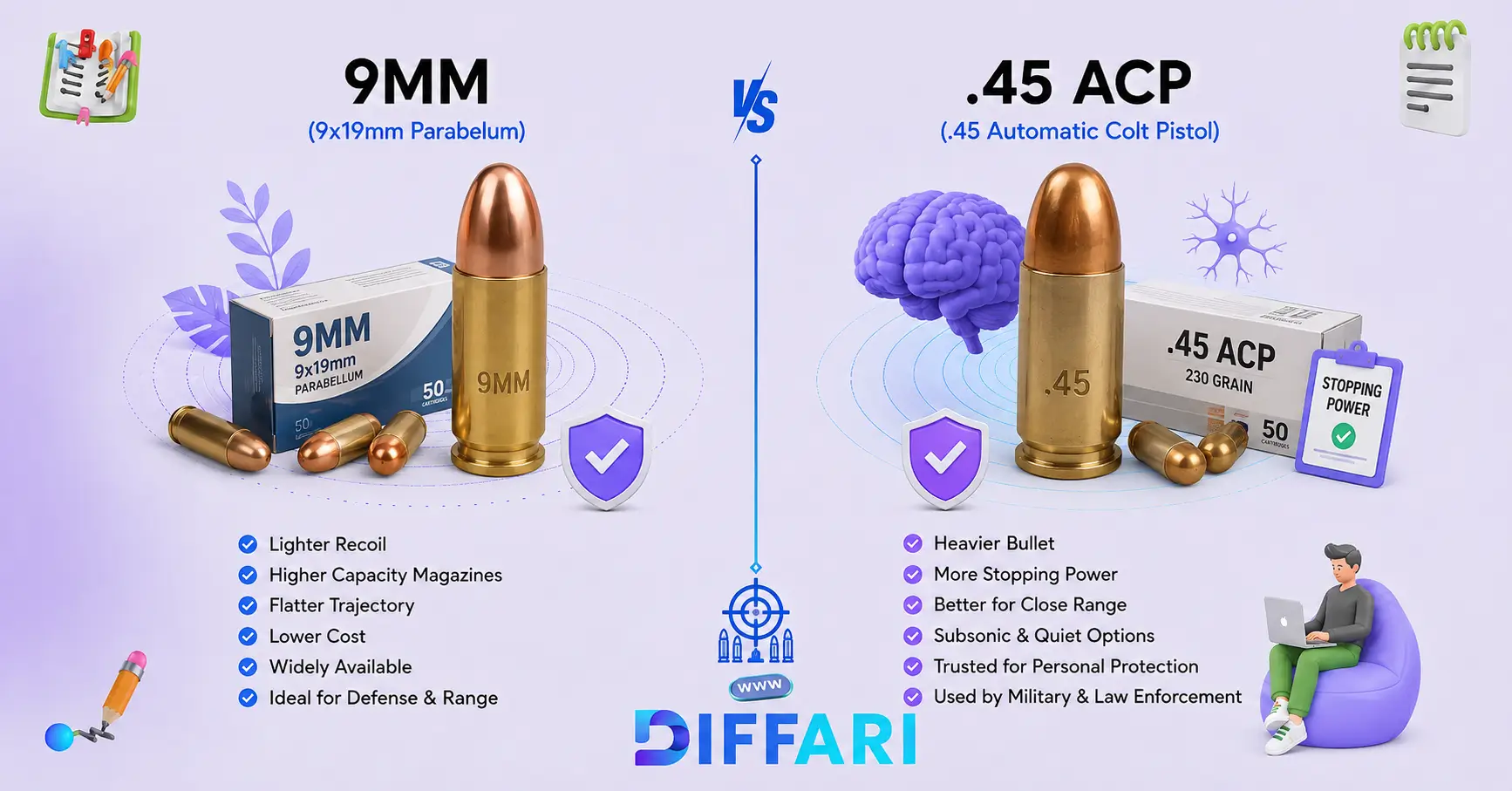

The difference between 9mm and .45 ACP comes down to more than bullet diameter. They are two distinct handgun cartridges with different projectile sizes, typical bullet weights, velocities, recoil characteristics, and common firearm configurations. The 9mm, also called 9×19mm or 9mm Luger, uses a smaller-diameter projectile, while .45 ACP uses a substantially larger projectile.
Both cartridges have a long history and remain widely recognized. However, comparing them requires looking at several factors rather than assuming that one is automatically better. The firearm, ammunition load, and intended application can all affect the practical differences between them.
Quick Answer
9mm and .45 ACP are different handgun cartridges. 9mm has a smaller bullet diameter and generally uses lighter, faster projectiles, while .45 ACP uses a larger, heavier projectile at generally lower velocities. 9mm firearms also commonly offer greater magazine capacity and lower felt recoil than comparable .45 ACP firearms.
In simple terms:
9mm = smaller, lighter, generally faster projectile with lower recoil and higher typical capacity.
.45 ACP = larger, heavier projectile with generally lower velocity and greater recoil.
The exact characteristics depend on the particular ammunition and firearm.
9mm vs .45 ACP at a Glance
| Feature | 9mm | .45 ACP |
| Full designation | 9×19mm | .45 ACP |
| Other names | 9mm Luger, 9mm Parabellum | .45 Auto |
| Bullet diameter | About .355 in / 9.01 mm | About .452 in / 11.5 mm |
| Typical bullet weight | Roughly 115–147 grains | Commonly 185–230 grains |
| Typical velocity | Generally higher | Generally lower |
| Felt recoil | Generally lower | Generally higher |
| Typical magazine capacity | Generally higher | Generally lower |
| Introduced | 1902 | 1905 |
Published specifications vary according to ammunition load. Outdoor Life, for example, lists 9mm bullet diameters at 9.01 mm and .45 ACP at 11.5 mm, while reporting substantially different typical projectile weights and velocity ranges.
What Is 9mm?
9mm usually refers to the 9×19mm cartridge, also known as 9mm Luger or 9mm Parabellum.
It was developed at the beginning of the 20th century and became one of the world’s most widely used handgun cartridges. Its relatively small projectile diameter allows firearms chambered for it to commonly accommodate more cartridges than comparable firearms chambered for larger-diameter cartridges.
Modern 9mm ammunition is available in a wide variety of loads, so velocity, bullet weight, pressure, and performance can vary considerably.
What Is .45 ACP?
.45 ACP stands for .45 Automatic Colt Pistol. It is also commonly called .45 Auto.
The cartridge was developed in the early 20th century and became particularly associated with the Colt M1911 and U.S. military service. Its projectile is considerably wider than a 9mm projectile.
Typical .45 ACP loads use heavier bullets and lower velocities than many 9mm loads. Outdoor Life lists common .45 ACP bullet masses around 185–230 grains, compared with approximately 115–124 grains for many 9mm loads.
What Is the Difference Between 9mm and .45 ACP?
The most obvious difference is projectile diameter.
A typical 9mm projectile has a diameter of approximately .355 inches, whereas .45 ACP is approximately .452 inches. That makes the .45 ACP projectile substantially wider.
But diameter is only one part of the comparison.
1. Bullet Size
9mm uses the smaller projectile.
.45 ACP uses a larger projectile.
This difference affects cartridge dimensions, firearm design, ammunition weight, and other characteristics.
2. Bullet Weight
9mm commonly uses lighter projectiles.
.45 ACP commonly uses heavier projectiles.
For example, published comparison data commonly places 9mm loads around 115–147 grains and .45 ACP loads around 185–230 grains, although ammunition is available outside these ranges.
3. Velocity
9mm generally launches its lighter projectile at a higher velocity.
.45 ACP generally uses a heavier projectile moving at a lower velocity.
This is an important reason why simply comparing bullet weight or diameter does not provide a complete picture of cartridge performance.
4. Recoil
In comparable handgun configurations, 9mm generally produces less felt recoil than .45 ACP.
A controlled test published by Shooting Illustrated found that the 9mm setups in its testing produced faster split times than the comparable .45 ACP setups. However, recoil varies with firearm weight, ammunition, projectile weight, and other factors, so the result should not be treated as a universal number for every firearm.
5. Magazine Capacity
Because 9mm uses a smaller-diameter cartridge, firearms chambered for it can often accommodate more cartridges in a magazine than comparable .45 ACP firearms.
This is a characteristic of firearm design rather than an absolute rule. Different handgun models can have very different capacities.
9mm and .45 ACP in Real-World Context
The historical popularity of the two cartridges is also quite different.
The 9mm became particularly prominent internationally and was adopted by numerous military and law-enforcement organizations. The .45 ACP became strongly associated with American military handguns, particularly the M1911.
Today, both remain established cartridges.
The modern comparison is also more complicated than older discussions suggest because ammunition technology has changed considerably. Shooting Illustrated notes that modern 9mm loads can provide terminal performance comparable with many .45 ACP loads, while the .45 ACP continues to offer characteristics associated with its larger projectile.
Are 9mm and .45 ACP Interchangeable?
No.
9mm and .45 ACP are different cartridges and are designed for firearms chambered specifically for those cartridges.
A firearm chambered for 9mm should not be treated as though it can accept .45 ACP ammunition, and vice versa.
The cartridge designation marked on a firearm and its manufacturer’s specifications should always be followed.
Common Misconceptions About 9mm vs .45 ACP
Misconception 1: “45” and “9mm” are just two names for the same ammunition.
They are not.
They have different dimensions, projectile diameters, bullet weights, and pressure characteristics.
Misconception 2: The larger bullet automatically makes .45 ACP better in every situation.
A larger projectile is an important physical difference, but it does not by itself determine overall performance.
Firearm design, ammunition, recoil, controllability, capacity, and other factors also matter.
Misconception 3: Every 9mm has identical performance.
It does not.
Different ammunition loads can have substantially different bullet weights, velocities, and pressures.
Misconception 4: Every .45 ACP has identical recoil.
It does not.
Recoil depends on factors including firearm weight, ammunition characteristics, projectile weight, and firearm design.
Common Comparisons
| If you’re comparing… | The key distinction is… |
| 9mm vs .45 bullet diameter | .45 ACP is wider |
| 9mm vs .45 bullet weight | .45 ACP commonly uses heavier bullets |
| 9mm vs .45 velocity | 9mm is generally faster |
| 9mm vs .45 recoil | 9mm generally has less felt recoil |
| 9mm vs .45 capacity | 9mm firearms commonly hold more |
| 9mm vs .45 terminology | Both are distinct cartridge families |
Which One Should I Use?
There is no scientifically responsible one-line answer that makes one cartridge universally superior.
If the comparison is purely about the general characteristics of the cartridges, 9mm is typically associated with:
- smaller projectiles
- lighter common bullet weights
- higher typical velocity
- lower felt recoil
- greater typical magazine capacity
Meanwhile, .45 ACP is typically associated with:
- larger projectiles
- heavier common bullet weights
- lower typical velocity
- greater felt recoil
- lower typical magazine capacity
The appropriate comparison depends on the specific firearm, ammunition, and purpose being considered.
9mm or .45 ACP? Practice Examples
1. Which cartridge has the larger projectile diameter?
Answer: .45 ACP
2. Which cartridge is commonly associated with lighter bullets?
Answer: 9mm
3. Which generally has higher projectile velocity?
Answer: 9mm
4. Which generally produces more felt recoil in comparable handgun configurations?
Answer: .45 ACP
5. Are 9mm and .45 ACP interchangeable?
Answer: No.
6. Which commonly allows greater magazine capacity?
Answer: 9mm
7. Is .45 ACP another name for 9mm?
Answer: No.
8. What does ACP stand for?
Answer: Automatic Colt Pistol.
Frequently Asked Questions
What is the main difference between 9mm and .45 ACP?
The most obvious difference is projectile diameter. 9mm uses a smaller projectile, while .45 ACP uses a substantially larger one. They also differ in typical bullet weight, velocity, recoil, and firearm capacity.
Is 9mm the same as .45 ACP?
No. They are separate handgun cartridges with different dimensions and specifications.
Is .45 ACP bigger than 9mm?
Yes. A typical .45 ACP projectile is approximately .452 inches in diameter, compared with approximately .355 inches for a 9mm projectile.
Does 9mm have less recoil than .45 ACP?
Generally, yes, when comparing reasonably similar handgun configurations. Actual felt recoil depends on the firearm and ammunition. A controlled comparison published by Shooting Illustrated found faster split times with the 9mm setups used in its test.
Does .45 ACP have a heavier bullet?
Generally, yes. Common .45 ACP loads use heavier bullets than many common 9mm loads.
Are 9mm and .45 ACP interchangeable?
No. They are different cartridges and must only be used in firearms specifically chambered for the applicable cartridge.
Which is more powerful, 9mm or .45 ACP?
There is no single answer based solely on caliber. Cartridge performance varies substantially with the ammunition load and firearm. Modern 9mm loads can perform similarly to many .45 ACP loads in relevant testing, so simplistic “more powerful” claims can be misleading.
Conclusion
The difference between 9mm and .45 ACP is primarily a difference in cartridge design and characteristics. 9mm uses a smaller, generally lighter projectile at higher typical velocity, while .45 ACP uses a larger, generally heavier projectile at lower typical velocity. 9mm also generally offers lower felt recoil and greater magazine capacity in comparable handgun configurations, while .45 ACP is known for its larger projectile and long history of service.

Sajid Ali is an English language educator and content specialist with 7+ years of teaching experience. He holds master’s degrees in Information Technology and Education from the Virtual University of Pakistan and writes SEO-optimized, learner-friendly vocabulary content for diffari.com.