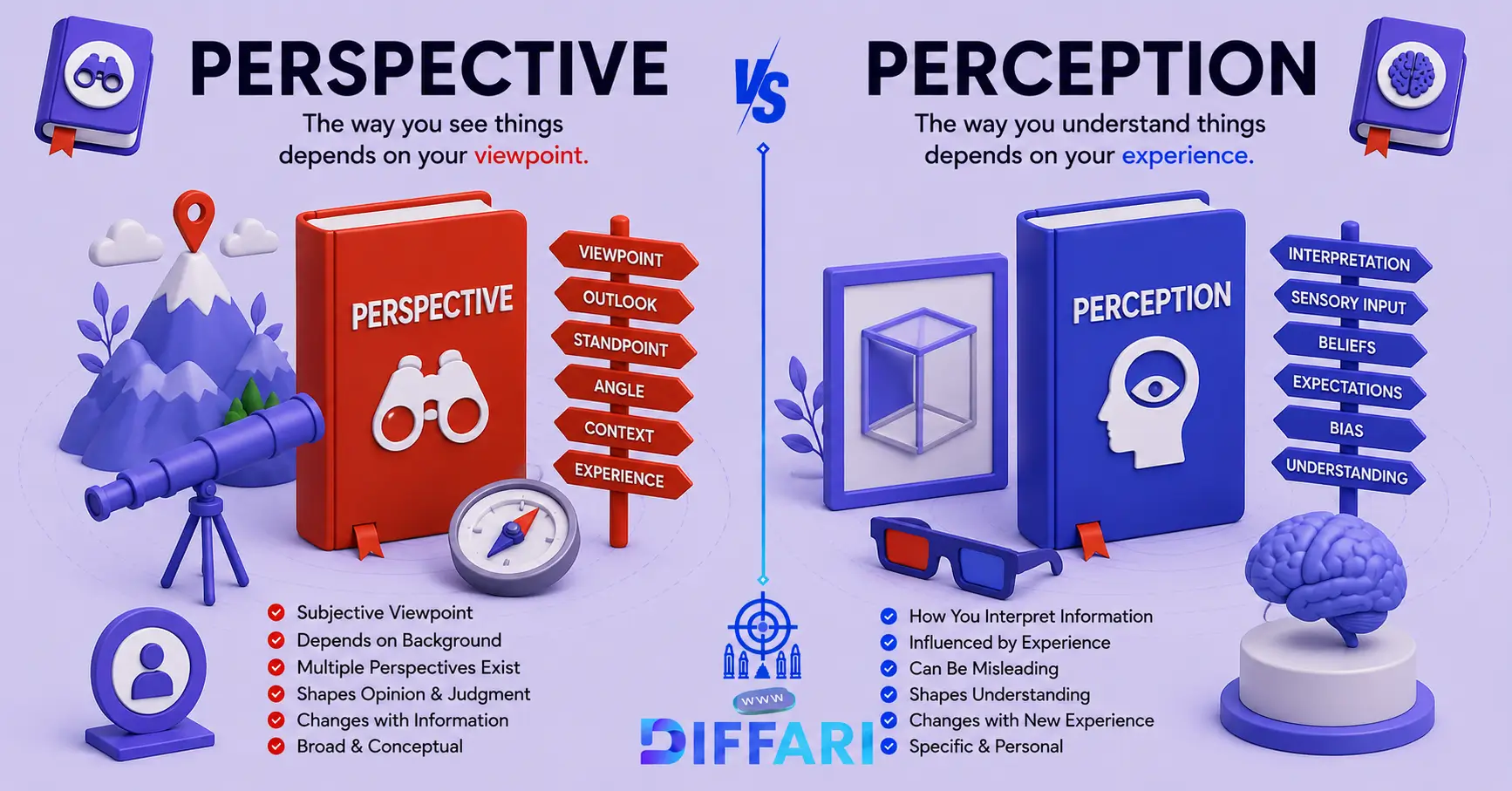
When two people experience the same situation, they may come away with very different understandings of it. That is where perspective and perception can become confusing. Both words describe ways people relate to or understand the world, but they are not exact synonyms.
Perspective usually refers to a particular viewpoint, standpoint, or way of considering something. Perception can refer to awareness through the senses, but it can also mean the way something is understood, interpreted, or regarded.
The easiest distinction is this: perspective is the viewpoint or framework you bring to something, while perception is what you notice, understand, or make of it.
Quick Answer
Perspective is a particular point of view or way of considering a subject, situation, or event.
Perception is awareness or understanding of something, including how it appears to you or the belief you form about it.
For example:
From my perspective, the project was a valuable learning experience.
My perception was that the manager was unhappy with the results.
In simple terms:
Perspective = the viewpoint or frame.
Perception = what you notice, understand, or believe about something.
Perspective vs Perception at a Glance
| Feature | Perspective | Perception |
| Basic meaning | A viewpoint or way of considering something | Awareness, understanding, or interpretation of something |
| Main idea | How you approach or view a subject | How something is noticed or understood |
| Often influenced by | Experience, beliefs, knowledge, position, context | Senses, attention, experience, expectations, and interpretation |
| Common use | Opinions, viewpoints, approaches, contexts | Impressions, awareness, beliefs, and sensory experience |
| Example | “From her perspective, the decision was reasonable.” | “His perception was that the decision was unfair.” |
| Can refer to senses? | Sometimes, especially in visual contexts | Yes |
| Can mean a viewpoint? | Yes | Sometimes, particularly as a belief or public opinion |
The distinction is not absolute because both words have broader meanings. Merriam-Webster, for example, defines perspective in terms of mental view, point of view, and the way a subject is mentally considered, while perception includes awareness through physical sensation and interpretation.
What Does Perspective Mean?
Perspective is a particular way of viewing, considering, or understanding something.
It can describe a person’s viewpoint:
From a parent’s perspective, safety comes first.
It can also describe a broader framework:
The issue looks different from an economic perspective.
Merriam-Webster includes meanings such as a mental view, point of view, and the relationship in which a subject is mentally viewed. It also uses perspective in visual and artistic contexts.
Common contexts for perspective
You commonly use perspective when discussing:
- opinions
- viewpoints
- attitudes
- approaches
- different ways of considering an issue
- professional or cultural viewpoints
- historical viewpoints
- visual viewpoints
Examples
She offered a different perspective on the problem.
Try to look at the situation from his perspective.
The book gives readers a historical perspective on the conflict.
From a business perspective, the decision makes sense.
The word can also have a visual meaning related to how objects appear according to their distance and position.
What Does Perception Mean?
Perception has several related meanings.
It can mean awareness through the senses:
Loud music can affect your perception of other sounds.
It can also mean the way something is understood, regarded, or believed to be the case:
The company’s public perception has improved.
Cambridge specifically lists both the sensory meaning and the meaning of a belief or opinion based on how something seems.
Common contexts for perception
You commonly use perception when discussing:
- awareness
- sensory experience
- impressions
- interpretation
- beliefs
- public opinion
- how someone or something is regarded
Examples
Her perception of the situation changed after she learned the facts.
The advertisement influenced consumers’ perception of the brand.
His perception of the color changed under different lighting.
Public perception can affect a company’s reputation.
What Is the Difference Between Perspective and Perception?
The central difference is what each word emphasizes.
Perspective emphasizes the viewpoint or framework from which something is considered.
Perception emphasizes the awareness, impression, understanding, or belief formed about something.
Consider this example:
Two employees attend the same meeting.
Their perception might concern what they noticed or understood during the meeting:
Maria perceived the manager’s comments as criticism.
Their perspectives might reflect their different viewpoints:
From Maria’s perspective, the manager was being overly critical.
From James’s perspective, the manager was simply offering useful feedback.
So, perception is often concerned with how something is perceived, while perspective is concerned with the standpoint from which it is viewed or considered.
However, the two concepts overlap. Your experiences and beliefs can influence both your perceptions and your perspectives.
How Perspective and Perception Work Together
Perspective and perception are related rather than completely separate.
Imagine that a friend does not reply to your message.
Your perception might be:
“She is ignoring me.”
Your perspective might be:
“People sometimes need space, so I should not assume anything.”
The same situation has produced a perception about what happened and a perspective through which you consider its meaning.
This is why saying that perception is always the first step and perspective is always the second would be too rigid. Real-world language does not require such a fixed sequence.
When to Use Perspective
Use perspective when you are talking about a viewpoint, standpoint, outlook, or way of considering something.
Use “perspective” for viewpoints
From my perspective, the plan is practical.
Use “perspective” for different approaches
The issue needs to be examined from a scientific perspective.
Use “perspective” for someone’s outlook
Traveling gave her a broader perspective on life.
Use “perspective” when comparing viewpoints
We have different perspectives on how the company should grow.
A useful test is:
Can I replace the word with “point of view” or “viewpoint”?
If yes, perspective is often the better choice.
When to Use Perception
Use perception when you mean awareness, sensory experience, impression, interpretation, or belief about something.
Use “perception” for an impression
My perception of him changed after our conversation.
Use “perception” for public opinion
The campaign changed public perception of the brand.
Use “perception” for sensory awareness
Darkness can affect your perception of distance.
Use “perception” for an interpretation
Her perception was that the meeting had gone badly.
A useful test is:
Am I talking about how something is noticed, experienced, interpreted, or regarded?
If yes, perception may be the appropriate word.
Perspective and Perception in Real Sentences
Perspective
From a teacher’s perspective, regular practice is essential.
The word refers to the teacher’s viewpoint.
Perception
The student’s perception was that the assignment was too difficult.
The word refers to how the student understood or regarded the assignment.
Both together
His perspective changed after his perception of the situation became clearer.
Here, perspective describes his broader viewpoint, while perception describes his understanding of the situation.
Another example
The photographer changed his perspective by moving closer to the subject.
This is about physical viewpoint.
The unusual lighting changed her perception of the room.
This is about how the room appeared or was experienced.
Common Collocations With Perspective and Perception
Common collocations with perspective
- different perspective
- broader perspective
- personal perspective
- new perspective
- alternative perspective
- historical perspective
- global perspective
- professional perspective
- from my perspective
- from a different perspective
- gain perspective
- put something into perspective
Cambridge and Merriam-Webster both show common uses involving different or broader ways of viewing a subject.
Common collocations with perception
- public perception
- personal perception
- common perception
- popular perception
- visual perception
- sensory perception
- perception of reality
- perception of risk
- change perception
- shape perception
- affect perception
Cambridge examples include expressions such as public perception and perceptions of war, demonstrating how frequently the word refers to beliefs or opinions about something.
Common Mistakes With Perspective and Perception
Mistake 1: Treating perception as only sensory
Incorrect assumption:
Perception only means what your senses detect.
Better understanding:
Perception can refer to sensory awareness, but it can also mean a belief, opinion, or understanding based on how something seems.
Mistake 2: Treating perspective and perception as exact synonyms
Less precise:
My perspective of the company is that its reputation is declining.
This is possible in some contexts, but perception may be more natural when you mean the impression or belief you have about the company:
My perception of the company is that its reputation is declining.
Mistake 3: Assuming perspective always means opinion
Perspective is broader than simply having an opinion. It can describe a standpoint, framework, or way of considering a subject.
From a historical perspective, the event had long-term consequences.
This is more about the analytical viewpoint than a personal opinion.
Pronunciation
The two words are pronounced differently.
Perspective
/pərˈspek.tɪv/
The main stress falls on SPEK.
Perception
/pərˈsep.ʃən/
The main stress falls on CEP.
They are therefore not homophones and should not be pronounced alike.
Are Perspective and Perception Interchangeable?
Usually not.
They overlap when discussing how people understand or interpret situations, but replacing one with the other can change the meaning.
Compare:
From my perspective, the policy is necessary.
This emphasizes the speaker’s viewpoint.
My perception is that the policy is necessary.
This emphasizes the speaker’s understanding or belief about the policy.
Both can be grammatical, but they focus on different aspects.
A useful distinction is:
Perspective asks:
From what viewpoint am I considering this?
Perception asks:
How do I notice, experience, understand, or regard this?
How to Remember the Difference
Think of perspective as the position and perception as the impression.
Perspective = viewpoint
Imagine standing at a particular place and looking at a scene. Your position gives you a particular viewpoint.
Perception = what you make of what you experience
Your senses, attention, experience, and interpretation influence what you perceive.
So remember:
Perspective = where/how you view something.
Perception = how you experience or understand something.
This is a practical shortcut, not an absolute linguistic rule.
Which One Should I Use?
Use perspective when you mean:
“a viewpoint, standpoint, or way of considering something.”
From my perspective, the decision was fair.
Use perception when you mean:
“an awareness, impression, understanding, or belief about something.”
Her perception of the situation was different.
Quick Decision Guide
Perception is also the better choice when referring to public opinion about a person, brand, or issue.
Perspective is the right choice when you mean a viewpoint or point of view.
Perception fits when you are talking about an impression or understanding of something.
For awareness gained through the senses, use perception.
When you mean a particular standpoint, perspective is more appropriate.
X or Y? Practice Examples
Choose perspective or perception.
- From my ___, the project needs more time.
- Public ___ of the company has improved.
- The darkness affected his ___ of distance.
- She offered a completely different ___ on the issue.
- His ___ of the event changed after he heard the full story.
- We need to examine the problem from a historical ___.
- The advertisement was designed to influence consumer ___.
- Traveling gave him a broader ___ on the world.
Answers
- perspective
- perception
- perception
- perspective
- perception
- perspective
- perception
- perspective
Frequently Asked Questions
What is the main difference between perspective and perception?
Perspective is a viewpoint or way of considering something, while perception is awareness, understanding, interpretation, or a belief about something.
Are perspective and perception the same?
No. They are related but not identical. Perspective focuses more on a viewpoint or framework, while perception focuses more on how something is noticed, experienced, understood, or regarded.
Can perception mean opinion?
Yes. Perception can mean a belief or opinion, especially one based on how something appears or is regarded. For example, “public perception” commonly means the way the public regards or thinks about something.
Can perspective mean point of view?
Yes. Perspective commonly means a point of view or particular way of considering something.
Is perception always related to the senses?
No. Perception can refer to sensory awareness, but it can also refer to a belief, opinion, impression, or understanding.
Can perspective affect perception?
Yes, in ordinary usage, a person’s experiences, beliefs, knowledge, and standpoint can influence how they notice and interpret situations. The two concepts are closely related rather than completely independent.
Which is correct: “my perspective” or “my perception”?
Both can be correct, depending on what you mean. Use my perspective for your viewpoint or standpoint. Use my perception for your understanding, impression, or belief about something.
What is an easy way to remember perspective vs perception?
Remember:
Perspective = viewpoint.
Perception = impression or understanding.
Conclusion
The difference between perspective and perception is mainly one of emphasis. Perspective refers to a viewpoint, standpoint, or framework from which you consider something. Perception refers to awareness, experience, interpretation, or a belief about something.