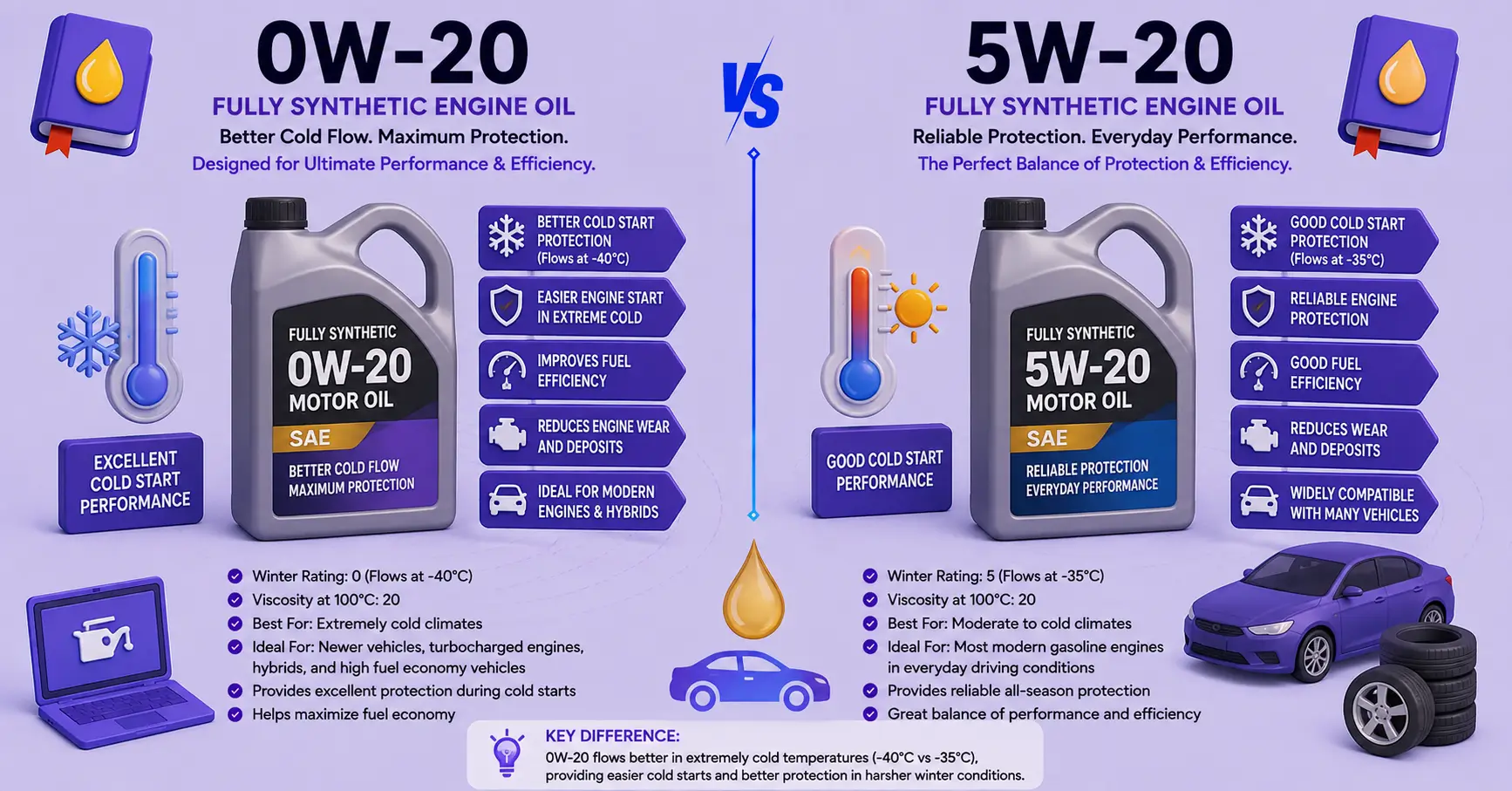

If you’re comparing 0W-20 and 5W-20, the most important difference is their performance at low temperatures. Both oils carry the same SAE 20 operating-temperature viscosity grade, but 0W-20 is designed to flow more readily in colder conditions than 5W-20.
That does not automatically mean 0W-20 is the right oil for every vehicle. Your owner’s manual determines the viscosity grade and oil specification your engine is designed to use. In some vehicles, the manufacturer permits 5W-20 as an alternative to 0W-20 under certain circumstances; in others, the specified grade should be followed exactly.
Quick Answer
The difference between 0W-20 and 5W-20 is primarily their low-temperature performance. The 0W grade has better cold-temperature flow characteristics than 5W, while both oils have an SAE 20 high-temperature viscosity grade.
In simple terms:
- 0W-20: better suited to very cold starts.
- 5W-20: slightly less fluid than 0W-20 at low temperatures.
- Both: SAE 20 oils for operating-temperature viscosity.
- Best choice: whichever viscosity and oil specification your vehicle manufacturer recommends.
The numbers should not be interpreted as “0-weight oil” and “5-weight oil” at one particular temperature. SAE viscosity classifications use standardized low-temperature tests and high-temperature viscosity requirements.
0W-20 vs. 5W-20 at a Glance
| Feature | 0W-20 | 5W-20 |
| SAE winter grade | 0W | 5W |
| Cold-temperature performance | Better | Good |
| Cold-start flow | Easier in very cold conditions | Slightly less fluid in very cold conditions |
| Operating-temperature grade | SAE 20 | SAE 20 |
| Intended use | Depends on vehicle specification | Depends on vehicle specification |
| Main advantage | Stronger low-temperature flow | Suitable where the manufacturer specifies or permits it |
| Can they always be substituted? | No | No |
The SAE J300 classification shows that 0W and 5W grades are evaluated at different low-temperature test points. For example, the 0W grade has a specified cold-cranking test temperature of −35°C, while 5W is tested at −30°C; their low-temperature pumping requirements are also different.
What Does 0W-20 Mean?
0W-20 is a multigrade engine-oil viscosity designation.
The “W” means winter, and the number before it describes the oil’s low-temperature performance under the SAE viscosity classification system. The 20 identifies the oil’s high-temperature viscosity grade.
The important point is that 0W does not mean the oil has a viscosity of zero at a particular temperature.
Instead, SAE J300 assigns winter grades based on standardized low-temperature cranking and pumping tests. A 0W oil meets the requirements for the colder test conditions associated with the 0W grade.
This is why 0W-20 can be advantageous for vehicles that regularly experience very cold starts.
Example
If a vehicle sits outside overnight during freezing weather, the engine oil becomes more resistant to flow as its temperature drops. An oil meeting the 0W requirements is designed to perform better under those cold-start conditions than an oil meeting the 5W requirements.
What Does 5W-20 Mean?
5W-20 is also a multigrade engine oil.
Its 5W classification means it meets the SAE requirements for the 5W winter grade, while 20 indicates its high-temperature viscosity grade.
Compared with 0W-20, 5W-20 has a higher winter-grade number and therefore does not meet the same low-temperature classification as 0W oil.
However, 5W-20 is still a relatively low-viscosity engine oil and is specified for many engines.
The key mistake is assuming that 5W-20 is simply a “thicker version” of 0W-20 under every condition. The meaningful distinction in the SAE grade is their low-temperature classification.
What Is the Difference Between 0W-20 and 5W-20?
The primary difference is low-temperature performance.
The first part of the grade changes:
0W → 5W
The second part stays the same:
20 → 20
That means both oils fall into the SAE 20 high-temperature viscosity grade, while 0W-20 has the lower winter classification.
SAE J300 lists the 0W and 5W grades with different low-temperature cranking and pumping requirements, while SAE 20 has its own high-temperature viscosity requirements.
Why Does the Difference Matter?
When an engine is cold, the oil needs to move through the lubrication system quickly enough to reach important engine components.
A lower winter-grade number indicates better low-temperature flow characteristics under the SAE tests.
Therefore:
0W-20 → better low-temperature flow
5W-20 → slightly less low-temperature flow
Once the engine reaches normal operating temperature, the simple “0 vs. 5” comparison is no longer the right way to understand the oil. Both carry the SAE 20 high-temperature grade.
0W-20 vs. 5W-20 in Cold Weather
This is where the difference matters most.
At lower temperatures, 0W-20 has an advantage over 5W-20 in cold-start performance because the 0W classification requires the oil to satisfy more demanding low-temperature performance tests.
According to SAE J300 data, 0W and 5W are assigned different cold-cranking and low-temperature pumping test temperatures.
For drivers in extremely cold environments, that distinction can become more important.
However, drivers should not automatically choose 0W-20 simply because it is “better in the cold.” The vehicle manufacturer may specify a particular oil grade and specification based on the engine’s design.
0W-20 vs. 5W-20 at Operating Temperature
Both oils end in 20, so they belong to the SAE 20 high-temperature viscosity grade.
This is an important distinction from the common misconception that 0W-20 becomes “0-weight” when hot while 5W-20 remains “5-weight.”
That is not how the SAE designation works.
The first portion identifies the winter/low-temperature classification. The second portion identifies the high-temperature viscosity grade.
SAE J300 specifies the SAE 20 grade using viscosity requirements measured at 100°C, along with high-temperature/high-shear requirements.
Therefore, the major SAE-grade difference between these two oils is not their basic high-temperature grade; it is their low-temperature classification.
Does 0W-20 Give Better Fuel Economy?
Potentially, but this should not be reduced to a universal rule that 0W-20 is always more fuel-efficient than every 5W-20 product.
Oil formulation, engine design, operating conditions, temperature, and manufacturer requirements all matter.
There is historical technical evidence that developing low-viscosity 0W-20 oils was associated with fuel-economy improvements compared with earlier 5W-20 formulations.
However, consumers should select the oil according to the vehicle manufacturer’s specification rather than choosing an oil solely because of a presumed fuel-economy advantage.
Can You Use 5W-20 Instead of 0W-20?
Sometimes, but not universally.
The correct answer depends on the vehicle.
Some manufacturers explicitly permit 5W-20 as an alternative when 0W-20 is unavailable. For example, Toyota owner information for several vehicles states that 5W-20 may be used when 0W-20 is unavailable, with instructions to return to 0W-20 at the next oil change.
That does not mean every vehicle that specifies 0W-20 can safely use 5W-20.
What Should You Do?
Check:
- Your owner’s manual.
- The required SAE viscosity.
- The required API/ILSAC or manufacturer specification.
- Any temporary-substitution instructions.
- Warranty requirements, if applicable.
If the manual specifies 0W-20 and does not approve 5W-20 as an alternative, do not assume the oils are interchangeable simply because both end in 20.
Can You Use 0W-20 Instead of 5W-20?
Again, sometimes, but not automatically.
Some lubricant manufacturers state that 0W-20 can be suitable for applications calling for 5W-20 because the oils share the same SAE 20 operating-temperature grade and 0W provides stronger low-temperature performance.
But the complete oil specification matters.
Two oils with the same viscosity grade can have different performance specifications, approvals, additive packages, or intended applications.
So the safe rule is:
Do not select oil by viscosity number alone. Match the viscosity and required oil specification to the vehicle manufacturer’s recommendation.
Common Mistakes With 0W-20 and 5W-20
Incorrect:
“0W-20 has zero viscosity when cold.”
Correct:
“0W describes the oil’s SAE winter/low-temperature classification.”
Why:
The SAE winter grade is based on standardized low-temperature performance tests rather than a simple viscosity value at one temperature.
Incorrect:
“5W-20 is always unsafe if the car uses 0W-20.”
Correct:
“Whether 5W-20 can replace 0W-20 depends on the vehicle manufacturer’s specifications.”
Why:
Some manufacturers explicitly permit 5W-20 as an alternative in certain vehicles, while others may require 0W-20.
Incorrect:
“The 20 means the oil is 20 times thicker than 0W.”
Correct:
“The 20 identifies the SAE high-temperature viscosity grade.”
Why:
The two numbers describe different parts of the multigrade classification.
Common Collocations With 0W-20 and 5W-20
Natural phrases include:
- 0W-20 engine oil
- 5W-20 engine oil
- 0W-20 synthetic oil
- 5W-20 synthetic oil
- 0W-20 motor oil
- 5W-20 motor oil
- 0W-20 viscosity
- 5W-20 viscosity
- recommended 0W-20 oil
- recommended 5W-20 oil
- cold-start performance
- engine oil viscosity
- oil viscosity grade
- SAE viscosity grade
Can 0W-20 and 5W-20 Be Used Interchangeably?
Not automatically.
They are closely related viscosity grades, but interchangeability depends on the vehicle.
A useful distinction is:
Same SAE 20 operating-temperature grade ≠ automatically identical oil specification.
For example, a Toyota manual may explicitly permit 5W-20 when 0W-20 is unavailable for a particular vehicle, but require returning to 0W-20 at the next oil change.
Therefore, always check the specific vehicle documentation rather than applying a universal substitution rule.
How to Remember the Difference
Remember it this way:
0W = better low-temperature classification
5W = slightly higher low-temperature classification
20 = same SAE high-temperature viscosity grade
So when comparing the two:
0W-20 and 5W-20 are most different when the engine is cold.
Which One Should I Use?
Use this simple decision guide:
If your vehicle manufacturer specifies 0W-20 → use 0W-20.
If your vehicle specifies 5W-20 → use 5W-20.
If your manual specifically permits either grade → choose according to the manufacturer’s guidance and your operating conditions.
If your manual allows 5W-20 as a temporary substitute for 0W-20 → follow the manual’s instructions about returning to 0W-20.
Do not choose between the oils solely because one seems “thinner” or “better.”
0W-20 or 5W-20? Practice Examples
1. Your owner’s manual specifies 0W-20 and you live somewhere with very cold winters.
Answer: 0W-20
It matches the specified grade and has the lower winter classification.
2. Your vehicle manual specifically says 5W-20 may be used when 0W-20 is unavailable.
Answer: 5W-20 may be acceptable according to that manufacturer’s instructions.
Follow the manual’s substitution and oil-change guidance.
3. Your manual specifies 5W-20 and says nothing about 0W-20.
Answer: 5W-20
Do not substitute another grade merely because it appears similar.
4. You see “20” on both bottles and assume they are identical.
Answer: Incorrect.
They share the SAE 20 high-temperature grade but have different winter classifications.
5. You want to choose an oil solely because it is better in cold weather.
Answer: Check the manufacturer’s specification first.
Cold-weather performance is important, but it does not override the vehicle’s required oil grade and specification.
Answers
- 0W-20
- 5W-20, if specifically permitted
- 5W-20
- They are not identical
- Follow the manufacturer’s specification first
Frequently Asked Questions
What is the main difference between 0W-20 and 5W-20?
The main SAE-grade difference is their low-temperature classification. 0W has stronger low-temperature performance requirements than 5W, while both are SAE 20 high-temperature grades.
Is 0W-20 thinner than 5W-20?
At low temperatures, 0W-20 is designed to flow more readily than 5W-20 under the SAE winter-grade tests. However, saying simply that one is “thinner” without specifying temperature can be misleading.
Is 0W-20 better than 5W-20?
Not universally. 0W-20 has an advantage in very cold conditions, but the best oil for a vehicle is the grade and specification recommended by its manufacturer.
Can I use 5W-20 instead of 0W-20?
Sometimes. Certain manufacturers explicitly allow 5W-20 as a temporary alternative when 0W-20 is unavailable. Toyota provides such instructions for several vehicles.
Can I use 0W-20 instead of 5W-20?
It may be acceptable for some vehicles, but you should verify the owner’s manual and required oil specification first. Some lubricant manufacturers identify 0W-20 as suitable for certain 5W-20 applications, but that should not be treated as a universal vehicle-specific rule.
Does the 20 mean the same thing in both oils?
Yes, both carry the SAE 20 high-temperature viscosity grade. The difference is in the winter/low-temperature classification.
What does the W mean in 0W-20?
The W means winter. The number before the W identifies the oil’s low-temperature classification under SAE viscosity standards.
Which is better for cold weather, 0W-20 or 5W-20?
0W-20 has the stronger low-temperature classification and is designed to perform better during very cold starts.
Conclusion
The difference between 0W-20 and 5W-20 is mainly their low-temperature performance. Both carry an SAE 20 high-temperature viscosity grade, but 0W-20 has the lower winter classification and is designed for better flow in colder conditions.
That does not make 0W-20 universally better for every engine. The correct choice depends on the vehicle manufacturer’s recommended viscosity and complete oil specification. In some vehicles, 5W-20 is explicitly permitted as an alternative; in others, it may not be.

Sajid Ali is an English language educator and content specialist with 7+ years of teaching experience. He holds master’s degrees in Information Technology and Education from the Virtual University of Pakistan and writes SEO-optimized, learner-friendly vocabulary content for diffari.com.