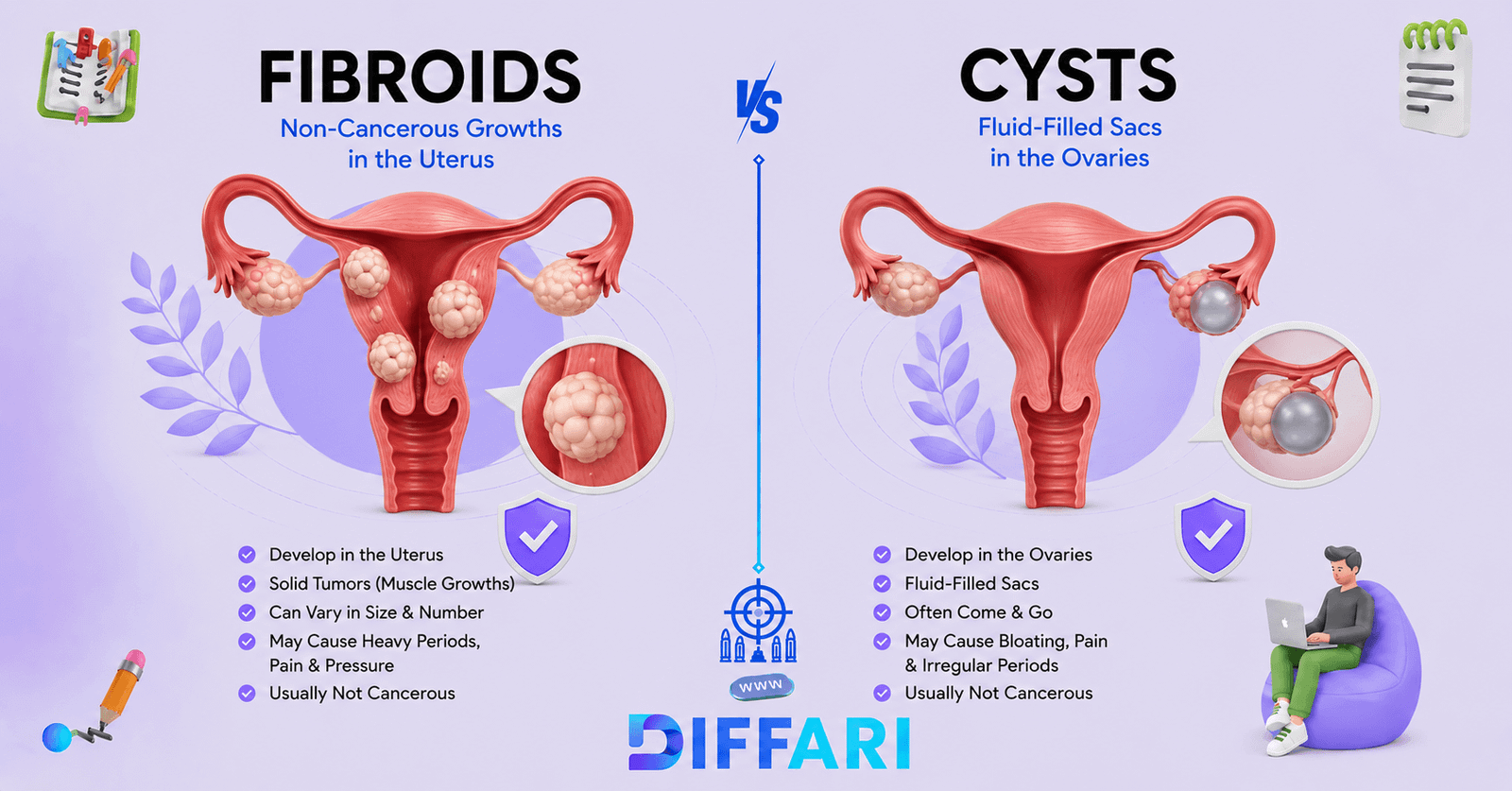
Fibroids and ovarian cysts are both common conditions that can affect the female reproductive system, and they can cause some of the same symptoms, including pelvic discomfort, bloating, and changes in menstrual bleeding. However, they are not the same condition. The most important difference is where they develop and what they are made of. Fibroids are benign growths that arise from the muscle of the uterus, while ovarian cysts are usually fluid-filled sacs that develop in or on an ovary.
Because their symptoms can overlap, you cannot reliably identify one from symptoms alone. A pelvic examination and imaging, particularly ultrasound, help healthcare professionals determine whether a pelvic mass is a fibroid, an ovarian cyst, or another condition.
Quick Answer
Fibroids are solid, benign growths that develop in the uterus, usually from uterine muscle.
Ovarian cysts are usually fluid-filled sacs that develop in or on an ovary.
The main difference is therefore location and structure:
Fibroid → uterus + muscle tissue
Ovarian cyst → ovary + usually fluid
Both can cause pelvic symptoms, but fibroids are more strongly associated with heavy or prolonged menstrual bleeding and pressure symptoms, while ovarian cysts can cause pelvic pain, particularly when a cyst becomes large, ruptures, or contributes to ovarian torsion.
Fibroids vs. Ovarian Cysts at a Glance
| Feature | Fibroids | Ovarian Cysts |
| Where they develop | In or around the uterus | In or on an ovary |
| What they are | Benign growths from uterine muscle | Usually fluid-filled sacs |
| Common symptoms | Heavy periods, pelvic pressure, pain | Pelvic pain, bloating, pressure |
| Effect on periods | Often heavy or prolonged bleeding | May cause cycle changes depending on the cyst |
| Diagnosis | Pelvic exam, ultrasound, sometimes MRI | Pelvic exam and ultrasound; additional tests may be needed |
| Natural course | May remain stable or shrink after menopause | Many functional cysts disappear on their own |
| Possible complications | Anemia, pressure symptoms, fertility problems in some cases | Rupture or ovarian torsion |
| Treatment | Observation, medicines, procedures, or surgery depending on symptoms | Often monitoring; surgery may be needed for some cysts |
The exact symptoms and treatment depend on the size, location, type, and individual circumstances.
What Are Fibroids?
Uterine fibroids, also called leiomyomas or myomas, are benign growths that develop from the muscular tissue of the uterus. They can occur within the uterine wall, on the outer surface of the uterus, or toward the inside of the uterine cavity.
Fibroids vary considerably in size and number. Some are so small that they cause no symptoms, while larger or strategically located fibroids can change the shape of the uterus or press against nearby organs.
Common fibroid symptoms
Fibroids may cause:
- Heavy or prolonged menstrual bleeding
- Painful periods or cramps
- Pelvic pain or pressure
- Lower abdominal or back discomfort
- Frequent urination
- Difficulty emptying the bladder
- Constipation or difficulty with bowel movements
- Pain during sex
- An enlarged abdomen or uterus
- Anemia caused by heavy blood loss
Some people with fibroids have no symptoms at all.
What Are Ovarian Cysts?
An ovarian cyst is a sac or pouch containing fluid or other tissue that forms in or on an ovary. Ovarian cysts are common, and many cause no symptoms and disappear without treatment.
Some ovarian cysts are functional, meaning they are associated with the normal menstrual cycle. Other types include dermoid cysts, cystadenomas, and endometriomas. Their behavior and treatment can vary considerably.
Common ovarian cyst symptoms
Many ovarian cysts cause no symptoms. When symptoms occur, they can include:
- Pelvic pain
- Pain on one side of the lower abdomen
- Bloating
- A feeling of fullness or pressure
- Pain during sex
- Changes in menstrual bleeding
- Difficulty with bowel movements
- Frequent urination
A cyst that ruptures can cause sudden, severe pain. A large cyst can also increase the risk of ovarian torsion, in which the ovary twists and its blood supply can be reduced or blocked.
What Is the Difference Between Fibroids and Cysts?
The biggest difference is where the growth develops and what it contains.
1. Location
Fibroids originate from the uterus.
Ovarian cysts develop in or on an ovary.
This distinction is usually more reliable than trying to identify the condition from symptoms alone.
2. Structure
Fibroids are growths made primarily from uterine muscle and connective tissue.
Ovarian cysts are usually sacs containing fluid, although some cysts can contain other types of tissue.
3. Menstrual symptoms
Fibroids are particularly associated with heavy or prolonged menstrual bleeding.
Ovarian cysts may cause changes in menstrual patterns, but many ovarian cysts do not cause noticeable symptoms at all.
4. Pain pattern
Fibroids can cause pelvic pressure, cramping, abdominal pain, or back pain.
Ovarian cysts can cause pelvic pain, sometimes more noticeably on one side. Sudden severe pain can occur if a cyst ruptures or contributes to ovarian torsion.
Fibroid Symptoms vs. Ovarian Cyst Symptoms
Symptoms can provide clues, but they cannot establish a diagnosis by themselves.
Symptoms more commonly associated with fibroids
Think about fibroids when the main problem involves:
- Very heavy periods
- Longer menstrual periods
- Pelvic heaviness or pressure
- Frequent urination
- Constipation caused by pressure
- An enlarged uterus or abdomen
- Anemia associated with heavy menstrual bleeding
Symptoms more commonly associated with ovarian cysts
Ovarian cysts may be more likely when symptoms include:
- One-sided pelvic pain
- Sudden pelvic pain
- Bloating
- Abdominal fullness
- Pain related to a ruptured cyst
- Pain associated with ovarian torsion
However, there is considerable overlap. A person with fibroids can have pelvic pain, and an ovarian cyst can sometimes be associated with menstrual changes. Therefore, symptoms should not be used as a substitute for medical evaluation.
How Do Doctors Tell Fibroids and Cysts Apart?
A healthcare professional may begin with a pelvic examination, but ultrasound is particularly important for identifying the location and characteristics of a pelvic growth.
Ultrasound
Ultrasound can show:
- Where the growth is located
- Its size
- Its shape
- Whether an ovarian mass is fluid-filled or solid
- The relationship between the mass and nearby reproductive organs
For fibroids, ultrasound can help confirm and map the size and location of the fibroids. For ovarian cysts, ultrasound can help determine the cyst’s appearance and whether it is fluid-filled or has solid components.
MRI
MRI may be used when additional detail about fibroids is needed, particularly when the uterus is enlarged or when treatment planning requires more information.
Blood tests
Blood tests may be appropriate in selected cases. For example, evaluation of an ovarian mass may include tests such as CA-125 when a healthcare professional believes further assessment is warranted. A CA-125 result alone does not diagnose ovarian cancer because levels can also rise in noncancerous conditions.
When Do Fibroids Need Treatment?
Not every fibroid needs treatment. Many people have fibroids without symptoms, and monitoring may be appropriate when symptoms are absent or mild.
Treatment may be considered when fibroids cause problems such as:
- Heavy menstrual bleeding
- Anemia
- Persistent pain
- Significant pelvic pressure
- Urinary or bowel symptoms
- Fertility or pregnancy concerns
Treatment options can include medicines, uterine artery embolization, radiofrequency ablation, myomectomy, and hysterectomy, depending on the person’s symptoms, fibroid characteristics, fertility plans, and other factors.
When Do Ovarian Cysts Need Treatment?
Many ovarian cysts disappear naturally and only require observation and follow-up. Treatment decisions depend on factors such as the cyst’s size, appearance, symptoms, age, and whether the person has gone through menopause.
Treatment or surgery may be considered when a cyst:
- Is large
- Persists or grows
- Causes significant symptoms
- Has concerning features on imaging
- Ruptures
- Contributes to ovarian torsion
- Raises concern about cancer
When surgery is necessary, the procedure may involve removing the cyst while preserving the ovary when appropriate, or removing the affected ovary in some circumstances.
Fibroids, Cysts, and Fertility
Neither diagnosis automatically means that pregnancy is impossible.
Fibroids can sometimes affect fertility, particularly when their size or location affects the uterine cavity. However, many people with fibroids are able to become pregnant.
Ovarian cysts also do not automatically cause infertility. Many common ovarian cysts have little effect on fertility and resolve without treatment. Certain cyst types or underlying conditions, however, may affect conception.
If pregnancy is a goal, fertility considerations should be discussed before choosing a treatment.
Can You Have Fibroids and Ovarian Cysts at the Same Time?
Yes.
Fibroids develop in the uterus, whereas ovarian cysts develop in or on the ovaries, so a person can have both conditions simultaneously.
If both are found on an ultrasound, the presence of both does not automatically mean that both are causing symptoms. A healthcare professional considers the location, size, appearance, symptoms, and medical history when deciding what needs attention.
Can Fibroids and Cysts Be Used Interchangeably?
No.
The terms describe different conditions.
A fibroid is a benign uterine growth arising from muscle tissue.
An ovarian cyst is a cystic structure in or on an ovary, usually containing fluid.
Calling an ovarian cyst a fibroid, or a uterine fibroid a cyst, can create confusion because their diagnosis, monitoring, complications, and treatment can differ.
Can Fibroids Turn Into Cancer?
Fibroids are almost always benign. Major medical sources state that they do not generally turn into cancer and that the occurrence of a cancerous uterine tumor such as leiomyosarcoma is extremely rare.
A rapidly changing or concerning pelvic mass still requires medical assessment because not every uterine mass is necessarily a typical fibroid.
Are Ovarian Cysts Cancerous?
Most ovarian cysts are benign, but not every ovarian cyst has the same risk profile.
The vast majority of ovarian cysts are noncancerous, and many disappear without treatment. However, some ovarian masses require additional evaluation, particularly when they have concerning imaging features or occur after menopause.
How to Remember the Difference
Use this simple rule:
Fibroid = uterus + muscle
Ovarian cyst = ovary + usually fluid
If you remember only one thing, remember the location.
A fibroid belongs to the uterus.
An ovarian cyst belongs to the ovary.
Which One Should I Use? — Practical Decision Guide
For medical terminology, use the term that matches the diagnosis:
A growth in the uterine muscle is called a fibroid.
An ovarian cyst refers to a cyst that develops in or on an ovary.
Heavy or prolonged menstrual bleeding can occur with fibroids, although other conditions may cause it as well.
Sudden severe pelvic pain may indicate an ovarian cyst complication and requires urgent medical assessment.
When both conditions appear on an ultrasound, they can coexist; a clinician can determine which condition, if either, is causing the symptoms.
Do not diagnose yourself from symptoms alone.
X or Y? Practice Examples
Choose fibroid or ovarian cyst.
- A benign growth develops from the muscle of the uterus.
- A fluid-filled sac develops on an ovary.
- A person has very heavy, prolonged menstrual bleeding associated with a uterine growth.
- A person develops sudden severe one-sided pelvic pain and an ovarian mass is present.
- A scan identifies a benign muscular growth within the uterus.
- A common functional growth associated with the menstrual cycle is found on an ovary.
- A pelvic mass is being evaluated to determine whether it originates from the uterus or ovary.
- A condition may cause pelvic pressure because it enlarges the uterus.
Answers
- Fibroid
- Ovarian cyst
- Fibroid
- Ovarian cyst
- Fibroid
- Ovarian cyst
- Either — imaging is needed to determine the source
- Fibroid
Frequently Asked Questions
What is the main difference between fibroids and cysts?
Fibroids are benign growths that develop from uterine muscle, while ovarian cysts are usually fluid-filled sacs that develop in or on an ovary.
Are fibroids and ovarian cysts the same thing?
No. They are different conditions that usually develop in different reproductive organs.
Which causes heavy periods more often, fibroids or ovarian cysts?
Fibroids are more strongly associated with heavy or prolonged menstrual bleeding. Ovarian cysts can cause menstrual changes, but many cause no symptoms.
Can ovarian cysts go away on their own?
Yes. Many functional ovarian cysts disappear without treatment, often within a few menstrual cycles.
Do fibroids go away on their own?
Fibroids may remain stable, grow, or shrink. They often shrink after menopause as reproductive hormone levels decrease.
Can you have fibroids and ovarian cysts together?
Yes. Because they develop in different parts of the reproductive system, both can occur in the same person.
Can fibroids and ovarian cysts affect fertility?
Either condition can be associated with fertility concerns in certain circumstances, but neither diagnosis automatically means infertility. The effect depends on the type, size, location, and individual circumstances.
How are fibroids and ovarian cysts diagnosed?
A pelvic examination and ultrasound are commonly used. Ultrasound can help identify the location and characteristics of a growth. Additional imaging or tests may be recommended when needed.
Do all fibroids and ovarian cysts require surgery?
No. Many fibroids can be monitored when they do not cause significant symptoms, and many ovarian cysts disappear without treatment. Surgery is considered when symptoms, size, persistence, complications, fertility concerns, or suspicious findings make intervention appropriate.
When should you seek urgent medical attention?
Sudden severe pelvic or abdominal pain, particularly with nausea or vomiting, can occur with complications such as ovarian torsion or a ruptured cyst and warrants urgent medical evaluation. Heavy bleeding accompanied by dizziness, fainting, or other concerning symptoms also requires prompt medical attention.
Conclusion
The difference between fibroids and cysts is easiest to understand by focusing on location and structure. Fibroids are benign muscular growths that develop in the uterus, while ovarian cysts are usually fluid-filled sacs that form in or on an ovary. Both can cause pelvic symptoms, but fibroids are particularly associated with heavy menstrual bleeding and pressure, whereas ovarian cysts can cause pelvic pain and, in some cases, complications such as rupture or torsion.