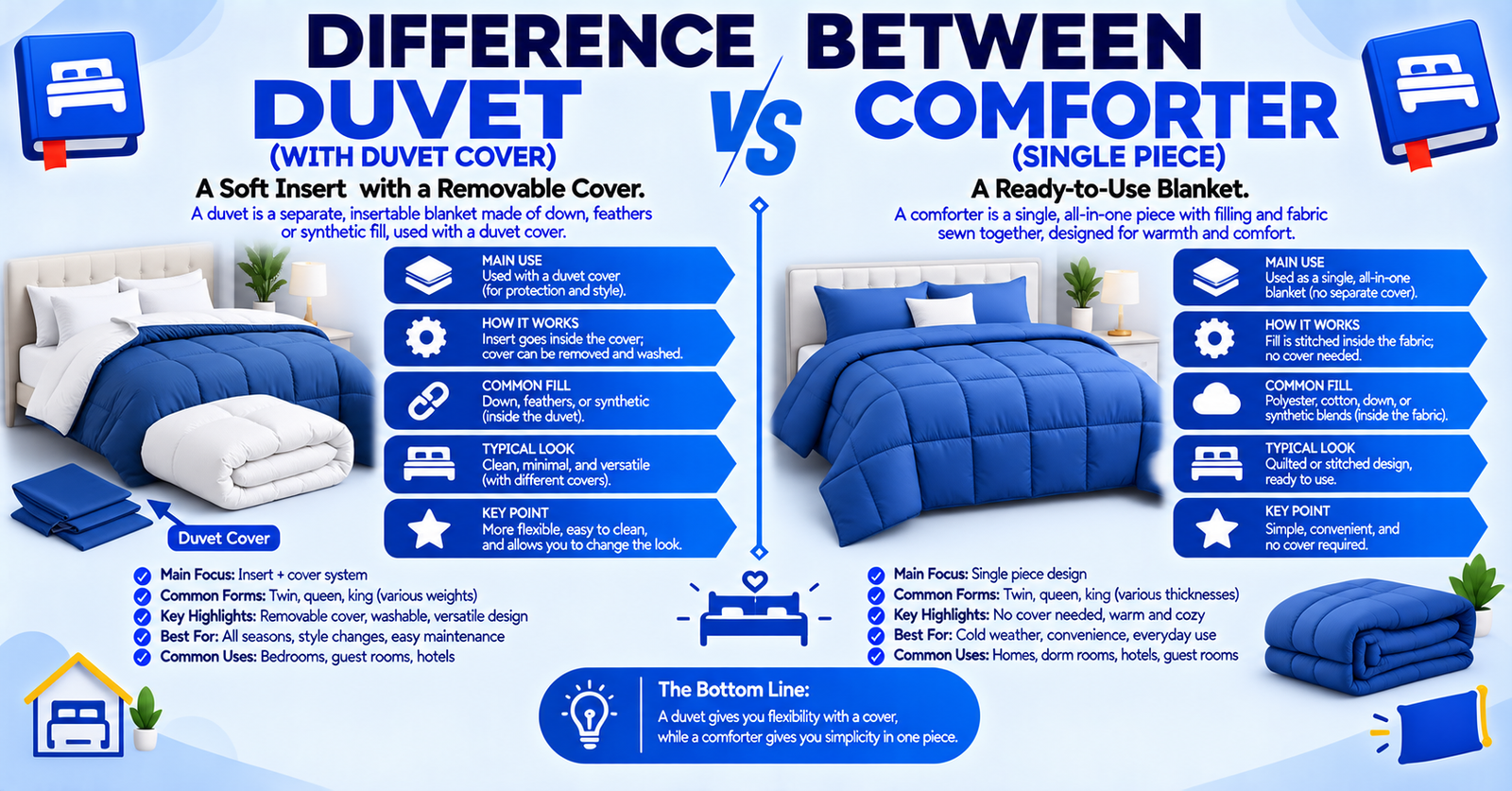
A duvet and a comforter are both types of bedding used to keep you warm while you sleep, and the two terms are sometimes used interchangeably. The main difference in common product terminology is how the bedding is constructed: a duvet is typically an insert designed to go inside a removable duvet cover, while a comforter is usually a finished, filled bed covering that is used on its own.
That distinction affects how you wash the bedding, change its appearance, assemble it, and sometimes manage warmth from season to season. However, the terminology is not completely fixed. In British English, duvet is the normal term for this type of bedding, while American English commonly uses comforter for a similar item.
Quick Answer
A duvet usually consists of a filled insert plus a removable duvet cover. A comforter is usually a single finished piece of bedding with the filling enclosed inside it.
The most useful practical distinction is:
Duvet = insert + removable cover
Comforter = one finished piece
A duvet system gives you a separate cover that can be removed and changed, while a comforter is normally ready to put on the bed as it is.
Duvet vs Comforter at a Glance
| Feature | Duvet | Comforter |
|---|---|---|
| Basic construction | Insert + removable cover | One finished piece |
| Cover | Separate duvet cover | Usually built into the bedding |
| Setup | Insert goes inside cover | Ready to use |
| Surface cleaning | Cover can be removed separately | Whole comforter usually needs cleaning |
| Style changes | Easy to change covers | Usually requires changing the whole comforter |
| Warmth | Depends on the insert and construction | Depends on the fill and construction |
| Cost | Insert and cover may be separate purchases | Often one main purchase |
| Common terminology | Especially common in British English | Especially common in American English |
These are typical distinctions rather than absolute product standards. Dictionaries themselves show considerable regional overlap between the terms.
What Is a Duvet?
A duvet is a soft, filled bed covering. In the common modern bedding system, the filled part is called a duvet insert, and it goes inside a separate duvet cover.
The insert may contain down, feathers, wool, cotton, synthetic fibers, or other insulating materials. The cover is usually made from a washable fabric and is secured around the insert with buttons, ties, snaps, or a zipper.
This setup is similar to a pillow and pillowcase:
- Duvet insert = the filled inner part
- Duvet cover = the removable outer layer
The word duvet comes from French and originally relates to down. Modern duvets, however, do not have to contain down; synthetic and other fills are also widely used.
Example
I put a clean duvet cover on the bed before the guests arrived.
Here, duvet cover refers specifically to the removable outer layer.
Another natural example is:
The duvet was too warm for summer.
In this sentence, duvet can refer to the bedding as a whole rather than specifically to the insert.
What Is a Comforter?
A comforter is generally a thick, soft bed covering filled with insulating material. The filling is enclosed within the outer fabric, and the entire item is normally used as one piece.
Comforters can contain down, feathers, cotton, wool, polyester, or other synthetic materials. They are often quilted or stitched to help keep the filling distributed throughout the bedding.
In American English, comforter is a common term for this type of bed covering. Cambridge defines it as a large, soft, flat bag filled with feathers or artificial material and used on a bed, while Oxford gives it as a North American term for a thick bed covering.
Example
I bought a new comforter for the guest room.
The comforter is a complete piece of bedding rather than a separate cover that requires an insert.
What Is the Difference Between a Duvet and a Comforter?
The biggest practical difference is how the bedding is put together.
A typical duvet system has two parts:
- A filled duvet insert
- A removable duvet cover
A typical comforter has one main part:
- A finished, filled bed covering
That difference creates several practical consequences.
1. Cleaning
A duvet cover can normally be removed from the insert and washed separately. This means you can clean the visible outer layer without putting the entire bulky insert through the washing machine every time.
A comforter has no separate standard cover, so when it needs cleaning, the whole piece generally has to be washed or professionally cleaned according to its care instructions.
However, this does not mean every duvet is automatically easier to clean. Some inserts require special care, and some comforters are specifically designed to be machine washable. Always follow the manufacturer’s care label.
2. Style
A duvet gives you more flexibility because you can replace the cover without replacing the insert.
For example, you could use:
- a light-colored linen cover in summer
- a darker cover in winter
- a patterned cover for a different bedroom style
With a comforter, the visible color and pattern are part of the main product. Changing the appearance usually means changing the entire comforter.
3. Setup
A comforter is simple: take it out and put it on the bed.
A duvet requires an extra step because the insert has to be placed inside its cover. Corner ties, buttons, snaps, or zippers help keep the two pieces together, but putting the cover on can take some effort.
4. Cost
A comforter can have a lower initial purchase price because you are buying one main item.
A duvet system can involve buying an insert and a cover separately. However, the long-term cost depends on the quality, materials, number of covers, and how often you replace each component.
Therefore, it is misleading to say that duvets are always more expensive or comforters are always cheaper. Compare the complete setup rather than just the price of one item.
Is a Duvet Warmer Than a Comforter?
Not necessarily.
This is one of the most important points to understand.
Warmth depends heavily on factors such as:
- type of fill
- amount of fill
- loft
- construction
- fabric
- weight
- insulation properties
A thick down comforter can be warmer than a lightweight duvet insert. Likewise, a high-loft duvet can be warmer than a thin comforter.
Some comparison guides describe duvets as generally warmer or loftier, but other current sources correctly emphasize that the category name alone does not determine warmth.
So instead of asking:
“Are duvets warmer than comforters?”
ask:
“What fill, weight, construction, and warmth rating does this particular product have?”
Which Is Easier to Clean?
A duvet system is often easier to maintain routinely because the cover can be removed and washed separately.
The important qualification is that the duvet insert still needs appropriate care. Some inserts can be machine washed, while others may require special cleaning.
A comforter can also be easy to maintain if it is machine washable and fits comfortably in the available washing machine and dryer.
The best choice therefore depends partly on your laundry setup, not just the bedding category.
Duvet and Comforter: Regional English Differences
The words become especially confusing when British and American English are compared.
In British English, duvet is the normal word for this type of filled bed covering. Cambridge labels duvet as UK usage and gives comforter as the US comparison.
In American English, comforter is a common word for a thick filled bed covering. Oxford also lists duvet as a term used in North American English, showing that the two words overlap.
This means that the difference is not purely linguistic.
For example:
British English: I need a new duvet.
American English: I need a new comforter.
Both speakers may be referring to broadly similar bedding.
There is also product terminology to consider. A retailer may specifically call the inner filled component a duvet insert, while another may use comforter for a similar-looking filled product.
That is why the safest approach when shopping is to check the actual construction and product description, rather than relying only on the name.
Can a Duvet and Comforter Be Used Interchangeably?
Sometimes, but not always.
In ordinary conversation, the terms can overlap, particularly across regions. Dictionaries explicitly reflect this overlap.
But when buying bedding, the construction matters.
If a product is sold as a duvet insert, it is normally intended to be used inside a duvet cover.
If a product is sold as a comforter, it is normally designed to be used by itself.
Some comforters can also be placed inside duvet covers, but dimensions, corner attachments, thickness, and construction can affect whether the combination works well.
So when the question is about language, the terms may overlap.
When the question is about products, check the manufacturer’s specifications.
Common Collocations With Duvet and Comforter
Knowing common combinations makes the difference easier to recognize in real-world English.
Common collocations with “duvet”
- duvet cover
- duvet insert
- duvet set
- double duvet
- king-size duvet
- warm duvet
- lightweight duvet
- down duvet
- synthetic duvet
- change the duvet cover
- wash the duvet cover
- pull the duvet over you
Common collocations with “comforter”
- comforter set
- down comforter
- down-alternative comforter
- lightweight comforter
- king-size comforter
- quilted comforter
- warm comforter
- wash the comforter
- put a comforter on the bed
- buy a new comforter
Notice that duvet cover is an especially strong clue that the bedding is part of a removable-cover system.
Common Mistakes With Duvet and Comforter
Incorrect assumption:
A duvet is always warmer than a comforter.
Better:
A duvet can be warmer or cooler depending on its fill and construction.
Why: The category name does not determine the thermal performance of the individual product.
Incorrect assumption:
A duvet always means the removable cover.
Better:
A duvet can refer to the filled bedding itself, while a duvet cover is the removable outer layer.
Why: Product terminology distinguishes the insert and cover, but ordinary usage can use duvet for the bedding system or filled covering as a whole.
Incorrect assumption:
Comforter and duvet always mean completely different things.
Better:
They often describe different bedding constructions, but the terms overlap across varieties of English and between retailers.
Why: Oxford and Cambridge both document regional overlap between the terms.
How to Remember the Difference
Use this simple rule:
Duvet = think “cover.”
Comforter = think “complete.”
If you’re looking at a fluffy insert that normally goes inside another removable piece of fabric, you’re dealing with a duvet system.
If you’re looking at one finished piece that is ready to put on the bed, you’re probably looking at a comforter.
Remember that this is a practical product rule, not an absolute dictionary rule.
Which One Should I Use?
The right choice depends on your priorities and how you plan to use the bedding.
- Prefer a removable cover and easy style changes? A duvet system may be the better fit.
- Want one finished piece with minimal setup? A comforter is usually simpler.
- Need an option that makes regular surface washing easier? A duvet cover can be convenient because it can be removed and washed separately.
- Want to skip the process of inserting and removing a cover? A comforter may be more straightforward.
- Looking for maximum warmth? Compare the actual fill, weight, and construction rather than relying on the product name alone.
- Shopping in the UK? “Duvet” is the standard term you will commonly encounter.
- Shopping in the US? “Comforter” is widely used, although “duvet” is also a familiar term.
The best option ultimately comes down to how you balance convenience, washing, style, warmth, and local terminology.
Duvet or Comforter? Practice Examples
Choose duvet or comforter for each sentence.
- I need to buy a new ______ for my guest room, and I don’t want a separate cover.
- She changed the ______ cover to give the bedroom a different look.
- The hotel bed had a fluffy ______ with a removable outer cover.
- I bought a matching ______ set with pillow shams.
- We keep two different covers for the same ______ insert.
- The ______ was ready to put on the bed straight from the package.
- He prefers a ______ because he can change the cover without buying new filling.
- She washed the ______ cover separately from the insert.
Answers
- comforter
- duvet
- duvet
- comforter
- duvet
- comforter
- duvet
- duvet
The exact terminology can vary by region and retailer, but these answers follow the common product distinction used throughout this article.
Frequently Asked Questions
What is the main difference between a duvet and a comforter?
A duvet typically forms part of a two-piece system consisting of a filled insert and removable cover. A comforter is generally a single finished piece of bedding.
Is a duvet the same as a comforter?
Not always. In everyday and regional usage, the terms can overlap. In bedding product terminology, however, a duvet commonly refers to an insert intended for a removable cover, while a comforter is normally used on its own.
Which is warmer, a duvet or a comforter?
Neither is automatically warmer. Warmth depends on the fill, amount of insulation, construction, weight, and other product specifications.
Which is easier to wash?
A duvet system can be easier for routine cleaning because the cover can be removed and washed separately. However, the insert still needs appropriate care, and some machine-washable comforters can also be straightforward to clean.
Do you need a duvet cover?
A duvet insert is normally designed to be used with a duvet cover. The cover protects the insert and provides the visible decorative layer.
Is “duvet” British English?
Duvet is strongly associated with British English, although it is also used in North American English. Cambridge labels duvet as UK usage, while Oxford documents North American usage as well.
Is “comforter” American English?
Comforter is especially common in American English for a thick bed covering. Oxford and Cambridge both identify this North American usage.
Can you put a comforter inside a duvet cover?
Sometimes. Whether it works well depends on the comforter’s dimensions, thickness, construction, and whether it has suitable attachment points. Check the manufacturer’s specifications rather than assuming every comforter will fit properly.
How can I remember the difference?
Think duvet = insert and cover system and comforter = finished one-piece covering. Then remember that regional English can use the words differently.
Conclusion
The practical difference between a duvet and a comforter is usually their construction. A duvet is typically an insert used with a removable cover, while a comforter is generally a finished, one-piece bed covering.
That difference affects cleaning, setup, styling, and how easily you can change the bedding. But warmth is not determined simply by the word duvet or comforter; the actual fill and construction matter.
For everyday use, remember the simplest rule: choose a duvet system when you want a removable, changeable cover; choose a comforter when you want one ready-to-use piece. And when the terminology seems confusing, check the product description rather than relying on the label alone.