Vodka and whiskey are both distilled spirits, but they are made with very different goals in mind. Vodka is generally produced to be clean and relatively neutral, while whiskey is made to retain and develop distinctive flavors from its grain mash and, in many styles, its time in oak.
That difference in production explains much of what you notice in the glass: vodka is usually clear and subtle, while whiskey is typically darker, more aromatic, and more complex.
Quick Answer
Vodka is a relatively neutral distilled spirit, while whiskey is a grain-based distilled spirit with a more pronounced flavor profile.
The biggest difference is how each spirit is produced and developed after distillation. Vodka is classified in U.S. regulations as a type of neutral spirit and is not aged in wood barrels under the standard vodka definition. Whiskey is made from fermented grain mash and must have the characteristic taste, aroma, and qualities associated with whiskey; many whiskey styles are matured in oak.
In simple terms:
Vodka → clean, neutral, versatile
Whiskey → rich, distinctive, often oak-influenced
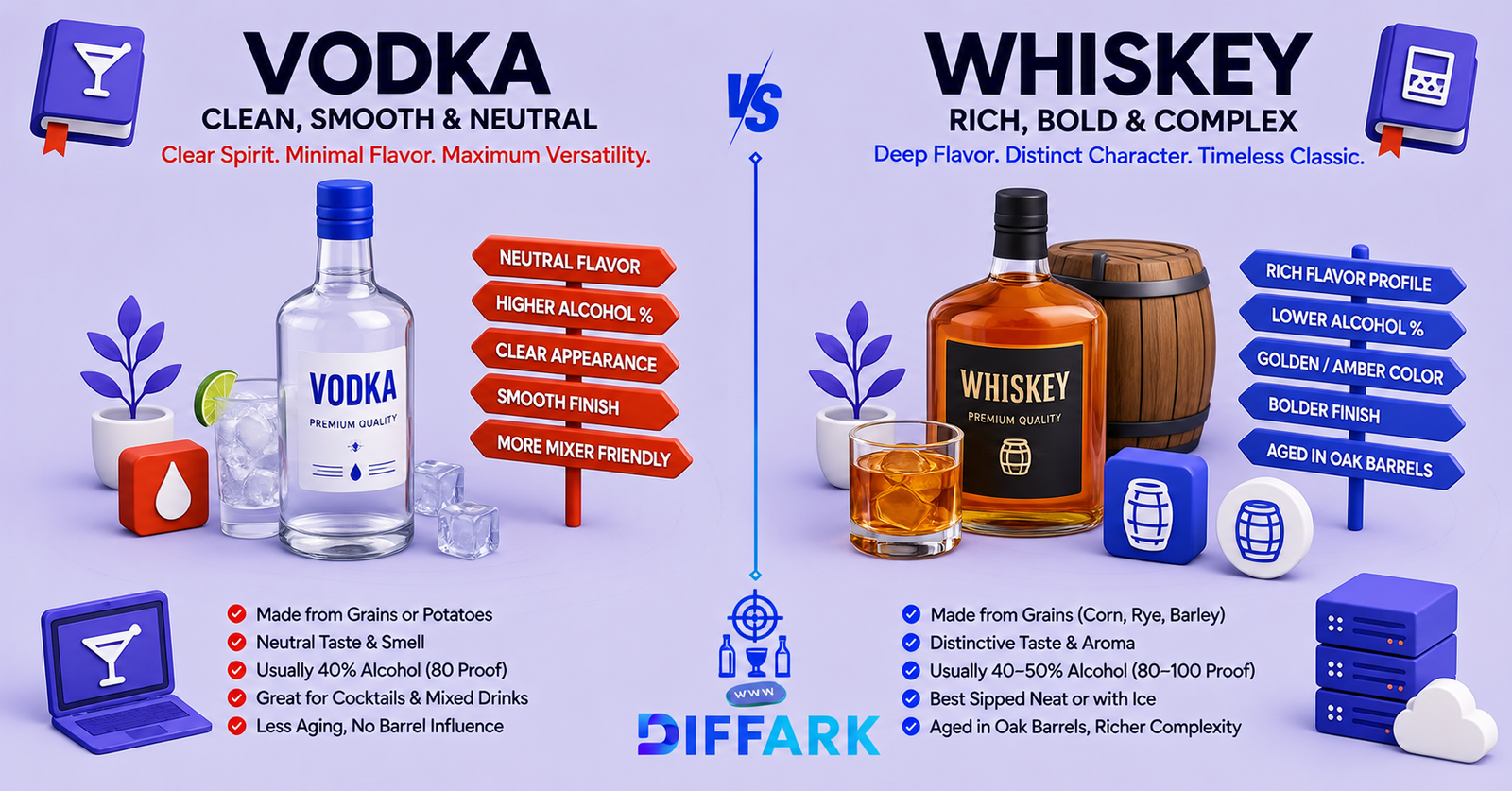
Vodka vs Whiskey at a Glance
| Feature | Vodka | Whiskey |
|---|---|---|
| Basic category | Neutral spirit | Grain-based distilled spirit |
| Main raw materials | Can be made from suitable agricultural materials, including grain or potatoes | Fermented grain mash |
| Typical character | Clean and relatively neutral | Richer and more distinctive |
| Aging | Standard vodka is not aged in wood | Many styles are matured in oak |
| Typical color | Clear | Usually amber to brown |
| Flavor | Subtle, clean, sometimes slightly sweet or creamy | Grain, oak, spice, caramel, fruit, smoke, or other notes depending on style |
| Common use | Cocktails and mixed drinks | Neat, on the rocks, and cocktails |
| Typical commercial strength | Often around 40% ABV | Often around 40% ABV, but higher-proof versions are common |
The important point is that neither category has one universal alcohol percentage. A standard 40% ABV vodka and a standard 40% ABV whiskey contain the same percentage of alcohol by volume. Some whiskey and vodka products are bottled at higher strengths.
What Is Vodka?
Vodka is a distilled spirit designed around a relatively neutral character.
In U.S. federal standards, vodka is classified as a type of neutral spirit. Neutral spirits are distilled at or above 95% alcohol by volume, and vodka may be treated under specific limits while still retaining the vodka designation. Standard vodka cannot be aged or stored in wood barrels under that standard.
Vodka can be produced from different raw materials, including grains and potatoes. What matters most to its identity is the highly neutral character created during production.
What does vodka taste like?
Vodka is generally much less expressive than whiskey. Depending on the product, you may notice subtle grain, mineral, peppery, creamy, or slightly sweet characteristics.
However, calling vodka completely “tasteless” is too simplistic. Different vodkas can have noticeably different textures and subtle aromas.
Vodka’s relatively neutral profile is one reason it works well in mixed drinks: it can provide alcohol without strongly dominating the other ingredients.
What Is Whiskey?
Whiskey, also spelled whisky, is a distilled spirit made from fermented grain mash.
Under U.S. federal standards, whiskey or whisky is a distilled spirit made from fermented mash of grain and distilled below 95% ABV, with the taste, aroma, and characteristics generally associated with whiskey. The general U.S. whiskey standard also specifies storage in oak barrels, with an exception for corn whiskey.
Different whiskey styles use different grains and production rules.
For example:
- Bourbon uses a mash containing at least 51% corn.
- Rye whiskey uses at least 51% rye.
- Wheat whiskey uses at least 51% wheat.
- Scotch whisky follows its own geographical and production requirements.
Scotch whisky, for example, must be matured in oak casks in Scotland for at least three years.
What does whiskey taste like?
Whiskey is generally more flavorful and aromatic than vodka.
Depending on the style, you may encounter notes such as:
- oak
- vanilla
- caramel
- spice
- dried fruit
- grain
- smoke
- roasted flavors
The exact profile depends heavily on the grain, distillation method, barrel, maturation conditions, and style.
What Is the Difference Between Vodka and Whiskey?
The central difference is the character each production method is designed to preserve.
Vodka is produced to achieve a highly neutral spirit. Whiskey, by contrast, retains more of the character of its grain-based distillate and develops additional flavor during maturation.
1. Ingredients
Vodka can be made from different agricultural raw materials, including grain and potatoes.
Whiskey is fundamentally associated with fermented grain mash. Different whiskey categories specify different grain compositions.
2. Distillation
Vodka is associated with very high-proof distillation intended to create neutrality.
Whiskey is distilled at a lower proof so more of the characteristic compounds from the fermented mash remain.
This is one of the most important reasons the two spirits taste so different.
3. Aging and maturation
Standard vodka is not aged in wood.
Whiskey commonly interacts with oak during maturation, and that interaction contributes significantly to its color, aroma, and flavor. However, the exact aging requirement depends on the whiskey style. For example, Scotch whisky requires at least three years of maturation, while U.S. whiskey categories have different rules.
4. Color
Vodka is normally clear because it is not matured in wood.
Whiskey is commonly amber or brown because of its interaction with wooden casks and, depending on the style, other production factors.
5. Flavor
Vodka generally emphasizes neutrality.
Whiskey emphasizes character.
That does not mean every vodka tastes exactly the same or every whiskey tastes smoky. Vodka can have subtle sensory differences, and whiskey styles range from light and delicate to heavily smoky.
How Production Changes the Flavor
A useful way to understand vodka vs whiskey is to follow what happens after fermentation.
Both begin with fermentation, where yeast converts sugars into alcohol. After that, the production goals become more distinct.
Vodka: distill toward neutrality → filter/treat as appropriate → dilute to bottling strength → bottle.
Whiskey: distill while retaining characteristic spirit character → mature according to the style → develop flavor and color → bottle.
That is why saying “whiskey is just aged vodka” is misleading. The two spirits have different production objectives before aging even becomes part of the equation.
When to Use Vodka
Vodka is a practical choice when you want a spirit that does not strongly dominate the other ingredients.
It is commonly used in cocktails such as:
- Martini
- Moscow Mule
- Bloody Mary
- Vodka Soda
- Cosmopolitan
If your priority is a clean, relatively neutral base, vodka is usually the more appropriate choice.
When to Use Whiskey
Whiskey is a better fit when you want the spirit itself to contribute substantial flavor.
It is commonly served:
- neat
- over ice
- with a small amount of water
- in spirit-forward cocktails
Classic whiskey cocktails include the Old Fashioned and Manhattan.
If you enjoy flavors associated with grain, oak, spice, caramel, fruit, or smoke, whiskey offers considerably more variation than a typical neutral vodka.
Vodka and Whiskey in Real Drinks
The difference becomes especially obvious in cocktails.
Consider a simple mixed drink.
Vodka + soda:
The soda and other ingredients remain prominent because vodka contributes relatively little flavor.
Whiskey + soda:
The whiskey’s grain, oak, spice, or caramel character remains noticeable.
This does not make one better than the other. They simply produce different results.
Which Is Stronger: Vodka or Whiskey?
Neither is automatically stronger.
Alcohol strength is measured by ABV (alcohol by volume), not by the category name.
A vodka labeled 40% ABV and a whiskey labeled 40% ABV contain the same percentage of alcohol.
The NIAAA uses a 1.5-ounce serving of 40% ABV distilled spirits—including vodka and whiskey—as an example of one U.S. standard drink, containing about 14 grams of pure alcohol.
However, whiskey has a broad market of higher-proof products, including barrel-proof or cask-strength expressions. Therefore, a particular whiskey can be considerably stronger than a particular vodka.
Important distinction
ABV = actual alcohol concentration.
Perceived strength = how strong the drink tastes or feels.
A spirit that tastes smoother or more neutral is not necessarily lower in alcohol.
Are Vodka and Whiskey the Same?
No.
They are both distilled spirits, but they are distinct categories with different production methods, flavor profiles, and typical uses.
They can overlap in some situations—for example, both can be used in cocktails—but one cannot simply be substituted for the other without changing the drink’s character.
Can Vodka and Whiskey Be Used Interchangeably?
Usually not.
You can technically experiment with substitutions in some cocktails, but the result will often taste substantially different.
For example, replacing vodka with whiskey in a drink designed around vodka’s neutrality introduces much more grain, oak, spice, or other whiskey characteristics.
Likewise, replacing whiskey with vodka removes much of the flavor that the whiskey contributes.
So the practical rule is:
If the recipe needs a neutral spirit → vodka is usually the better fit.
If the recipe depends on the spirit’s flavor → whiskey is usually the better fit.
Common Mistakes About Vodka and Whiskey
Mistake 1: “Vodka is always stronger than whiskey.”
Incorrect: Vodka is stronger because it is more neutral.
Correct: Strength depends on the bottle’s ABV.
Why: Neutral flavor does not determine alcohol concentration.
Mistake 2: “All whiskey is aged for the same amount of time.”
Incorrect: Every whiskey must be aged for exactly the same period.
Correct: Aging and maturation requirements vary by whiskey category and jurisdiction.
Why: Different types of whiskey have different legal and production standards.
Mistake 3: “Vodka has no flavor at all.”
Incorrect: Every vodka is completely tasteless.
Correct: Vodka is generally intended to be neutral, but individual products can have subtle aromas, flavors, and textural differences.
Mistake 4: “Brown whiskey means it is automatically better.”
Incorrect: Darker whiskey is always higher quality.
Correct: Color tells you something about the spirit’s production, but color alone does not establish quality.
Common Collocations With Vodka and Whiskey
Vodka
- vodka cocktail
- vodka soda
- vodka martini
- flavored vodka
- plain vodka
- distilled vodka
- vodka bottle
- vodka-based cocktail
Whiskey
- whiskey cocktail
- whiskey sour
- whiskey neat
- whiskey on the rocks
- bourbon whiskey
- rye whiskey
- Scotch whisky
- barrel-proof whiskey
- single malt whisky
These combinations are useful because they show how the words naturally appear in real-world English.
How to Remember the Difference
Use this simple rule:
Vodka = neutrality
Whiskey = character
Think of vodka as a spirit that is often intended to blend into a drink, while whiskey is often intended to be part of the flavor experience.
This is not an absolute rule, but it is a useful starting point.
Which One Should I Use?
Use this quick decision guide:
For a relatively neutral spirit, choose vodka.
For a richer and more distinctive flavor, whiskey is the better choice.
When making a cocktail designed around vodka, use vodka.
For a whiskey-based cocktail, choose whiskey.
If you want to sip the spirit and explore grain, oak, spice, fruit, or smoke, whiskey offers more flavor complexity.
On the other hand, vodka is often better when you want the other ingredients to remain the focus.
Vodka or Whiskey? Practice Examples
Choose vodka or whiskey.
- You want a neutral base for a cocktail.
- You want a spirit with noticeable oak and spice.
- You are making a traditional Old Fashioned.
- You want to make a vodka soda.
- You prefer a spirit-forward drink with complex barrel flavors.
- You want the mixer to remain the dominant flavor.
Answers
- Vodka
- Whiskey
- Whiskey
- Vodka
- Whiskey
- Vodka
Frequently Asked Questions
What is the main difference between vodka and whiskey?
Vodka is generally produced to be relatively neutral, while whiskey is a grain-based spirit that retains and develops more distinctive flavor, often through oak maturation.
Is vodka stronger than whiskey?
Not necessarily. Strength depends on ABV. A 40% ABV vodka and a 40% ABV whiskey have the same alcohol concentration.
Is whiskey always brown?
No. Whiskey’s appearance depends on its production and maturation. Many whiskeys are amber or brown because of their interaction with wood, but color alone does not define whiskey.
Is vodka always made from potatoes?
No. Vodka can be made from different raw materials, including grains and potatoes.
Is whiskey always made from barley?
No. Whiskey can be made from different grains, including corn, rye, wheat, and barley, depending on the style.
Are vodka and whiskey interchangeable?
Usually not. They can sometimes be substituted experimentally, but the resulting drink will have a different flavor profile.
Why does whiskey taste stronger than vodka?
Whiskey often has more pronounced flavor compounds from its grain-based distillate and maturation. That can make it seem more intense, but perceived intensity should not be confused with ABV.
What is the difference between whisky and whiskey?
The spelling generally reflects regional or category conventions. Whisky is common in Scotland and Canada, while whiskey is common in the United States and Ireland, although individual regional naming rules can be more specific.
Conclusion
The main difference between vodka and whiskey is not simply color or taste—it begins with how each spirit is produced. Vodka is generally made to achieve a relatively neutral character, while whiskey is produced to preserve and develop distinctive grain and, in many styles, oak-derived characteristics.