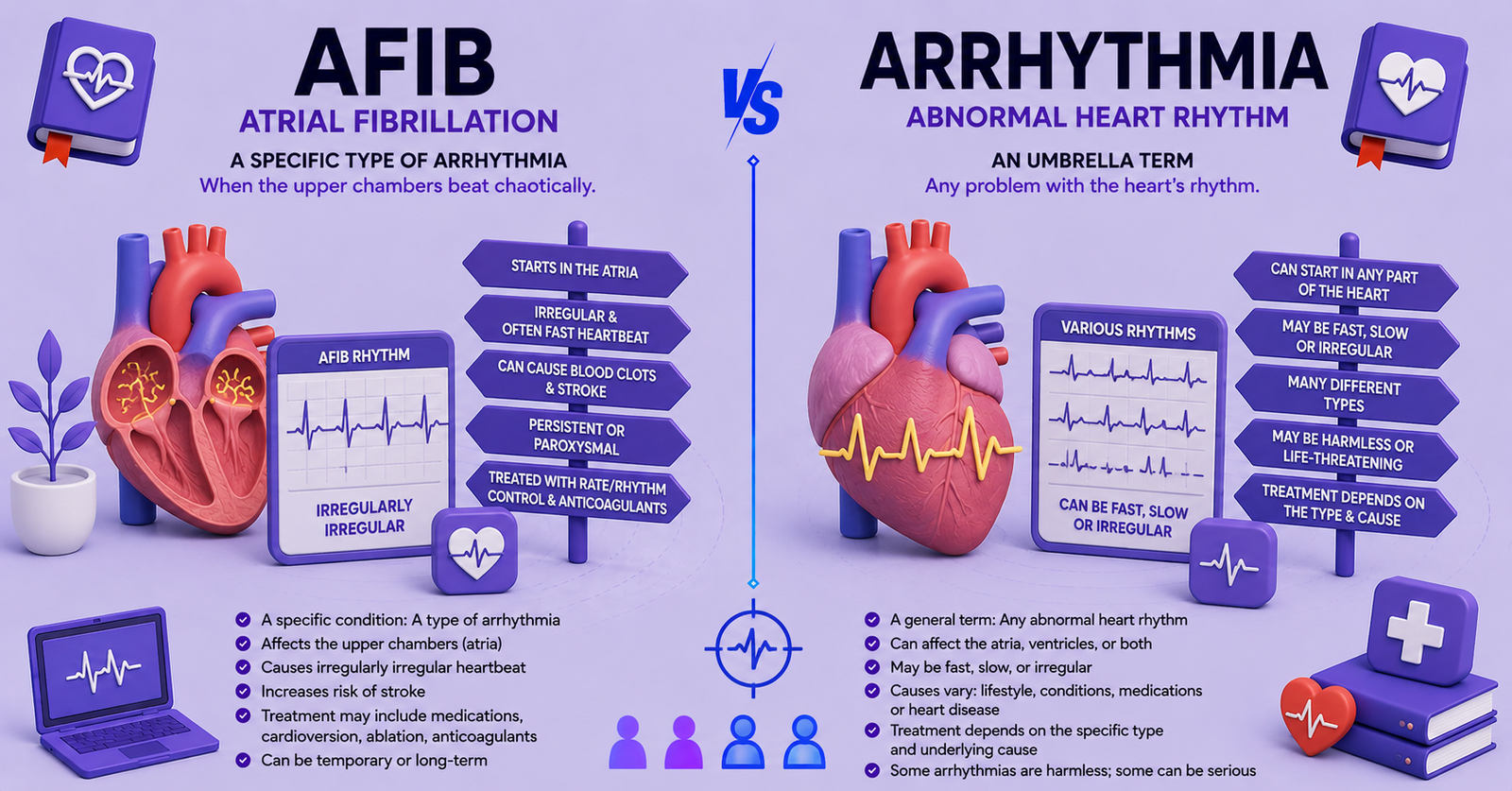

AFib and arrhythmia are closely related terms, but they are not two separate conditions that sit side by side. The important distinction is that AFib, or atrial fibrillation, is a specific type of arrhythmia.
An arrhythmia is a broad term for a problem with the rate or rhythm of the heartbeat. AFib is one particular arrhythmia involving chaotic electrical activity in the heart’s upper chambers, called the atria.
Understanding this relationship makes the difference much easier:
Arrhythmia is the broad category; AFib is one specific condition within that category.
Quick Answer
AFib is a type of arrhythmia.
Arrhythmia refers broadly to an abnormal heart rate or rhythm. The heart may beat too fast, too slowly, or irregularly.
AFib (atrial fibrillation) is a specific arrhythmia in which the heart’s atria experience chaotic electrical activity, causing an irregular and often rapid heartbeat.
So:
All AFib is arrhythmia, but not all arrhythmia is AFib.
AFib vs Arrhythmia at a Glance
| Feature | Arrhythmia | AFib |
|---|---|---|
| What it means | Broad term for an abnormal heart rate or rhythm | A specific type of arrhythmia |
| Category | General category | Specific condition |
| Can be too fast? | Yes | Often |
| Can be too slow? | Yes | AFib itself is generally associated with an irregular, often rapid rhythm |
| Can be irregular? | Yes | Yes |
| Main area involved | Depends on the type | Primarily the atria |
| Examples | AFib, atrial flutter, tachycardia, bradycardia and others | Atrial fibrillation |
| Stroke risk | Depends on the specific arrhythmia | AFib can increase the risk of blood clots and stroke |
Arrhythmia is an umbrella term, while AFib is one diagnosis under that umbrella. The American Heart Association lists AFib among several types of arrhythmias.
What Is an Arrhythmia?
An arrhythmia is a problem involving the heart’s rate or rhythm.
The heart normally follows an organized electrical system that coordinates each heartbeat. When that electrical activity changes, the heart may beat:
- too quickly
- too slowly
- irregularly
- or in an otherwise abnormal rhythm
The American Heart Association uses arrhythmia as a broad term for problems involving the rate or rhythm of the heartbeat.
There are many different types of arrhythmias.
Examples include:
- atrial fibrillation
- atrial flutter
- tachycardia
- bradycardia
- premature contractions
- ventricular fibrillation
- conduction disorders
Therefore, simply saying that someone has an arrhythmia does not tell you which particular rhythm problem they have.
What Is AFib?
AFib is short for atrial fibrillation.
It is a specific type of arrhythmia involving abnormal electrical activity in the heart’s upper chambers, known as the atria.
During AFib, the atria beat in a chaotic and irregular way rather than contracting in their normal coordinated pattern. This can result in an irregular and often rapid heartbeat.
AFib can occur in episodes or persist for longer periods. Medical sources describe forms including paroxysmal, persistent, long-standing persistent and permanent AFib.
Some people with AFib notice symptoms such as:
- palpitations
- a racing or pounding heartbeat
- shortness of breath
- dizziness or lightheadedness
- fatigue
- weakness
Others may have no noticeable symptoms.
What Is the Difference Between AFib and Arrhythmia?
The biggest difference is specificity.
Arrhythmia is a broad medical term describing an abnormal heart rate or rhythm.
AFib is one specific type of abnormal rhythm.
Think of it like this:
Arrhythmia → category
AFib → one member of that category
For example, a person can have an arrhythmia without having AFib. Their arrhythmia could instead be another rhythm problem, such as atrial flutter, tachycardia, bradycardia or a premature contraction.
On the other hand, if a person has confirmed AFib, they have an arrhythmia by definition.
The simplest rule
AFib is an arrhythmia.
Arrhythmia does not necessarily mean AFib.
How AFib Fits Into the Arrhythmia Category
A useful way to visualize the relationship is:
Abnormal heart rhythm
↓
Arrhythmia
↓
Different types of arrhythmia
↓
AFib / atrial fibrillation
This distinction is important because the word arrhythmia alone is not specific enough to identify the underlying rhythm disorder.
The National Heart, Lung, and Blood Institute specifically describes atrial fibrillation as a type of arrhythmia.
Other Types of Arrhythmias
AFib is only one form of arrhythmia.
Other examples include:
Atrial Flutter
Atrial flutter is another abnormal rhythm involving the atria. Unlike AFib, the atrial activity in atrial flutter is typically very fast but more organized. The two conditions can have similar symptoms and can occur in the same person.
Tachycardia
Tachycardia refers to a heart rate that is faster than normal. It can occur in different forms depending on where the abnormal rhythm originates.
Bradycardia
Bradycardia refers to a slower-than-normal heart rate. It is another type of rhythm problem and is not the same thing as AFib.
Premature Contractions
These are extra or early heartbeats that can occur in otherwise different rhythm conditions.
Ventricular Fibrillation
Ventricular fibrillation is a serious abnormal rhythm involving the heart’s lower chambers and is very different from AFib. The AHA includes it among the various types of arrhythmias.
AFib vs Other Arrhythmias
The term arrhythmia tells you that something is abnormal about the heart’s rhythm, but it does not identify exactly what is happening.
AFib is more specific.
| Term | What it tells you |
|---|---|
| Arrhythmia | There is an abnormality in heart rate or rhythm |
| AFib | The specific rhythm problem is atrial fibrillation |
| Tachycardia | The heart rate is abnormally fast |
| Bradycardia | The heart rate is abnormally slow |
| Atrial flutter | A specific abnormal atrial rhythm |
This is why doctors may need an ECG/EKG or other rhythm monitoring to determine which arrhythmia is actually present. Heart rhythm tests can record the heart’s electrical activity and help identify abnormal rhythms.
When Is AFib Different From a General Arrhythmia?
If someone says:
“I have an arrhythmia.”
That statement is broad. It does not necessarily mean they have AFib.
If someone says:
“I have AFib.”
That is much more specific. They are referring to atrial fibrillation, a particular type of arrhythmia.
So the terms cannot always be substituted for one another.
Example
“AFib is an arrhythmia.”
Correct.
“Every arrhythmia is AFib.”
Incorrect.
“AFib is one type of arrhythmia.”
Correct.
Symptoms of AFib and Arrhythmias
Symptoms depend heavily on the particular type of arrhythmia.
Possible symptoms of an abnormal heart rhythm can include:
- palpitations
- dizziness
- fainting
- fatigue
- shortness of breath
- chest discomfort
- unusually fast or slow heartbeat
AFib can cause palpitations, fatigue, shortness of breath, dizziness and weakness, although some people have no symptoms.
Because different arrhythmias can produce similar symptoms, symptoms alone cannot reliably tell you whether someone has AFib.
Why AFib Matters
AFib deserves particular attention because it can increase the risk of blood clots and stroke.
During AFib, the atria do not contract normally. Blood can pool in the atria, which can contribute to clot formation. A clot can travel to the brain and cause a stroke. AFib is also associated with heart failure and other cardiovascular complications.
This does not mean that every arrhythmia carries exactly the same risks.
The risks depend on the specific type of arrhythmia and the person’s overall health.
Common Mistakes With AFib and Arrhythmia
Incorrect:
AFib and arrhythmia are two completely different conditions.
Correct:
AFib is a specific type of arrhythmia.
Why:
Arrhythmia is the broader category, while AFib identifies a particular abnormal rhythm.
Incorrect:
If someone has an arrhythmia, they have AFib.
Correct:
Someone with an arrhythmia may have AFib or another type of abnormal heart rhythm.
Why:
There are multiple types of arrhythmias. AFib is only one of them.
Incorrect:
AFib means the heart is always beating fast.
Better:
AFib causes an irregular rhythm and is often associated with a rapid heartbeat, but symptoms and heart rate can vary.
Mayo Clinic describes AFib as an irregular and often very rapid heart rhythm, and some people may not notice symptoms.
Common Terms Associated With AFib and Arrhythmia
| Term | Meaning |
|---|---|
| AFib | Atrial fibrillation |
| AF | Another abbreviation for atrial fibrillation |
| Arrhythmia | Abnormal heart rate or rhythm |
| Atria | The heart’s two upper chambers |
| Ventricles | The heart’s two lower chambers |
| ECG/EKG | Test that records the heart’s electrical activity |
| Palpitations | Awareness of a racing, pounding or fluttering heartbeat |
| Tachycardia | Fast heart rate |
| Bradycardia | Slow heart rate |
Can AFib and Arrhythmia Be Used Interchangeably?
Usually, no.
The words describe different levels of specificity.
You can accurately say:
AFib is an arrhythmia.
But you cannot replace every use of arrhythmia with AFib, because a person may have an entirely different type of arrhythmia.
Think of the relationship this way:
“Arrhythmia” = general category
“AFib” = specific diagnosis
Therefore, AFib is more specific than arrhythmia.
Which One Should I Use?
Use arrhythmia when you are talking generally about an abnormal heart rhythm and the specific type is unknown or not relevant.
Use AFib when you specifically mean atrial fibrillation.
Quick Decision Guide
Any abnormal heart rhythm → arrhythmia is the broader term.
For atrial fibrillation specifically → use AFib.
A diagnosis of atrial fibrillation → AFib is the appropriate term.
When the specific rhythm disorder is unknown → arrhythmia is the safer, broader term.
How to Remember the Difference
Use this simple rule:
AFib is inside the arrhythmia category.
Or remember:
Arrhythmia = umbrella
AFib = one thing under the umbrella
That prevents the most common misunderstanding: thinking that AFib and arrhythmia are two completely separate categories.
X or Y? Practice Examples
Choose AFib or arrhythmia.
- A doctor says the patient has an abnormal heart rhythm but has not identified the exact type yet.
Answer: arrhythmia - A patient has been diagnosed with atrial fibrillation.
Answer: AFib - A statement says, “Atrial fibrillation is a type of ___.”
Answer: arrhythmia - A patient has an abnormal rhythm caused by chaotic electrical activity in the atria.
Answer: AFib - A doctor is discussing abnormal heart rhythms as a general group.
Answer: arrhythmia - A medical record specifically identifies atrial fibrillation.
Answer: AFib - Someone asks for the broad term covering AFib, atrial flutter and other abnormal rhythms.
Answer: arrhythmia - Someone asks specifically about irregular rhythm originating from chaotic activity in the atria.
Answer: AFib
Frequently Asked Questions
Is AFib the same as an arrhythmia?
No. AFib is a type of arrhythmia. Arrhythmia is the broader term for problems involving the heart’s rate or rhythm.
Is AFib an arrhythmia?
Yes. Atrial fibrillation is a specific type of arrhythmia.
Are all arrhythmias AFib?
No. There are many types of arrhythmias, including AFib, atrial flutter, tachycardia, bradycardia and others.
Is AFib the most common arrhythmia?
AFib is described by the American Heart Association as the most common type of irregular heart rhythm, and clinical sources describe it as a very common cardiac arrhythmia.
Can someone have an arrhythmia without having AFib?
Yes. AFib is only one type of arrhythmia. Other rhythm disorders can also cause an abnormal heartbeat.
Does AFib always cause symptoms?
No. Some people experience palpitations, shortness of breath, fatigue or dizziness, while others may have no noticeable symptoms.
Why is AFib important?
AFib can increase the risk of blood clots, stroke and heart failure, so it should be appropriately evaluated and managed.
How is AFib diagnosed?
AFib may be identified through an ECG/EKG and other heart-rhythm monitoring methods. Longer-term monitors can record heart rhythm over extended periods when needed.
Is AFib more serious than every other arrhythmia?
Not necessarily. “Arrhythmia” covers many different conditions with different risks. AFib has particular concerns, especially its association with blood clots and stroke, but the seriousness of an arrhythmia depends on the specific rhythm and the individual situation.
Conclusion
The difference between AFib and arrhythmia is mainly one of specificity. Arrhythmia is the broad term for an abnormal heart rate or rhythm, while AFib (atrial fibrillation) is one specific type of arrhythmia involving chaotic electrical activity in the atria.
The easiest rule to remember is:
AFib is an arrhythmia, but not every arrhythmia is AFib.

Sajid Ali is an English language educator and content specialist with 7+ years of teaching experience. He holds master’s degrees in Information Technology and Education from the Virtual University of Pakistan and writes SEO-optimized, learner-friendly vocabulary content for diffari.com.