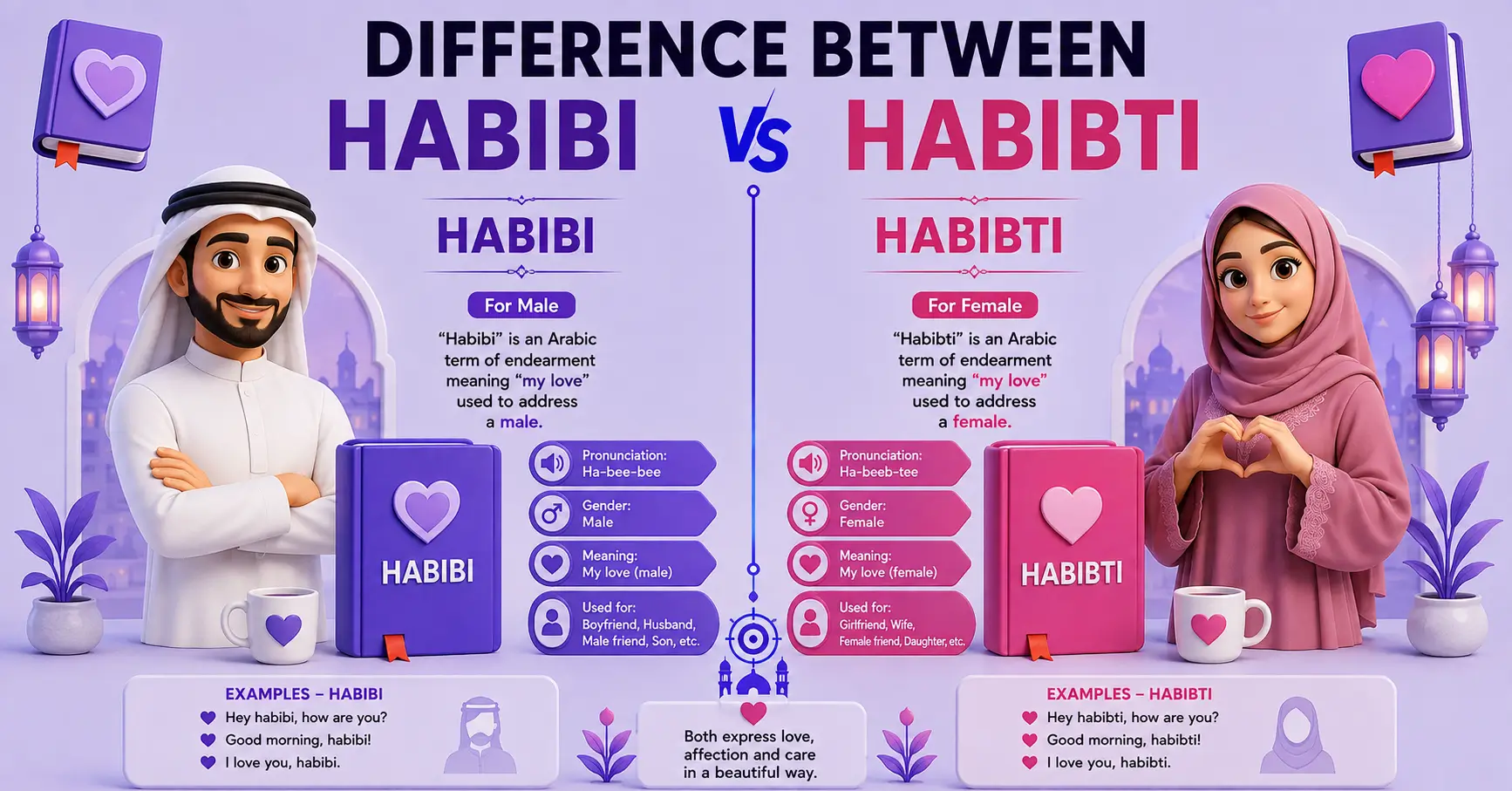
Habibi and habibti are Arabic terms of affection that both can mean “my beloved,” “my dear,” “my love,” or “darling.” The main difference is the gender of the person being addressed: habibi (حبيبي) is the masculine form, while habibti (حبيبتي) is the feminine form.
This distinction does not depend on whether the speaker is male or female. A woman speaking to a man can say habibi, while a man speaking to a woman can say habibti. The relationship also matters: these expressions can be romantic, familial, friendly, or warmly familiar depending on the situation.
Quick Answer
Habibi (حبيبي) means “my beloved” or “my dear” when addressing a male.
Habibti (حبيبتي) means “my beloved” or “my dear” when addressing a female.
The easiest rule is:
Talking to a man → habibi.
Talking to a woman → habibti.
The speaker’s gender does not determine the form. The gender of the person being addressed does.
Habibi vs Habibti at a Glance
| Feature | Habibi | Habibti |
|---|---|---|
| Arabic | حبيبي | حبيبتي |
| Gender of person addressed | Male | Female |
| Basic meaning | My beloved / my dear | My beloved / my dear |
| Common English equivalents | My love, darling, dear | My love, darling, dear |
| Pronunciation | ha-BEE-bee | ha-BEEB-tee |
| Romantic use | Yes | Yes |
| Friendly/family use | Yes | Yes |
| Main distinction | Masculine form | Feminine form |
Both forms are derived from the same Arabic word family associated with being beloved or dear. Arabic learning materials explicitly list حَبيبي / حَبيبتي as the masculine and feminine forms of “my love.”
What Does Habibi Mean?
Habibi (حبيبي) is an Arabic term of affection that literally conveys the idea of “my beloved” or “my dear.”
The basic word habib (حبيب) means someone who is beloved or dear. The -i ending expresses “my,” giving habibi the sense of “my beloved.”
Although English speakers often associate habibi with romantic relationships, Arabic usage is much broader.
Someone might use habibi with:
- a husband or boyfriend
- a son
- a brother
- a close male friend
- another person in a warm or familiar interaction
For example:
Good morning, habibi.
Depending on the relationship, this could mean “Good morning, my love,” “Good morning, my dear,” or simply convey warm affection.
The surrounding relationship and tone are important because habibi does not automatically indicate romantic interest.
What Does Habibti Mean?
Habibti (حبيبتي) is the feminine counterpart of habibi.
It can be translated as:
- my beloved
- my dear
- my love
- darling
- sweetheart
The form is built from the feminine habiba (حبيبة) plus the first-person possessive element. Wiktionary identifies حبيبتي (ḥabībatī) as the first-person singular possessive form of the feminine noun حبيبة.
You use habibti when addressing a girl or woman.
For example:
Good morning, habibti.
Depending on the relationship, this might be affectionate language between romantic partners, family members, or close friends.
What Is the Difference Between Habibi and Habibti?
The central difference is grammatical gender.
Habibi is the masculine form.
Habibti is the feminine form.
The important point is that the gender belongs to the person you are talking to, not the person speaking.
For example:
| Speaker | Person addressed | Correct form |
|---|---|---|
| Woman | Man | Habibi |
| Man | Man | Habibi |
| Man | Woman | Habibti |
| Woman | Woman | Habibti |
So a common misunderstanding is thinking that a woman must say habibti because she is female. That is incorrect.
A woman speaking affectionately to a male friend or partner can say:
Habibi.
A man speaking affectionately to a female friend or partner can say:
Habibti.
Does the Speaker’s Gender Matter?
No.
This is one of the most useful rules for learners.
The form changes according to who is being addressed.
For example:
A woman to her husband: habibi
A man to his wife: habibti
Likewise:
A father to his son: habibi
A mother to her daughter: habibti
The same principle applies when friends use these expressions.
This is why it is better to remember:
Look at the listener, not the speaker.
Are Habibi and Habibti Romantic?
Not necessarily.
Both words can be romantic, but neither one is exclusively romantic.
In a romantic relationship, habibi or habibti can be equivalent to “my love,” “darling,” or “sweetheart.”
But Arabic speakers can also use these terms affectionately with family members and friends. The context, relationship, tone, and regional usage help determine the emotional meaning.
For example:
Habibi, how are you?
Between romantic partners, it may sound intimate.
Between close male friends, it may simply sound warm and friendly.
Therefore, hearing someone say habibi does not automatically mean that the relationship is romantic.
When to Use Habibi
Use habibi when addressing a male in an affectionate or familiar way.
Common contexts include:
Romantic
I miss you, habibi.
Here, “my love” is a natural interpretation.
Family
Come here, habibi.
A parent might use this affectionately with a son.
Friendship
Thanks, habibi.
Among close male friends, it can express warmth without romantic meaning.
Informal social interaction
In some Arabic-speaking communities, habibi is also used in friendly everyday interactions. Its exact force depends on the speaker, listener, relationship, dialect, and situation.
When to Use Habibti
Use habibti when addressing a female affectionately or warmly.
For example:
Romantic
Good night, habibti.
Family
Are you okay, habibti?
A parent or relative may use it affectionately with a daughter or other female family member.
Friendship
Thank you, habibti.
Close female friends may use it warmly without romantic meaning. Palestinian Arabic sources, for example, describe habibti as common between female friends as well as in family and romantic contexts.
Habibi and Habibti in Sentences
Here are some practical examples:
Habibi
“How are you, habibi?”
Used when addressing a male.
“Thank you, habibi.”
This can be friendly or affectionate depending on the relationship.
“Good morning, habibi.”
A romantic partner or family member might use it affectionately.
Habibti
“How are you, habibti?”
Used when addressing a female.
“Thank you, habibti.”
This can be friendly, familial, or romantic.
“Good morning, habibti.”
The meaning depends on the relationship.
The same English translations—“dear,” “darling,” or “my love”—can therefore correspond to different Arabic forms depending on the gender of the person being addressed.
Pronunciation: Habibi vs Habibti
The common learner-friendly pronunciations are approximately:
- Habibi: ha-BEE-bee
- Habibti: ha-BEEB-tee
More precisely, the Arabic pronunciation contains the consonant ḥ (ح), which is different from the ordinary English “h.” Exact pronunciation can vary somewhat across dialects.
Wiktionary gives ḥabībī as approximately /ħa.biː.biː/ and ḥabībatī as /ħa.biː.ba.tiː/.
For a beginner, the most important difference to hear is the ending:
habibi → -bi
habibti → -bti
Spelling: Habibi vs Habibti
In Arabic script, the distinction is especially clear:
حبيبي = habibi
حبيبتي = habibti
Because these Arabic words are often written in Latin letters, you may encounter variations such as habeebi, habibty, or habibati. Transliteration is not governed by English spelling rules, so different systems can represent the same Arabic sounds in different ways.
For a general English-language article, habibi and habibti are the clearest spellings to use consistently.
Common Mistakes With Habibi and Habibti
Mistake 1: Thinking habibi is always romantic
Incorrect assumption:
“If someone says habibi, they must be flirting.”
Better understanding:
Habibi can be romantic, but it can also be friendly, familial, or simply warm.
Context determines the intended meaning.
Mistake 2: Choosing the word based on the speaker
Incorrect assumption:
“I am a woman, so I should say habibti.”
Correct:
The form depends on the person you are addressing.
A woman addressing a man can say habibi.
Mistake 3: Assuming habibti is only for girlfriends or wives
Incorrect assumption:
“Habibti is only for a romantic female partner.”
Correct:
Habibti can also be used affectionately with family members and friends.
Mistake 4: Treating the words as completely interchangeable
In standard usage, they are not simply interchangeable.
If you are directly addressing a male, habibi is the normal masculine form.
If you are directly addressing a female, habibti is the normal feminine form.
Some dialects and casual speech can show more flexibility, but learners should start with the gender-matching rule.
Common Collocations and Phrases
You will often encounter these expressions:
| Phrase | Meaning |
|---|---|
| ya habibi | Oh my dear / my beloved |
| ya habibti | Oh my dear / my beloved |
| habibi | My dear / my love, to a male |
| habibti | My dear / my love, to a female |
The word ya (يا) is a common Arabic particle used when directly addressing someone, so ya habibi and ya habibti are natural forms of direct address.
Can Habibi and Habibti Be Used Interchangeably?
Usually, no.
The basic grammatical distinction should be preserved:
Male → habibi
Female → habibti
However, real spoken Arabic is not identical across every dialect or social setting. Some colloquial communities may use habibi more broadly, including for women in particular contexts. The Mezzofanti Guild specifically notes this type of usage in some Egyptian colloquial speech.
For an Arabic learner who wants the safest standard choice, use:
habibi for a male
habibti for a female
How to Remember the Difference
Use the final sound as your memory trick:
Habibi → B = Boy
Habibti → T = woman/feminine form
The “B = boy” trick is only a learner mnemonic, not the grammatical explanation. The actual distinction comes from Arabic grammatical gender.
An even better rule is:
No T for a male → habibi.
T sound for a female → habibti.
Which One Should I Use?
Use this quick decision guide:
Are you addressing a man or boy?
→ Habibi
Are you addressing a woman or girl?
→ Habibti
Are you asking whether it is romantic?
→ Either can be romantic, but neither is automatically romantic.
Are you wondering whether your own gender changes the word?
→ No. The listener’s gender is what matters.
X or Y? Practice Examples
Choose habibi or habibti.
- You are speaking to your male friend: “Thanks, ___.”
- You are speaking to your sister: “Good morning, ___.”
- A woman is speaking affectionately to her husband: “I miss you, ___.”
- A man is speaking to his daughter: “Come here, ___.”
- A man is speaking to his male friend: “How are you, ___?”
- A woman is speaking to her female friend: “Thank you, ___.”
- You are addressing a female romantic partner: “Good night, ___.”
- You are addressing a male romantic partner: “I love you, ___.”
Answers
- habibi
- habibti
- habibi
- habibti
- habibi
- habibti
- habibti
- habibi
Notice that the speaker’s gender never determines the answer. The person being addressed does.
Frequently Asked Questions
What is the difference between habibi and habibti?
Habibi is the masculine form used when addressing a male, while habibti is the feminine form used when addressing a female. Both can mean “my dear,” “my beloved,” or “my love.”
Is habibi for a boy or a girl?
In the basic Arabic usage rule, habibi is used when addressing a boy or man.
Is habibti for a boy or a girl?
Habibti is the feminine form used when addressing a girl or woman.
Can a woman say habibi?
Yes. A woman can say habibi when she is addressing a male. The speaker’s gender does not determine the form.
Can a man say habibti?
Yes. A man can say habibti when addressing a female.
Is habibi romantic?
Sometimes, but not always. Habibi can be romantic, but Arabic speakers also use it with friends, family members, and in other warm social contexts.
Is habibti romantic?
It can be romantic, but it can also be affectionate and non-romantic. Context determines the intended feeling.
Are habibi and habibti the same word?
They come from the same word family and share the basic idea of affection, but they are different gendered forms.
What does habibi literally mean?
Habibi (حبيبي) can be understood literally as “my beloved” or “my dear,” based on habib plus the first-person possessive element.
What does habibti literally mean?
Habibti (حبيبتي) means approximately “my beloved” or “my dear” when addressing a female.
How do you pronounce habibi?
A useful English approximation is ha-BEE-bee. The Arabic ḥ sound is more throaty than the ordinary English “h.”
How do you pronounce habibti?
A useful approximation is ha-BEEB-tee. The final -ti helps distinguish the feminine form.
Conclusion
The difference between habibi and habibti is mainly grammatical gender. Habibi (حبيبي) is used when addressing a male, while habibti (حبيبتي) is used when addressing a female. The speaker’s gender does not matter; the person being addressed does.
Both expressions can mean “my dear,” “my beloved,” “my love,” or “darling,” and neither is automatically romantic. Friends and family can use them affectionately too.
The easiest rule to remember is:
Talking to a man → habibi.
Talking to a woman → habibti.