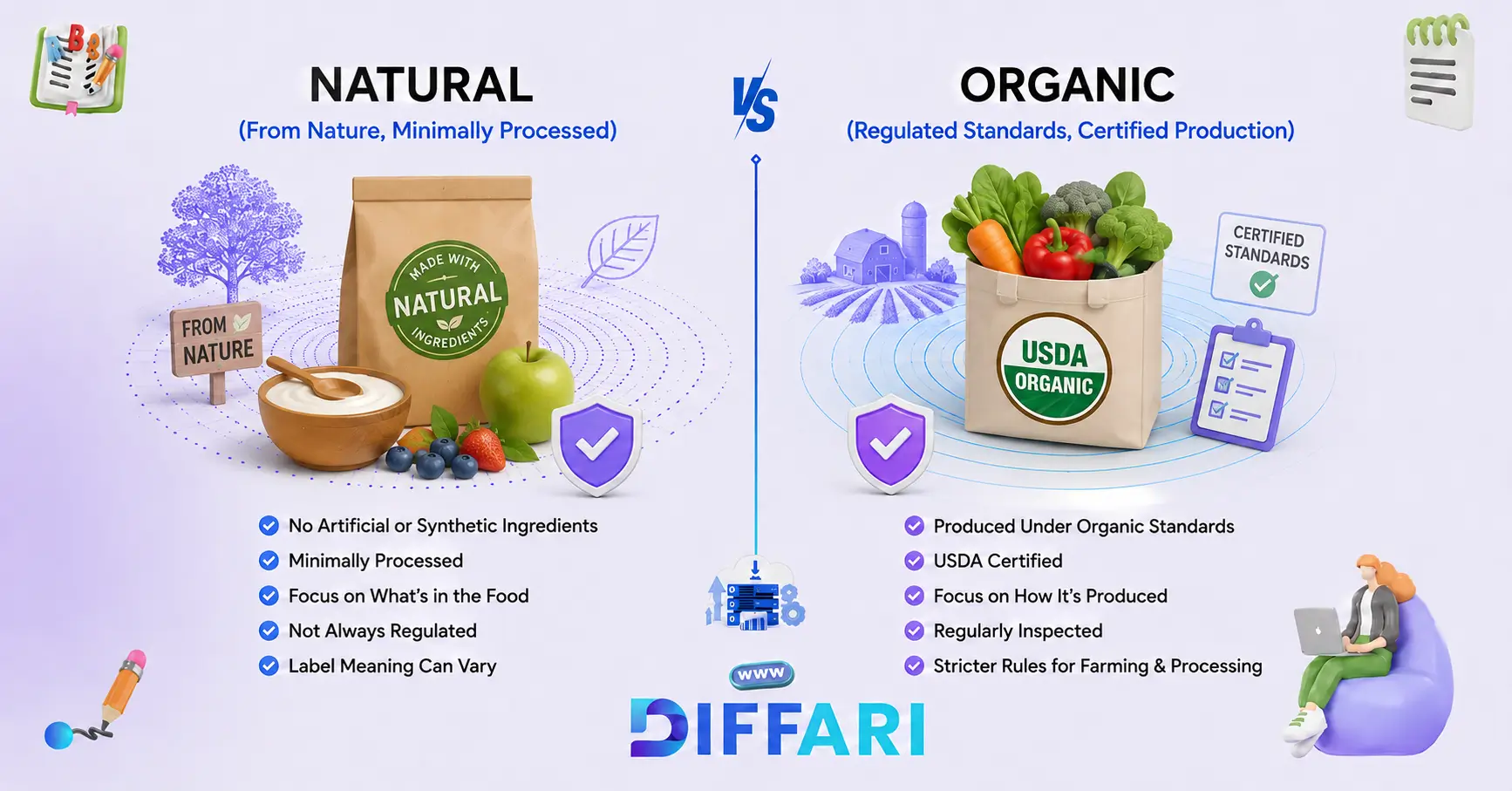

When shopping for food, you may see products labeled natural or organic and assume the two terms mean roughly the same thing. They do not. The difference between natural and organic mainly comes down to what the label is describing and how strongly that claim is regulated.
In the United States, organic is a defined labeling category governed by USDA standards and certification requirements. The term natural is more complicated: FDA has a longstanding policy for the term but has not established a formal regulatory definition for natural food, while USDA has a specific definition for natural meat and poultry.
Understanding this distinction can help you read food labels more accurately and avoid assuming that “natural” automatically means “organic” or that “organic” automatically means healthier.
Quick Answer
Natural generally refers to the absence of artificial or synthetic ingredients under the applicable labeling standard, and for USDA-regulated meat and poultry it also means the product is only minimally processed.
Organic refers to food produced and handled according to specific organic production standards, with certified organic products subject to USDA requirements in the United States.
The simplest way to remember the difference is:
Natural describes certain characteristics of the product or its ingredients, while organic describes a regulated method of agricultural production and handling.
A product can be natural without being organic, and the two terms should not be treated as interchangeable.
Natural vs Organic at a Glance
| Feature | Natural | Organic |
| Basic idea | Generally concerns artificial/synthetic ingredients or processing | Concerns regulated production and handling methods |
| Certification | Depends on product and claim | USDA organic certification applies to regulated organic products |
| Farming practices | Does not generally establish organic farming practices | Organic standards establish specific production requirements |
| Synthetic pesticides | Natural label alone does not establish that they were not used | Organic production restricts prohibited substances and practices |
| Processing | For USDA meat/poultry, only minimally processed | Organic standards also regulate processing and ingredients |
| USDA Organic seal | No | Available for eligible USDA organic products |
| Meaning of “better” | Not necessarily healthier | Not automatically healthier |
| Interchangeable? | No | No |
USDA states that organic is a labeling term indicating that food or another agricultural product has been produced through approved methods, while USDA’s meat and poultry definition of natural focuses on no artificial ingredients or added color and minimal processing.
What Does Natural Mean?
The meaning of natural depends on the food category and the regulatory context.
For human food generally, the FDA has not established a formal definition through rulemaking. Its longstanding policy considers natural to mean that nothing artificial or synthetic, including color additives regardless of source, has been included in or added to a food when such substances would not normally be expected in that food. FDA’s policy does not address farming practices such as pesticide use, nor does it establish a general nutritional or health benefit for foods labeled natural.
For meat and poultry, USDA’s Food Safety and Inspection Service uses a more specific definition. A natural product contains no artificial ingredient or added color and is only minimally processed; the label must explain what the natural claim means.
What “Natural” Does Not Automatically Mean
A natural label does not automatically tell you that:
- the food was grown organically;
- no pesticides were used during farming;
- the product is more nutritious;
- the food contains no processing;
- the food is healthier than every comparable product.
This is one of the most important distinctions when comparing natural and organic.
What Does Organic Mean?
Organic is a regulated labeling term in the United States.
USDA explains that organic products must be produced through approved methods and that organic standards address agricultural production, handling, and processing. The standards are verified by USDA-accredited certifying agents before products can be labeled USDA organic.
Organic production standards restrict practices and substances that are allowed in conventional production. USDA describes organic production as integrating cultural, biological, and mechanical practices that promote resource cycling, ecological balance, and biodiversity.
For products labeled organic, the production system therefore matters—not simply whether the final ingredients appear “natural.”
What Is the Main Difference Between Natural and Organic?
The central difference is scope.
Natural generally addresses what is in the food and, for certain products such as meat and poultry, how minimally it has been processed.
Organic addresses how agricultural products are produced, handled, and processed under a defined regulatory system.
For example, a food ingredient can come from a natural source without having been produced under certified organic farming standards.
That means:
Natural does not automatically equal organic.
And:
Organic does not simply mean “natural.”
The organic label carries a specific regulatory meaning that goes beyond the ordinary idea of something occurring in nature.
Regulation and Certification
This is one of the clearest differences between the two terms.
USDA organic labeling has defined categories. A product labeled “Organic” must contain at least 95% certified organic ingredients, excluding salt and water, subject to additional requirements. Products labeled “100 Percent Organic” meet a higher standard, while products labeled “Made with Organic” must contain at least 70% organically produced ingredients and cannot display the USDA Organic seal.
By contrast, “natural” does not have one equivalent federal certification system covering all foods. FDA has specifically stated that it has not established a formal regulatory definition for natural food labeling, while USDA has its own requirements for natural meat and poultry claims.
So, if you are looking at a U.S. food label, organic generally provides much more information about regulated production practices than the word natural does by itself.
Natural and Organic in Real-World Examples
Example 1: Fresh vegetables
Suppose you see two bags of tomatoes.
One is labeled natural and another is certified organic.
The word natural alone does not establish that the tomatoes were grown under USDA organic standards.
The organic label, however, indicates that the product falls under USDA’s organic production and labeling requirements.
Example 2: Packaged food
Imagine a snack labeled “made with natural ingredients.”
That phrase does not automatically mean the entire product is organic.
A separate organic claim has its own composition and labeling requirements under USDA regulations.
Example 3: Meat
The distinction becomes especially important with meat.
Under USDA’s meat and poultry labeling rules, natural means no artificial ingredient or added color and only minimal processing, with an explanatory statement required on the label.
An organic meat product, on the other hand, must comply with USDA organic production requirements.
Therefore, “natural chicken” and “organic chicken” communicate different information.
Does Natural Mean Healthier?
No—not automatically.
The word natural does not itself establish that a food has superior nutritional value.
FDA’s policy on natural does not establish a special nutritional or health benefit for foods carrying that term.
A food can contain naturally occurring ingredients and still be high in sugar, sodium, calories, or saturated fat.
For that reason, when evaluating whether a food is healthy, look beyond the front-of-package label. Check the:
- Nutrition Facts label
- ingredient list
- serving size
- added sugars
- sodium
- saturated fat
- protein
- fiber
“Natural” is not a substitute for evaluating the actual nutritional profile of a food.
Does Organic Mean Healthier?
Not necessarily.
Organic and healthy are related to different questions.
The organic label primarily tells you that the product meets applicable organic production and handling standards. It does not mean that every organic food is automatically more nutritious than every non-organic alternative.
For example, an organic cookie is still a cookie. The fact that its ingredients meet organic requirements does not automatically make it a nutritionally superior food.
Therefore:
Organic describes production standards; healthy describes nutritional quality and dietary context.
These concepts should not be treated as synonyms.
Common Mistakes With Natural and Organic
Incorrect:
Natural means pesticide-free.
Correct:
A natural label by itself does not establish that a food was produced without pesticides.
Why: Natural and organic address different labeling and production concepts. Organic standards specifically regulate production practices, whereas FDA’s natural policy does not address farming practices such as pesticide use.
Incorrect:
Natural and organic mean the same thing.
Correct:
Natural and organic are different labeling concepts.
Why: Organic has defined USDA production and certification standards, while natural has different regulatory treatment depending on the food category.
Incorrect:
Organic means chemical-free.
Correct:
Organic production restricts specified substances and practices; it does not mean that the food contains no chemicals whatsoever.
Why: Everything around us, including natural substances, consists of chemicals. Organic standards regulate particular substances and production methods rather than eliminating chemistry from food.
Incorrect:
Organic always means healthier.
Correct:
Organic indicates compliance with organic production standards, not an automatic health advantage.
Why: Nutritional quality must be evaluated separately.
Common Collocations With Natural and Organic
Natural
- natural ingredients
- natural food
- natural flavors
- natural products
- all-natural
- natural ingredients
- minimally processed
- natural meat
Organic
- organic food
- organic ingredients
- organic farming
- organic agriculture
- certified organic
- organic produce
- organic meat
- USDA organic
- organic certification
- organic standards
These combinations reflect the different semantic fields surrounding the two words: natural commonly focuses on ingredients and product characteristics, while organic frequently connects with production, agriculture, certification, and standards.
Can Natural and Organic Be Used Interchangeably?
No.
They can appear together on product packaging, but they do not communicate the same information.
A product may have ingredients that are naturally sourced without being produced under organic standards.
Likewise, an organic product is not simply being described as “natural”; the organic claim refers to compliance with specific production and handling requirements.
The safest rule is:
Do not substitute “natural” for “organic” when you specifically mean certified organic production.
How to Remember the Difference
Use this simple memory rule:
Natural = what it is like
Organic = how it was produced
This is not a complete legal definition, but it is a useful way to remember the basic distinction.
Think of it this way:
- Natural: Focuses on ingredients, artificial/synthetic components, or processing characteristics depending on the applicable standard.
- Organic: Focuses on regulated agricultural production and handling.
Which One Should I Use?
When choosing between natural and organic, start by considering what you want to know about the product.
To verify organic production standards, look for an appropriate organic claim and certification information.
For products labeled “natural,” check the specific claim and review the ingredient and Nutrition Facts labels rather than assuming the food is organic.
When nutrition is your main concern, focus on the Nutrition Facts label and ingredient list.
For information about farming practices, look for organic certification or specific production claims.
In other words, do not ask only, “Is this natural or organic?”
Ask:
What information does this particular label actually guarantee?
Natural or Organic? Practice Examples
Choose natural, organic, or neither/depends based on the meaning being described.
- You want to identify food produced under USDA organic standards.
- You see meat labeled as having no artificial ingredients and being minimally processed.
- You want to know whether a product is nutritionally healthy.
- You want to know whether agricultural production followed organic standards.
- You see a product described as natural and assume it is certified organic.
- You want to determine whether a food contains artificial ingredients under an applicable natural claim.
Answers
- Organic — organic labeling is tied to USDA organic standards.
- Natural — this matches USDA’s meat and poultry natural labeling definition.
- Neither label alone — check the Nutrition Facts and ingredient list.
- Organic — organic standards address regulated production methods.
- Incorrect assumption — natural does not automatically mean organic.
- Natural — depending on the applicable product/category standard, the natural claim addresses artificial or synthetic ingredients and related characteristics.
Frequently Asked Questions
What is the difference between natural and organic?
Natural generally concerns artificial or synthetic ingredients and, for certain foods such as meat and poultry, minimal processing. Organic is a regulated labeling category based on specific production and handling standards.
Is natural food organic?
No. A product can be described as natural without meeting USDA organic requirements.
Is organic food natural?
The two terms are not interchangeable. Organic is a specific regulatory production and labeling category rather than simply another word for natural.
Is natural food healthier than organic food?
Not automatically. Neither word by itself provides a complete assessment of nutritional quality.
Does natural mean pesticide-free?
No. A natural claim by itself does not establish that a food was produced without pesticides. FDA’s natural policy does not address agricultural production methods such as pesticide use.
Does organic mean chemical-free?
No. Organic standards restrict particular substances and production practices; they do not mean that organic food contains no chemicals.
What does USDA Organic mean?
It indicates that the product meets applicable USDA organic standards. For packaged products labeled “Organic,” USDA generally requires at least 95% certified organic ingredients, excluding salt and water, along with other requirements.
What does natural mean on meat?
For USDA-regulated meat and poultry, natural means the product contains no artificial ingredient or added color and is only minimally processed. The label must include a statement explaining the natural claim.
Can a product be both natural and organic?
Yes, a product can carry both types of claims when the applicable requirements are satisfied. However, the claims communicate different information and should not be treated as synonyms.
Conclusion
The difference between natural and organic is mainly about what each term tells you. Natural generally concerns artificial or synthetic ingredients and, for USDA-regulated meat and poultry, minimal processing. Organic refers to a regulated system of agricultural production, handling, and labeling.

Sajid Ali is an English language educator and content specialist with 7+ years of teaching experience. He holds master’s degrees in Information Technology and Education from the Virtual University of Pakistan and writes SEO-optimized, learner-friendly vocabulary content for diffari.com.