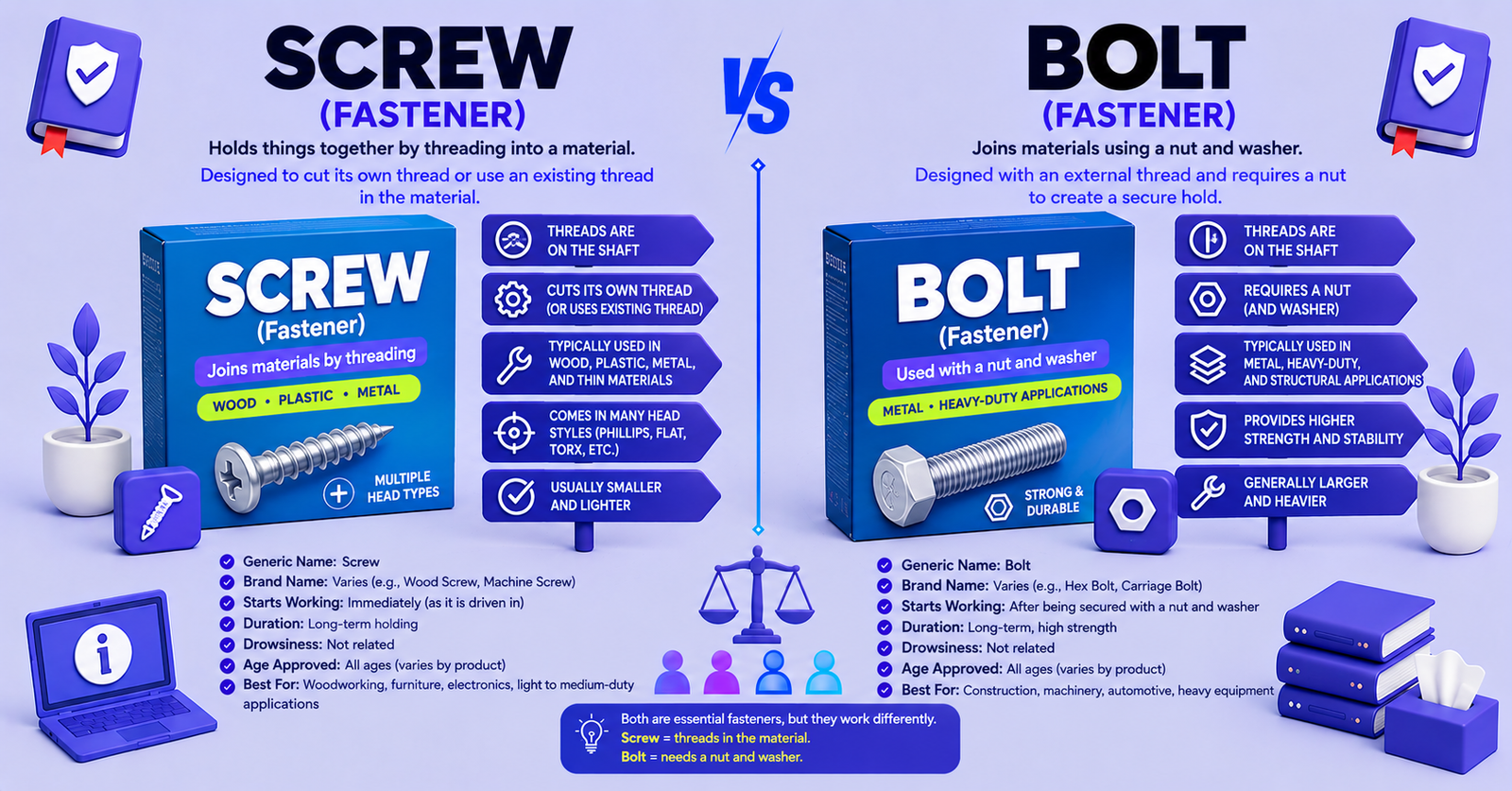

Screws and bolts are both threaded fasteners used to hold materials or components together, so they can look nearly identical. The main difference is how they are designed to engage with the parts being joined and how the joint is normally tightened. A bolt is generally designed to pass through assembled parts and work with a nut, while a screw can engage a preformed internal thread or form its own thread and is normally tightened through its head. In practice, however, the distinction is more nuanced than simply looking for a nut or counting the threads.
Quick Answer
A screw is an externally threaded fastener designed to engage a preformed internal thread or form its own thread in the material, and it is normally tightened by turning its head.
A bolt is an externally threaded fastener designed to pass through holes in assembled parts and is normally tightened or released by turning a nut.
The easiest practical rule is:
Screw → engages the material or a tapped hole.
Bolt → passes through the parts and normally works with a nut.
However, this is a practical shortcut rather than a universal visual rule. Engineering standards use additional design and intended-use criteria to distinguish screws from bolts.
Screw vs Bolt at a Glance
| Feature | Screw | Bolt |
|---|---|---|
| Basic function | Fastens by engaging an internal thread or forming one | Fastens assembled parts, normally with a nut |
| Typical installation | Turn the head | Normally turn the nut |
| Nut required? | Usually not | Normally intended to work with a nut |
| Hole | Tapped, preformed, pilot, or self-forming application | Usually a clearance hole through the joined parts |
| Thread engagement | Engages directly with material or an internal thread | Engages with a separate nut |
| Common applications | Wood, sheet metal, electronics, furniture, machine assemblies | Machinery, structural connections, automotive and other through-joints |
| Main source of holding force | Thread engagement and head clamping | Clamping through bolt-and-nut assembly |
| Appearance | Many head and drive styles | Often hex or other wrench-driven heads |
| Classification | Based on design and intended function | Based on design and intended function |
The table describes common practice rather than an absolute rule. Standards-based definitions focus on how the fastener is designed to function, not simply on whether it happens to have a nut in a particular application.
What Is a Screw?
A screw is an externally threaded fastener that can engage a preformed internal thread or form its own thread in the material being fastened.
Many screws are driven directly through their heads using a screwdriver, bit, hex key, or similar tool. Depending on the type, a screw may have a pointed end, a blunt end, coarse threads, fine threads, or specialized thread geometry.
Common examples include:
- Wood screws
- Machine screws
- Self-tapping screws
- Sheet-metal screws
- Drywall screws
- Deck screws
- Socket-head screws
- Lag screws
A wood screw, for example, can be driven into a prepared hole in wood and hold the material without requiring a separate nut.
A machine screw is different from a wood screw because it normally engages a preformed internal thread, such as a tapped hole or a nut.
How a Screw Holds Material Together
The screw’s threads engage with the material or an existing internal thread. When the screw is tightened, its head presses against the material and creates a clamped connection.
The exact mechanism depends on the screw type and the material.
For example:
The carpenter drove a wood screw into the timber.
Here, the screw engages directly with the wood.
Another example:
The technician installed a machine screw into the tapped aluminum housing.
Here, the screw engages with threads that already exist in the housing.
What Is a Bolt?
A bolt is an externally threaded fastener designed to pass through holes in assembled parts and is normally intended to be tightened or released by turning a nut.
A typical bolt assembly may include:
- Bolt
- Nut
- Washer
- Two or more joined components
For example:
The mechanic inserted the bolt through the two metal plates and tightened the nut.
The bolt passes through the plates, while the nut engages the bolt’s threads.
Bolts are common in machinery, automotive assemblies, structural connections, equipment, and other applications where a strong, serviceable joint is required.
What Is the Difference Between a Screw and a Bolt?
The central difference is how the fastener is designed to create the connection.
A screw is capable of engaging a preformed internal thread or creating its own thread and is normally tightened through its head.
A bolt is designed to pass through assembled parts and is normally tightened with a nut.
This distinction is reflected in the ANSI/ASME B18.2.1 terminology reproduced in U.S. government guidance: a bolt is designed for insertion through holes and normally tightened with a nut, while a screw can mate with a preformed internal thread or form its own thread and is tightened through the head.
The Important Exception
It is tempting to memorize:
Screw = no nut
Bolt = nut
That is useful for everyday projects, but it is not a complete engineering definition.
Some screws can be used with nuts. Some fasteners that look like bolts can technically fall under screw classifications depending on their design and intended application. U.S. Customs guidance based on ANSI/ASME B18.2.1 describes multiple primary and supplementary criteria for making the distinction.
Therefore, a nut is an important clue, but not the only criterion.
Threaded Hole vs Clearance Hole
One of the most useful practical differences is the type of hole involved.
Screw and a Tapped Hole
A screw can be installed into a tapped hole containing internal threads.
For example:
A machine screw threads into the tapped hole in the metal bracket.
The internal threads grip the screw.
Bolt and a Clearance Hole
A bolt normally passes through a clearance hole. The hole is large enough for the bolt’s body to pass through, and the nut on the opposite side engages the bolt’s external threads.
For example:
The bolt passes through both plates, and the nut is tightened on the other side.
This distinction helps explain why bolts and screws can perform similar jobs while using different fastening systems.
Are Bolts Stronger Than Screws?
There is no universal answer that says all bolts are stronger than all screws.
Strength depends on factors such as:
- Fastener diameter
- Fastener material
- Grade
- Thread design
- Thread engagement
- Joint design
- Applied load
- Base material
- Torque
- Vibration
- Installation quality
A properly selected screw can create a very strong joint. A poorly selected or poorly installed bolt can also produce a weak connection.
The more useful question is:
Which fastener is appropriate for this particular joint?
For heavily loaded through-connections, bolts are often appropriate because a bolt-and-nut assembly can produce substantial clamping force across the joined components.
For many woodworking, sheet-metal, furniture, and general assembly applications, screws are convenient because they can engage directly with the material or an existing internal thread.
When to Use a Screw
A screw is generally appropriate when:
- You need to fasten into wood.
- You need to fasten sheet metal.
- The material has a suitable tapped hole.
- You want the fastener to engage directly with the material.
- Access to the opposite side is limited.
- You want a relatively simple installation.
- A separate nut is unnecessary.
Example
Suppose you are attaching a wooden shelf bracket to a wooden wall support.
A suitable screw can be driven into the wood without needing access to the back side of the assembly.
That is one reason screws are extremely common in woodworking and furniture assembly.
When to Use a Bolt
A bolt is generally appropriate when:
- The joint can accommodate a through-hole.
- A nut can be installed on the opposite side.
- Strong clamping is required.
- The assembly needs to be repeatedly disassembled.
- The application involves machinery or structural components.
- The joint design calls for a conventional bolt-and-nut connection.
Example
Suppose two steel plates need to be clamped together.
A bolt can pass through both plates, with a washer and nut on the opposite side. Tightening the nut draws the plates together.
This arrangement is common in mechanical and structural applications.
Screw and Bolt Examples
Example 1: Wooden Furniture
I used screws to attach the wooden panels.
Why?
The screws can engage directly with the wood, so a separate nut is unnecessary.
Example 2: Steel Plates
The workers joined the plates with bolts and nuts.
Why?
The bolts pass through the plates and the nuts provide the threaded engagement.
Example 3: Machine Housing
The technician inserted machine screws into the tapped holes.
Why?
The housing already contains internal threads.
Example 4: Structural Assembly
The steel members were connected using bolts and nuts.
Why?
The connection is designed around through-holes and a clamped joint.
Common Mistakes With Screws and Bolts
Mistake 1: Assuming Every Hex-Head Fastener Is a Bolt
Incorrect assumption:
“It has a hex head, so it must be a bolt.”
Why this is unreliable:
Head shape alone does not determine whether an externally threaded fastener is classified as a screw or bolt.
Fastener standards consider design and intended function, not just appearance.
Mistake 2: Saying Bolts Always Need Nuts
Oversimplified statement:
“A bolt is any threaded fastener that has a nut.”
Why it can be misleading:
A nut is a strong practical clue, but formal classification can involve additional criteria.
Mistake 3: Saying Screws Are Always Smaller
Incorrect assumption:
“Small fasteners are screws and large fasteners are bolts.”
Why it is wrong:
Size alone does not establish the classification.
Mistake 4: Saying Bolts Are Always Stronger
Incorrect assumption:
“Bolts are stronger because bolts are bigger.”
Why it is misleading:
Strength depends on material, diameter, grade, joint design, thread engagement, loading, and installation.
Mistake 5: Using Thread Length as the Only Rule
Some people use:
Fully threaded = screw
Partially threaded = bolt
This can be a useful visual tendency, but it is not a universal classification rule. Current engineering references show that fastener identification involves more than simply checking whether the shank is fully threaded.
Can Screws and Bolts Be Used Interchangeably?
Sometimes, but not automatically.
The correct choice depends on the joint.
A screw designed for a tapped hole may not be appropriate for a through-hole-and-nut connection. Likewise, replacing a specified structural bolt with an ordinary screw can change the mechanical behavior of the joint.
Before substituting one for another, consider:
- Diameter
- Thread specification
- Material
- Strength grade
- Thread engagement
- Hole size
- Joint design
- Load
- Vibration
- Required torque
- Applicable engineering standards
For critical mechanical or structural connections, the specified fastener should be used rather than making a substitution based only on appearance.
Common Collocations With Screw and Bolt
Screw
- tighten a screw
- loosen a screw
- drive a screw
- screw head
- screw thread
- machine screw
- wood screw
- self-tapping screw
- screw hole
- screw driver / screwdriver
Bolt
- tighten a bolt
- loosen a bolt
- bolt and nut
- bolt hole
- bolt head
- bolt thread
- hex bolt
- structural bolt
- carriage bolt
- bolt connection
How to Remember the Difference
Use this practical memory rule:
A screw engages the material or an internal thread; a bolt normally passes through the parts and works with a nut.
Think of the installation:
Screw: turn the head → the screw engages the material or internal thread.
Bolt: pass it through the parts → install the nut → tighten the joint.
Remember that this is a practical shortcut, not a complete standards-based classification test.
Which One Should I Use?
Use a screw when:
- You are fastening into wood or another suitable substrate.
- You have a tapped hole.
- You cannot easily reach the opposite side.
- You want direct thread engagement.
Use a bolt when:
- The fastener will pass through the joined parts.
- A nut can be installed.
- The joint is designed around a bolt-and-nut connection.
- You need the characteristics of a conventional bolted joint.
Simple Decision Guide
A fastener designed to engage a tapped hole or form its own thread is generally a screw.
A bolt typically passes through the assembled parts and is secured with a nut.
For structurally or mechanically critical applications, follow the specified fastener standard rather than relying on appearance alone.
Screw or Bolt? Practice Examples
Choose screw or bolt.
- I used a ___ to attach the wooden board.
- The mechanic passed the ___ through the metal plates and tightened the nut.
- The technician installed a machine ___ into the tapped hole.
- The construction crew connected the steel members using ___ and nuts.
- I need a fastener that can be driven directly into the wood.
- The assembly has a clearance hole and room for a nut on the back.
- The aluminum housing already has internal threads.
- The joint specification calls for a particular structural fastener and nut.
Answers
- Screw
- Bolt
- Screw
- Bolts
- Screw
- Bolt
- Screw
- Bolt
These answers reflect the typical practical applications described above; specialized fastener classification can depend on the exact design and applicable standard.
Frequently Asked Questions
What is the main difference between a screw and a bolt?
A screw is designed to engage a preformed internal thread or form its own thread and is normally tightened through its head. A bolt is designed to pass through assembled parts and is normally tightened with a nut.
Does a bolt always need a nut?
Not necessarily as an absolute rule. A nut is a defining feature of many conventional bolt applications, but formal fastener classification is more nuanced than simply checking whether a nut happens to be present.
Are screws and bolts the same thing?
No. They are both externally threaded fasteners, but they are designed for different fastening arrangements. Their names can sometimes overlap in everyday usage.
Are bolts stronger than screws?
Not automatically. Strength depends on the fastener material, dimensions, grade, threads, joint design, loading, and installation.
Can a screw be used with a nut?
Yes, some screws can be used with nuts. The presence of a nut by itself does not necessarily change the underlying fastener classification.
Are all screws pointed?
No. Many screws have pointed ends, especially screws designed to enter materials directly, but machine screws and other types can have blunt ends.
Are bolts always partially threaded?
No. Partial threading is common in many bolts, but thread length alone is not a universal way to distinguish bolts from screws.
Which is better, a screw or a bolt?
Neither is universally better. The appropriate choice depends on the material, joint design, load, access, required strength, installation method, and applicable specification.
Conclusion
The difference between a screw and a bolt is mainly about how the fastener is designed to create and maintain the joint. A screw can engage a preformed internal thread or form its own thread and is normally tightened through its head. A bolt is designed to pass through assembled parts and is normally used with a nut.
For everyday work, remember: screws commonly engage the material or a tapped hole, while bolts commonly pass through the parts and clamp them with a nut. For engineering or structural applications, however, use the applicable fastener specification rather than relying only on appearance, thread length, or whether a nut is present.

Sajid Ali is an English language educator and content specialist with 7+ years of teaching experience. He holds master’s degrees in Information Technology and Education from the Virtual University of Pakistan and writes SEO-optimized, learner-friendly vocabulary content for diffari.com.