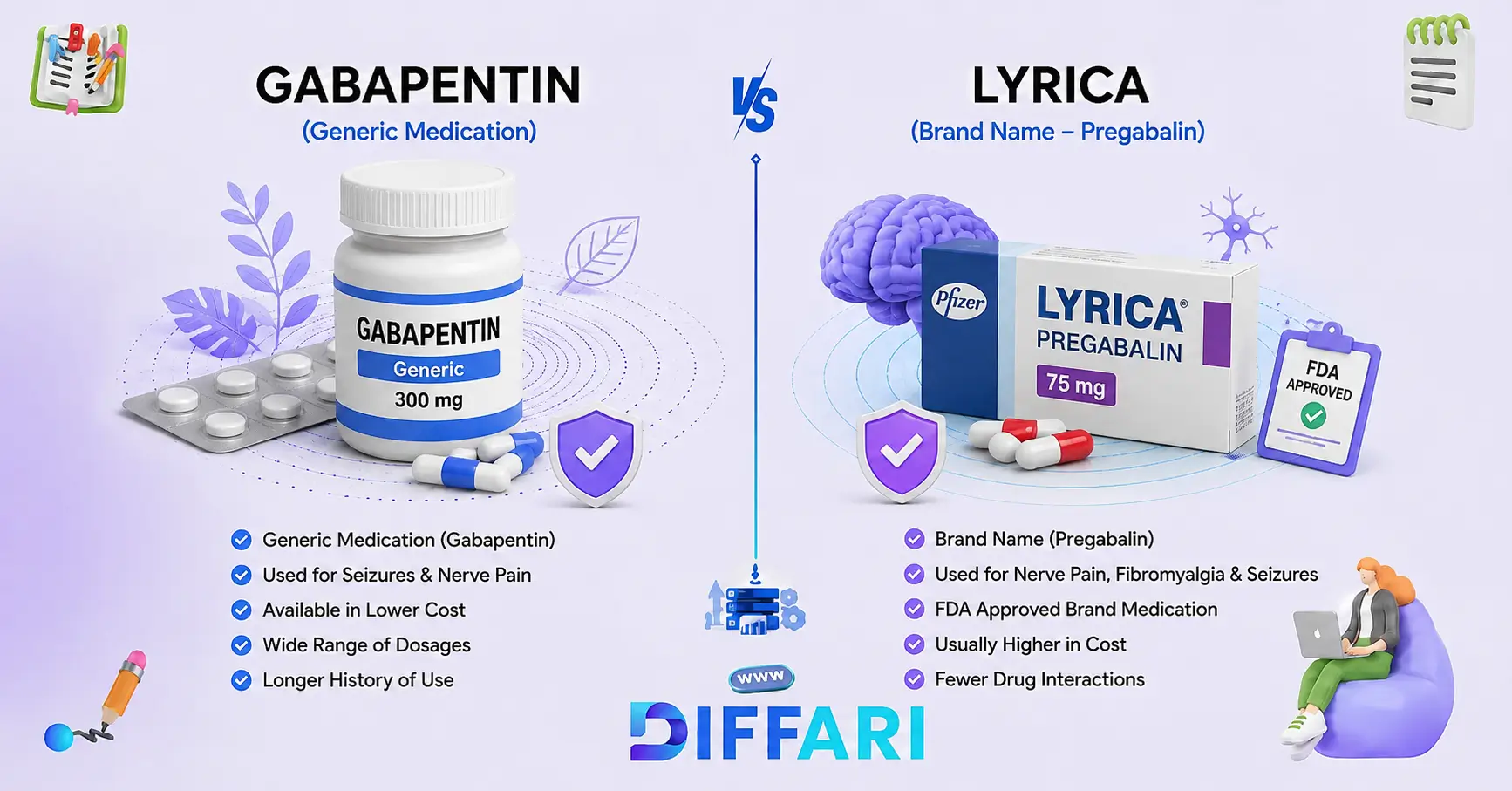

Gabapentin and Lyrica often come up in the same conversations because they belong to the same medication family and can treat certain types of nerve pain and seizures. However, they are not the same drug. Gabapentin is the active ingredient in medications such as Neurontin, while Lyrica is the brand name for pregabalin.
Both medications have related mechanisms of action, but they differ in their approved uses, absorption, dosing, formulations, and controlled-substance status in the United States.
Understanding these differences matters when someone wants to know whether gabapentin and Lyrica are interchangeable or whether Lyrica simply represents a stronger version of gabapentin.
Quick Answer
Gabapentin and Lyrica (pregabalin) are different but closely related medications. Both drugs belong to the gabapentinoid class and affect the alpha-2-delta subunit of voltage-gated calcium channels.
The main difference involves their absorption, dosing, and FDA-approved uses. Pregabalin generally has more predictable absorption than gabapentin. The FDA approves Lyrica for diabetic peripheral neuropathy, postherpetic neuralgia, partial-onset seizures, fibromyalgia, and neuropathic pain associated with spinal cord injury. Standard gabapentin capsules have FDA-approved indications for postherpetic neuralgia and adjunctive treatment of partial-onset seizures.
Neither medication automatically works better or feels stronger for every person or condition.
Gabapentin vs. Lyrica at a Glance
| Feature | Gabapentin | Lyrica (Pregabalin) |
| Active ingredient | Gabapentin | Pregabalin |
| Drug class | Gabapentinoid | Gabapentinoid |
| Common brand association | Neurontin | Lyrica |
| FDA-approved pain use | Postherpetic neuralgia | Several neuropathic pain conditions |
| Seizure use | Partial-onset seizures | Partial-onset seizures |
| Fibromyalgia | Not an FDA-approved indication | FDA-approved indication |
| Absorption | Less predictable at higher doses | More predictable |
| U.S. federal controlled status | Not federally scheduled | Schedule V |
| Kidney function | Dose adjustment may be necessary | Dose adjustment may be necessary |
The FDA-approved indications above reflect current U.S. labeling for standard gabapentin capsules and Lyrica.
What Is Gabapentin?
Gabapentin is a prescription medication that doctors use for certain seizure disorders and nerve pain.
The FDA labels standard gabapentin capsules for:
- Postherpetic neuralgia
- Adjunctive treatment of partial-onset seizures
Doctors also prescribe gabapentin for other conditions on an off-label basis. An off-label use means a clinician uses an approved medication for a purpose that does not appear in its FDA-approved labeling.
Patients can obtain gabapentin as a generic medication, and Neurontin is one brand associated with the drug. Different gabapentin formulations can have different dosing and pharmacokinetic characteristics, so patients should not automatically treat every gabapentin product as interchangeable.
People with reduced kidney function may need lower or less frequent doses because the kidneys help eliminate gabapentin from the body.
What Is Lyrica?
Lyrica is the brand name for pregabalin.
The FDA approves Lyrica for:
- Neuropathic pain associated with diabetic peripheral neuropathy
- Postherpetic neuralgia
- Adjunctive treatment of partial-onset seizures
- Fibromyalgia
- Neuropathic pain associated with spinal cord injury
Patients can also obtain pregabalin as a generic medication.
In the United States, federal law classifies Lyrica and pregabalin as Schedule V controlled substances. Standard gabapentin does not have the same federal scheduling under the Controlled Substances Act, although individual states can impose additional requirements.
What Is the Difference Between Gabapentin and Lyrica?
The most important differences involve their active ingredients, approved uses, pharmacokinetics, dosing, and legal classification.
1. They contain different active ingredients
Gabapentin contains gabapentin.
Lyrica contains pregabalin.
The two drugs have related pharmacological effects, but pregabalin does not simply represent another brand name for gabapentin.
2. Their FDA-approved uses differ
This difference matters when doctors select treatment for a particular condition.
The FDA approves standard gabapentin capsules for postherpetic neuralgia and adjunctive treatment of partial-onset seizures.
The FDA gives Lyrica a broader U.S. label that includes diabetic peripheral neuropathy, postherpetic neuralgia, partial-onset seizures, fibromyalgia, and neuropathic pain associated with spinal cord injury.
Doctors can prescribe either medication for off-label uses when they consider it clinically appropriate, but patients should distinguish those uses from FDA-approved indications.
3. Pregabalin has more predictable absorption
The drugs also differ in how the body absorbs them.
Research shows that pregabalin reaches high and predictable bioavailability after oral administration. Gabapentin, in contrast, shows decreasing bioavailability as the dose increases.
This pharmacokinetic difference helps explain why people should never treat equal milligram amounts of gabapentin and pregabalin as equivalent doses.
4. Their dosing systems differ
Gabapentin and pregabalin use different dosing recommendations.
Current gabapentin labeling describes dosing schedules that can involve three daily doses for several approved indications.
Lyrica dosing varies according to the condition and can involve two or three daily doses. Doctors also adjust the dose for adults with reduced kidney function.
Therefore, never convert gabapentin to Lyrica by simply matching the number of milligrams.
A healthcare professional should determine an appropriate regimen when someone switches between these medications.
5. Their controlled-substance status differs
U.S. federal law classifies Lyrica/pregabalin as a Schedule V controlled substance.
Federal law does not place standard gabapentin under the same controlled-substance schedule.
However, some U.S. states have additional rules for gabapentin, so federal classification does not necessarily describe every state requirement.
When Is Gabapentin Used?
Doctors may prescribe gabapentin for:
- Postherpetic neuralgia
- Adjunctive treatment of partial-onset seizures
- Other conditions through off-label prescribing
Doctors consider the patient’s condition, kidney function, other medications, and treatment response when selecting a dose.
When Is Lyrica Used?
Doctors may prescribe Lyrica/pregabalin for:
- Diabetic peripheral neuropathy
- Postherpetic neuralgia
- Partial-onset seizures
- Fibromyalgia
- Neuropathic pain associated with spinal cord injury
The specific condition, kidney function, other medications, and individual response all influence treatment decisions.
Gabapentin and Lyrica in Real-World Use
Doctors commonly discuss both medications in relation to neuropathic pain, but research does not support the simple idea that Lyrica always works better.
Systematic reviews and clinical studies show that both pregabalin and gabapentin can reduce certain types of neuropathic pain compared with placebo. However, researchers have found different results across studies and patient groups.
Some comparative studies have reported greater pain reduction with pregabalin in particular populations. That finding does not mean pregabalin will work better for every patient or every type of pain.
Doctors therefore choose between these medications based on the condition, patient factors, tolerability, kidney function, other medications, and treatment response.
Is Lyrica Stronger Than Gabapentin?
Not necessarily.
People often describe medications as “stronger,” but that description oversimplifies the differences between gabapentin and pregabalin.
Pregabalin generally has more predictable absorption than gabapentin, but that characteristic does not mean it will provide better results for every patient.
A more accurate statement is:
Pregabalin has more predictable absorption than gabapentin, but neither medication is universally more effective or stronger.
Side Effects of Gabapentin and Lyrica
Both medications can affect the central nervous system and cause similar side effects.
People commonly experience:
- Dizziness
- Drowsiness
- Fatigue
- Blurred or double vision
- Swelling in the extremities
- Difficulty with coordination
- Weight gain
The frequency and severity of these effects can vary according to the medication, dose, formulation, and individual patient.
Important Safety Point
The FDA warns that gabapentin and pregabalin can cause serious breathing problems in people with certain respiratory risk factors.
The risk can increase when people combine either medication with opioids or other central nervous system depressants. Older adults and people with impaired respiratory function may also face higher risk.
Anyone taking gabapentin or pregabalin should discuss other sedating medications with a healthcare professional.
Common Mistakes With Gabapentin and Lyrica
Incorrect:
Lyrica is just the brand name for gabapentin.
Correct:
Lyrica is a brand name for pregabalin.
Why: Gabapentin and pregabalin contain different active ingredients, although both belong to the gabapentinoid family.
Incorrect:
300 mg of gabapentin equals 300 mg of Lyrica.
Correct:
Gabapentin and pregabalin have different dosing systems and should not be converted by matching milligrams.
Why: Their pharmacokinetic properties and dosing recommendations differ.
Incorrect:
Lyrica is always stronger than gabapentin.
Correct:
Pregabalin has different pharmacokinetic properties, but its effectiveness depends on the condition and the individual.
Why: Clinical response varies among patients and conditions.
Incorrect:
Everyone can switch from gabapentin to Lyrica using the same dose.
Correct:
A healthcare professional should determine the appropriate dose when switching medications.
Why: The drugs have different dosing systems, and kidney function can affect the appropriate dose.
Common Collocations With Gabapentin and Lyrica
Gabapentin
Common medical phrases include:
- gabapentin dose
- gabapentin side effects
- gabapentin for nerve pain
- gabapentin withdrawal
- gabapentin treatment
- gabapentin capsules
Lyrica / Pregabalin
Common phrases include:
- Lyrica dose
- Lyrica side effects
- pregabalin for nerve pain
- pregabalin dosage
- Lyrica treatment
- pregabalin capsules
These phrases describe common ways people and healthcare sources discuss the medications; they do not imply that every use represents an FDA-approved indication.
Can Gabapentin and Lyrica Be Used Interchangeably?
No—not automatically.
Although both medications belong to the gabapentinoid family, they have different active ingredients, approved indications, pharmacokinetic properties, dosing recommendations, and regulatory classifications.
A doctor may decide to switch a patient from one medication to the other. However, the patient should follow a specific treatment plan rather than substitute one medication at the same milligram dose.
Both drugs also require attention to kidney function when clinicians determine appropriate dosing.
How to Remember the Difference
Use this simple rule:
Gabapentin = gabapentin
Lyrica = pregabalin
Then remember:
Same family, different drug.
This distinction prevents the most common misunderstanding about the two medications.
Which One Should I Use?
There is no universal answer.
If you mean the active ingredient:
→ Gabapentin = gabapentin
→ Lyrica = pregabalin
If you mean FDA-approved uses:
→ Check the specific condition because the approved indications differ.
If you mean effectiveness:
→ Neither medication is universally better; individual response matters.
If you mean switching medications:
→ Do not make the conversion yourself. Ask a prescriber or pharmacist to determine the appropriate regimen.
If you have reduced kidney function:
→ A healthcare professional may need to adjust the dose.
Gabapentin or Lyrica? Practice Examples
Choose gabapentin or Lyrica/pregabalin based on each statement.
- The medication contains gabapentin as its active ingredient.
- The medication contains pregabalin as its active ingredient.
- The medication has an FDA-approved indication for fibromyalgia.
- The medication has an FDA-approved indication for postherpetic neuralgia.
- U.S. federal law classifies the medication as a Schedule V controlled substance.
Answers
- Gabapentin
- Lyrica/pregabalin
- Lyrica/pregabalin
- Both
- Lyrica/pregabalin
These examples focus on the differences discussed in current U.S. labeling and federal drug classification.
Frequently Asked Questions
What is the difference between gabapentin and Lyrica?
Gabapentin and Lyrica are different medications in the same general drug family. Gabapentin contains gabapentin, while Lyrica contains pregabalin. The drugs differ in their approved uses, dosing, absorption, and U.S. regulatory classification.
Is Lyrica the same as gabapentin?
No. Lyrica is the brand name for pregabalin, not gabapentin.
Is Lyrica stronger than gabapentin?
Not necessarily. Pregabalin has more predictable absorption, but “stronger” does not provide an accurate universal comparison. Effectiveness depends on the condition and individual response.
Are gabapentin and Lyrica used for the same conditions?
They overlap for some conditions, including postherpetic neuralgia and partial-onset seizures. Lyrica also has FDA-approved indications for fibromyalgia, diabetic peripheral neuropathy, and neuropathic pain associated with spinal cord injury.
Can you take gabapentin and Lyrica together?
Do not combine or change these medications without medical supervision. Both drugs can cause central nervous system effects, and the FDA warns about serious breathing problems with gabapentinoids in certain higher-risk situations.
Do gabapentin and Lyrica have the same side effects?
They share several possible side effects, including dizziness and drowsiness. However, the frequency and overall side-effect profile can vary between the two medications and among individual patients.
Is pregabalin the generic name for Lyrica?
Yes. Pregabalin is the generic name for the active ingredient in Lyrica.
Do gabapentin and pregabalin work in the same way?
They have related mechanisms and both affect the alpha-2-delta subunit of voltage-gated calcium channels. However, they remain different medications with different pharmacokinetic and dosing characteristics.
Conclusion
The difference between gabapentin and Lyrica goes beyond their names. Gabapentin and pregabalin are different but closely related gabapentinoid medications. They share a related mechanism of action, but their approved uses, absorption, dosing, and U.S. controlled-substance classifications differ.

Sajid Ali is an English language educator and content specialist with 7+ years of teaching experience. He holds master’s degrees in Information Technology and Education from the Virtual University of Pakistan and writes SEO-optimized, learner-friendly vocabulary content for diffari.com.