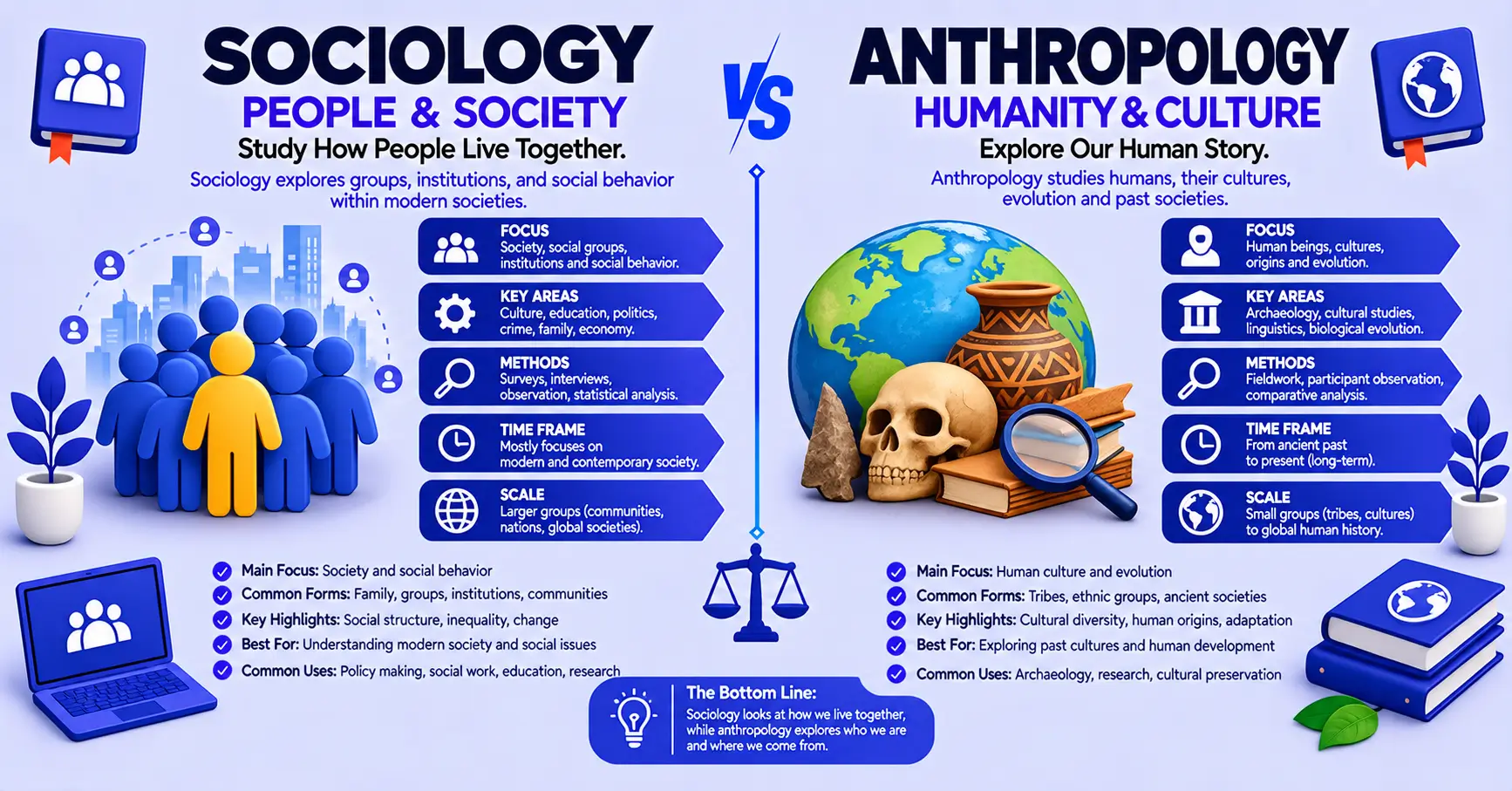

Sociology and anthropology are closely related social sciences that both seek to understand human beings and the ways people live together. The confusion comes from their considerable overlap: both can study culture, inequality, identity, religion, family, migration, communities, and social change.
The main difference is the lens each discipline tends to use. Sociology focuses more directly on social relationships, structures, institutions, groups, and patterns within society. Anthropology takes a broader, holistic approach to humanity, examining culture and human life across different societies, places, and periods, and—depending on the branch—even human biology, language, and archaeology.
The distinction is not absolute. Modern sociologists and anthropologists use overlapping methods and sometimes investigate exactly the same subject from different perspectives.
Quick Answer
Sociology is the systematic study of social life, social relationships, institutions, structures, and social change.
Anthropology is the broader study of humanity, including human cultures, biological development, language, archaeology, and human life across time and place.
The simplest practical distinction is this:
Sociology tends to ask how society and its structures shape people and social behavior, while anthropology tends to ask how human beings live, create meaning, adapt, and differ across cultures and contexts.
However, this should be treated as a useful guide rather than a strict dividing line. Sociologists can conduct ethnographic fieldwork, and anthropologists can study large-scale contemporary issues and use quantitative evidence.
Sociology vs Anthropology at a Glance
| Aspect | Sociology | Anthropology |
| Main focus | Social life, relationships, structures, and institutions | Humanity, culture, human diversity, and human development |
| Typical perspective | Social systems and patterns | Holistic and comparative |
| Common topics | Inequality, family, education, crime, class, politics | Culture, language, human evolution, customs, kinship, archaeology |
| Common methods | Surveys, statistics, interviews, ethnography, content analysis | Ethnography, participant observation, interviews, comparative research, and other methods |
| Time perspective | Often emphasizes contemporary social life | Can examine past and present |
| Major subfields | Vary by institution and specialization | Cultural, biological, linguistic, and archaeological anthropology in the U.S. four-field tradition |
| Typical question | How does society influence behavior? | How do humans live, adapt, communicate, and create meaning? |
The table describes common tendencies rather than rigid rules. The two disciplines overlap considerably in both subject matter and research methods.
What Is Sociology?
Sociology is the systematic study of social life. It examines how people interact, how groups and institutions operate, how societies change, and how social structures influence individual and collective behavior.
The American Sociological Association describes sociology as the scientific study of social life and notes that sociologists investigate subjects such as family, crime, politics, race, gender, and social class. Sociological research can use statistical analysis, surveys, ethnography, conversational analysis, content analysis, and other research approaches.
A sociologist might investigate questions such as:
- Why does educational inequality persist?
- How does social class affect opportunity?
- What causes patterns of crime to differ between communities?
- How do social movements produce change?
- How does family structure influence children’s experiences?
- How do organizations affect people’s behavior?
Sociology therefore often pays close attention to patterns and relationships within society.
Common Areas of Sociology
Sociology can include the study of:
- social class
- inequality
- race and ethnicity
- gender
- family
- education
- religion
- politics
- crime and deviance
- organizations
- work
- communities
- social movements
- globalization
- social change
For example, if researchers want to understand why students from different socioeconomic backgrounds have different educational outcomes, a sociological study might examine income, schools, family circumstances, institutional policies, social networks, and broader patterns across a population.
What Is Anthropology?
Anthropology is the study of humanity in a broad and holistic sense.
The American Anthropological Association describes anthropology as encompassing different approaches to human experience, including biological bodies and genetics, human history, present-day communities, language, cultural practices, and social organization. In the U.S. tradition, four major fields are commonly identified: biological anthropology, archaeology, cultural anthropology, and linguistic anthropology.
An anthropologist might ask:
- How do different cultures understand family?
- How have humans adapted biologically to different environments?
- How does language influence identity?
- What can archaeological remains reveal about past societies?
- How do people in a particular community understand health or illness?
- How do cultural traditions change when communities migrate?
This broad scope is one of anthropology’s most important distinguishing features.
The Four Major Fields of Anthropology
1. Cultural Anthropology
Cultural anthropology examines people’s beliefs, practices, values, relationships, customs, and ways of making meaning.
Researchers may spend extended periods learning about a community through fieldwork and participant observation.
2. Biological Anthropology
Biological anthropology examines humans from a biological and evolutionary perspective.
Topics can include human evolution, genetics, adaptation, human biology, and relationships with other primates.
3. Linguistic Anthropology
Linguistic anthropology examines language in relation to culture and social life.
It can explore how people communicate, how language relates to identity, and how speech practices operate within communities.
4. Archaeological Anthropology
Archaeological anthropology uses material evidence to understand people and societies of the past.
Artifacts, settlements, tools, human remains, and other archaeological evidence can help researchers reconstruct earlier ways of life.
This four-field structure helps explain why anthropology can extend beyond subjects normally associated with sociology.
What Is the Main Difference Between Sociology and Anthropology?
The clearest difference is scope and perspective.
Sociology primarily examines social relationships, structures, institutions, groups, and patterns of social life.
Anthropology takes a more holistic view of humanity, potentially combining cultural, biological, linguistic, and archaeological perspectives.
But there is an important qualification: sociology is not limited to large populations, and anthropology is not limited to small communities or ancient cultures.
For example, a sociologist can conduct ethnographic research by observing people in a particular community. Likewise, an anthropologist can study urban life, technology, globalization, organizations, or other contemporary issues.
So the best distinction is not:
Sociology = modern society
Anthropology = ancient society
Instead, think:
Sociology emphasizes social structures and patterns, while anthropology emphasizes a broader, contextual understanding of humanity and cultural variation.
Difference in Scope
Sociology generally concentrates on social life and the relationships between individuals, groups, and institutions.
Anthropology has a wider disciplinary scope because it can include:
- culture
- biology
- language
- archaeology
- human evolution
- social organization
- material culture
- human diversity
The American Anthropological Association explicitly describes anthropology as a discipline concerned with human life across time, space, and social settings.
This means anthropology can move from studying ancient human ancestors to contemporary cultural practices, depending on the specialization.
Difference in Research Methods
Both disciplines use multiple research methods, so it would be inaccurate to say that sociology is “quantitative” and anthropology is “qualitative.”
There are tendencies, however.
Sociology often uses:
- surveys
- statistical analysis
- demographic data
- interviews
- content analysis
- ethnography
- comparative research
The American Sociological Association specifically lists statistical analysis, survey research, ethnography, conversational analysis, and content analysis among sociological research methods.
Anthropology often uses:
- ethnography
- participant observation
- interviews
- fieldwork
- comparative research
- archaeological analysis
- biological analysis
- linguistic analysis
Participant observation and immersive fieldwork are particularly associated with cultural anthropology, although anthropological research methods vary substantially by subfield.
The important point
The methods overlap.
A sociologist can conduct ethnographic fieldwork, and an anthropologist can use quantitative data. Current scholarship and educational resources increasingly emphasize this methodological overlap.
Difference in Time and Cultural Perspective
Another common distinction concerns time.
Sociology often emphasizes contemporary societies and current social processes, such as inequality, education, organizations, political behavior, crime, and social change.
Anthropology can examine both past and present, allowing researchers to compare human societies across different historical and cultural settings.
This broader temporal perspective is especially visible in archaeology and biological anthropology.
However, contemporary anthropology is not simply the study of the past. Anthropologists also study present-day communities, cities, technology, language, health, globalization, and other modern phenomena.
How Sociology and Anthropology Overlap
The two disciplines have substantial common ground.
Both can study:
- culture
- identity
- religion
- family
- gender
- race and ethnicity
- inequality
- migration
- globalization
- communities
- power
- social relationships
- social change
This means two researchers could study the same subject while asking different questions.
Example: Migration
A sociologist might examine:
How does migration affect employment, social class, education, or integration across a large population?
An anthropologist might examine:
How do migrants experience identity, family relationships, language, and cultural belonging in their everyday lives?
Neither approach is automatically better. They simply emphasize different dimensions of the same human phenomenon.
A Simple Example of the Difference
Imagine a researcher wants to study a neighborhood.
A sociological approach might ask:
- How does income vary across households?
- What patterns exist in educational attainment?
- How do local institutions influence residents?
- What social factors contribute to inequality?
- How does the neighborhood compare with other communities?
An anthropological approach might ask:
- What does belonging mean to residents?
- How do people understand their traditions?
- How are cultural identities expressed?
- What everyday practices shape community life?
- How do residents interpret changes occurring around them?
In reality, there can be considerable overlap between these questions. The difference lies more in the researcher’s perspective and analytical emphasis than in a fixed list of subjects.
Common Misunderstandings About Sociology and Anthropology
Misunderstanding 1: Sociology only studies modern society
Not exactly.
Sociology commonly emphasizes contemporary social life, but sociological research can examine historical societies, historical documents, social change over time, and long-term social processes.
Misunderstanding 2: Anthropology only studies ancient cultures
Incorrect.
Anthropologists study contemporary communities as well as past societies. The field includes present-day cultural anthropology, linguistic anthropology, biological anthropology, archaeology, and many specialized areas.
Misunderstanding 3: Sociology uses numbers, while anthropology only uses interviews
Too simplistic.
Sociologists use qualitative methods, including ethnography, while anthropologists use a range of qualitative, quantitative, scientific, and comparative approaches depending on their specialization.
Misunderstanding 4: Sociology and anthropology study completely different subjects
No.
Their subject matter overlaps heavily. Culture, inequality, identity, family, religion, migration, and social relationships can all be studied in both disciplines.
Common Terms to Know
| Term | Usually associated with |
| Social structure | Sociology |
| Social institution | Sociology |
| Social inequality | Both |
| Culture | Both, especially anthropology |
| Ethnography | Both |
| Participant observation | Anthropology, but also used in sociology |
| Social change | Both |
| Human evolution | Anthropology |
| Archaeology | Anthropology |
| Linguistic anthropology | Anthropology |
| Statistical analysis | Sociology and many other disciplines |
| Social class | Sociology and anthropology |
| Kinship | Anthropology and sociology |
| Globalization | Both |
The word “usually” matters here. None of these associations should be treated as an exclusive ownership of a subject.
Which Should I Study: Sociology or Anthropology?
The better choice depends on the questions you want to answer.
Choose sociology if you are especially interested in:
- social inequality
- institutions
- education
- crime
- politics
- organizations
- social policy
- social class
- demographic patterns
- contemporary social problems
- broad social trends
Sociology may suit you if you naturally ask:
“How do social structures and institutions influence people’s lives?”
Choose anthropology if you are especially interested in:
- culture
- cross-cultural comparison
- human evolution
- archaeology
- language and culture
- cultural practices
- fieldwork
- human diversity
- communities and lived experience
- how people make meaning
Anthropology may suit you if you naturally ask:
“How do different people live, understand their world, and create meaning within their cultural contexts?”
The choice does not have to be absolute. The two fields overlap significantly, and some academic programs combine them. Current university guidance also emphasizes that students should consider the kinds of questions, methods, and subjects that interest them rather than treating one discipline as universally better.
Can Sociology and Anthropology Be Used Interchangeably?
No, not as names for the same academic discipline.
They are related but distinct fields.
You can, however, use concepts and methods from both disciplines when researching human behavior and society.
For example, a study of religion could be:
- sociological
- anthropological
- historical
- psychological
- political
depending on the research question and theoretical approach.
So the disciplines are overlapping, not interchangeable.
How to Remember the Difference
Use this simple rule:
Sociology → society and social structures
Anthropology → humanity, culture, and human diversity
If you want to understand how institutions, groups, and social systems shape people’s lives, think sociology.
If you want a broader picture of humans across cultures, places, and time, think anthropology.
Remember that this is a shortcut—not a definition that excludes every exception.
Which One Should I Use?
If you are choosing a field of study, think about the questions you most want to explore.
Sociology may be the better fit if you want to study social institutions, inequality, policy, organizations, or large-scale social patterns.
Anthropology is a strong choice for those drawn to culture, human diversity, fieldwork, language, archaeology, or human evolution.
For students interested in both society and culture, either field could be a good fit. A combined or interdisciplinary program may also be worth considering.
Interested in both society and culWhich One Should I Use?
If you are choosing a field of study, think about the questions you most want to explore.
Sociology may be the better fit if you want to study social institutions, inequality, policy, organizations, or large-scale social patterns.
Anthropology is a strong choice for those drawn to culture, human diversity, fieldwork, language, archaeology, or human evolution.
For students interested in both society and culture, either field could be a good fit. A combined or interdisciplinary program may also be worth considering.ture → Either may fit, and a combined or interdisciplinary program may be worth considering.
X or Y? Practice Examples
Choose sociology or anthropology for each situation.
- A researcher analyzes national survey data to study patterns of social inequality.
- A researcher spends an extended period living with a community to understand its cultural practices.
- A researcher studies human evolution using fossil evidence.
- A researcher examines how schools reproduce differences in social class.
- A researcher investigates how language and cultural identity influence one another.
- A researcher studies crime rates across different social groups.
- A researcher investigates an ancient settlement through archaeological remains.
- A researcher studies how a community understands marriage, kinship, and tradition.
Answers
- Sociology — the emphasis is on broad social patterns and inequality.
- Anthropology — immersive cultural fieldwork is strongly associated with cultural anthropology.
- Anthropology — human evolution falls within biological anthropology.
- Sociology — the focus is social institutions and inequality.
- Anthropology — particularly linguistic anthropology.
- Sociology — the focus is on social patterns surrounding crime.
- Anthropology — archaeological anthropology examines material evidence from past societies.
- Anthropology — particularly cultural anthropology, although sociology can study these subjects too.
Frequently Asked Questions
What is the main difference between sociology and anthropology?
Sociology primarily examines social relationships, structures, institutions, and patterns of social life, while anthropology takes a broader approach to humanity, including culture, human diversity, language, biology, and archaeology. The disciplines overlap considerably.
Are sociology and anthropology the same thing?
No. They are separate but closely related social sciences. Both study human behavior and social life, but they traditionally emphasize different perspectives and scopes.
Is anthropology broader than sociology?
In the traditional U.S. four-field model, anthropology has a particularly broad scope because it can include cultural, biological, linguistic, and archaeological study. However, saying that anthropology is simply “broader” should not imply that sociology is narrow; sociology covers a large range of social processes and institutions.
Is sociology more quantitative than anthropology?
Sociology has a strong tradition of quantitative research, including surveys and statistical analysis, but it also uses qualitative methods such as ethnography. Anthropology is strongly associated with qualitative fieldwork, especially participant observation, but anthropologists also use other research methods.
Is anthropology only about ancient cultures?
No. Anthropology includes extensive research on contemporary people and communities. Depending on the specialization, anthropologists may study culture, language, biology, technology, health, cities, migration, or ancient societies.
Which is better, sociology or anthropology?
Neither is universally better. Sociology may be a stronger fit for someone interested in social institutions, inequality, policy, and broad social patterns. Anthropology may be a stronger fit for someone interested in culture, cross-cultural comparison, human evolution, language, archaeology, or immersive fieldwork.
Can sociology and anthropology study the same topic?
Yes. Both can study subjects such as religion, family, gender, migration, inequality, identity, and globalization. The research question, theoretical perspective, and method may differ.
Does anthropology include sociology?
No. Anthropology and sociology are separate disciplines. However, they overlap and frequently draw on related theories, concepts, and research methods.
What is the easiest way to remember the difference?
Think:
Sociology = society and social structures.
Anthropology = humanity, culture, and human diversity.
This shortcut is useful, but remember that both fields can investigate culture, communities, institutions, and social behavior.
Conclusion
The difference between sociology and anthropology is mainly a difference in perspective, scope, and emphasis, not a strict division of subjects.
Sociology tends to focus on social relationships, institutions, structures, groups, and patterns of social life. Anthropology takes a broader and more holistic approach to humanity, examining culture and human diversity and, depending on the subfield, biology, language, archaeology, and human development.

Sajid Ali is an English language educator and content specialist with 7+ years of teaching experience. He holds master’s degrees in Information Technology and Education from the Virtual University of Pakistan and writes SEO-optimized, learner-friendly vocabulary content for diffari.com.