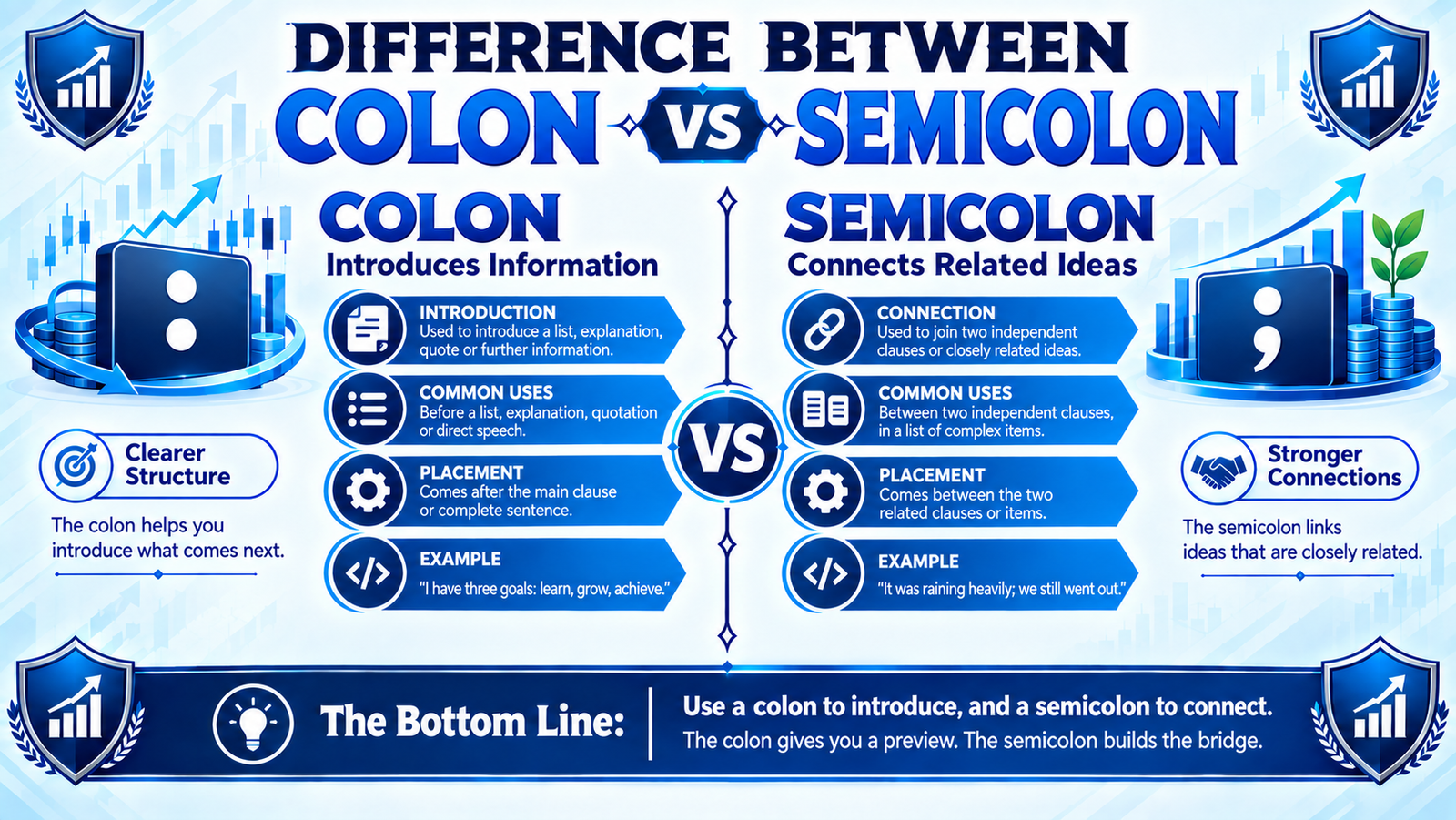
The colon (:) and semicolon (;) look similar, but they perform different jobs in English writing. Both can appear between substantial parts of a sentence, which is why writers often confuse them.
The simplest distinction is this: a colon usually introduces or explains information that follows, while a semicolon connects closely related independent clauses or separates complex items in a list.
For example, a colon works in “She packed three things: a notebook, a pen, and a charger.” A semicolon works in “She packed her bag; then she left for school.”
Understanding the relationship between the parts of the sentence makes choosing the correct mark much easier.
Quick Answer
A colon (:) is mainly used to introduce, explain, identify, or expand on information that comes before it.
A semicolon (;) is mainly used to connect two closely related independent clauses or to separate complicated items in a list.
Simple rule:
Colon = introduces or explains
Semicolon = connects or separates
Compare:
Colon:
I need three things: a pen, paper, and a notebook.
Semicolon:
I need to study; my exam is tomorrow.
The colon points the reader toward information that follows. The semicolon keeps two related complete thoughts together.
Colon vs Semicolon at a Glance
| Feature | Colon (:) | Semicolon (;) |
|---|---|---|
| Main function | Introduces or expands information | Connects closely related independent clauses |
| Before a simple list | Yes, when appropriately introduced | No |
| Between independent clauses | Yes, when the second expands/explains the first | Yes, when the clauses are closely related |
| Complex list items | Usually not as the separator | Yes |
| Introduces an explanation | Yes | No |
| Introduces some quotations | Yes | No |
| Usually followed by a capital letter? | Not necessarily | Usually no |
| Main idea | “Here comes more information” | “These complete ideas belong together” |
The important point is that these marks are not interchangeable simply because they both create a strong break in a sentence.
What Does a Colon Mean?
A colon (:) is a punctuation mark used to introduce material that explains, expands, identifies, illustrates, or provides details about what comes before it.
Think of the colon as pointing forward.
Example
She had one goal: finish the project today.
The phrase “finish the project today” explains what her goal was.
Colons are commonly used before:
- lists
- explanations
- examples
- clarifications
- certain quotations
- rules or principles
- information that directly expands on the preceding statement
Example: Introducing a list
We need four ingredients: flour, eggs, milk, and sugar.
The first part sets up the list.
Example: Introducing an explanation
There was only one problem: we had no money.
The material after the colon explains the problem.
Example: Introducing an expansion
She finally understood the truth: the plan would not work.
The second part expands on “the truth.”
What Does a Semicolon Mean?
A semicolon (;) is primarily used to connect two closely related independent clauses without using a coordinating conjunction.
An independent clause contains a complete thought and can function as a sentence.
Example
The weather was terrible; we stayed home.
Both sides work independently:
The weather was terrible.
We stayed home.
The semicolon shows that the two complete thoughts are closely related.
A semicolon can also separate items in a complicated list when those items already contain commas.
What Is the Difference Between a Colon and a Semicolon?
The central difference is the relationship between the information on each side.
A colon points forward
The material after the colon normally gives the reader something that explains, identifies, illustrates, or expands what came before.
She knew exactly what she needed: more time.
The second part explains what she needed.
A semicolon connects sideways
A semicolon places two independent clauses next to each other because they are closely related.
She needed more time; the deadline was tomorrow.
Both clauses express complete thoughts.
The easiest way to remember it
Colon:
“Here is the explanation.”
Semicolon:
“These two complete thoughts are connected.”
When to Use a Colon
Use a colon when the second part of the sentence is being introduced by the first.
1. Before a List
I bought three things: bread, milk, and eggs.
The words before the colon establish the list.
2. Before an Explanation
He had one concern: the deadline was too close.
The second part explains the concern.
3. Before an Example
She follows one simple rule: always double-check your work.
The material after the colon gives the rule.
4. Before a Formal Quotation
A colon can introduce a quotation when the quotation is not grammatically integrated into the preceding sentence.
The author makes an important point: “Good writing requires careful revision.”
The exact punctuation surrounding quotations can depend on the style guide being followed, so formal academic or professional work should follow its required style.
5. Between a Statement and Its Expansion
There was only one answer: we had to start again.
The second clause expands on the first statement.
When Not to Use a Colon
A common mistake is placing a colon wherever a list appears.
Do not automatically put a colon after an incomplete introductory phrase.
Incorrect
I bought: bread, milk, and eggs.
The phrase “I bought” does not naturally set up the list as a complete statement.
Better
I bought bread, milk, and eggs.
Or:
I bought three things: bread, milk, and eggs.
The second version creates an appropriate introduction before the list.
When to Use a Semicolon
Use a semicolon primarily when you want to connect two closely related independent clauses.
Example
I finished my work; I went home.
Both parts can stand as sentences.
Another example
The store was closed; we went somewhere else.
Again, both sides are complete thoughts.
The semicolon is useful when a period feels too disconnected but a comma would not be grammatically sufficient.
Semicolons With Transitional Words
A semicolon can appear before transitional words such as:
- however
- therefore
- moreover
- nevertheless
- consequently
- meanwhile
- otherwise
Example
The task was difficult; however, we completed it.
The semicolon separates the two independent clauses, while however expresses their relationship.
Another example:
The deadline was approaching; therefore, we worked late.
The semicolon comes before therefore, followed by a comma after the transitional word.
Semicolons in Complex Lists
This is one of the most useful differences between the two marks.
A colon can introduce a list, while semicolons can separate list items when the items themselves contain commas.
Example
The conference attracted speakers from Austin, Texas; Toronto, Ontario; London, England; and Sydney, Australia.
Each location contains a comma.
Using semicolons between the locations makes the boundaries between the individual items much clearer.
So remember:
Colon = introduces the list.
Semicolon = can separate complicated items within the list.
Colon vs Semicolon Between Clauses
This is where the distinction becomes more subtle.
A semicolon can connect two independent clauses:
The rain stopped; we went outside.
A colon can also connect two independent clauses when the second clause explains or expands the first:
We knew what we had to do: we had to leave.
The two punctuation marks therefore cannot be distinguished simply by saying:
“A colon never connects sentences.”
That would be too broad.
The better rule is:
Use a semicolon when two related independent clauses are being connected. Use a colon when the second part specifically explains, expands, identifies, or develops the first.
Colon and Semicolon in Real Sentences
Colon examples
She had one priority: finish the assignment.
The second part identifies her priority.
We need three things: time, patience, and practice.
The colon introduces the list.
He finally discovered the problem: the cable was disconnected.
The second part explains the problem.
Semicolon examples
She finished the assignment; then she went to bed.
Two related thoughts are connected.
The restaurant was full; we decided to eat elsewhere.
Both clauses are complete and closely related.
I wanted to call him; however, it was already late.
The semicolon connects the independent clauses around the transitional word.
Common Mistakes With Colons and Semicolons
Mistake 1: Using a semicolon before a simple list
Incorrect:
I bought three things; bread, milk, and eggs.
Correct:
I bought three things: bread, milk, and eggs.
Why: The punctuation introduces a list, so a colon is appropriate.
Mistake 2: Using a semicolon after a dependent clause
Incorrect:
Although it was raining; we went outside.
Correct:
Although it was raining, we went outside.
Why: “Although it was raining” is not an independent clause. A semicolon cannot normally separate it from the main clause in this way.
Mistake 3: Using a comma where a semicolon is needed
Incorrect:
I finished the report, I sent it to my manager.
This creates a comma splice.
Correct:
I finished the report; I sent it to my manager.
Or:
I finished the report, and I sent it to my manager.
Mistake 4: Treating colon and semicolon as interchangeable
Incorrect:
She had one goal; finish the project.
Correct:
She had one goal: finish the project.
The second part explains what the goal was.
Mistake 5: Capitalizing automatically after a semicolon
Normally, the word after a semicolon begins with a lowercase letter:
The meeting ended; everyone went home.
A capital letter would still be used when the next word normally requires one, such as a proper name.
Common Collocations and Patterns
Instead of thinking about “collocations” in the same way you would for vocabulary words, it is more useful to recognize common punctuation patterns.
Common colon patterns
- one thing:
- the following:
- three reasons:
- one problem:
- the answer is simple:
- remember this rule:
- there is one explanation:
Examples:
There is one problem: we are out of time.
Remember this rule: check the sentence structure first.
Common semicolon patterns
Semicolons frequently occur in structures such as:
Independent clause; independent clause.
Independent clause; however, independent clause.
Independent clause; therefore, independent clause.
Item containing commas; item containing commas; item containing commas.
These patterns are more useful than memorizing isolated examples.
Can a Colon and Semicolon Be Used Interchangeably?
Usually, no.
They can sometimes appear in similar positions, especially when two independent clauses are involved, but they communicate different relationships.
Compare:
She had one choice: leave immediately.
The second part explains the choice.
With:
She had one choice; she left immediately.
The semicolon simply connects two related independent clauses.
Changing the punctuation can therefore change how the reader interprets the relationship between the ideas.
How to Remember the Difference
Use this simple memory strategy:
Colon = Look forward
A colon tells the reader:
“More specific information is coming.”
Example:
I need one thing: your help.
Semicolon = Look sideways
A semicolon tells the reader:
“These two complete thoughts are closely connected.”
Example:
I need your help; the deadline is tomorrow.
One-line memory trick
Colon introduces. Semicolon connects.
That is the easiest starting rule, as long as you remember that a colon can also connect clauses when the second one explains or expands the first.
Which One Should I Use?
When you’re unsure, ask what the second part is doing.
If the second part introduces a list:
Use :
I packed three things: clothes, shoes, and a jacket.
If the second part explains the first:
Use :
She had one problem: she was late.
If both sides are complete, closely related thoughts:
Consider ;
She was late; the meeting had already started.
If the list items contain commas:
Use ; between the items
We visited Paris, France; Rome, Italy; and Madrid, Spain.
Quick decision rule
Am I introducing or explaining something?
→ Colon :
Am I connecting two related complete thoughts?
→ Semicolon ;
Am I separating complicated list items that already contain commas?
→ Semicolon ;
Colon or Semicolon? Practice Examples
Choose the correct punctuation mark.
1.
I need three things ___ a laptop, a charger, and a mouse.
Answer: Colon
I need three things: a laptop, a charger, and a mouse.
2.
The weather was getting worse ___ we decided to go home.
Answer: Semicolon
The weather was getting worse; we decided to go home.
3.
She knew exactly what she wanted ___ more time.
Answer: Colon
She knew exactly what she wanted: more time.
4.
The store was closed ___ however, we found another one nearby.
Answer: Semicolon
The store was closed; however, we found another one nearby.
5.
We visited Dallas, Texas ___ Denver, Colorado ___ and Phoenix, Arizona.
Answer: Semicolons
We visited Dallas, Texas; Denver, Colorado; and Phoenix, Arizona.
6.
There was only one problem ___ nobody had the key.
Answer: Colon
There was only one problem: nobody had the key.
7.
I wanted to continue ___ I was too tired.
Answer: Semicolon
I wanted to continue; I was too tired.
Frequently Asked Questions
What is the main difference between a colon and a semicolon?
A colon (:) generally introduces, explains, identifies, or expands information. A semicolon (;) generally connects closely related independent clauses or separates complex list items.
Can a colon connect two complete sentences?
Yes. A colon can connect independent clauses when the second clause explains, expands, or develops the first.
She knew the truth: he had lied.
Can a semicolon introduce a list?
Not normally as an introductory punctuation mark. A colon is generally used to introduce a list, while semicolons can separate complex list items that already contain commas.
Can I replace a semicolon with a colon?
Not automatically. If the second clause merely provides another closely related complete thought, a semicolon may be appropriate. If it explains or expands the first clause, a colon may be more appropriate.
Are a colon and semicolon the same?
No. They have different grammatical functions, even though both are punctuation marks that can occur between substantial parts of a sentence.
Should I capitalize after a colon?
Not always. In ordinary prose, the word after a colon is often lowercase unless it would normally require capitalization. Some style systems use capitalization in particular situations, so follow the style guide relevant to your writing.
Should I capitalize after a semicolon?
Normally, no. The word after a semicolon usually begins with lowercase unless it is a proper noun or would otherwise require capitalization.
Which punctuation mark introduces a list?
A colon commonly introduces a list when the preceding wording appropriately sets up the list.
Which punctuation mark joins two independent clauses?
A semicolon can join two closely related independent clauses. A colon can also connect independent clauses when the second one explains or expands the first.
Conclusion
The difference between a colon and a semicolon comes down to the relationship between the ideas they separate.
Use a colon (:) when you are introducing, explaining, identifying, or expanding information. Use a semicolon (;) when you are connecting closely related independent clauses or separating complicated list items.
The easiest rule to remember is:
Colon = introduces. Semicolon = connects.
When you’re uncertain, look at what follows the punctuation. If it explains or expands the first part, consider a colon. If it is another complete thought that belongs closely with the first, consider a semicolon.