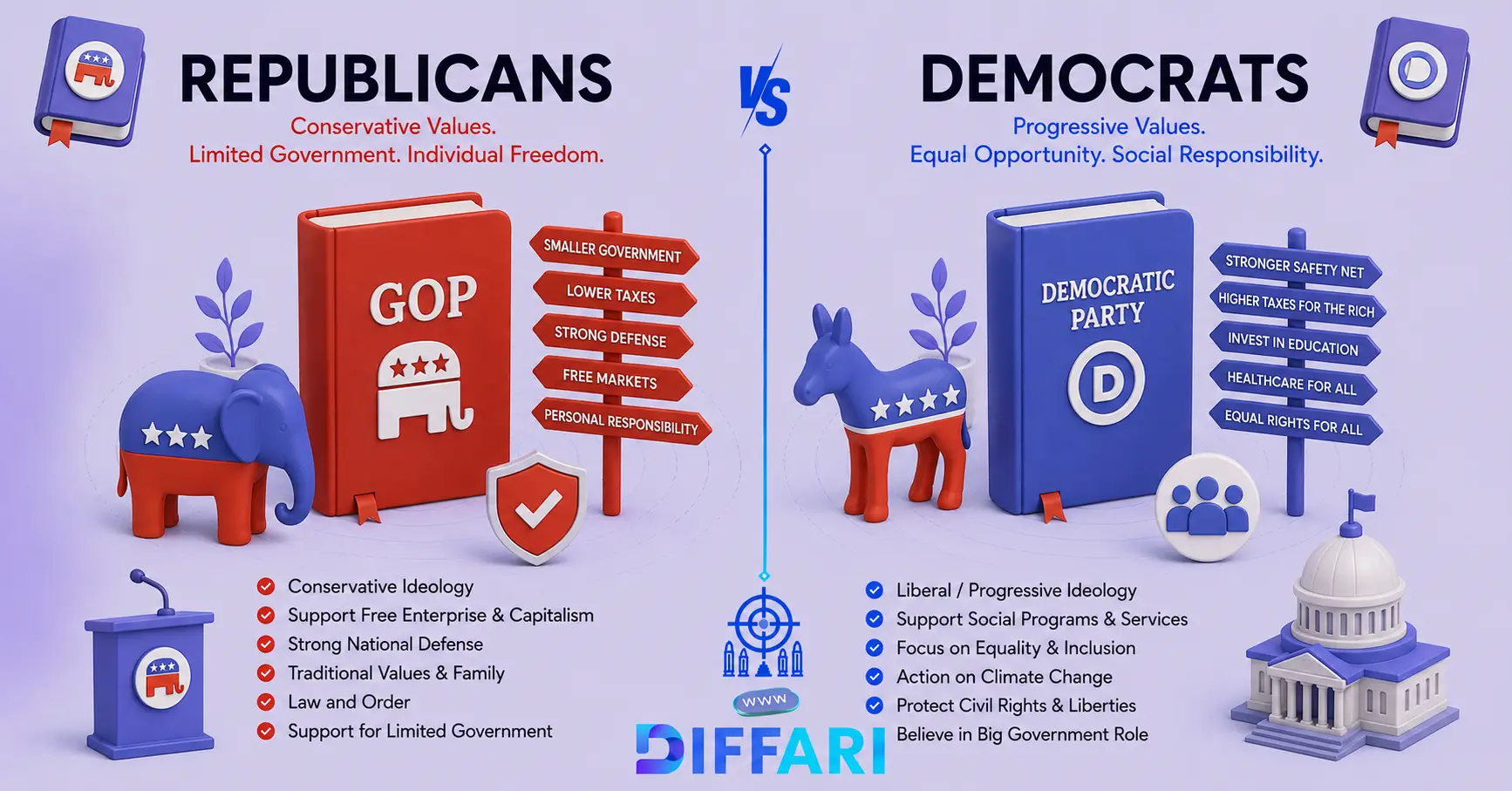
Republicans and Democrats are the two major political parties in the United States, but they generally differ in how they approach government, the economy, social issues, and public policy. Republicans are usually associated with conservative ideas, while Democrats are generally associated with liberal or progressive ideas. However, that summary is only a starting point: both parties contain different factions, and their positions change over time.
The clearest way to understand the difference is to compare what each party generally prioritizes on issues such as taxes, healthcare, immigration, abortion, climate policy, education, crime, regulation, and national defense.
Quick Answer
Republicans generally favor conservative policies, emphasizing lower taxes, less federal regulation, stronger immigration enforcement, gun rights, a strong national defense, and greater emphasis on individual responsibility and state authority.
Democrats generally favor liberal or progressive policies, emphasizing government programs and regulation to address economic and social problems, broader access to healthcare, environmental protection, abortion rights, worker protections, and civil-rights protections.
The biggest difference is often the parties’ views about the role and size of government: Republicans generally prefer a more limited federal role in many areas, while Democrats are generally more willing to use federal programs, spending, and regulation to address social and economic problems. These are broad tendencies, not rules that describe every voter or politician.
Republicans vs Democrats at a Glance
| Issue | Republicans | Democrats |
| General ideology | Conservative | Liberal/progressive |
| Government | Generally favor a more limited federal role | Generally support a more active federal role |
| Taxes | Generally favor lower taxes and tax reductions | Generally more supportive of progressive taxation and public investment |
| Regulation | Generally favor reducing federal regulation | Generally more supportive of regulation in areas such as labor, environment, and consumer protection |
| Healthcare | Emphasize choice, competition, and market-based approaches | Emphasize broader access and government-supported healthcare |
| Immigration | Favor stronger border enforcement and stricter immigration controls | Generally favor border security alongside expanded legal immigration and pathways for some undocumented immigrants |
| Abortion | Generally support more restrictions, while emphasizing state authority | Generally support protecting abortion access |
| Guns | Stronger emphasis on Second Amendment rights | Generally favor additional gun-safety restrictions |
| Climate/environment | Generally emphasize energy production and fewer energy restrictions | Generally emphasize climate action and clean-energy investment |
| Education | Stronger emphasis on parental rights, school choice, and state control | Generally support greater federal investment and public-school programs |
| Labor | More mixed toward unions and generally favor fewer employment regulations | Generally more supportive of unions and worker protections |
| Crime | Generally emphasize policing, enforcement, and public safety | Generally combine enforcement with prevention, rehabilitation, and criminal-justice reform |
| National defense | Generally emphasize military strength | Support a strong military but often place greater emphasis on diplomacy alongside defense |
These are broad comparisons rather than descriptions of every Republican or Democrat. Current party platforms and public opinion can also differ from one election cycle to another.
What Is the Republican Party?
The Republican Party, often called the GOP, is one of the two major political parties in the United States. Modern Republicans are generally associated with conservatism, although the party contains different ideological factions.
The party’s 2024 platform emphasized border security and immigration enforcement, tax reductions, deregulation, domestic manufacturing, expanded energy production, school choice, gun rights, a strong military, and greater emphasis on state authority in several areas.
In broad terms, Republican policy thinking often emphasizes:
- individual responsibility
- lower taxes
- economic growth
- fewer federal regulations
- private-sector activity
- stronger border enforcement
- public safety and law enforcement
- gun rights
- traditional or socially conservative positions
- military strength
- state and local control in some policy areas
However, “Republican” does not automatically mean that a person agrees with every Republican policy. Republican voters can differ significantly on economic, social, and foreign-policy questions.
What Is the Democratic Party?
The Democratic Party is the other major U.S. political party. Modern Democrats are generally associated with liberalism and progressivism, although the party also includes moderates and conservatives.
The Democratic Party’s 2024 platform emphasized economic investment, worker protections, healthcare access, environmental and clean-energy policies, reproductive rights, civil rights, infrastructure, and expanded legal immigration alongside border security.
In broad terms, Democratic policy thinking often emphasizes:
- an active government role in addressing social problems
- healthcare access
- social safety-net programs
- worker and union protections
- environmental regulation and climate action
- civil-rights protections
- abortion access
- consumer protections
- public investment
- expanded legal immigration
Again, not every Democrat supports every Democratic policy. The party includes different political viewpoints.
What Is the Main Difference Between Republicans and Democrats?
The fundamental difference is how the parties generally view the role of government and how public problems should be addressed.
Republicans generally place greater emphasis on limited government, individual responsibility, private enterprise, lower taxes, deregulation, public safety, and state authority.
Democrats generally place greater emphasis on government programs, regulation, public investment, social protections, environmental action, and using federal policy to address inequality and access to services.
That distinction becomes easier to see when individual policy issues are compared.
Republicans vs Democrats on the Economy and Taxes
Republicans generally favor lower taxes, reduced regulation, private investment, and policies intended to encourage business activity and economic growth.
The Republican Party’s 2024 platform called for making Trump-era tax cuts permanent, additional tax reductions, deregulation, increased energy production, and an “America First” trade approach.
Democrats generally place greater emphasis on government investment, worker protections, infrastructure, and using taxation and public programs to support economic goals.
The Democratic 2024 platform emphasized investing in infrastructure, manufacturing, workers, clean energy, and public programs while arguing for a “middle out and bottom up” economic approach.
Simple distinction:
Republicans generally emphasize lower taxes, deregulation, and private-sector growth.
Democrats generally emphasize public investment, worker protections, and a more active government role in the economy.
The real-world difference is not always absolute. Current public opinion can also shift from one election cycle to another. In July 2026, Pew found Americans almost evenly divided over which party they agreed with more on economic policy: 37% chose Democrats and 36% Republicans.
Republicans vs Democrats on Healthcare
Healthcare is another major dividing line.
Democrats generally support broader government involvement in healthcare and policies designed to increase affordability and access. Their 2024 platform supported expanding healthcare access and affordability and protecting and strengthening major public healthcare programs.
Republicans generally place greater emphasis on competition, consumer choice, transparency, and private-sector approaches. The 2024 Republican platform proposed increasing transparency and competition while seeking to lower healthcare and prescription-drug costs.
A useful shortcut is:
Democrats → greater government-supported access
Republicans → greater emphasis on choice, competition, and market mechanisms
Current public opinion reflects this difference. In Pew’s July 2026 survey, Americans were more likely to say they agreed with Democrats than Republicans on healthcare policy, 42% versus 28%.
Republicans vs Democrats on Immigration
Immigration is one of the areas where the parties have especially clear differences.
Republicans generally favor stricter immigration enforcement, stronger border controls, deportation of people who are unlawfully present, and more restrictive immigration policies. The 2024 Republican platform made border security and large-scale deportation central priorities and also called for merit-based legal immigration.
Democrats generally support border security but place greater emphasis on expanding legal immigration, protecting certain immigrant populations, and creating legal pathways for some undocumented immigrants. The Democratic 2024 platform included both border-security measures and expanded legal immigration policies.
Simple distinction:
Republicans generally emphasize enforcement and restriction.
Democrats generally combine border enforcement with legal immigration expansion and humanitarian protections.
In July 2026, Pew found Republicans held a modest public-perception advantage over Democrats on immigration policy, 41% to 36%.
Republicans vs Democrats on Abortion
Abortion is another major area of disagreement.
Republicans generally support greater restrictions on abortion and emphasize the authority of states to establish abortion laws. The 2024 Republican platform stated opposition to late-term abortion while supporting prenatal care, birth control, and IVF.
Democrats generally support protecting access to abortion and reproductive healthcare. Their 2024 platform explicitly emphasized protecting abortion access and reproductive healthcare.
Simple distinction:
Republicans → generally favor more abortion restrictions
Democrats → generally favor protecting abortion access
The issue remains politically important, although individual voters within both parties can hold different views.
Republicans vs Democrats on Climate and Energy
Republicans generally emphasize expanding domestic energy production, including oil and natural gas, reducing energy regulations, and limiting policies they view as costly restrictions on energy production.
The 2024 Republican platform called for substantially increasing U.S. energy production and removing what it described as burdensome energy restrictions.
Democrats generally place greater emphasis on climate policy, renewable energy, emissions reduction, and clean-energy investment. Their 2024 platform highlighted clean-energy investment and climate-related policies.
Simple distinction:
Republicans generally emphasize energy production and fewer restrictions.
Democrats generally emphasize climate action and clean-energy investment.
Pew’s July 2026 polling found a substantial Democratic advantage in public agreement on environmental and climate policy: 44% selected Democrats compared with 30% Republicans.
Republicans vs Democrats on Guns
Republicans generally place greater emphasis on the constitutional right to keep and bear arms and oppose many proposed firearm restrictions.
Democrats generally support additional gun-safety regulations, such as measures designed to restrict access to firearms for people considered dangerous or to strengthen background-check and other safety requirements.
The Republican 2024 platform explicitly emphasized the right to keep and bear arms, while the Democratic platform supported additional measures addressing gun violence and firearm safety.
The practical distinction is therefore:
Republicans → prioritize gun rights
Democrats → prioritize additional gun-safety restrictions
Republicans vs Democrats on Crime and Criminal Justice
Republicans generally emphasize policing, enforcement, punishment for serious offenses, and public order.
Democrats generally support law enforcement as well but tend to place greater emphasis on prevention, rehabilitation, alternatives to incarceration, and reforms intended to address perceived problems in the criminal-justice system.
This does not mean Democrats oppose policing or Republicans oppose criminal-justice reform. The difference is generally about which tools should receive greater emphasis.
Current public opinion shows a meaningful partisan distinction: Pew’s July 2026 survey found 43% agreed more with Republicans on crime policy compared with 29% for Democrats.
Republicans vs Democrats on Education
Republicans generally emphasize:
- parental rights
- school choice
- homeschooling
- state and local control
- career-oriented education
The 2024 Republican platform strongly emphasized school choice, parental rights, and returning greater educational authority to states.
Democrats generally emphasize:
- public-school investment
- teacher and worker protections
- expanded educational access
- financial assistance
- federal support for education programs
The two parties can therefore differ over both funding and who should have the greatest authority over education policy.
Republicans vs Democrats on Government and Regulation
This is one of the simplest ways to remember the broader ideological difference.
Republicans generally argue that excessive federal regulation can restrict businesses, economic growth, and individual freedom. Their platform calls for reducing regulations and limiting federal involvement in several areas.
Democrats generally view government regulation as an important tool for protecting workers, consumers, public health, and the environment.
For example, the Democratic platform emphasizes competition policy, consumer protections, labor protections, and environmental regulation.
So, broadly:
Republicans → “Use less government where possible.”
Democrats → “Use government when it can solve or reduce a public problem.”
That is a simplification, but it is useful for understanding the ideological starting point.
Republicans vs Democrats on Foreign Policy and National Defense
Both parties support national defense and recognize the importance of U.S. national security. The disagreement is often about priorities and methods.
Republicans traditionally place strong emphasis on military strength, national sovereignty, border security, and deterrence.
Democrats also support a strong military but generally place greater emphasis on diplomacy, alliances, international cooperation, and multilateral institutions alongside military power.
The differences are therefore less accurately described as “strong military vs weak military” and more accurately described as differences over how military power should be combined with diplomacy and international engagement.
Where Republicans and Democrats Overlap
The parties are not opposites on every issue.
Both generally:
- support the constitutional system
- participate in the same U.S. democratic institutions
- support national defense
- recognize the importance of economic growth
- support Social Security and Medicare, although they differ over how programs should be managed and funded
- support border security, although they differ significantly over how immigration policy should work
- seek to win elections and control Congress or the presidency
- contain moderates and more ideologically committed factions
This overlap matters because describing every policy as completely “Republican” or completely “Democratic” can create a misleading picture.
Are All Republicans Conservative and All Democrats Liberal?
No.
Republicans are generally more conservative than Democrats, and Democrats are generally more liberal than Republicans, but neither party is ideologically uniform.
A Republican may be economically conservative but socially moderate. A Democrat may be progressive on social issues but more moderate on economic policy. Independents can also hold combinations of views that do not fit neatly into either party.
Merriam-Webster specifically cautions that Republican and Democrat should not simply be treated as permanent synonyms for conservative and liberal because political parties change over time.
The same point is important historically: today’s Republican and Democratic coalitions are not identical to the parties of the 19th or early 20th centuries.
How to Remember the Difference
A simple memory rule is:
Republicans generally emphasize individual responsibility, limited government, lower taxes, regulation reduction, stronger enforcement, and conservative social policies.
Democrats generally emphasize government action, public investment, social programs, worker protections, environmental policies, and progressive social policies.
Another shortcut:
Republicans generally ask, “How can government do less or give individuals and states more control?”
Democrats generally ask, “How can government help address this problem?”
This is a conceptual shortcut, not a description of every party member.
Which One Should I Use?
If you’re trying to understand the general political orientation:
If you mean conservative U.S. politics → think Republican.
If you mean liberal or progressive U.S. politics → think Democrat.
If you’re comparing a specific policy:
Lower taxes and less regulation → generally Republican
More government investment and regulation → generally Democratic
Stricter immigration enforcement → generally Republican
Broader legal immigration and pathways for some undocumented immigrants → generally Democratic
More abortion restrictions → generally Republican
Protecting abortion access → generally Democratic
Stronger emphasis on gun rights → generally Republican
More firearm regulations → generally Democratic
More fossil-fuel production and fewer energy restrictions → generally Republican
More climate regulation and clean-energy investment → generally Democratic
These are general tendencies rather than absolute rules.
Republicans or Democrats? Practice Examples
Choose the party that the statement generally aligns with.
- Favoring lower taxes and less federal regulation: Republican or Democrat?
- Supporting broader abortion access: Republican or Democrat?
- Emphasizing stronger border enforcement and deportation: Republican or Democrat?
- Supporting expanded clean-energy investment: Republican or Democrat?
- Emphasizing school choice and parental authority: Republican or Democrat?
- Supporting stronger union and worker protections: Republican or Democrat?
- Emphasizing gun rights: Republican or Democrat?
- Supporting broader government involvement in healthcare: Republican or Democrat?
Answers
- Republican
- Democrat
- Republican
- Democrat
- Republican
- Democrat
- Republican
- Democrat
These answers describe broad party tendencies rather than positions held by every individual politician or voter.
Frequently Asked Questions
What is the main difference between Republicans and Democrats?
The broadest difference is their approach to government and public policy. Republicans generally favor a more limited federal role, lower taxes, less regulation, and conservative social policies. Democrats generally support a more active government role, public investment, social programs, environmental policies, and progressive social policies.
Are Republicans conservative?
Generally, yes. The Republican Party is broadly associated with conservatism, although individual Republicans can hold moderate or different positions.
Are Democrats liberal?
Generally, yes. The Democratic Party is broadly associated with liberalism and progressivism, although individual Democrats can be moderate or hold more conservative positions on particular issues.
What is the difference between a Republican and a Democrat?
A Republican is generally a member or supporter of the Republican Party, while a Democrat is generally a member or supporter of the Democratic Party. Their parties differ on many economic, social, and government-policy questions.
Is GOP the same as Republican?
Yes. GOP is a common nickname for the Republican Party and is traditionally expanded as “Grand Old Party.”
Are Republicans and Democrats the same?
No. They are the two major U.S. political parties, but they generally have different ideological priorities and policy positions. Pew research consistently finds that most Americans perceive substantial differences between them.
Which party supports lower taxes?
Republicans generally favor lower taxes and tax reductions. Democrats are generally more supportive of progressive taxation and using tax revenue to fund public programs and investment.
Which party supports abortion rights?
Democrats generally support protecting abortion access. Republicans generally favor greater restrictions and emphasize state authority over abortion policy.
Which party is more conservative?
The Republican Party is generally considered more conservative, while the Democratic Party is generally considered more liberal or progressive.
Do Republicans and Democrats agree on anything?
Yes. Both parties include people who support national defense, economic growth, democratic institutions, public safety, and other broad goals. Their disagreement is often about how those goals should be achieved.
Conclusion
The difference between Republicans and Democrats is best understood as a broad difference in political philosophy and policy priorities rather than a simple division between two completely opposite groups. Republicans generally emphasize limited government, lower taxes, deregulation, stronger immigration enforcement, gun rights, and conservative social policies. Democrats generally emphasize government action, public investment, healthcare access, worker protections, environmental policies, and abortion rights.