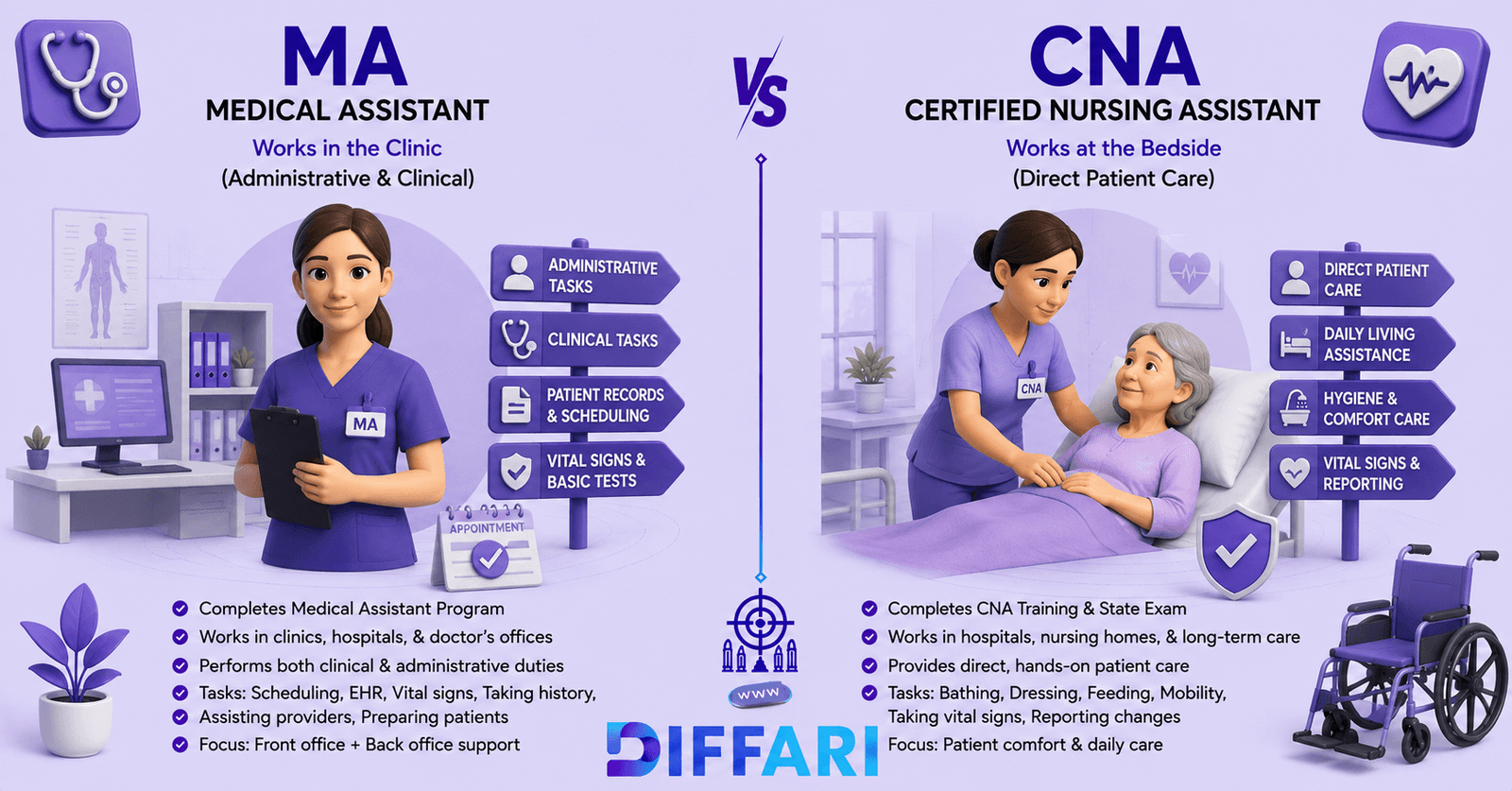
Choosing an entry-level healthcare career can be confusing when two jobs appear to involve many of the same tasks. Medical Assistants (MAs) and Certified Nursing Assistants (CNAs) both interact with patients, take vital signs, and support healthcare teams, but their primary responsibilities are different.
An MA generally combines clinical and administrative support, often in physician offices, clinics, and other outpatient settings. A CNA focuses much more on hands-on basic patient care, particularly activities such as bathing, dressing, eating, toileting, mobility, and transferring patients under nursing supervision.
Understanding that difference is important because the two careers involve different work environments, training paths, physical demands, and long-term career directions.
Quick Answer
A Medical Assistant (MA) supports healthcare providers with a combination of clinical and administrative tasks, while a Certified Nursing Assistant (CNA) primarily provides hands-on basic patient care under the supervision of nurses.
In simple terms:
MA = clinical support + administrative work
CNA = direct patient care + daily living assistance
An MA may take a patient’s history, record vital signs, schedule appointments, prepare patients for examinations, collect specimens, and maintain medical records. A CNA may help a patient bathe, dress, eat, use the bathroom, move between a bed and wheelchair, and report changes in the patient’s condition to nursing staff.
Neither career is universally “better.” The better choice depends on the type of healthcare work you want to perform.
MA vs CNA at a Glance
| Category | Medical Assistant (MA) | Certified Nursing Assistant (CNA) |
|---|---|---|
| Primary focus | Clinical and administrative support | Direct basic patient care |
| Typical settings | Physician offices, clinics, outpatient centers, hospitals | Nursing facilities, hospitals, assisted living, home care |
| Typical supervisor | Physician, advanced practice provider, nurse, or practice manager depending on workplace | Registered nurse or licensed practical/vocational nurse |
| Patient contact | Moderate to high | Usually very high |
| Administrative work | Common | Limited |
| Daily-living assistance | Not usually the central role | Central part of the job |
| Training | Often postsecondary education such as a certificate | State-approved training and competency requirements |
| Certification | Not universally required for employment | State requirements commonly apply |
| Physical demands | Varies by workplace | Often physically demanding |
| Best fit | People who want clinical and office responsibilities | People who want hands-on bedside care |
The exact scope of duties and credential requirements can vary by employer and state.
What Is a Medical Assistant?
A Medical Assistant (MA) is a healthcare worker who supports physicians and other healthcare professionals through a mixture of administrative and clinical duties.
According to the U.S. Bureau of Labor Statistics, medical assistants may interview patients, record medical histories, measure vital signs, help physicians with examinations, schedule appointments, collect specimens, maintain medical records, and perform certain medication or injection-related tasks when permitted by state law and directed by a physician.
This combination makes the MA role relatively broad.
Common MA Duties
Depending on the workplace, an MA may:
- Take and record blood pressure, temperature, weight, and other vital signs.
- Collect patient histories.
- Prepare patients for examinations.
- Assist physicians during examinations and procedures.
- Collect blood or other specimens.
- Enter information into medical records.
- Schedule appointments.
- Maintain supplies.
- Handle certain administrative tasks.
- Perform specific clinical procedures permitted by state law and employer policy.
For example, an MA working in a primary-care clinic might room patients in the morning, record their vital signs, update medication information, prepare them for the physician, and then spend part of the day handling records or appointment-related tasks.
What Is a CNA?
A Certified Nursing Assistant (CNA) is a direct-care healthcare worker who helps patients with basic needs and activities of daily living.
CNAs work as part of a healthcare team under the supervision of licensed practical/vocational nurses or registered nurses. Typical responsibilities include bathing and cleaning patients, helping them dress and use the toilet, feeding them, repositioning them, transferring them between beds and wheelchairs, measuring vital signs, and reporting health concerns to nurses.
The CNA role is therefore much more centered on hands-on patient care.
Common CNA Duties
A CNA may:
- Help patients bathe.
- Assist with dressing.
- Help patients use the toilet.
- Serve meals and help patients eat.
- Reposition patients.
- Transfer patients safely.
- Help patients move around.
- Measure vital signs.
- Observe patients and report concerns to nurses.
- Provide basic comfort and personal-care assistance.
The exact tasks permitted to a CNA vary by state, training, employer, and level of supervision.
What Is the Difference Between MA and CNA?
The biggest difference is the type of support each professional provides.
An MA primarily supports medical providers and the operation of a clinical practice, combining administrative and clinical responsibilities.
A CNA primarily supports patients directly, helping them with basic care and everyday activities under nursing supervision.
Consider these two examples:
Example 1: Medical Assistant
A patient arrives at a doctor’s office. The MA checks the patient’s information, records vital signs, updates the medical history, prepares the patient for the examination, and assists the provider.
Example 2: CNA
A patient in a nursing facility needs help getting out of bed, dressing, eating breakfast, and moving to a wheelchair. The CNA provides that hands-on assistance and reports relevant observations to the nursing staff.
Both professionals contribute to patient care, but their primary responsibilities are different.
When to Choose a Medical Assistant Career
An MA career may suit you if you like a mixture of patient interaction, clinical tasks, and administrative responsibilities.
Consider MA training if you would rather:
- Work in a physician’s office or outpatient clinic.
- Support doctors and other healthcare providers.
- Perform basic clinical procedures.
- Take patient histories and vital signs.
- Work with medical records.
- Schedule appointments or handle other office responsibilities.
- Develop skills that combine healthcare and office work.
Medical assistants are employed heavily in physicians’ offices, although hospitals and outpatient care centers also employ them. BLS data show that physicians’ offices accounted for the largest share of MA employment in 2025.
When to Choose a CNA Career
A CNA career may be a better fit if you want close, hands-on contact with patients.
Consider CNA training if you would rather:
- Help patients with everyday physical needs.
- Work directly with patients for much of your shift.
- Assist with bathing, dressing, feeding, toileting, and mobility.
- Work in nursing or residential care.
- Gain experience in a nursing-focused environment.
- Enter healthcare through a comparatively focused training route.
CNAs are especially common in nursing care facilities and hospitals. BLS data indicate that nursing care facilities and hospitals are the two largest employment settings for nursing assistants.
MA and CNA Work Environments
Work environment is one of the easiest ways to distinguish these careers.
Medical Assistant
MAs commonly work in:
- Physicians’ offices
- Outpatient clinics
- Hospitals
- Outpatient care centers
- Specialty medical practices
The setting can influence the MA’s exact responsibilities. One MA might spend much of the day assisting with clinical procedures, while another may perform more administrative work.
CNA
CNAs commonly work in:
- Nursing care facilities
- Hospitals
- Assisted living facilities
- Continuing-care communities
- Home healthcare
The work is generally more physically active. CNAs may spend much of their shift standing, moving patients, or helping with personal care.
MA vs CNA Education and Training
The education path is another significant difference.
Medical assistants typically need postsecondary education, such as a certificate, although some people enter the occupation through on-the-job training. MA programs can also lead to diplomas or associate degrees depending on the institution and career plan.
CNAs generally follow a state-approved training program that includes nursing-related instruction and supervised clinical experience. They commonly must pass a state competency examination and meet state-specific certification or registry requirements.
Because CNA requirements are state-specific, students should check the rules of the state where they intend to work.
MA vs CNA Certification
The word “certified” in CNA is important.
Nursing assistants commonly need to complete approved training, pass a competency exam, and appear on a state registry to work in certain settings such as nursing homes. Federal regulations also require facilities to verify applicable nurse-aide registry status.
Medical assistants are different. National MA certification is not universally required simply to work as an MA, although certification may be required or preferred by particular employers.
One recognized credential is the CMA (AAMA). Eligibility for the CMA examination includes graduation from a medical assisting program accredited by CAAHEP or ABHES, subject to the certification organization’s specific eligibility rules.
Therefore:
CNA certification is generally tied to state requirements, while MA certification depends more on the credential and employer.
MA vs CNA Salary
Salary varies by location, experience, employer, specialty, and work setting, so national figures should be used as a general reference rather than a guaranteed wage.
The U.S. Bureau of Labor Statistics reports a $45,690 median annual wage for medical assistants in May 2025.
For nursing assistants, BLS reports a $42,260 median annual wage in May 2025.
That puts the national median for MAs somewhat above that of nursing assistants in the latest BLS figures.
However, salary alone should not determine the decision. A higher-paying position in a setting you dislike may be a worse career fit than a slightly lower-paying job that matches your strengths and preferred working environment.
MA vs CNA Job Outlook
The occupations also have different projected growth rates.
BLS currently projects 13% employment growth for medical assistants from 2025 to 2035, considerably faster than the average for all occupations.
For nursing assistants, BLS’s current occupational profile projects slower growth. The latest available profile reports 2% growth for nursing assistants from 2024 to 2034, although it still projects substantial annual openings largely because workers leave or change occupations.
These projections describe the U.S. labor market and should not be interpreted as a guarantee of employment in a particular state or city.
Can an MA Work as a CNA?
Not automatically.
Being trained or certified as a medical assistant does not generally make someone a CNA automatically because the occupations have different training and regulatory frameworks.
CNA requirements are governed by state-specific rules, and nursing assistants commonly must complete an approved training pathway and competency requirements before being placed on the appropriate state registry.
An MA who wants to become a CNA should therefore check the requirements of the state where they want to work.
Are MA and CNA Interchangeable?
No.
MA and CNA are different healthcare occupations.
Some basic activities overlap, including taking vital signs and interacting with patients. However, the primary purpose of each role is different.
MA: Supports medical providers through a combination of clinical and administrative work.
CNA: Provides basic hands-on patient care under nursing supervision.
Because scope-of-practice rules can vary by state and workplace, a task performed by one professional is not automatically permitted for the other.
Which One Is Better: MA or CNA?
There is no universal winner. The better choice depends on your preferred work environment, responsibilities, and career goals.
Choose MA if:
Clinical and administrative duties appeal to you → MA
Physician offices or outpatient clinics suit your preferences → MA
Patient intake and medical records interest you → MA
A combination of office and clinical responsibilities sounds appealing → MA
Choose CNA if:
Hands-on patient care is what you prefer → CNA
Helping patients with daily activities appeals to you → CNA
Close bedside interaction fits your strengths → CNA
Nursing-care environments match your career interests → CNA
A simple rule is:
If you want to support the provider and the clinic, lean toward MA. If you want to spend more of your day directly caring for patients, lean toward CNA.
Which Career Is Better for Nursing?
A CNA role can provide substantial exposure to direct patient care and nursing environments, which may be valuable for someone considering future nursing education.
However, becoming a CNA does not automatically qualify someone to become an RN or LPN/LVN. Nursing licensure requires its own education and licensing pathway.
An MA can also build healthcare experience, but the work is generally more connected to medical offices, provider support, clinical procedures, and administrative functions.
If your long-term goal is nursing, compare the specific experience you want to gain rather than assuming one entry-level job automatically leads to a nursing license.
MA or CNA? Practice Examples
Choose the career that best matches each situation.
- You want to help physicians in an outpatient clinic.
→ MA - You want to spend much of your shift helping residents with bathing and dressing.
→ CNA - You enjoy appointment scheduling and medical records as well as patient care.
→ MA - You want extensive hands-on experience helping patients with mobility.
→ CNA - You prefer a combination of administrative and clinical duties.
→ MA - You want a role centered on activities of daily living.
→ CNA - You want to work primarily in a physician’s office.
→ MA - You prefer nursing-home or residential-care work.
→ CNA
Answers
- MA
- CNA
- MA
- CNA
- MA
- CNA
- MA
- CNA
Frequently Asked Questions
What is the main difference between MA and CNA?
The main difference is the focus of the job. MAs generally combine clinical and administrative support, while CNAs primarily provide hands-on basic patient care under nursing supervision.
Is an MA higher than a CNA?
Neither position is simply “higher.” They are different occupations with different responsibilities, training, and workplace structures.
Is CNA harder than MA?
That depends on what you mean by “harder.” CNA work can be physically demanding because it often involves bathing, transferring, repositioning, feeding, and assisting patients with mobility. MA work can require switching between clinical and administrative responsibilities.
Who usually has more direct patient contact, an MA or CNA?
A CNA generally has more continuous hands-on patient contact, particularly when working in nursing or residential care. An MA also interacts directly with patients but typically combines that interaction with clinical and administrative responsibilities.
Do MAs and CNAs need the same certification?
No. CNA requirements are generally connected to state-approved training, competency evaluation, and state registry requirements. MA certification is not universally mandatory, although professional certification may be required or preferred for particular jobs.
Can an MA become a CNA?
Yes, an MA can pursue CNA work, but being an MA does not automatically make someone a CNA. State-specific training, competency, certification, or registry requirements may apply.
Which pays more, MA or CNA?
In the latest BLS national data, medical assistants have a higher median annual wage: $45,690 for MAs versus $42,260 for nursing assistants in May 2025. Individual wages vary considerably by location and employer.
Which career is faster to enter?
CNA training is often a more focused entry pathway, but exact requirements and program length vary by state. Medical assistants typically complete postsecondary education such as a certificate, although some enter through on-the-job training.
Is MA or CNA better for you?
Choose MA if you want a mixture of clinical and administrative work, especially in outpatient healthcare. Choose CNA if you want primarily hands-on patient care and daily-living assistance.
Conclusion
The difference between MA and CNA comes down primarily to the kind of healthcare support each professional provides. A Medical Assistant usually combines clinical and administrative responsibilities, often supporting physicians in outpatient settings. A Certified Nursing Assistant focuses more directly on basic patient care, including daily activities, mobility, comfort, and personal assistance under nursing supervision.