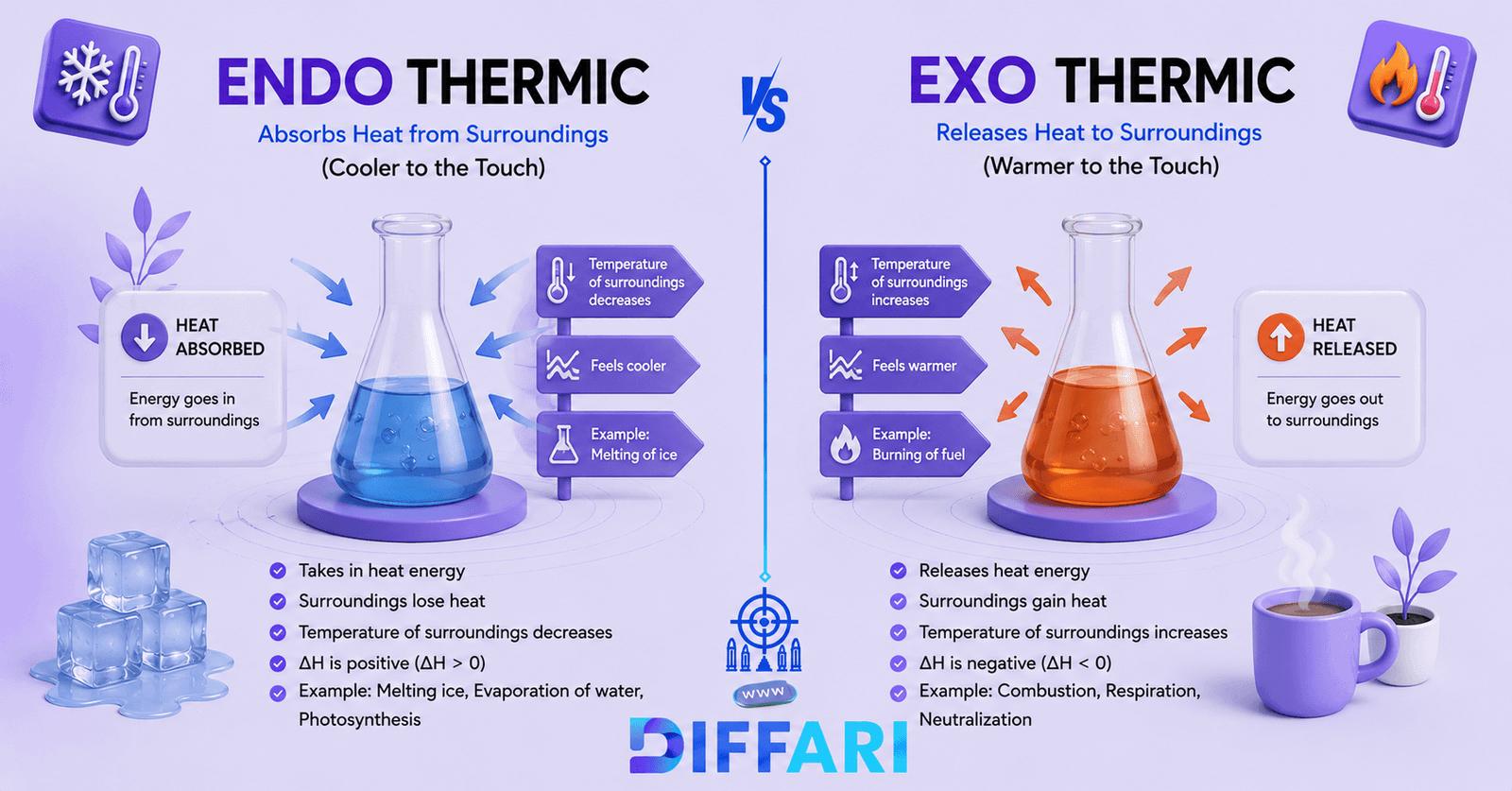

Endothermic and exothermic are two terms used to describe how energy moves during a chemical reaction or physical process. They are easy to confuse because both describe energy changes, but they represent opposite directions of heat transfer.
An endothermic process absorbs heat from its surroundings, while an exothermic process releases heat to its surroundings. This difference also appears in the sign of the enthalpy change: endothermic processes have a positive ΔH, while exothermic processes have a negative ΔH under the usual thermochemical convention.
If you remember only one rule, remember this:
Endothermic = heat goes in.
Exothermic = heat goes out.
Quick Answer
Endothermic means a system absorbs heat from its surroundings, so the surroundings may become cooler. Its enthalpy change, ΔH, is positive.
Exothermic means a system releases heat to its surroundings, so the surroundings may become warmer. Its ΔH is negative.
The simplest distinction is the direction of heat flow:
Surroundings → system = endothermic
System → surroundings = exothermic
Endothermic vs Exothermic at a Glance
| Feature | Endothermic | Exothermic |
| Heat flow | Into the system | Out of the system |
| Effect on surroundings | Usually cools them | Usually warms them |
| ΔH | Positive | Negative |
| Product energy | Higher than reactants | Lower than reactants |
| Energy absorbed? | Yes | No, overall heat is released |
| Typical example | Melting ice | Combustion |
| Memory clue | Heat goes in | Heat goes out |
The distinction is based on energy transfer between the system and its surroundings, not simply on whether something feels hot or cold.
What Does Endothermic Mean?
Endothermic describes a process in which the system absorbs heat from its surroundings.
The word can be remembered as:
- endo = within or into
- thermic = related to heat
So, think:
Endothermic = heat enters the system.
For example, when ice melts, the water absorbs energy from its surroundings. Melting therefore requires an input of heat and is an endothermic physical process. Other endothermic phase changes include evaporation, boiling, and sublimation.
In a chemical reaction, an endothermic process has:
ΔH > 0
This means the products have a higher enthalpy than the reactants under the stated conditions.
Example of an Endothermic Process
A cold pack can become cold when a suitable substance dissolves in water and the overall process absorbs heat from the surroundings. The University of California San Diego demonstrates ammonium nitrate dissolving in water as an endothermic process.
What Does Exothermic Mean?
Exothermic describes a process in which the system releases heat to its surroundings.
The word can be remembered as:
- exo = outside or out
- thermic = related to heat
So:
Exothermic = heat exits the system.
Combustion is a familiar example. When a fuel burns, energy is released to the surroundings, often as heat and sometimes as light as well.
An exothermic reaction has:
ΔH < 0
The products have lower enthalpy than the reactants under the stated conditions.
Example of an Exothermic Process
The combustion of methane is exothermic because the overall reaction releases heat. Freezing and condensation are also exothermic physical processes because energy is released to the surroundings as the substance changes state.
What Is the Main Difference Between Endothermic and Exothermic?
The fundamental difference is the direction of heat transfer.
Endothermic
Heat moves from the surroundings into the system.
The system gains heat.
ΔH is positive.
Exothermic
Heat moves from the system into the surroundings.
The system loses heat.
ΔH is negative.
A useful way to visualize it is:
Endothermic:
Surroundings → Heat → System
Exothermic:
System → Heat → Surroundings
This system-versus-surroundings perspective is more reliable than simply memorizing “cold” and “hot.”
How Does ΔH Show the Difference?
ΔH, or enthalpy change, describes the heat change of a process under constant-pressure conditions.
The sign gives you an important clue:
- ΔH > 0 → endothermic
- ΔH < 0 → exothermic
Enthalpy of Endothermic and Exothermic Reactions
In an endothermic reaction, the products have greater enthalpy than the reactants. This higher energy level corresponds to a positive ΔH value.
By contrast, an exothermic reaction produces products with lower enthalpy than the reactants. The difference results in a negative ΔH because energy is released to the surroundings.
For example: melting ice is endothermic, while freezing water is exothermic.
Reactants → Products
If:
H(products) > H(reactants)
then:
ΔH > 0 → endothermic
If:
H(products) < H(reactants)
then:
ΔH < 0 → exothermic
The sign of ΔH is also reversed when a thermochemical equation is reversed. A process that is endothermic in one direction is exothermic in the reverse direction.
What Happens to Chemical Bonds?
Chemical reactions involve breaking existing bonds and forming new ones.
Breaking bonds requires energy.
Forming bonds releases energy.
The overall reaction is determined by the balance between those two energy changes. If more energy is required to break the reactant bonds than is released when product bonds form, the overall reaction is endothermic. If more energy is released when product bonds form than is required to break the reactant bonds, the overall reaction is exothermic.
A useful approximation for bond-energy calculations is:
ΔH ≈ energy of bonds broken − energy of bonds formed
This is why simply saying “bond breaking is endothermic” does not tell you whether the entire reaction is endothermic. Both bond breaking and bond formation occur during a reaction.
Endothermic Examples
Common endothermic processes include:
- Melting ice
- Boiling water
- Evaporation
- Sublimation
- Some dissolving processes
- Certain chemical decompositions
- Photosynthesis as an overall energy-absorbing process
Melting, evaporation, and sublimation require energy to be transferred into the system.
For example:
Ice + heat → liquid water
The ice absorbs energy as it changes from solid to liquid.
Important clarification about photosynthesis
Photosynthesis requires an input of energy, primarily from sunlight. It is therefore commonly taught as an energy-absorbing process. However, it is better to say that photosynthesis absorbs radiant energy rather than loosely describing sunlight as simply “heat.” This distinction keeps the explanation scientifically precise.
Exothermic Examples
Common exothermic processes include:
- Combustion
- Freezing
- Condensation
- Deposition
- Some dissolving processes
- Certain acid-base reactions
For example, when water vapor condenses into liquid water, energy is released to the surroundings. Freezing likewise releases energy.
Combustion is another familiar example. A burning fuel transfers energy to the surroundings as heat and often light.
How Can You Tell if a Process Is Endothermic or Exothermic?
Use this three-step method.
Step 1: Identify the system
Ask:
What part of the process am I studying?
The reacting chemicals or changing substance are usually treated as the system.
Step 2: Determine the direction of heat flow
Ask:
Does heat enter or leave the system?
- Heat enters → endothermic
- Heat leaves → exothermic
Step 3: Check ΔH if it is provided
- Positive ΔH → endothermic
- Negative ΔH → exothermic
If a reaction mixture becomes warmer, that often indicates an exothermic process because heat has been transferred to the surroundings. If the mixture becomes cooler, that often indicates an endothermic process because heat has been absorbed from the surroundings.
Endothermic vs Exothermic Energy Diagrams
Energy diagrams provide another way to distinguish the two.
Endothermic Energy Diagram
An endothermic reaction has products at a higher energy level than the reactants. Because the products contain more enthalpy, the overall ΔH is positive.
A simplified energy diagram looks like this:
Energy
  ↑
  │             Products
  │             ─────────
  │
  │
  │   Reactants
  │   ─────────
  │
  └────────────────────→ Reaction progress
The upward difference between the reactant and product energy levels represents a positive ΔH, indicating that the system absorbs energy from its surroundings.
Exothermic Energy Diagram
In an exothermic reaction, the products are lower in energy than the reactants. As a result, the overall enthalpy change (ΔH) is negative.
Energy
  ↑
  │   Reactants
  │   ─────────
  │
  │
  │             Products
  │             ─────────
  │
  └────────────────────→ Reaction progress
The downward difference between the reactants and products represents a negative ΔH. This lower energy level indicates that the system releases energy to its surroundings during the reaction.
The overall energy difference is negative because the products are at a lower enthalpy than the reactants.
Activation Energy vs ΔH
This is one of the most important distinctions to understand.
Activation energy (Ea) is the energy needed to reach the transition state and get a reaction started.
ΔH is the overall enthalpy difference between reactants and products.
They are not the same thing.
An exothermic reaction can still require activation energy. For example, a fuel may burn exothermically but still require a spark or another initial energy input to begin reacting.
So:
Activation energy tells you how high the energy barrier is.
ΔH tells you the overall energy difference between reactants and products.
A catalyst can lower activation energy without changing the overall ΔH of the reaction.
Are Phase Changes Endothermic or Exothermic?
Yes. Endothermic and exothermic classifications apply to physical processes as well as chemical reactions.
| Phase Change | Type |
| Melting | Endothermic |
| Evaporation | Endothermic |
| Boiling | Endothermic |
| Sublimation | Endothermic |
| Freezing | Exothermic |
| Condensation | Exothermic |
| Deposition | Exothermic |
The key is the direction of heat transfer, not whether a new chemical substance is produced. A phase change changes physical state without necessarily creating a new substance.
Common Mistakes With Endothermic and Exothermic
Mistake 1: Thinking endothermic means “hot”
Incorrect:
An endothermic reaction is hot because it involves energy.
Correct:
An endothermic process absorbs heat from its surroundings.
Why:
“Endothermic” describes the direction of heat transfer, not simply how hot the system feels.
Mistake 2: Thinking exothermic reactions need no energy to start
Incorrect:
An exothermic reaction does not require activation energy.
Correct:
An exothermic reaction can still require activation energy.
Why:
Activation energy and ΔH describe different parts of the energy profile.
Mistake 3: Reversing the ΔH signs
Incorrect:
Positive ΔH means exothermic.
Correct:
Positive ΔH means endothermic; negative ΔH means exothermic.
Mistake 4: Saying breaking bonds releases energy
Incorrect:
Breaking a chemical bond releases energy.
Correct:
Breaking a chemical bond requires energy, while forming a chemical bond releases energy.
The overall reaction still depends on the balance between bonds broken and bonds formed.
Mistake 5: Assuming exothermic means spontaneous
Incorrect:
If a reaction is exothermic, it must happen spontaneously.
Correct:
Exothermicity and spontaneity describe different thermodynamic properties.
A reaction’s spontaneity depends on Gibbs free energy, ΔG, which involves both enthalpy and entropy. An exothermic process is not automatically spontaneous under every condition.
Common Collocations With Endothermic and Exothermic
Endothermic
- endothermic reaction
- endothermic process
- endothermic change
- endothermic reaction absorbs heat
- endothermic process has positive ΔH
- endothermic phase change
- endothermic energy profile
Exothermic
- exothermic reaction
- exothermic process
- exothermic change
- exothermic reaction releases heat
- exothermic process has negative ΔH
- exothermic phase change
- exothermic energy profile
These combinations are useful because students commonly encounter the terms in exactly these contexts.
Can Endothermic and Exothermic Be Used Interchangeably?
No.
They describe opposite directions of heat transfer.
Use endothermic when heat is absorbed by the system.
Use exothermic when heat is released by the system.
They are therefore not interchangeable:
Melting ice is endothermic, not exothermic.
Burning fuel is generally exothermic, not endothermic.
The same distinction applies to ΔH:
Positive ΔH = endothermic
Negative ΔH = exothermic
How to Remember the Difference
Use the prefixes:
ENDO = IN
Think:
Endo → energy/heat enters.
EXO = OUT
Think:
Exo → energy/heat exits.
Another simple memory rule is:
Endothermic takes heat in. Exothermic sends heat out.
You can also remember the ΔH signs:
Endothermic = +
Exothermic = −
Which One Should I Use?
Use this quick decision guide:
Choose “endothermic” when heat enters the system.
By contrast, choose “exothermic” when heat leaves the system.
A positive ΔH indicates an endothermic reaction.
A negative ΔH indicates an exothermic reaction.
When products have higher enthalpy than reactants, the reaction is endothermic.
When products have lower enthalpy than reactants, the reaction is exothermic.
For a temperature observation:
Surroundings become warmer → likely exothermic.
Surroundings become cooler → likely endothermic.
The last two clues are observations of heat transfer; the fundamental classification is based on the direction of energy transfer between the system and surroundings.
Endothermic or Exothermic? Practice Examples
Choose endothermic or exothermic.
- Ice melts in a warm room.
- Water freezes in a freezer.
- Methane burns in oxygen.
- Liquid water evaporates.
- Water vapor condenses.
- A chemical process absorbs heat from the surrounding solution.
- A reaction has ΔH = +75 kJ.
- A reaction has ΔH = −125 kJ.
- A process has products at a higher enthalpy than its reactants.
- A process releases heat into its surroundings.
Answers
- Endothermic — melting absorbs heat.
- Exothermic — freezing releases heat.
- Exothermic — combustion releases heat.
- Endothermic — evaporation requires energy input.
- Exothermic — condensation releases heat.
- Endothermic — heat enters the system.
- Endothermic — ΔH is positive.
- Exothermic — ΔH is negative.
- Endothermic — products have higher enthalpy.
- Exothermic — heat leaves the system.
Frequently Asked Questions
What is the difference between endothermic and exothermic?
An endothermic process absorbs heat from its surroundings, while an exothermic process releases heat to its surroundings. Endothermic processes have positive ΔH, while exothermic processes have negative ΔH.
Is endo the same as endothermic?
In informal chemistry discussion, “endo” is commonly used as shorthand for “endothermic.” For formal writing, however, endothermic is the clearer and more complete term.
Is endothermic positive or negative?
Endothermic processes have a positive ΔH because the system absorbs heat under constant-pressure conditions.
Is exothermic positive or negative?
Exothermic processes have a negative ΔH because the system releases heat under constant-pressure conditions.
Does endothermic mean the temperature always decreases?
Not necessarily. A decrease in the temperature of the surroundings can indicate heat absorption, but temperature also depends on the specific experimental setup and other energy transfers. The fundamental definition of endothermic is heat absorbed by the system.
Does exothermic mean the reaction is spontaneous?
No. Exothermic describes enthalpy/heat release, while spontaneity is determined by Gibbs free energy, ΔG, under the relevant conditions.
Is melting endothermic or exothermic?
Melting is endothermic because heat is absorbed as a solid changes into a liquid.
Is freezing endothermic or exothermic?
Freezing is exothermic because heat is released as a liquid changes into a solid.
Is combustion endothermic or exothermic?
Combustion is generally exothermic because the overall process releases heat to the surroundings.
Can an exothermic reaction require energy to start?
Yes. An exothermic reaction can have an activation-energy barrier. An initial spark, heat source, or other energy input can initiate the reaction even though the overall reaction subsequently releases more energy than it absorbs.
Conclusion
The difference between endothermic and exothermic comes down to the direction of heat transfer. An endothermic process absorbs heat, giving it a positive ΔH, while an exothermic process releases heat, giving it a negative ΔH.

Sajid Ali is an English language educator and content specialist with 7+ years of teaching experience. He holds master’s degrees in Information Technology and Education from the Virtual University of Pakistan and writes SEO-optimized, learner-friendly vocabulary content for diffari.com.