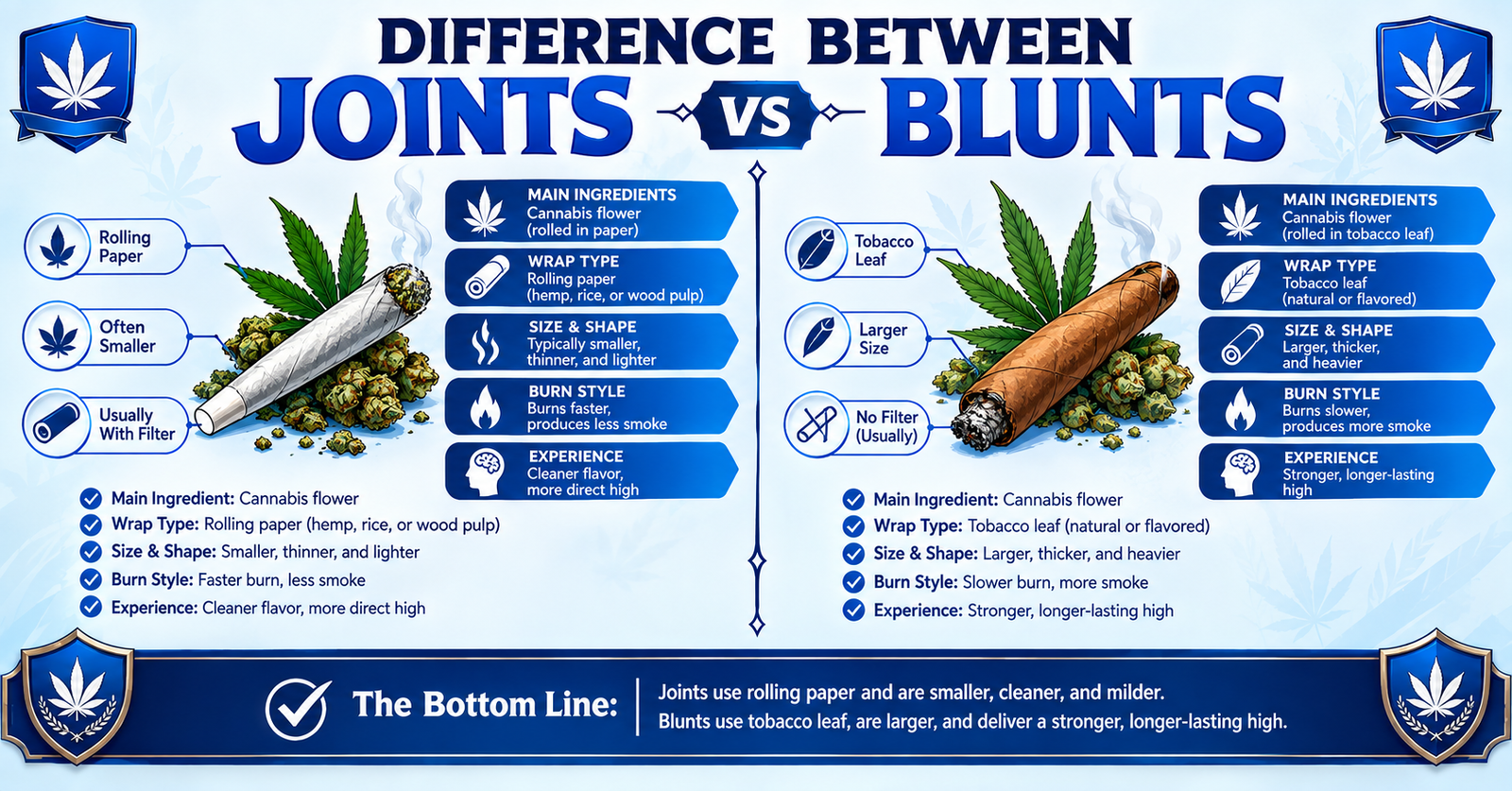

Joints and blunts are both terms used for cannabis prepared in a rollable form, but they are not exactly the same. The main difference is the material used around the cannabis. A joint is generally made with thin rolling paper, while a traditional blunt uses a cigar or tobacco-based wrap. Hemp-based wraps can also be marketed as blunts, so the word does not always mean that tobacco is present.
Understanding that distinction also helps explain differences in tobacco exposure, flavor, size, and terminology. This guide breaks down the difference between joints and blunts and explains how they relate to the third term you may encounter: spliff.
Quick Answer
A joint is typically cannabis rolled in thin rolling paper, while a traditional blunt is cannabis contained in a cigar or tobacco-based wrap.
The most important distinction is therefore the wrap, not simply the size. Joints generally do not contain tobacco, whereas traditional tobacco-wrapped blunts involve tobacco in the wrapper. Tobacco-free hemp wraps are also available, so not every product called a blunt contains tobacco.
Joints vs. Blunts at a Glance
| Feature | Joint | Blunt |
|---|---|---|
| Main wrapping material | Thin rolling paper | Traditionally cigar or tobacco-based wrap |
| Cannabis inside | Usually cannabis flower | Usually cannabis flower |
| Tobacco | Generally none | Present when a tobacco wrap is used |
| Nicotine | Generally none from the wrap | Possible with tobacco wraps |
| Typical appearance | Thin, paper-wrapped roll | Usually thicker and darker |
| Burn characteristics | Often burns relatively quickly | Often burns more slowly because of the thicker wrap |
| Flavor | Usually less influenced by the wrapper | Tobacco wraps can add their own flavor |
| Tobacco-free versions | Standard | Hemp-wrap versions exist |
These are general distinctions rather than absolute rules because products and terminology vary.
What Is a Joint?
A joint is a cannabis roll made with thin rolling paper. The cannabis is placed inside the paper, which is then formed into a cigarette-like roll or cone.
Rolling papers can be made from materials such as hemp, rice, flax, or wood pulp. The exact paper and construction can vary, but the defining idea is a thin paper wrapper around cannabis.
The word joint is therefore primarily describing the form in which the cannabis is rolled rather than a particular cannabis strain or potency.
Example
He bought a pre-rolled joint from the licensed retailer.
Here, joint refers to the rolled cannabis product.
What Is a Blunt?
A blunt traditionally refers to cannabis placed inside a cigar, cigar wrapper, or tobacco-based wrap. NIDA describes blunts as cigars or cigar wrappers that have been partly or completely refilled with cannabis.
Because the wrapper is thicker than typical rolling paper, traditional blunts are often visually different from joints.
The terminology has evolved, however. Some products marketed as blunt wraps are made from hemp rather than tobacco. In those cases, the product can have the physical characteristics associated with a blunt without necessarily containing tobacco or nicotine.
What Is the Difference Between Joints and Blunts?
The simplest distinction is:
Joint = thin rolling paper
Traditional blunt = cigar or tobacco-based wrap
That difference affects several characteristics.
1. Wrapping Material
The wrapping material is the clearest way to distinguish the two.
Joints generally use thin rolling paper. Traditional blunts use cigar-style or tobacco-based material.
2. Tobacco and Nicotine
A standard joint does not normally contain tobacco.
A traditional tobacco-wrapped blunt involves tobacco in the wrapper. Consequently, it can expose the smoker to nicotine and other tobacco-related chemicals.
A hemp-wrapped blunt is different because the wrapper does not necessarily contain tobacco.
This distinction matters because “blunt” does not automatically mean “tobacco-free” or “contains tobacco” in every modern usage. The material of the wrap needs to be considered.
3. Size
Blunts are often larger than joints, but size is not the defining difference.
A large joint is still a joint if it uses the relevant rolling paper. Likewise, a smaller blunt is still a blunt if it uses the relevant blunt-style wrap.
Some sources report that blunts commonly contain more cannabis than joints, but the amount varies widely by product and individual preparation.
4. Burn Characteristics
The thicker material commonly used for a blunt can produce a slower burn than thin rolling paper.
However, burn time depends on multiple factors, including the wrapper, construction, moisture, and amount of material. It should not be treated as a fixed rule.
5. Flavor
The wrapper can affect the flavor of the smoke.
A thin rolling paper generally contributes less flavor than a tobacco-based cigar wrapper. A tobacco wrap can therefore add a distinct tobacco or cigar character to the experience.
Hemp wraps may produce a different flavor profile from tobacco wraps.
Joint vs. Blunt: Tobacco Exposure
This is one of the most important distinctions to understand.
A traditional tobacco-wrapped blunt introduces tobacco into the smoking process through its wrapper. A conventional joint does not normally contain tobacco.
Research comparing joints and blunts has found differences in physiological measures under experimental conditions. One controlled study found higher carbon-monoxide levels after blunt smoking, while joints produced higher plasma THC and higher subjective ratings of intoxication in that particular experiment. The study was small, so its results should not be interpreted as a universal prediction for every joint or blunt.
More broadly, CDC states that smoking cannabis can expose people to harmful chemicals and that using cannabis and tobacco together may increase exposure to chemicals that can affect the lungs and cardiovascular system.
Are Hemp Blunts the Same as Traditional Blunts?
Not exactly.
The term blunt has traditionally been associated with cigar or tobacco-based wrappers, but hemp blunt wraps are also widely discussed and marketed.
A hemp wrap can resemble a traditional blunt in form and burn characteristics while avoiding tobacco in the wrapper.
Therefore:
- Traditional blunt: tobacco/cigar-style wrap
- Hemp blunt: hemp-based wrap
- Joint: typically thin rolling paper
This is why asking whether “blunts contain tobacco” has a more nuanced answer than simply saying yes.
Joint vs. Blunt vs. Spliff
A spliff is another term that is often confused with joints and blunts.
The basic distinction is:
| Term | Wrapper | Tobacco in filling/wrap |
|---|---|---|
| Joint | Rolling paper | Usually no |
| Spliff | Rolling paper | Yes, traditionally mixed with cannabis |
| Traditional blunt | Cigar/tobacco-based wrap | Tobacco is in the wrapper |
Leafly specifically distinguishes the three by the material used and whether tobacco is included.
This makes spliff particularly important when comparing terminology across regions. In some cannabis cultures, especially outside the United States, the terms may be used somewhat differently in casual conversation.
Do Joints and Blunts Have Different Effects?
It is tempting to say that a blunt always produces a stronger effect than a joint, but that is too broad.
The actual experience can depend on factors such as:
- cannabis composition
- THC concentration
- amount consumed
- individual response
- smoking method
- presence of tobacco
- characteristics of the wrapper
A controlled study comparing joints and blunts found different THC and carbon-monoxide measurements, but it involved specific experimental conditions and a small sample.
Therefore, there is no reliable universal rule that one format will always produce a stronger effect than the other.
Health Considerations
The comparison should not be interpreted as meaning that one form of smoked cannabis is harmless.
CDC states that smoked cannabis, regardless of how it is smoked, can harm lung tissue and can expose users to toxins, irritants, and carcinogens. Smoking cannabis is also associated with respiratory symptoms such as cough and mucus production.
A traditional tobacco-wrapped blunt adds another consideration: tobacco exposure.
CDC notes that using cannabis and tobacco together may increase exposure to harmful chemicals affecting the lungs and cardiovascular system.
So the useful distinction is not “joint = safe” and “blunt = unsafe.” Both involve smoke exposure when cannabis is smoked, while a tobacco-wrapped blunt adds tobacco-related exposure.
Common Mistakes With Joints and Blunts
Mistake 1: “A blunt is just a bigger joint.”
Why it is misleading:
Size is not the primary definition. The wrapping material is the more important distinction.
Mistake 2: “Every blunt contains tobacco.”
Why it is misleading:
Traditional blunts use tobacco or cigar-style wraps, but hemp-based blunt wraps also exist.
Mistake 3: “A joint always contains only cannabis.”
Why it needs qualification:
A conventional joint is generally cannabis in rolling paper, but terminology can vary. A spliff, for example, uses rolling paper while incorporating tobacco.
Mistake 4: “Blunts always produce a stronger high.”
Why it is misleading:
Effects depend on many variables, and experimental research does not establish a universal rule that blunts always produce stronger intoxication.
Mistake 5: “Joint, blunt, and spliff mean the same thing.”
Why it is incorrect:
The terms traditionally describe different combinations of cannabis, tobacco, and wrapping materials.
Common Collocations
Joint
Common expressions include:
- cannabis joint
- marijuana joint
- rolled joint
- pre-rolled joint
- paper-wrapped joint
- joint smoking
Blunt
Common expressions include:
- cannabis blunt
- marijuana blunt
- tobacco-wrapped blunt
- cigar blunt
- blunt wrap
- hemp blunt
Spliff
Common expressions include:
- cannabis spliff
- tobacco spliff
- joint and spliff
- cannabis-and-tobacco spliff
These phrases reflect common usage rather than strict grammatical rules.
Are Joints and Blunts Interchangeable?
Usually not when the terms are being used precisely.
Both can refer broadly to rolled cannabis, but they traditionally identify different forms.
If the distinction matters, use:
- joint for cannabis in conventional rolling paper
- blunt for cannabis in a cigar or blunt-style wrap
- spliff for cannabis mixed with tobacco in rolling paper
Because informal cannabis terminology varies, context still matters.
How to Remember the Difference
Use this simple rule:
Paper = joint. Wrap = blunt. Tobacco mixed into rolling paper = spliff.
The word joint is associated with a thin paper roll, while blunt is traditionally associated with the thicker cigar-style wrap.
Remember that modern hemp wraps create an important exception to the assumption that every blunt contains tobacco.
Which One Should I Use?
For terminology rather than consumption advice:
If you mean cannabis rolled in conventional thin rolling paper → “joint.”
If you mean cannabis contained in a traditional cigar or tobacco-style wrap → “blunt.”
If you mean cannabis mixed with tobacco and rolled in paper → “spliff.”
If the wrap is made from hemp, describing it as a hemp blunt makes the distinction clearer.
X or Y? Practice Examples
Choose joint, blunt, or spliff.
- Cannabis was rolled in thin paper without tobacco.
- Cannabis was placed inside a cigar wrapper.
- Cannabis and tobacco were mixed together inside rolling paper.
- A tobacco-free hemp wrap was used around cannabis.
- Someone refers to a conventional paper-wrapped cannabis roll.
Answers
- Joint
- Blunt
- Spliff
- Hemp blunt
- Joint
The exact terminology can vary in casual conversation, but these answers follow the common distinctions described by major reference and educational sources.
Frequently Asked Questions
What is the main difference between a joint and a blunt?
The main difference is the wrapping material. A joint is generally rolled in thin rolling paper, while a traditional blunt uses a cigar or tobacco-based wrap.
Do blunts contain tobacco?
Traditional blunts use tobacco or cigar-style wraps, so tobacco exposure can occur through the wrapper. However, hemp-based blunt wraps also exist and do not necessarily contain tobacco.
Do joints contain tobacco?
A conventional joint generally contains cannabis in rolling paper without tobacco. A spliff, by contrast, traditionally combines cannabis and tobacco in rolling paper.
Is a blunt just a large joint?
No. Although blunts are often larger, size is not the defining distinction. The wrapping material is more important.
What is the difference between a joint, blunt, and spliff?
A joint generally uses rolling paper without tobacco, a traditional blunt uses a cigar or tobacco-style wrap, and a spliff uses rolling paper with cannabis and tobacco together.
Are hemp blunts tobacco-free?
A hemp wrap itself does not contain tobacco, but product composition should be checked rather than assumed. Hemp-based blunt wraps are specifically available as alternatives to traditional tobacco wraps.
Is smoking a joint safer than smoking a blunt?
It is not accurate to describe smoking cannabis as safe. CDC states that smoked cannabis can harm lung tissue regardless of how it is smoked. A traditional tobacco-wrapped blunt also introduces tobacco exposure, which adds another source of harmful chemicals.
Are joints and blunts the same thing?
No. They are related forms of cannabis smoking, but the terms traditionally describe different wrapping materials.
Conclusion
The difference between joints and blunts mainly comes down to the wrap. A joint is generally cannabis rolled in thin paper, while a traditional blunt uses a cigar or tobacco-based wrap. Hemp-based blunt wraps create an important tobacco-free variation. Joints, blunts, and spliffs are therefore related but distinct terms.
The easiest rule is: paper usually means joint, a traditional cigar-style wrap means blunt, and cannabis mixed with tobacco in rolling paper means spliff. Because terminology varies, describing the actual wrapping material is the clearest way to avoid confusion.

Sajid Ali is an English language educator and content specialist with 7+ years of teaching experience. He holds master’s degrees in Information Technology and Education from the Virtual University of Pakistan and writes SEO-optimized, learner-friendly vocabulary content for diffari.com.