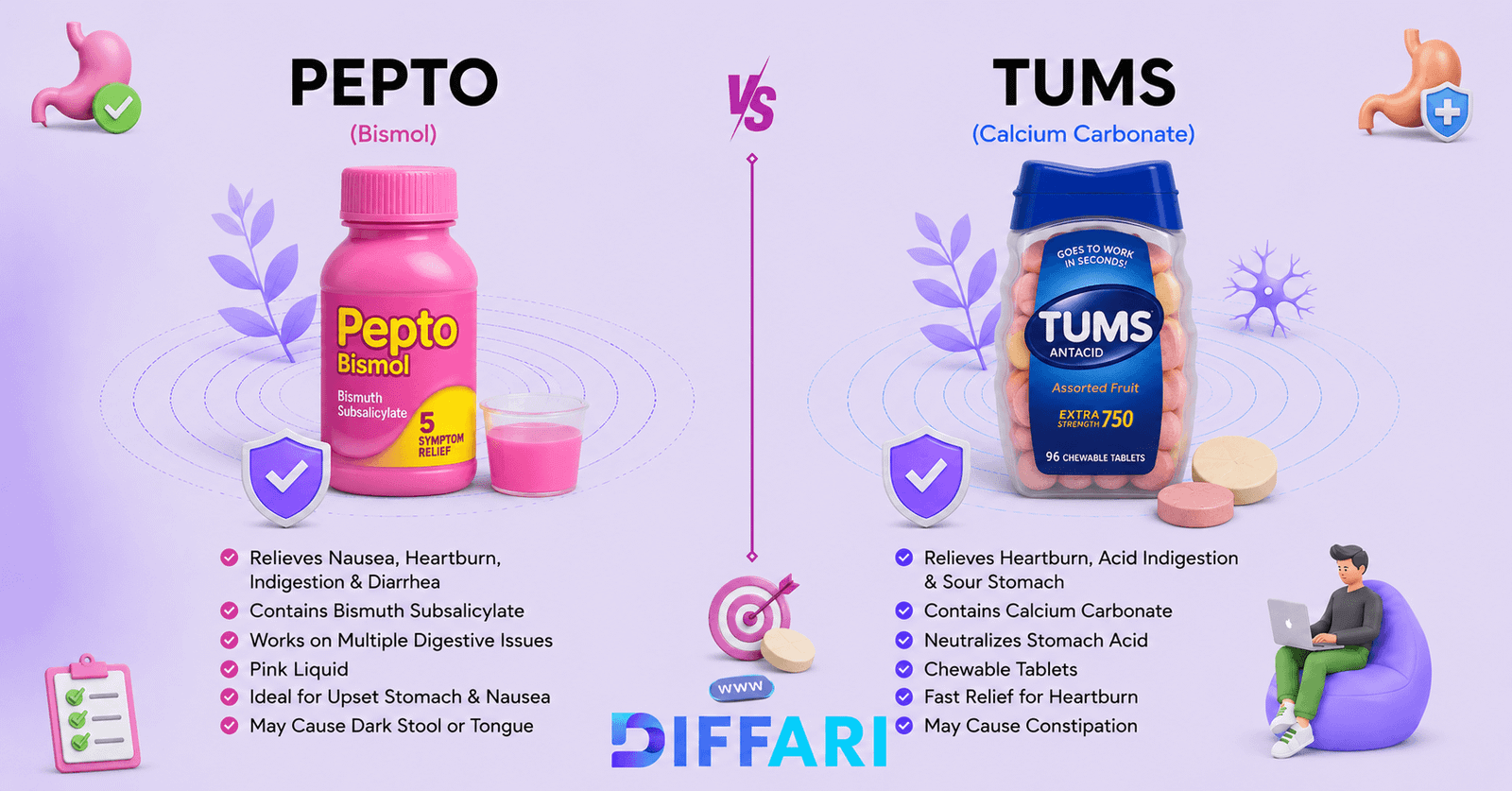

Pepto-Bismol and TUMS are both over-the-counter medicines used for digestive discomfort, but they are not the same type of medicine. Pepto-Bismol contains bismuth subsalicylate, while TUMS contains calcium carbonate. Their purposes overlap in some areas, such as heartburn and indigestion, but they work differently and are better suited to different symptom patterns.
In general, TUMS is the more targeted choice when the main problem is heartburn or acid indigestion. Pepto-Bismol is designed for a broader range of digestive symptoms, including nausea, upset stomach, and diarrhea, as well as heartburn and indigestion.
Quick Answer
Pepto-Bismol and TUMS both can relieve some symptoms of heartburn and indigestion, but they work differently.
Pepto-Bismol contains bismuth subsalicylate and is used for symptoms such as diarrhea, nausea, heartburn, indigestion, and upset stomach.
TUMS contains calcium carbonate, an antacid that neutralizes stomach acid and is primarily used for heartburn, acid indigestion, sour stomach, and associated upset stomach.
Simple rule: If acid-related burning is your main problem, TUMS is the more targeted option. If diarrhea, nausea, or a broader upset-stomach pattern is the main issue, Pepto-Bismol is designed to address more of those symptoms.
Pepto-Bismol vs TUMS at a Glance
| Feature | Pepto-Bismol | TUMS |
| Active ingredient | Bismuth subsalicylate | Calcium carbonate |
| Main drug type | Upset-stomach reliever and antidiarrheal | Antacid |
| Main uses | Diarrhea, nausea, upset stomach, indigestion, heartburn | Heartburn, acid indigestion, sour stomach |
| Helps diarrhea? | Yes | No |
| Helps nausea? | Yes, when associated with the indicated digestive symptoms | Not primarily |
| Helps heartburn? | Yes | Yes |
| Main action | Provides protective and digestive/antidiarrheal effects | Neutralizes stomach acid |
| Common forms | Liquid, caplets, chewables | Chewable tablets |
| Key safety consideration | Contains salicylate | May interact with certain medicines |
Product labeling confirms these different purposes and active ingredients.
What Is Pepto-Bismol?
Pepto-Bismol is an over-the-counter digestive medicine whose active ingredient is bismuth subsalicylate. Its U.S. product labeling identifies it as an upset-stomach reliever and antidiarrheal. It is indicated for travelers’ diarrhea, diarrhea, and upset stomach associated with symptoms such as heartburn, indigestion, nausea, gas, belching, and fullness.
Bismuth subsalicylate works locally in the digestive tract. It can help reduce diarrhea and inflammation and provides a protective effect over the gastrointestinal lining.
Pepto-Bismol is especially relevant when you have:
- diarrhea
- nausea
- general upset stomach
- indigestion
- heartburn alongside other digestive symptoms
- symptoms after overeating or drinking
It therefore has a broader symptom profile than a standard calcium-carbonate antacid.
What Is TUMS?
TUMS is an antacid whose active ingredient is calcium carbonate. Its purpose is to relieve heartburn, acid indigestion, sour stomach, and upset stomach associated with those acid-related symptoms.
Calcium carbonate works by neutralizing stomach acid. This is why TUMS is particularly useful when the uncomfortable sensation is caused by excess or refluxed stomach acid.
TUMS is especially relevant when you have:
- heartburn
- acid indigestion
- sour stomach
- acid-related upset stomach
TUMS is therefore more specialized toward acid-related symptoms than Pepto-Bismol.
What Is the Main Difference Between Pepto-Bismol and TUMS?
The biggest difference is their active ingredients and how they address digestive symptoms.
Pepto-Bismol uses bismuth subsalicylate, which provides broader digestive relief and has antidiarrheal activity.
TUMS uses calcium carbonate, which acts as an antacid by neutralizing stomach acid.
That difference leads to a useful practical distinction:
TUMS is mainly an acid-relief medicine, while Pepto-Bismol is a broader upset-stomach and diarrhea medicine.
They can both help with heartburn, but heartburn is not the only symptom Pepto-Bismol targets, while TUMS is not indicated for diarrhea.
How Do Pepto-Bismol and TUMS Work?
How Pepto-Bismol Works
Bismuth subsalicylate acts locally in the digestive tract. It can coat and protect gastrointestinal surfaces, reduce inflammation, and help reduce fluid loss associated with diarrhea.
This broader action helps explain why Pepto-Bismol can be useful when stomach discomfort is accompanied by nausea or diarrhea.
How TUMS Works
TUMS works differently. Calcium carbonate neutralizes stomach acid, reducing the acidity responsible for acid-related heartburn and indigestion. TUMS states that it starts working on contact and is intended for fast heartburn relief.
When to Use Pepto-Bismol
Pepto-Bismol is more directly aligned with symptoms such as:
- diarrhea
- nausea
- upset stomach
- indigestion
- heartburn accompanied by broader digestive discomfort
For example:
You have diarrhea and an upset, queasy stomach → Pepto-Bismol is designed for this symptom pattern.
You have nausea and indigestion after eating too much → Pepto-Bismol may be appropriate if the product labeling applies to your situation.
The important point is that Pepto-Bismol should be used according to its specific product label and your individual circumstances.
When to Use TUMS
TUMS is more directly suited to acid-related symptoms, particularly:
- heartburn
- acid indigestion
- sour stomach
- upset stomach associated with those symptoms
For example:
You eat a meal and develop a burning sensation in your chest consistent with occasional heartburn → TUMS is specifically designed to provide antacid relief.
TUMS is not indicated for diarrhea.
Pepto-Bismol vs TUMS by Symptom
| If your main problem is… | More directly aligned option | Why |
| Heartburn | TUMS | It directly neutralizes stomach acid |
| Acid indigestion | TUMS | It is an antacid intended for acid indigestion |
| Sour stomach | TUMS | Calcium carbonate neutralizes acid |
| Diarrhea | Pepto-Bismol | Bismuth subsalicylate is an antidiarrheal |
| Nausea with upset stomach | Pepto-Bismol | Its labeled uses include nausea and upset stomach |
| General digestive upset | Pepto-Bismol | It covers several digestive symptoms |
| Heartburn plus diarrhea | Pepto-Bismol may fit the broader symptom pattern | It is labeled for both heartburn and diarrhea |
These are symptom-based distinctions, not a claim that one medicine is universally better. Product labeling and individual medical circumstances should determine the final choice.
Common Mistakes With Pepto-Bismol and TUMS
Mistake 1: Treating them as identical medicines
Incorrect idea:
“Pepto-Bismol and TUMS are basically the same.”
Correct:
They are different medicines with different active ingredients and mechanisms.
Why:
Pepto-Bismol contains bismuth subsalicylate, whereas TUMS contains calcium carbonate.
Mistake 2: Using TUMS for diarrhea
Incorrect idea:
“TUMS is an upset-stomach medicine, so it should stop diarrhea.”
Correct:
TUMS is not indicated to treat diarrhea.
Mistake 3: Assuming Pepto is only for diarrhea
Incorrect idea:
“Pepto-Bismol is just a diarrhea medicine.”
Correct:
Its labeled uses also include heartburn, indigestion, nausea, and upset stomach.
Mistake 4: Assuming faster means better
TUMS is designed for fast acid neutralization, but that does not make it the better choice for every digestive symptom. The correct choice depends on what symptom you are trying to relieve.
Common Collocations and Phrases
Pepto-Bismol
- Pepto-Bismol for diarrhea
- Pepto-Bismol for upset stomach
- Pepto-Bismol for nausea
- Pepto-Bismol for indigestion
- Pepto-Bismol for heartburn
- bismuth subsalicylate
- Pepto-Bismol tablets
- Pepto-Bismol liquid
TUMS
- TUMS for heartburn
- TUMS for acid indigestion
- TUMS antacid
- TUMS calcium carbonate
- TUMS chewable tablets
- TUMS for sour stomach
- TUMS for occasional heartburn
These phrases reflect the actual use cases associated with the products rather than artificial keyword combinations.
Side Effects and Safety Differences
This is one area where the two products differ significantly.
Pepto-Bismol Safety
Pepto-Bismol contains a salicylate. Its labeling says not to use it if you are allergic to salicylates, including aspirin, or if you are taking other salicylate products. It also carries warnings related to bleeding problems, ulcers, anticoagulant medicines, and certain other medications.
Pepto-Bismol can also cause temporary darkening of the tongue or stool.
Children and teenagers recovering from chickenpox or flu-like illness should not use the product because of the risk associated with Reye’s syndrome.
If diarrhea becomes worse or lasts more than 48 hours, MedlinePlus advises stopping bismuth subsalicylate and contacting a healthcare professional.
TUMS Safety
TUMS contains calcium carbonate and is generally used as an antacid for occasional acid-related symptoms. Its labeling warns that antacids can interact with prescription medicines. It also says not to use the maximum dosage for more than two weeks unless advised by a doctor.
Because different TUMS products contain different strengths, follow the exact directions on your product’s label rather than applying a generic tablet count from another TUMS product.
Pregnancy and Breastfeeding
This is an area where readers should not rely on a generic “Pepto vs TUMS” answer.
The NHS advises avoiding Pepto-Bismol during pregnancy and breastfeeding.
TUMS states that calcium-carbonate antacids may be used for occasional heartburn during pregnancy, but its guidance recommends discussing treatment with a doctor, and individual TUMS labels contain pregnancy-specific dosage limits.
Therefore, pregnancy or breastfeeding is a reason to check with a doctor or pharmacist before choosing either product, rather than simply assuming one is appropriate.
Can You Take Pepto-Bismol and TUMS Together?
Pepto-Bismol and TUMS work differently, and a drug-interaction checker reports no interaction found between Pepto-Bismol and TUMS Regular Strength. However, that does not guarantee that combining them is appropriate for every person or situation.
Both products can interact with other medicines, so if you take prescription drugs, blood thinners, antibiotics, or other regular medicines, ask a pharmacist or doctor before combining OTC products. Pepto-Bismol has specific salicylate-related precautions, while antacids can affect the absorption or action of certain medicines.
Do not combine them simply because one did not work quickly. First determine what symptom you are actually treating.
Are Pepto-Bismol and TUMS Interchangeable?
No, not generally.
They overlap for certain symptoms, especially heartburn and indigestion, but they are not interchangeable medicines.
Think of the distinction this way:
TUMS → acid-focused relief
Pepto-Bismol → broader digestive and antidiarrheal relief
If your main problem is acid-related burning, TUMS is directly designed for that purpose. If diarrhea or nausea is part of the main problem, Pepto-Bismol covers symptoms that TUMS does not.
How to Remember the Difference
Use this simple memory rule:
TUMS = Tames stomach acid
Pepto = broader stomach upset relief
The mnemonic is not a medical rule; it is simply a way to remember the basic distinction.
Which One Should I Use?
Use the symptom, not the brand name, as your starting point.
For heartburn or acid indigestion, choose TUMS.
When diarrhea is the main problem, Pepto-Bismol is the more directly aligned option.
Nausea accompanied by an upset stomach may be better suited to Pepto-Bismol.
With a sour stomach, TUMS may be the more appropriate choice.
When several digestive symptoms occur together, especially diarrhea, Pepto-Bismol may provide more directly relevant relief.
Frequent, severe, persistent, or unusual symptoms warrant advice from a healthcare professional rather than repeated reliance on OTC treatment.
TUMS labeling specifically advises seeking medical advice when symptoms persist beyond two weeks. Similarly, bismuth subsalicylate guidance recommends medical attention if diarrhea lasts beyond 48 hours or symptoms worsen.
X or Y? Practice Examples
1. You have occasional heartburn after a meal.
Answer: TUMS
It is specifically formulated as an antacid that neutralizes stomach acid.
2. You have diarrhea and an upset stomach.
Answer: Pepto-Bismol
Bismuth subsalicylate is indicated for diarrhea and upset stomach.
3. You have a sour stomach caused by acid indigestion.
Answer: TUMS
This is one of TUMS’s labeled uses.
4. You feel nauseated and have general stomach discomfort.
Answer: Pepto-Bismol
Nausea and upset stomach are among its labeled uses.
5. You have diarrhea and heartburn at the same time.
Answer: Pepto-Bismol may be more directly aligned with the overall symptom pattern.
Its labeling includes both diarrhea and heartburn, whereas TUMS is not indicated for diarrhea.
Frequently Asked Questions
What is the main difference between Pepto-Bismol and TUMS?
Pepto-Bismol contains bismuth subsalicylate and is used for several digestive symptoms, including diarrhea, nausea, upset stomach, indigestion, and heartburn. TUMS contains calcium carbonate and works primarily as an antacid to neutralize stomach acid.
Is Pepto-Bismol or TUMS better for heartburn?
For straightforward occasional heartburn or acid indigestion, TUMS is the more targeted option because it is an antacid that neutralizes stomach acid. Pepto-Bismol can also relieve heartburn, particularly when it occurs alongside broader digestive symptoms.
Is Pepto-Bismol better than TUMS for diarrhea?
Yes, when comparing these two products specifically, Pepto-Bismol is the relevant option for diarrhea. TUMS is not indicated to treat diarrhea.
Does TUMS help nausea?
TUMS is intended primarily for heartburn, acid indigestion, sour stomach, and associated upset stomach. It is not primarily a nausea medicine.
Are Pepto-Bismol and TUMS the same?
No. Their active ingredients and mechanisms are different. Pepto-Bismol contains bismuth subsalicylate, while TUMS contains calcium carbonate.
Can you take Pepto-Bismol and TUMS together?
A drug-interaction checker reports no interaction found between Pepto-Bismol and TUMS Regular Strength, but that does not mean combining them is appropriate for everyone. People taking other medications should check with a pharmacist or doctor before combining OTC medicines.
Which works faster, Pepto-Bismol or TUMS?
TUMS is designed to start neutralizing acid on contact and is marketed for fast heartburn relief. Pepto-Bismol generally has a broader digestive action rather than simply neutralizing acid.
Can you take Pepto-Bismol during pregnancy?
The NHS advises against taking Pepto-Bismol during pregnancy and breastfeeding. Anyone who is pregnant or breastfeeding should discuss suitable treatment with a doctor or pharmacist.
Can children take Pepto-Bismol?
U.S. Pepto-Bismol labeling states that the product is indicated for adults and children 12 years and older and carries specific warnings concerning children and teenagers with chickenpox or flu-like symptoms.
Conclusion
The difference between Pepto-Bismol and TUMS comes down primarily to what symptom you are trying to relieve. TUMS contains calcium carbonate and is an antacid designed mainly for heartburn, acid indigestion, and sour stomach. Pepto-Bismol contains bismuth subsalicylate and provides broader relief for digestive symptoms such as diarrhea, nausea, upset stomach, indigestion, and heartburn.

Sajid Ali is an English language educator and content specialist with 7+ years of teaching experience. He holds master’s degrees in Information Technology and Education from the Virtual University of Pakistan and writes SEO-optimized, learner-friendly vocabulary content for diffari.com.