
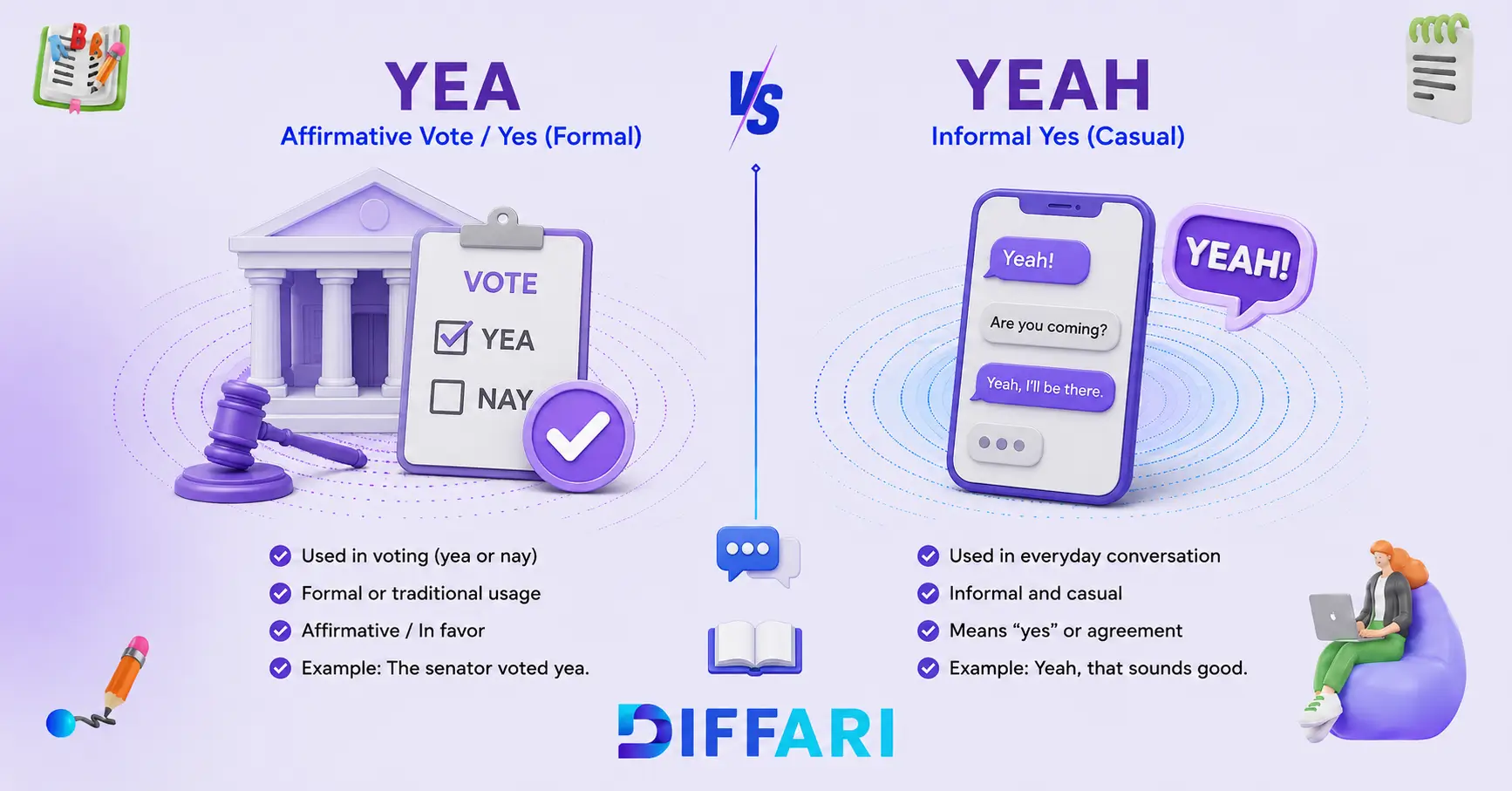
If you are unsure whether to write yea or yeah, you are not alone. The two words look similar and are both associated with agreement, but they have different roles in modern English. Yeah is the common informal way to say “yes,” while yea is most strongly associated with an affirmative vote and certain traditional or emphatic uses.
The important point is that yea is not simply a more formal spelling of yeah. In formal writing, yes is normally the better choice when you simply mean “yes.” Understanding the context will help you choose the correct word.
Quick Answer
Yeah is an informal way to say yes, especially in conversation, texting, and other casual situations.
Yea means yes or in favor, particularly in voting. It can also appear in older or emphatic language.
So:
- Yeah → casual “yes”
- Yea → affirmative vote or traditional/specialized “yes”
- Yes → standard neutral or formal “yes”
- Yay → excitement or celebration
Yea vs. Yeah at a Glance
| Feature | Yea | Yeah |
| Main meaning | Yes; affirmative vote | Informal yes |
| Typical use | Voting, traditional or specialized language | Conversation and casual writing |
| Part of speech | Adverb; noun for an affirmative vote | Adverb |
| Tone | Formal, traditional, or specialized depending on context | Informal |
| Pronunciation | /jeɪ/ | /jeə/ |
| Common expression | “yea or nay” | “Yeah, sure” |
| Example | “The senator voted yea.” | “Yeah, I agree.” |
Cambridge lists yea as /jeɪ/ and yeah as /jeə/, while Merriam-Webster gives yea the pronunciation /ˈyā/ and describes it as an affirmative vote.
What Does “Yeah” Mean?
Yeah is an informal word meaning yes. It is extremely common in everyday spoken English and also appears frequently in texts, messages, dialogue, and casual writing.
For example:
- “Yeah, I can help.”
- “Yeah, that sounds good.”
- “Did you finish the project?” — “Yeah.”
- “Yeah, I remember him.”
Because yeah is informal, it is usually not the best choice for highly formal writing. In a business report, academic paper, or formal letter, yes will generally sound more appropriate.
For example:
Casual:
“Yeah, I agree with your idea.”
More formal:
“Yes, I agree with your idea.”
Cambridge and Merriam-Webster both classify yeah as informal and define it as a form of “yes.”
What Does “Yea” Mean?
Yea is a word meaning yes, in favor, or affirmative. Its clearest modern use is in voting.
For example:
- “The senator voted yea.”
- “The motion passed with 40 yeas and 12 nays.”
- “Members were asked to vote yea or nay.”
As a noun, yea can refer to an affirmative vote or a person casting an affirmative vote.
Yea also has older or emphatic uses. Merriam-Webster records a use meaning something like “not only so, but” and an informal use referring to a degree or extent. These uses are much less common in ordinary modern conversation.
Therefore, it is inaccurate to think of yea as simply the formal equivalent of yeah.
What Is the Difference Between Yea and Yeah?
The main difference is usage and context.
Yeah is the everyday informal word for yes
If you are answering a friend, responding to a casual question, or writing a text message, yeah is normally the natural choice.
“Are you coming with us?”
“Yeah, I’ll be there.”
Yea is mainly associated with affirmative voting
When describing a vote, yea is the standard word.
“The proposal received 25 yeas and 8 nays.”
You would not normally write:
“The proposal received 25 yeahs and 8 nays.”
The distinction becomes especially obvious in the established expression “yea or nay,” meaning an affirmative or negative decision.
Yea, Yeah, Yes, and Yay
These four words are easy to confuse, but they do different jobs.
Yeah
In informal English, yeah is a casual way of saying yes.
“Yeah, I understand.”
Yes
The standard neutral word for agreement or affirmation is yes. It works naturally in both everyday and formal situations.
“Yes, I understand.”
Yay
When you want to express excitement, happiness, approval, or celebration, yay is the appropriate word.
“Yay! We won!”
So:
Yea = affirmative vote
Yeah = informal yes
Yes = standard yes
Yay = excitement
When to Use “Yeah”
Use yeah when you want a casual, conversational form of yes.
Common situations include:
- everyday conversation
- text messages
- social media
- casual emails
- informal dialogue
- relaxed discussions
Examples:
“Yeah, I’ll call you later.”
“Yeah, that makes sense.”
“Do you want some coffee?”
“Yeah, please.”
“Yeah, I know what you mean.”
One important point is that yeah can communicate different attitudes depending on tone. For example, “Yeah, sure” can express genuine agreement, but in another context it can sound doubtful or sarcastic. Merriam-Webster specifically notes uses such as “yeah, right” for disbelief or skepticism.
When to Use “Yea”
Use yea when the context involves an affirmative vote or traditional voting terminology.
Examples:
“The members voted yea.”
“The bill passed with 60 yeas and 15 nays.”
“The chair asked for a yea or nay.”
You may also encounter yea in historical, literary, religious, or deliberately traditional language.
However, don’t use yea simply because you want to make a sentence containing yeah sound more formal.
For example:
“Yea, I agree with your proposal.”
This may be understandable, but it does not naturally mean “formal yeah.”
A better formal version is:
“Yes, I agree with your proposal.”
That distinction is important: yes is the normal neutral/formal alternative to yeah.
Yea and Yeah in Sentences
Compare these examples:
Yeah
“Yeah, I’ll finish it today.”
Why? The speaker is giving a casual affirmative response.
Yea
“The committee voted yea on the amendment.”
Why? The sentence is describing an affirmative vote.
Yes
“Yes, I approve the proposed changes.”
Why? The context is more formal, so the neutral word yes is appropriate.
Yay
“Yay! We finally finished the project.”
Why? The speaker is expressing excitement, not simply answering yes.
Pronunciation: Yea vs. Yeah
The words are also different in pronunciation.
- Yea → /jeɪ/ — like “yay”
- Yeah → /jeə/ in Cambridge’s UK/US pronunciation — roughly like the vowel sound in “air” with a /y/ beginning.
This means yea and yay are pronounced alike, but yea and yeah are not necessarily pronounced the same.
That gives you another useful distinction:
yea = yay in pronunciation
yeah = informal yes
Common Mistakes With Yea and Yeah
Mistake 1: Using “yea” as a formal version of “yeah”
Incorrect for ordinary modern usage:
“Yea, I would be happy to attend.”
Better:
“Yes, I would be happy to attend.”
Why: Yes is the normal neutral/formal affirmative. Yea has more specialized or traditional uses.
Mistake 2: Using “yeah” for a formal vote
Incorrect:
“The bill received 50 yeahs and 20 nays.”
Correct:
“The bill received 50 yeas and 20 nays.”
Why: yea is the established term for an affirmative vote.
Mistake 3: Confusing “yea” with “yay”
Yea:
“The senator voted yea.”
Yay:
“Yay! We won!”
Why: Yea indicates affirmation or an affirmative vote, while yay expresses excitement or celebration.
Common Expressions With Yea and Yeah
“Yea or nay”
Yea or nay means yes or no, particularly in the context of a decision or vote.
“We need a yea or nay from the committee.”
It can also be used humorously or informally when asking someone for a definite decision.
“Yeah, sure”
This is a common conversational expression.
“Can you help me tomorrow?”
“Yeah, sure.”
Depending on tone, it can express genuine agreement or, occasionally, skepticism.
“Yeah, right!”
This expression can be used sarcastically to indicate that the speaker does not believe something.
“He says he’ll finish everything in five minutes.”
“Yeah, right!”
Can Yea and Yeah Be Used Interchangeably?
Usually not.
They overlap because both can be associated with affirmation, but their normal contexts are different.
Use:
- yeah for casual “yes”
- yea for an affirmative vote or specialized/traditional usage
- yes for a neutral or formal affirmative response
For example:
“Yeah, I agree.”
This is natural casual English.
“The board voted yea.”
This is natural voting terminology.
But:
“Yea, I agree.”
does not simply function as a formal replacement for Yeah, I agree.
How to Remember the Difference
Use this simple rule:
Yeah = everyday yes
Yea = yes vote
And remember the pair:
yea ↔ nay
A yea is an affirmative vote, while a nay is a negative vote.
For formal writing, remember a third word:
yes = neutral/formal
So the easiest three-way rule is:
Yeah for casual conversation.
Yes for neutral or formal writing.
Yea for affirmative votes and specialized/traditional uses.
Which One Should I Use?
Use this quick decision guide:
If you mean casual “yes” → use yeah.
“Yeah, I’ll come.”
If you mean standard or formal “yes” → use yes.
“Yes, I agree.”
If you mean an affirmative vote → use yea.
“The members voted yea.”
If you mean excitement → use yay.
“Yay! We did it.”
Yea or Yeah? Practice Examples
Choose yea, yeah, yes, or yay.
- “___, I can help you tomorrow.”
- “The senator voted ___ on the bill.”
- “___! We finally won.”
- “The committee recorded 32 ___ and 10 nays.”
- “___, I understand your point.”
- “The chair asked members to vote ___ or nay.”
- “___, that sounds like a great idea.”
- “___, I approve the proposal.”
Answers
- Yeah — casual agreement.
- Yea — affirmative vote.
- Yay — excitement.
- Yeas — affirmative votes.
- Yes — neutral/formal response.
- Yea — part of the expression “yea or nay.”
- Yeah — casual agreement.
- Yes — appropriate for a neutral/formal response.
Frequently Asked Questions
What is the difference between yea and yeah?
Yea is mainly used for an affirmative vote and in some traditional or emphatic contexts, while yeah is the informal everyday form of yes.
Is “yea” a formal version of “yeah”?
Not exactly. Although both can express affirmation, yea has specialized uses, particularly in voting. If you simply want a formal version of yeah, yes is normally the better choice.
Is “yeah” correct English?
Yes. Yeah is a legitimate English word and is widely used as an informal form of yes.
Is “yea” still used today?
Yes. It remains common in voting terminology, especially in expressions such as “yea or nay.” It can also appear in historical, traditional, and emphatic language.
Are yea and yeah pronounced the same?
No. Yea is pronounced /jeɪ/, while yeah is generally pronounced /jeə/ in Cambridge’s UK and US entries.
Are yea and yay pronounced the same?
Yes. Yea and yay are pronounced /jeɪ/, although they have different meanings.
Should I use “yea” or “yeah” for yes?
For ordinary casual conversation, use yeah. For a formal or neutral response, use yes. Use yea when the context is an affirmative vote or another specialized/traditional use.
Conclusion
The difference between yea and yeah mainly comes down to context. Yeah is the common informal way to say “yes,” while yea is especially associated with affirmative voting and can also appear in traditional or emphatic language. Yes is usually the best neutral or formal alternative, while yay expresses excitement.