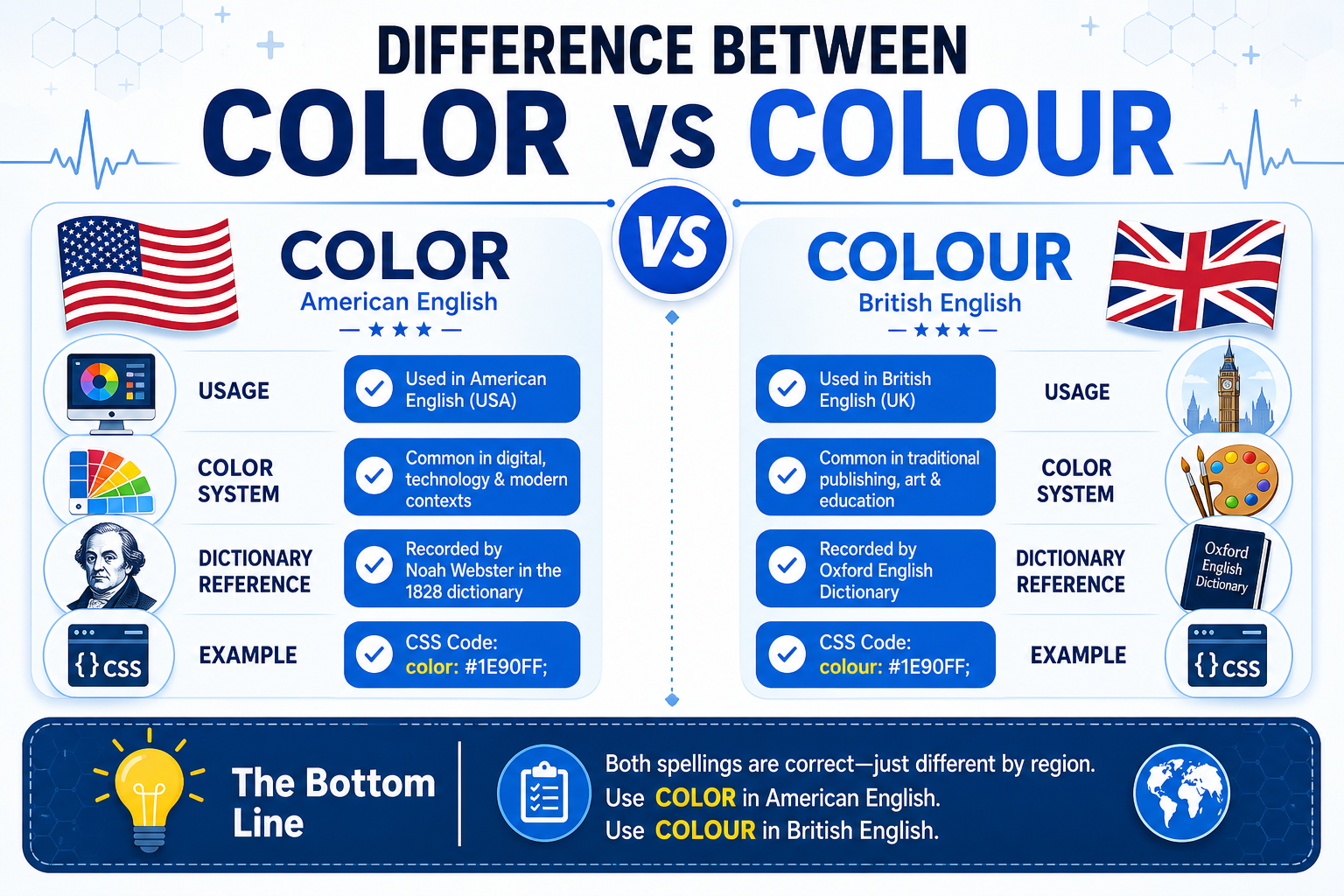
If you have seen both color and colour, you may wonder whether they have different meanings or whether one of them is incorrect. They actually mean the same thing. The difference is mainly a matter of regional spelling: color is the standard spelling in American English, while colour is the standard British English spelling.
The choice becomes important when you are writing for a particular audience, publication, school, or organization. Once you choose an English variety, it is best to keep the spelling consistent throughout your writing.
Quick Answer
Color and colour have the same meaning and are pronounced essentially the same way. The main difference is spelling.
- Color = standard American English spelling
- Colour = standard British English spelling
For US English, write color. For British English, write colour. The same regional pattern generally carries over to related forms such as colored/coloured, coloring/colouring, and colorful/colourful.
Color vs Colour at a Glance
| Feature | Color | Colour |
|---|---|---|
| Standard variety | American English | British English |
| Meaning | Same | Same |
| Basic pronunciation | Same | Same |
| Spelling | No u | Includes u |
| Noun | color | colour |
| Verb | color | colour |
| Plural | colors | colours |
| Past form | colored | coloured |
| -ing form | coloring | colouring |
| Adjective | colorful | colourful |
The important point is that this is a spelling difference, not a difference in the basic meaning of the word.
What Does “Color” Mean?
Color is the standard American English spelling of the word.
As a noun, it refers to the visual quality associated with shades such as red, blue, green, and yellow. It can also refer to the particular shade or appearance of an object.
Examples:
- My favorite color is blue.
- What color are your eyes?
- The walls are a warm neutral color.
- The sunset filled the sky with brilliant colors.
Color can also function as a verb. It can mean to add or change color, such as when using crayons, paint, or dye.
Examples:
- The children colored the pictures.
- She wants to color her hair.
- He colored the drawing with blue and green pencils.
The word can also have figurative uses. For example, something can color a person’s judgment or opinion by influencing the way they see a situation.
What Does “Colour” Mean?
Colour is the standard British English spelling of the same word.
It has the same basic meanings as color. As a noun, it can refer to a hue, shade, or visual appearance.
Examples:
- My favourite colour is blue.
- What colour are your eyes?
- The flowers have beautiful colours.
- The room needs a little more colour.
It can also be used as a verb:
- She coloured the picture.
- He decided to colour his hair.
- The children were colouring at the table.
So, changing color to colour does not change the basic meaning. It changes the spelling convention being used.
What Is the Difference Between Color and Colour?
The main difference between color and colour is regional spelling.
American English normally uses:
color
British English normally uses:
colour
The two forms have the same basic meanings, grammatical functions, and ordinary pronunciation.
For example:
American English:
What is your favorite color?
British English:
What is your favourite colour?
Notice that the regional spelling difference can appear in more than one word. Favorite is also the American spelling, while favourite is the British spelling.
The important lesson is therefore not simply “remove the u.” It is to use a consistent variety of English.
When to Use “Color”
Use color when you are following American English spelling conventions.
This is appropriate for many:
- US websites
- American school assignments
- US business documents
- American publications
- US-focused marketing content
- Writing that follows an American style guide
Examples:
- The brand uses blue as its primary color.
- Which color would you like?
- The artist mixed several colors.
- She colored the picture.
- The website uses a bright and colorful design.
If your document is written in American English, color is normally the appropriate choice.
When to Use “Colour”
Use colour when you are following British English spelling conventions.
Examples:
- Blue is my favourite colour.
- The artist used several bright colours.
- Which colour would you like?
- She coloured the picture.
- The garden looks very colourful.
The choice should follow the English variety required by your audience, employer, school, publisher, or style guide.
Color and Colour in Sentences
Here are equivalent examples in the two spelling systems:
American English
My favorite color is green.
British English
My favourite colour is green.
American English
She colored the picture with red and yellow crayons.
British English
She coloured the picture with red and yellow crayons.
American English
The website uses a colorful design.
British English
The website uses a colourful design.
The meaning does not change. The spelling changes because the underlying English variety changes.
Related Spelling Differences
The color/colour distinction is part of a broader pattern involving some words ending in -or in American English and -our in British English.
| American English | British English |
|---|---|
| color | colour |
| colored | coloured |
| coloring | colouring |
| colorful | colourful |
| colorless | colourless |
| favor | favour |
| favorite | favourite |
| honor | honour |
| neighbor | neighbour |
Not every English word follows this exact pattern, so it is better to learn established spelling pairs rather than assume that every -or word needs an -our version.
Common Collocations With Color and Colour
Because the two forms have the same meaning, their common combinations are generally the same apart from spelling.
Examples include:
- bright color / bright colour
- dark color / dark colour
- primary color / primary colour
- favorite color / favourite colour
- skin color / skin colour
- eye color / eye colour
- color palette / colour palette
- color scheme / colour scheme
- color wheel / colour wheel
- color combination / colour combination
- color blindness / colour blindness
- color theory / colour theory
When writing for a particular audience, keep the spelling consistent across the entire phrase.
Common Mistakes With Color and Colour
Incorrect for consistent American English
My favourite colour is blue.
Better American English
My favorite color is blue.
The issue is not that colour is an incorrect English word. The problem is that the sentence mixes British and American spelling conventions.
Incorrect for consistent British English
My favorite color is blue.
Better British English
My favourite colour is blue.
Again, both individual words are legitimate English spellings. The problem is inconsistency within the chosen variety.
Another common mistake
Some writers assume that colour is a completely different word from color.
It is not. In ordinary usage, the two are regional spellings of the same word.
Are Color and Colour Pronounced the Same?
Yes. In ordinary English, color and colour are pronounced the same way.
The spelling difference does not normally create a pronunciation difference.
Cambridge gives corresponding US and UK pronunciations for the two forms, with the familiar difference between the US and UK pronunciation systems rather than a difference caused by the extra u in the spelling.
So you do not need to pronounce the u in colour.
The practical rule is:
The spelling changes; the word’s ordinary pronunciation does not.
Can Color and Colour Be Used Interchangeably?
They can be interchangeable in meaning, but you should not casually switch between them within the same piece of writing.
For example, if a US website consistently uses American English, it should normally use:
color, colored, coloring, colorful
A British-English publication would normally use:
colour, coloured, colouring, colourful
The two systems communicate the same meaning, but consistency helps readers recognize the intended regional style.
How to Remember the Difference
Use this simple rule:
American English → color
British English → colour
Think of the extra u as part of the British spelling:
British → colour
American → color
You can also remember the related forms as a family:
American: color → colored → coloring → colorful
British: colour → coloured → colouring → colourful
Which One Should I Use?
Choose the version that best matches your audience and style guide.
For a US audience, use color**.**
British English uses colour**.**
When your organization or publication has a specific style guide, follow its preferred spelling.
For general content, select one variety of English and use it consistently throughout the page.
For example:
US: My favorite color is blue.
UK: My favourite colour is blue.
There is no need to choose one as universally correct. The correct choice depends on the English variety you are following.
Color or Colour? Practice Examples
Choose color or colour according to the stated variety.
- American English: What is your favorite ___?
- British English: What is your favourite ___?
- American English: She ___ the drawing yesterday.
- British English: She ___ the drawing yesterday.
- American English: The website has a very ___ design.
- British English: The website has a very ___ design.
- American English: The artist used several bright ___.
- British English: The artist used several bright ___.
Answers
- color
- colour
- colored
- coloured
- colorful
- colourful
- colors
- colours
The spelling changes according to the English variety, but the underlying meaning remains the same.
Frequently Asked Questions
What is the difference between color and colour?
Color is the standard American English spelling, while colour is the standard British English spelling. They have the same basic meaning.
Is color or colour correct?
Both are correct. Use color for American English and colour for British English.
Is color American or British?
Color is the standard American English spelling.
Is colour American or British?
Colour is the standard British English spelling.
Are color and colour pronounced the same?
Yes. The spelling difference does not normally create a difference in pronunciation.
Can I use color and colour in the same document?
You can understand both forms, but it is better to choose the spelling system appropriate to your audience and remain consistent throughout the document.
Is coloring or colouring correct?
Both are correct in their respective varieties. Coloring is American English, while colouring is British English.
Is colored or coloured correct?
Both are correct. Colored is the American spelling, while coloured is the British spelling.
Is colorful or colourful correct?
Both are correct. Colorful is the American spelling, while colourful is the British spelling.
Conclusion
The difference between color and colour is primarily a difference in regional spelling, not meaning. Color is the standard American English form, while colour is the standard British English form. They have the same basic meanings and ordinary pronunciation.
The easiest rule is simple: use color for American English and colour for British English. More importantly, keep related spellings consistent throughout your writing. If you are following a particular publication, school, employer, or style guide, use the spelling convention it requires.