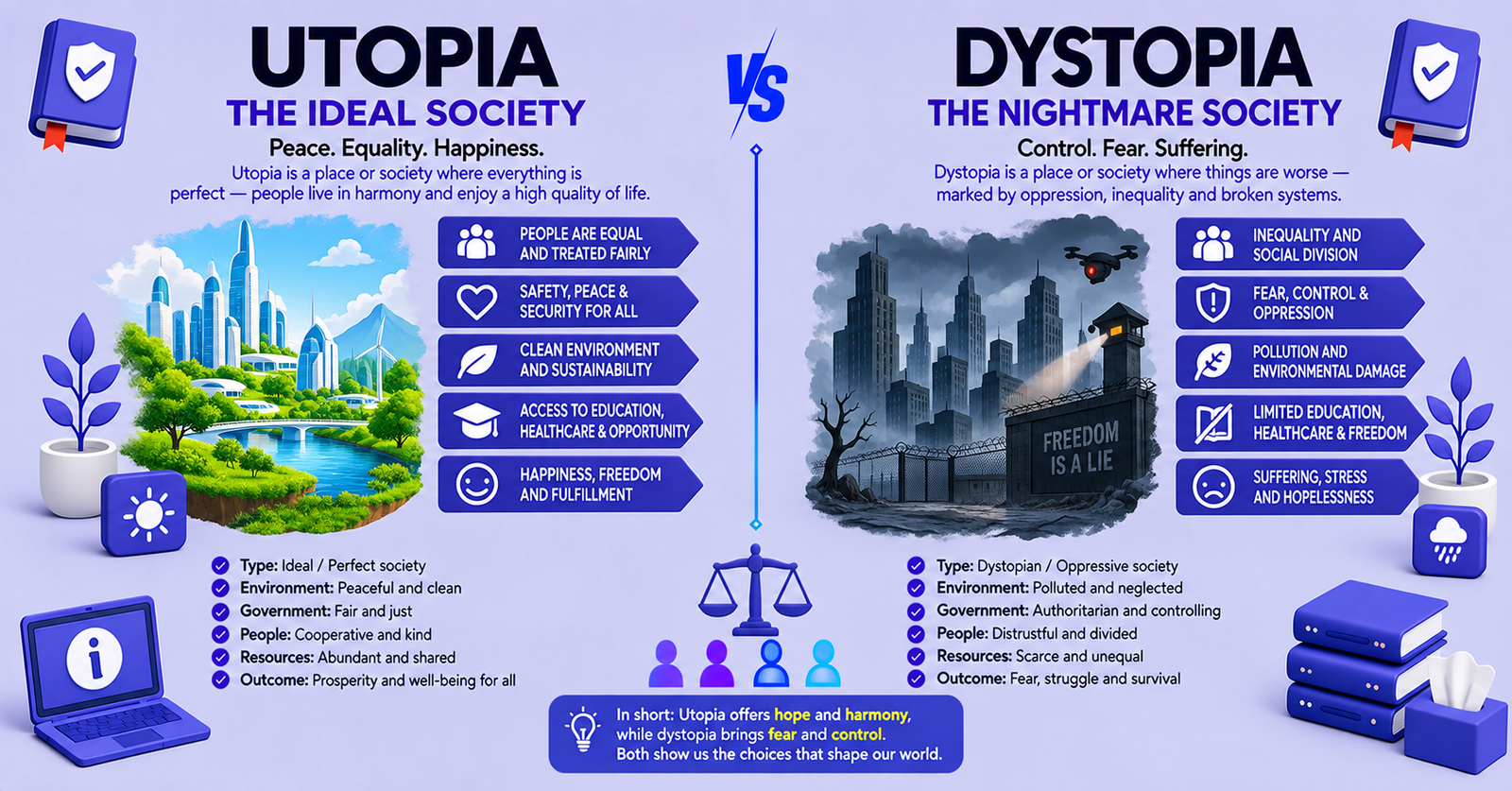

Utopia and dystopia both describe imagined societies, but they present very different visions of how life could be organized. A utopia represents an ideal or highly desirable society, while a dystopia presents a society marked by serious suffering, oppression, control, or other harmful conditions. Cambridge Dictionary defines utopia as a perfect society and dystopia as a very bad or unfair society, especially an imagined one.
The distinction becomes more interesting in literature. A utopian vision may explore what a better society could look like, while a dystopian story often takes existing fears—such as surveillance, inequality, censorship, or unchecked political power—and imagines their consequences.
Understanding this difference helps you identify the terms correctly and recognize why authors use them.
Quick Answer
Utopia is an imagined society designed or presented as ideal, harmonious, or significantly better than ordinary society.
Dystopia is an imagined society characterized by serious problems such as oppression, suffering, surveillance, inequality, censorship, or extreme social control.
The simplest difference:
Utopia shows an ideal society; dystopia shows a harmful society, often as a warning about where real-world problems could lead.
However, the two concepts can overlap. A society created with the goal of achieving perfection can become dystopian if maintaining that “perfect” system requires coercion or removes individual freedom.
Utopia vs. Dystopia at a Glance
| Feature | Utopia | Dystopia |
| Basic meaning | An ideal or highly desirable society | A harmful, oppressive, or frightening society |
| Main impression | Hopeful | Bleak or threatening |
| Social conditions | Harmony, prosperity, justice, or equality | Suffering, inequality, fear, or control |
| Typical themes | Peace, cooperation, progress, perfection | Surveillance, censorship, conformity, oppression |
| Literary function | Imagines a better way of living | Warns about social or political dangers |
| Typical relationship to reality | Presents an improved alternative | Exaggerates problems or projects them into the future |
| Common adjective | Utopian | Dystopian |
What Does Utopia Mean?
Utopia is a noun referring to an imagined ideal society or place.
Cambridge Dictionary describes it as a perfect society in which people work well together and are happy. Merriam-Webster also gives meanings including a place of ideal perfection, particularly in government, laws, and social conditions.
A utopia might be imagined as a society with:
- little or no poverty
- social harmony
- justice
- equality
- peace
- effective government
- abundant resources
- cooperation
- high quality of life
For example:
The novel describes a utopia where poverty and war have disappeared.
Here, utopia refers to the imagined ideal society.
Utopian
The adjective is utopian.
The politician proposed a utopian vision of a society without poverty.
The word can also be used more critically when an idea seems unrealistically idealistic or difficult to implement. Merriam-Webster includes “an impractical scheme for social improvement” among its meanings.
What Does Dystopia Mean?
Dystopia is a noun describing an imagined society in which conditions are extremely bad, unfair, oppressive, or frightening.
Cambridge Dictionary associates dystopia with suffering and particularly with imaginary future societies after a major catastrophe or destructive change.
A dystopian society might involve:
- government oppression
- constant surveillance
- censorship
- forced conformity
- extreme inequality
- loss of personal freedom
- propaganda
- environmental destruction
- technological control
- widespread fear
For example:
The novel portrays a dystopia where the government monitors every citizen.
The adjective is dystopian:
The film presents a dystopian future controlled by an authoritarian government.
Dystopian fiction frequently uses an imagined society to expose or exaggerate problems that exist in the real world.
What Is the Difference Between Utopia and Dystopia?
The central difference is the condition of the imagined society and what the society represents.
A utopia presents an idealized vision of society. It emphasizes what could be better: peace, equality, cooperation, prosperity, or justice.
A dystopia presents a deeply undesirable social order. It often emphasizes what can go wrong: oppression, surveillance, inequality, fear, censorship, or the loss of freedom.
For example:
Utopia: Citizens live peacefully, have their basic needs met, and participate fairly in society.
Dystopia: Citizens have everything they need materially, but the government controls their speech, movement, relationships, and information.
This second example illustrates an important point: material comfort alone does not make a society utopian. Freedom and human well-being can matter just as much as prosperity.
Utopia and Dystopia in Literature
The concepts are particularly important in literature because authors use imagined societies to examine real-world ideas.
Thomas More’s Utopia, published in 1516, gave the word its modern literary importance. The work describes an imaginary island society and has been interpreted both as an idealized social vision and as a satire that encourages readers to think critically about society.
Dystopian literature developed differently. Dystopian works commonly place readers in societies where political, social, technological, or environmental problems have become extreme. The resulting world can function as a warning about the direction of contemporary society.
Common utopian themes
- hope
- harmony
- equality
- social improvement
- peace
- abundance
- ideal government
Common dystopian themes
- surveillance
- censorship
- oppression
- conformity
- propaganda
- inequality
- authoritarianism
- environmental collapse
- loss of individuality
When to Use the Term Utopia
Use utopia when you are describing an imagined society or place that is presented as exceptionally ideal or desirable.
Examples
The author imagines a utopia without poverty.
The community was founded around a utopian vision of equality.
The fictional island appears to be a utopia where everyone has access to education and healthcare.
The key idea is idealization.
When to Use the Term Dystopia
Use dystopia when the imagined society is fundamentally harmful, oppressive, frightening, or dehumanizing.
Examples
The novel depicts a dystopia where citizens are constantly monitored.
The film imagines a dystopian society controlled by artificial intelligence.
The story presents a dystopia in which independent thought is forbidden.
The key idea is systemic harm or oppression, rather than merely an unpleasant setting.
Utopia and Dystopia in Real-World Context
Although the terms are strongly associated with fiction, they can also be used more broadly.
For example:
The new city was promoted as a technological utopia.
This means the city was presented as an exceptionally advanced and desirable place.
By contrast:
Critics warned that the proposed system could create a digital dystopia.
Here, dystopia expresses concern that technology or social systems could produce excessive control or harm.
These uses are often metaphorical rather than claims that an actual place literally is a fictional dystopia.
Examples of Utopia and Dystopia
Utopian examples
A fictional society might be considered utopian if:
- citizens enjoy political equality
- basic needs are reliably met
- violence is extremely rare
- people cooperate peacefully
- institutions are considered fair
- society provides widespread opportunity
Dystopian examples
A fictional society might be dystopian if:
- the government monitors citizens constantly
- independent thought is punished
- information is controlled
- people are forced to conform
- social classes are severely unequal
- technology is used to suppress freedom
Classic dystopian literature includes works such as George Orwell’s 1984 and Ray Bradbury’s Fahrenheit 451. Modern discussions also commonly include works such as Margaret Atwood’s The Handmaid’s Tale and Suzanne Collins’ The Hunger Games.
Common Mistakes With Utopia and Dystopia
Mistake 1: Treating dystopia as any bad place
Incorrect:
The abandoned house is a dystopia because it is frightening.
Better:
The novel creates a dystopian society in which the government controls its citizens.
Why:
A dystopia normally refers to a broader social condition or imagined society, not simply an unpleasant building or frightening location.
Mistake 2: Assuming dystopia only means a future society
Incorrect assumption:
A society cannot be dystopian unless it is set in the future.
Better understanding:
Dystopian works frequently use future or alternate societies, but the essential feature is the harmful or oppressive social condition, not simply the date in which the story occurs.
Cambridge Dictionary specifically notes the common association with imaginary future societies, but the concept is broader than a requirement that every dystopia be futuristic.
Mistake 3: Assuming utopia means literally perfect in every possible sense
Incorrect:
Anything described as utopian must have absolutely no problems.
Better understanding:
In ordinary usage, utopian can describe an idealized vision, proposal, or society. Literary utopias can also contain contradictions and limitations.
In fact, scholars have long debated whether apparently perfect societies can truly satisfy every member of a diverse population.
Common Collocations With Utopia and Dystopia
Collocations with utopia
- imagined utopia
- perfect utopia
- utopian society
- utopian vision
- utopian ideal
- utopian community
- utopian dream
- utopian future
- utopian philosophy
Collocations with dystopia
- dystopian society
- dystopian future
- dystopian fiction
- dystopian novel
- dystopian world
- dystopian vision
- dystopian government
- dystopian regime
- dystopian nightmare
These combinations help you recognize how the words are normally used in real writing.
Can a Utopia Become a Dystopia?
Yes.
This is one of the most important nuances in the comparison.
A society may begin with a goal that sounds utopian—such as eliminating crime, creating equality, achieving perfect security, or maximizing happiness. But the methods used to achieve that goal can become oppressive.
For example:
A government promises a perfectly safe society and installs surveillance everywhere.
At first, safety sounds utopian.
But if surveillance removes privacy and citizens are punished for questioning the government, the resulting society may become dystopian.
This is why utopian and dystopian ideas are often closely connected in literature. A system designed to eliminate problems can create new problems when it demands too much control.
Are Utopia and Dystopia Interchangeable?
No.
They normally describe contrasting visions.
- Utopia → desirable or idealized society
- Dystopia → undesirable, oppressive, or harmful society
However, they can appear together in the same story.
A fictional society may claim to be utopian while the author gradually reveals that it is actually dystopian.
This distinction is particularly useful when analyzing literature because the society’s appearance and its actual effect on its citizens may not be the same.
Utopian vs. Dystopian Fiction
Utopian fiction generally explores an imagined better society or alternative social arrangement.
Dystopian fiction generally presents a damaged or oppressive society and often uses it to criticize or warn against real-world tendencies.
A useful way to remember the literary difference is:
Utopian fiction asks, “What could a better society look like?”
Dystopian fiction asks, “What could go terribly wrong with society?”
The distinction is not absolute, though. Some works combine hope and fear, and some apparently utopian societies contain serious contradictions.
What Is the Difference in Their Purpose?
Another useful distinction is purpose.
Utopia often emphasizes possibility
The author can use an ideal society to explore:
- better government
- social equality
- peace
- cooperation
- technological progress
- alternative ways of living
Dystopia often emphasizes warning
The author can use a damaged society to explore:
- political oppression
- misuse of technology
- environmental destruction
- inequality
- propaganda
- loss of freedom
- excessive conformity
Dystopian literature therefore often connects an imagined future to concerns about the present.
How to Remember the Difference
Use this simple rule:
Utopia = ideal society.
Dystopia = harmful or oppressive society.
You can also remember:
Utopia → “ideal”
Dystopia → “disturbing”
The word dystopia contains the prefix dys-, associated with something bad, abnormal, or difficult. Its history is connected with the Greek-rooted construction of the word and with John Stuart Mill’s use of “dystopian” in a 1868 parliamentary speech.
Which One Should I Use?
Use utopia when you mean:
an imagined ideal or highly desirable society
Use dystopia when you mean:
an imagined society characterized by serious suffering, oppression, control, or other systemic problems
Quick Decision Guide
Use utopia for an imagined society presented as ideal, peaceful, or highly desirable.
Use dystopia for an imagined society characterized by oppression, suffering, extreme control, or loss of freedom.
A society can appear utopian on the surface but actually be dystopian if its apparent perfection depends on severe restrictions or control.
Utopia or Dystopia? Practice Examples
Choose utopia or dystopia.
- The novel describes a peaceful society where poverty has been eliminated.
- Citizens are monitored constantly and cannot criticize the government.
- The author imagines a world where everyone has equal access to education.
- People must follow government-approved beliefs or face punishment.
- The story presents an ideal community built around cooperation and equality.
- A corporation controls every aspect of citizens’ lives.
- The fictional society promises perfect security but eliminates personal privacy.
- The author imagines a future where humans live peacefully with abundant resources.
Answers
- Utopia
- Dystopia
- Utopia
- Dystopia
- Utopia
- Dystopia
- Dystopia
- Utopia
Frequently Asked Questions
What is the difference between utopia and dystopia?
A utopia is an imagined ideal or highly desirable society, while a dystopia is an imagined society characterized by serious problems such as oppression, suffering, surveillance, or extreme social control.
Is dystopia the opposite of utopia?
In simple terms, yes: utopia represents an idealized society, while dystopia represents an undesirable one. However, the relationship is more complicated in literature because dystopian societies can develop from utopian ideals taken to harmful extremes.
Are utopia and dystopia always fictional?
No. The terms are frequently used in literature and speculative fiction, but utopian and dystopian can also describe ideas, proposals, political visions, or real-world situations metaphorically.
What is a utopian society?
A utopian society is an imagined community designed or presented as exceptionally ideal, often emphasizing peace, justice, equality, prosperity, or social harmony.
What is a dystopian society?
A dystopian society is an imagined social order in which people experience significant suffering, oppression, inequality, censorship, surveillance, or loss of freedom.
Can a society be both utopian and dystopian?
Yes, depending on whose perspective is considered. A society may provide security and prosperity for some people while restricting or harming others. A story may also deliberately present a society that appears utopian before revealing dystopian characteristics.
Why do authors write dystopian stories?
Dystopian stories often exaggerate real-world concerns to examine what could happen if harmful social, political, technological, or environmental trends continue unchecked.
What is the adjective for utopia?
The adjective is utopian.
The novel presents a utopian vision of society.
What is the adjective for dystopia?
The adjective is dystopian.
The film explores a dystopian future.
Is every bad future a dystopia?
No. A dystopia is generally more than a future containing disasters or unpleasant events. The concept usually involves a broader social condition in which institutions, systems, or power structures create or maintain serious oppression, suffering, or loss of freedom.
Conclusion
The difference between utopia and dystopia is primarily the kind of society they represent. Utopia describes an imagined ideal or highly desirable society, while dystopia describes an imagined society marked by serious suffering, oppression, inequality, or control.
The easiest rule is:
Utopia imagines an ideal society; dystopia imagines a society gone seriously wrong.

Sajid Ali is an English language educator and content specialist with 7+ years of teaching experience. He holds master’s degrees in Information Technology and Education from the Virtual University of Pakistan and writes SEO-optimized, learner-friendly vocabulary content for diffari.com.