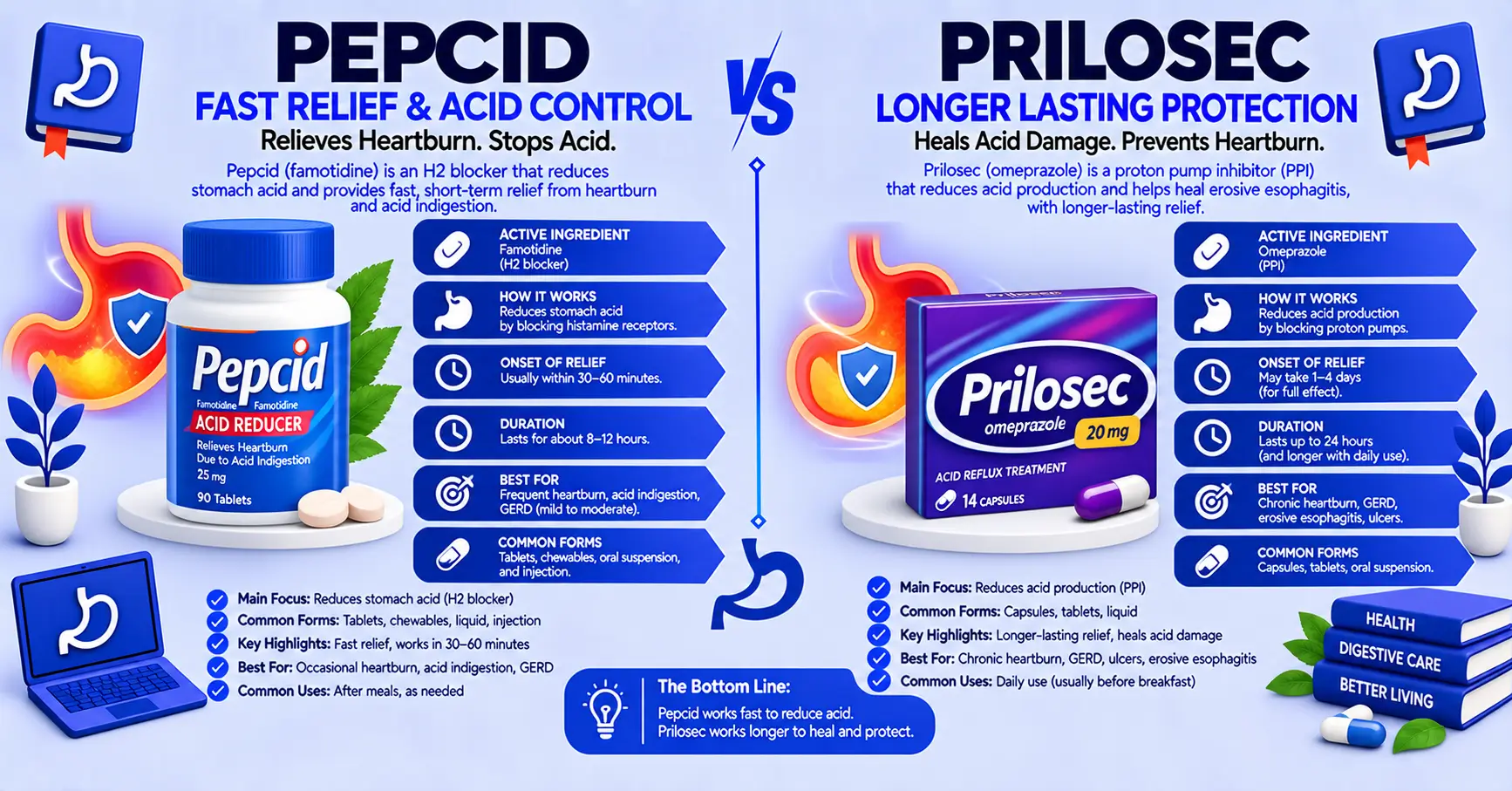

Pepcid and Prilosec are both used to reduce problems caused by stomach acid, but they are not the same type of medication. Pepcid contains famotidine, an H2 receptor blocker, while Prilosec contains omeprazole, a proton pump inhibitor (PPI). Their different mechanisms affect how quickly they work, how they are used, and how long treatment may be needed.
For OTC products in the United States, Pepcid is primarily labeled for relief or prevention of certain heartburn symptoms, while Prilosec OTC is intended for frequent heartburn and is not designed for immediate relief.
Quick Answer
Pepcid (famotidine) is an H2 blocker that reduces stomach-acid production and generally starts working faster. Prilosec (omeprazole) is a PPI that suppresses acid production more directly at the stomach’s proton pumps and is intended for frequent heartburn rather than immediate relief.
In simple terms:
Pepcid is generally the faster-acting option for occasional heartburn, while Prilosec is designed as a daily treatment for frequent heartburn.
That does not mean one medication is universally better. The appropriate choice depends on the condition being treated, symptom frequency, other medications, and individual health factors.
Pepcid vs. Prilosec at a Glance
| Feature | Pepcid | Prilosec |
| Active ingredient | Famotidine | Omeprazole |
| Drug class | H2 receptor blocker | Proton pump inhibitor |
| Main OTC role | Relief/prevention of certain heartburn symptoms | Frequent heartburn |
| How it works | Blocks histamine-2 receptors involved in acid production | Blocks stomach proton pumps that release acid |
| Speed | Generally starts working in about 15–30 minutes for Pepcid AC | May take 1–4 days for full effect |
| Typical OTC pattern | Can be used for occasional symptoms according to the label | Once daily for a 14-day course |
| Immediate relief? | Yes, depending on formulation | No |
| Duration | Acid control can last many hours | Designed for prolonged acid suppression |
| Generic | Famotidine | Omeprazole |
PEPCID states that its H2-blocker products can begin working in 15–30 minutes, whereas OTC PPIs such as Prilosec may take 1–4 days for full effect.
What Is Pepcid?
Pepcid is a brand name associated with famotidine, an H2 receptor blocker.
Famotidine reduces stomach-acid production by blocking histamine-2 receptors that signal the stomach to produce acid. This makes it different from an antacid, which neutralizes acid already present in the stomach.
For OTC Pepcid AC, the label describes uses including relief of heartburn associated with acid indigestion and sour stomach and prevention of certain heartburn symptoms related to eating or drinking particular foods and beverages.
How fast does Pepcid work?
Pepcid AC generally starts working within 15–30 minutes, according to the manufacturer. Some Pepcid formulations also contain an antacid, which changes how quickly the product begins to neutralize acid.
This makes the distinction important:
Pepcid = generally quicker acid-reduction action
Prilosec = slower onset but longer-term acid suppression
What Is Prilosec?
Prilosec is a brand name for omeprazole, a proton pump inhibitor.
Instead of blocking histamine receptors, omeprazole acts on the stomach’s acid-producing proton pumps. PPIs reduce the amount of acid released into the stomach and are used for conditions involving excessive or problematic acid production.
Prilosec is available in both prescription and OTC forms, and the indications differ between those products. Prilosec OTC is specifically intended for frequent heartburn, defined by FDA consumer guidance as heartburn occurring two or more days a week.
How fast does Prilosec work?
Prilosec OTC is not intended for immediate relief. Its labeling says it may take 1–4 days for full effect, although some people experience complete symptom relief sooner.
That is one of the most important differences between Pepcid and Prilosec.
What Is the Difference Between Pepcid and Prilosec?
The central difference is their drug class and mechanism of action.
Pepcid contains famotidine, an H2 receptor blocker. It blocks histamine-2 receptors involved in stimulating stomach-acid production.
Prilosec contains omeprazole, a PPI. It acts on the proton pumps responsible for releasing acid into the stomach.
Both reduce stomach acid, but they do so at different points in the acid-production process.
This difference leads to an important practical distinction:
- Pepcid generally works faster.
- Prilosec generally requires regular daily use to achieve its full OTC effect.
- Pepcid is associated with occasional/unexpected heartburn relief.
- Prilosec OTC is intended for frequent heartburn.
Pepcid vs. Prilosec: Which Works Faster?
Pepcid generally works faster.
PEPCID’s official information says Pepcid AC begins working in approximately 15–30 minutes. In contrast, Prilosec OTC may take 1–4 days to reach its full effect.
So if the question is specifically:
“Which one is intended for immediate relief?”
Pepcid fits that role better than Prilosec OTC.
However, faster does not automatically mean more effective for every condition. PPIs can provide stronger acid suppression and are important treatments for several acid-related disorders. Mayo Clinic lists both H2 blockers and PPIs among medications used for heartburn, while clinical research has found omeprazole can provide greater control of reflux symptoms in some patient groups.
Pepcid vs. Prilosec for Occasional Heartburn
For occasional or unexpected heartburn, Pepcid may be the more relevant OTC category because famotidine products are designed to provide relatively rapid acid reduction.
PEPCID specifically describes its H2-blocker products as suitable for unexpected heartburn and says certain Pepcid AC products can also be taken before a meal to help prevent heartburn.
Prilosec OTC is different.
It is intended for frequent heartburn, not occasional immediate relief. FDA guidance states that OTC PPIs are intended for frequent heartburn and are not intended for immediate relief.
Pepcid vs. Prilosec for Frequent Heartburn
For frequent heartburn, Prilosec OTC is specifically designed for this treatment pattern.
The OTC omeprazole labeling instructs adults to take one tablet daily for 14 days and states that the product may take 1–4 days for full effect. It also says not to use it for more than 14 days unless directed by a doctor.
The FDA similarly states that OTC PPIs are intended for a 14-day course and may be used up to three times per year according to OTC labeling.
If heartburn continues, worsens, or repeatedly requires medication beyond the OTC instructions, medical evaluation is appropriate rather than simply extending self-treatment.
When to Use Pepcid
For OTC use, Pepcid may be appropriate for the type of occasional heartburn described on its product labeling.
Think of Pepcid when the main situation is:
- unexpected heartburn
- heartburn associated with acid indigestion or sour stomach
- a need for relatively quick acid reduction
- certain predictable meals that trigger heartburn
Pepcid’s OTC label also warns against using it with other acid reducers and recommends asking a doctor or pharmacist before use if you take prescription medication.
When to Use Prilosec
Prilosec OTC is designed around a different situation:
- frequent heartburn
- heartburn occurring two or more days per week
- a need for sustained acid suppression rather than immediate relief
The OTC product is taken once daily for a 14-day course and should be taken before eating in the morning according to its labeling.
Prescription omeprazole has broader medical uses, so Prilosec OTC should not be treated as interchangeable with every prescription omeprazole regimen.
Pepcid and Prilosec in Real-World Examples
Example 1: Occasional heartburn
You rarely experience heartburn and suddenly develop symptoms after a meal.
Pepcid may fit the OTC use case better because famotidine is intended for relatively rapid relief of certain heartburn symptoms.
Example 2: Frequent heartburn
You experience heartburn several days each week.
Prilosec OTC is specifically designed for frequent heartburn, rather than immediate relief of a single episode.
Example 3: You need relief right now
You have heartburn and want an OTC product intended to work quickly.
Prilosec is not the appropriate immediate-relief category. OTC PPIs may take 1–4 days for full effect.
Example 4: You have persistent reflux symptoms
If symptoms continue despite OTC treatment, the question is no longer simply “Pepcid or Prilosec?” Persistent symptoms may require evaluation for GERD or another underlying condition. Mayo Clinic recommends medical evaluation when nonprescription treatment does not work or is needed frequently.
Common Collocations With Pepcid and Prilosec
Because these are medication names rather than commonly confused English words, useful search and usage combinations include:
Pepcid
- Pepcid AC
- Pepcid Complete
- Pepcid for heartburn
- Pepcid famotidine
- Pepcid H2 blocker
- Pepcid acid reducer
Prilosec
- Prilosec OTC
- Prilosec omeprazole
- Prilosec PPI
- Prilosec for frequent heartburn
- Prilosec acid reducer
- Prilosec for acid reflux
Common Mistakes With Pepcid and Prilosec
Mistake 1: Treating them as the same drug
Incorrect idea:
“Pepcid and Prilosec are basically the same medication.”
Correct:
Pepcid/famotidine is an H2 blocker, while Prilosec/omeprazole is a PPI.
Why: They reduce acid through different mechanisms.
Mistake 2: Expecting Prilosec to work immediately
Incorrect idea:
“I took Prilosec and should feel immediate relief.”
Correct:
OTC Prilosec is not intended for immediate relief and may take 1–4 days for full effect.
Why: PPIs work through sustained suppression of stomach acid rather than providing the same rapid effect expected from an H2 blocker.
Mistake 3: Assuming stronger acid suppression means better for everyone
Incorrect idea:
“Prilosec is stronger, so everyone with heartburn should use it.”
Correct:
The appropriate medication depends on the type and frequency of symptoms and the underlying condition.
Why: Different medications are designed for different treatment situations.
Mistake 4: Continuing OTC treatment indefinitely
OTC Prilosec has a defined 14-day course, and Pepcid’s OTC labeling also tells users to seek medical advice when symptoms persist or prolonged use is needed.
Safety and Important Warnings
Medication comparisons should not focus only on which drug works faster.
Pepcid and kidney function
Famotidine is substantially cleared by the kidneys. Current prescribing information recommends dosage adjustments in moderate or severe renal impairment, and higher exposure can increase the risk of adverse reactions.
The OTC Pepcid AC label also specifically tells people with kidney disease to ask a doctor before use.
Prilosec and medication interactions
Omeprazole can interact with other medications. FDA materials and Prilosec labeling have specifically addressed interactions involving medicines such as clopidogrel and warfarin, among others.
This is particularly important if you take prescription medications regularly.
When not to self-treat
Pepcid’s OTC labeling warns users to seek medical advice for symptoms such as trouble or pain swallowing, vomiting blood, black or bloody stools, unexplained weight loss, persistent symptoms, and certain chest symptoms.
These symptoms can indicate a condition that should not simply be treated as ordinary heartburn.
Can Pepcid and Prilosec Be Used Interchangeably?
No—not automatically.
They have overlapping purposes because both reduce stomach acid, but they belong to different drug classes and have different treatment patterns.
For OTC use:
Pepcid: generally associated with occasional/unexpected heartburn relief.
Prilosec OTC: intended for frequent heartburn and requires daily treatment rather than immediate symptom relief.
Whether someone should switch from one to the other depends on why the medication is being used, symptom frequency, other medications, and individual medical circumstances.
Do not assume that taking both together is automatically appropriate. Pepcid AC labeling says not to use it with other acid reducers, so combination use should be discussed with a healthcare professional rather than improvised.
How to Remember the Difference
A simple way to remember the basic distinction is:
Pepcid = H2 blocker = quicker relief
Prilosec = PPI = frequent heartburn treatment
Another useful rule is:
Unexpected heartburn → think about the H2-blocker category.
Frequent heartburn → think about the PPI category.
These are broad OTC-use principles, not individualized treatment instructions.
Which One Should I Use?
Use this as a general information guide, not a personal prescription:
If you have occasional heartburn and want relatively fast relief → Pepcid/famotidine is the relevant OTC category.
you have frequent heartburn → Prilosec OTC/omeprazole is specifically labeled for that pattern.
If symptoms persist, worsen, or require repeated treatment → talk with a healthcare professional rather than simply taking more medication.
The most important point is that “faster” and “stronger” are not the same thing. Pepcid and Prilosec are designed differently because they suppress stomach acid differently.
Pepcid or Prilosec? Practice Examples
Choose the category that best fits each situation.
- Someone experiences occasional unexpected heartburn and wants relatively rapid relief.
- Someone has heartburn two or more days each week.
- Someone expects an OTC medication to provide immediate relief but is considering Prilosec.
- Someone has moderate or severe kidney impairment and is considering famotidine.
- Someone takes several prescription medications and wants to start an acid reducer.
- Someone has persistent heartburn despite following an OTC treatment course.
Answers
- Pepcid/famotidine category
- Prilosec OTC/omeprazole category
- Prilosec is not intended for immediate relief
- Medical/pharmacist guidance is especially important with famotidine
- Ask a doctor or pharmacist about potential interactions
- Seek medical advice rather than continuing self-treatment indefinitely
These answers are based on OTC labeling and FDA guidance rather than a personalized treatment recommendation.
Frequently Asked Questions
What is the main difference between Pepcid and Prilosec?
Pepcid contains famotidine, an H2 receptor blocker, while Prilosec contains omeprazole, a proton pump inhibitor. Both reduce stomach acid, but they act through different mechanisms and have different treatment patterns.
Which works faster, Pepcid or Prilosec?
Pepcid AC generally starts working in about 15–30 minutes. Prilosec OTC may take 1–4 days to reach its full effect and is not intended for immediate relief.
Is Pepcid or Prilosec better for frequent heartburn?
Prilosec OTC is specifically labeled for frequent heartburn, which FDA consumer guidance describes as heartburn occurring two or more days per week.
Is Pepcid better for occasional heartburn?
Pepcid’s OTC labeling is directed toward relief and prevention of certain heartburn symptoms and it generally acts faster than an OTC PPI.
Are Pepcid and Prilosec the same type of medicine?
No. Pepcid/famotidine is an H2 receptor blocker, whereas Prilosec/omeprazole is a proton pump inhibitor.
Can Pepcid replace Prilosec?
Not automatically. They have different drug classes, mechanisms, onset times, and labeled uses. A substitution should depend on the condition being treated and individual circumstances.
Can you take Pepcid and Prilosec together?
Do not assume that combining them is appropriate. OTC Pepcid AC labeling says not to use it with other acid reducers. Ask a doctor or pharmacist before combining acid-reducing medicines.
Does Prilosec work immediately?
No. Prilosec OTC is not intended for immediate relief and may take 1–4 days for full effect.
Does Pepcid treat GERD?
Prescription famotidine is used for GERD, while OTC Pepcid products have specific OTC indications and limitations. Prescription and OTC labeling should not be treated as interchangeable.
Which one has fewer drug interactions?
Neither should automatically be considered interaction-free. Both acid reducers can interact with medications, and the appropriate choice depends on the specific medicines a person takes. FDA guidance recommends asking a doctor or pharmacist when taking prescription drugs.
Conclusion
The difference between Pepcid and Prilosec comes down primarily to their drug classes and how they suppress stomach acid. Pepcid (famotidine) is an H2 blocker that generally acts faster, making it associated with occasional or unexpected heartburn relief. Prilosec (omeprazole) is a PPI designed for frequent heartburn and is not intended for immediate relief.

Sajid Ali is an English language educator and content specialist with 7+ years of teaching experience. He holds master’s degrees in Information Technology and Education from the Virtual University of Pakistan and writes SEO-optimized, learner-friendly vocabulary content for diffari.com.