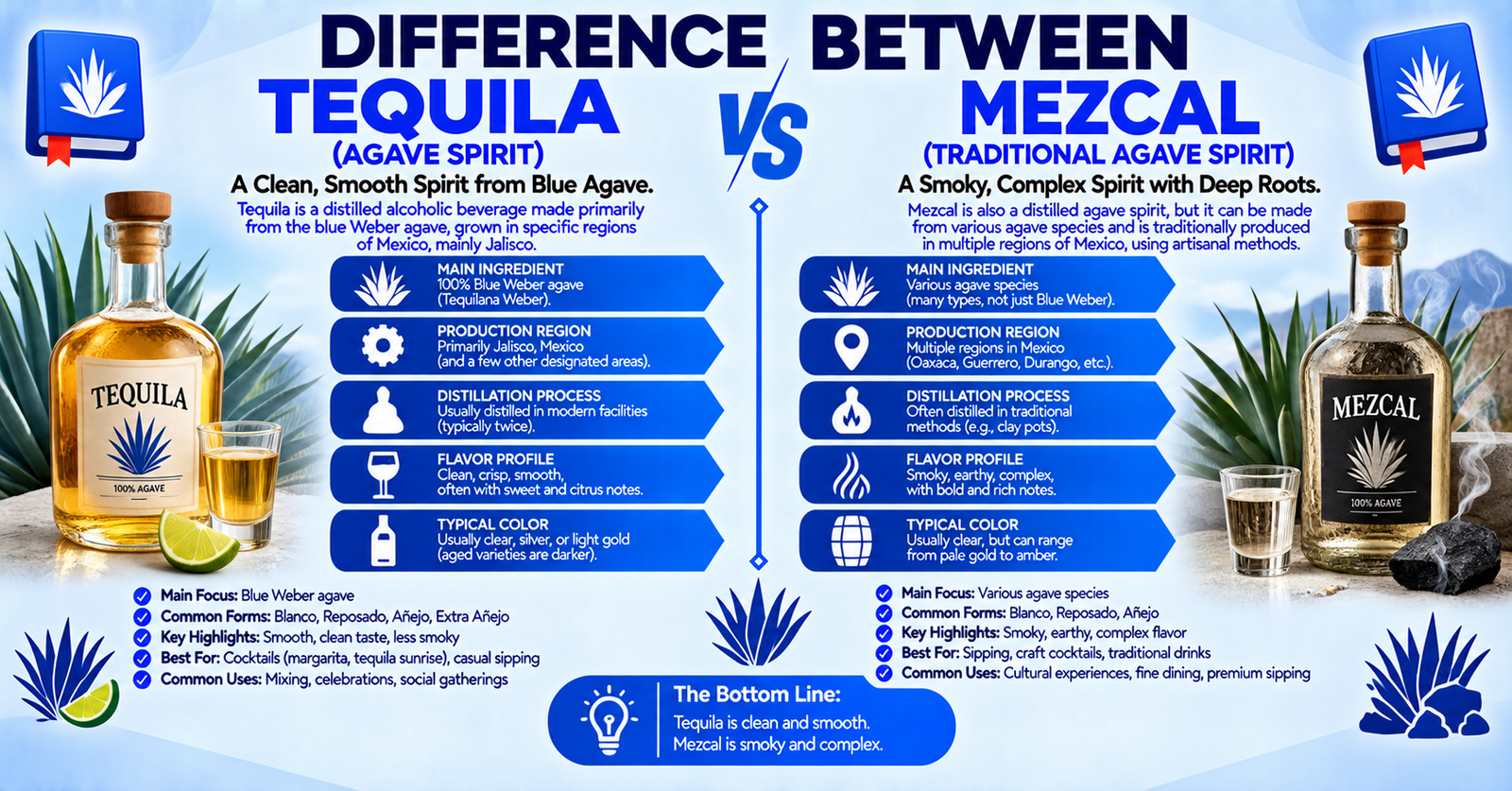
Tequila and mezcal are both Mexican spirits made from agave, so it is easy to assume they are simply two names for the same drink. They are not. Modern Mexican regulations define tequila and mezcal as distinct categories, with different rules covering the agave used, where the spirit can be produced, and how it is made.
The most noticeable difference often appears in the glass: mezcal is frequently associated with smoky, earthy flavors, while tequila often has brighter, cleaner agave, citrus or vegetal notes. But that shortcut is incomplete. Mezcal is not always intensely smoky, and tequila is not limited to one flavor profile. Production methods, agave variety, region and maturation all influence the final spirit.
Quick Answer
Tequila is a regulated Mexican spirit made from Blue Weber agave in designated areas of Mexico. Mezcal is a separately regulated Mexican spirit made from 100% agave, with multiple permitted agave varieties and its own designated production regions.
The biggest practical differences are the agave varieties allowed, production methods, geographic designation and resulting flavor. Tequila is commonly produced by cooking agave with steam, while traditional mezcal production often roasts the agave in underground or earthen pits, which can contribute smoky flavors.
One terminology point matters: you may see the statement “all tequila is mezcal, but not all mezcal is tequila.” This reflects older and broader use of mezcal as a term for distilled agave spirits, but today tequila and mezcal are legally separate regulated categories in Mexico.
Tequila vs Mezcal at a Glance
| Feature | Tequila | Mezcal |
|---|---|---|
| Main raw material | Blue Weber agave | 100% agave |
| Agave varieties | Blue Weber only under the tequila standard | Multiple permitted agave/maguey varieties |
| Legal production area | Designated municipalities in 5 Mexican states | Designated areas covered by the Mezcal denomination |
| Typical cooking method | Steam ovens/autoclaves and other permitted methods | Traditional mezcal commonly uses fire-roasted pits; methods vary by category |
| Common flavor impression | Bright, vegetal, citrusy, fruity or peppery depending on expression | Often smoky, earthy, herbal, fruity or mineral |
| Aging categories | Blanco, joven/gold, reposado, añejo, extra añejo | Joven/blanco, reposado and añejo, with additional regulated classes |
| Common cocktails | Margarita, Paloma, Ranch Water | Mezcal Margarita, Mezcal Paloma, spirit-forward cocktails |
The table describes broad patterns rather than rules for every bottle. Production techniques and flavor can vary considerably within both categories.
What Is Tequila?
Tequila is a Mexican distilled spirit made from Agave tequilana Weber, variedad azul, commonly called Blue Weber agave. Mexico’s tequila standard specifies the permitted agave and the geographical area in which tequila can be produced. The protected tequila denomination covers designated municipalities in Jalisco, Michoacán, Guanajuato, Nayarit and Tamaulipas.
The harvested center of the agave is commonly called the piña or head. Its carbohydrates are converted into fermentable sugars before fermentation and distillation.
Tequila is divided into categories and classes based on how it is formulated and subsequently matured. Importantly, the Mexican standard distinguishes ordinary Tequila from Tequila 100% de agave. Ordinary tequila may contain up to 49% of its fermentable sugars from permitted non-agave sources under the standard, whereas tequila labeled 100% agave derives its sugars from Blue Weber agave.
That means the phrase “tequila” does not automatically mean “100% agave tequila.”
What Is Mezcal?
Mezcal is a separately regulated Mexican distilled spirit defined under NOM-070-SCFI-2016. The standard describes mezcal as a spirit made from 100% maguey or agave, produced from mature agave heads that have been cooked, fermented and distilled.
Unlike tequila, mezcal is not restricted to Blue Weber agave. Different mezcal expressions can use different agave species or traditional regional varieties, including familiar names such as Espadín and Tobalá.
The result is a much broader range of possible aromas and flavors. The agave species, growing environment, fermentation, cooking method, distillation and producer all influence the finished spirit.
What Is the Main Difference Between Tequila and Mezcal?
The simplest accurate explanation is:
Tequila has a much narrower raw-material definition: it must use Blue Weber agave and comply with tequila’s geographic and production rules. Mezcal has a broader range of permitted agaves and its own geographic and production standards.
The production process is particularly important to flavor.
Traditional mezcal production often cooks agave piñas in earthen pits over fire. Tequila production commonly uses steam-based ovens or autoclaves. Roasting over fire can introduce smoky aromas and flavors, while steam cooking generally preserves a cleaner expression of the cooked agave.
But smoky does not equal mezcal in every case. The amount of smoke varies with the mezcal’s production method and other factors. Likewise, tequila can have complex, expressive flavors rather than being simply “smooth” or “sweet.”
Agave: Tequila vs Mezcal
This is one of the clearest distinctions.
Tequila
Tequila’s regulated raw material is Blue Weber agave (Agave tequilana Weber variety azul). The Mexican standard requires the agave used for tequila to be that specified variety and to come from the protected territory.
Mezcal
Mezcal allows a much broader range of agave varieties. The name of the agave used is required on regulated mezcal labeling, and different varieties can contribute substantially different flavor profiles.
This is one reason mezcal can offer such a wide sensory range.
How Are Tequila and Mezcal Made Differently?
Both spirits begin with agave, and both involve cooking, extracting sugars, fermentation and distillation. The important differences appear in the details.
Tequila production
Tequila commonly uses steam cooking in above-ground ovens or autoclaves. After cooking, the agave is processed to extract fermentable sugars, fermented and distilled. Industrial tequila production can involve highly mechanized processes.
Mezcal production
Traditional mezcal production commonly cooks agave in underground or earthen pits heated with wood and hot rocks. The cooked agave may then be crushed using traditional equipment such as a tahona before fermentation and distillation. Other mezcal production methods exist, and not every mezcal is made using exactly the same traditional process.
The important point is that production method influences flavor. Pit roasting is one major reason smoky notes are common in mezcal.
Where Are Tequila and Mezcal Made?
Tequila and mezcal both have protected geographic designations, but their permitted areas differ.
Tequila’s protected denomination covers 181 municipalities across five Mexican states: Jalisco, Michoacán, Guanajuato, Nayarit and Tamaulipas. Jalisco is by far the most prominent tequila-producing region.
Mezcal has its own denomination and standard. Its recognized production territory covers designated areas across multiple Mexican states, with Oaxaca accounting for the large majority of mezcal production.
So “made in Mexico” alone is not enough to determine whether an agave spirit legally qualifies as tequila or mezcal.
How Do Tequila and Mezcal Taste?
Flavor is where the difference becomes especially noticeable.
Tequila
Depending on the variety and maturation, tequila can show:
- cooked agave
- citrus
- pepper
- herbal notes
- fruit
- vegetal flavors
- vanilla and oak in aged expressions
Blanco tequila often lets the fresh or cooked-agave character come forward, while barrel maturation can add additional flavors.
Mezcal
Mezcal can show:
- smoke
- roasted agave
- earth
- herbs
- fruit
- minerals
- spice
- savory notes
However, not every mezcal is heavily smoky. The degree of smoke depends on how the agave is cooked and on the individual production style. WSET specifically cautions against reducing mezcal to “smoky tequila.”
100% Agave Tequila vs Mixto Tequila
This is an important distinction that is frequently missed in simple tequila-vs-mezcal articles.
Under Mexico’s tequila standard, regular tequila can be formulated with up to 49% of its fermentable sugars from permitted non-agave sources, while tequila labeled 100% agave must derive its sugars from Blue Weber agave.
Mezcal, by contrast, is defined by its current standard as a 100% maguey or agave spirit.
Therefore, comparing “tequila” with “mezcal” without mentioning the 100% agave distinction can leave out an important part of the picture.
When to Use Tequila
Choose tequila when you want the characteristic agave profile of tequila and a cocktail whose balance is built around that spirit.
Tequila works naturally in drinks such as:
- Margarita
- Paloma
- Ranch Water
- Tequila Sunrise
For a classic Margarita, blanco tequila provides a bright agave base that works with lime and orange liqueur.
Tequila is also suitable for sipping. The idea that tequila is only a shot spirit is misleading; quality tequila can be enjoyed neat just as other distilled spirits can.
When to Use Mezcal
Choose mezcal when you want more of the character associated with roasted agave, earthiness and, depending on the expression, smoke.
Mezcal can work particularly well in:
- Mezcal Margarita
- Mezcal Paloma
- Oaxaca-style Old Fashioned variations
- spirit-forward cocktails
- neat pours intended for slow tasting
The choice is often about the flavor direction you want rather than one spirit being universally preferable.
Can Tequila and Mezcal Be Used Interchangeably?
Sometimes, but they do not produce the same result.
You can replace tequila with mezcal in many cocktails, but the drink’s character will change. A Margarita made with mezcal may have noticeably more roasted, smoky and earthy notes than one made with tequila.
The reverse substitution can also work, but it removes some of the character that the recipe may have been designed around.
A useful rule is:
If the recipe depends on bright, clean agave and citrus, start with tequila. If it benefits from roasted, smoky or earthy depth, consider mezcal.
Cocktail sources commonly recommend this flavor-based approach rather than treating the spirits as identical substitutes.
Common Mistakes With Tequila and Mezcal
Mistake 1: “Mezcal is just smoky tequila.”
Incorrect idea:
Mezcal is basically tequila with smoke added.
Correct:
Mezcal and tequila are distinct regulated categories with different permitted agaves, geographic rules and production standards.
Why:
Smoke is an important flavor associated with many traditional mezcals, but it does not define the entire category.
Mistake 2: “Every tequila is 100% agave.”
Incorrect idea:
All tequila contains only agave sugars.
Correct:
Look for “100% agave” if you specifically want tequila made entirely from Blue Weber agave sugars.
Why:
The Mexican tequila standard permits another category in which up to 49% of the fermentable sugars may come from permitted non-agave sources.
Mistake 3: “All mezcal is extremely smoky.”
Incorrect idea:
If a mezcal is not intensely smoky, it cannot be authentic.
Correct:
Mezcal can range from subtly smoky to strongly smoky, alongside fruity, herbal, earthy and mineral characteristics.
Why:
Production methods and agave varieties differ considerably.
Mistake 4: “Mezcal is always stronger than tequila.”
Incorrect idea:
Mezcal automatically has more alcohol.
Correct:
Flavor intensity and alcohol strength are different things.
Why:
A smoky or intense flavor does not by itself establish a higher ABV. Always check the bottle’s stated alcohol percentage.
Common Collocations and Phrases
Tequila
- Blue Weber agave
- blanco tequila
- reposado tequila
- añejo tequila
- 100% agave tequila
- tequila blanco
- tequila Margarita
- tequila shot
- tequila-based cocktail
Mezcal
- mezcal joven
- artisanal mezcal
- ancestral mezcal
- mezcal producer
- mezcal tasting
- smoky mezcal
- agave mezcal
- mezcal Margarita
- mezcal Paloma
These combinations reflect how the terms commonly appear in spirits education and cocktail contexts.
Pronunciation
The two words are pronounced differently:
- tequila: commonly pronounced approximately tuh-KEE-luh
- mezcal: commonly pronounced approximately meh-SKAHL
They are not homophones and should not be confused as pronunciation variants.
How to Remember the Difference
Use this three-part memory rule:
Tequila = Blue Weber + designated tequila territory + tequila production rules.
Mezcal = multiple agave possibilities + its own designated territory + broader production traditions.
And for flavor:
Think “roasted” rather than simply “smoky” when remembering traditional mezcal.
That distinction is more reliable because not every mezcal has the same level of smoke.
Which One Should I Use?
The best choice depends on the flavor and style you want. If you’re making a classic Margarita or Paloma and want a bright agave profile, choose tequila. On the other hand, if you prefer roasted, earthy, or smoky flavors, mezcal is the better fit.
The choice also depends on the type of agave you’re interested in. If you want to explore different agave varieties, choose mezcal, whereas if you specifically want Blue Weber agave, choose tequila.
There is also an important distinction when choosing tequila itself. If you want tequila made entirely from agave sugars, look for “100% agave” on the label. Finally, if you’re substituting tequila and mezcal in a cocktail, expect the flavor balance to change, particularly because mezcal can add more noticeable smoky and earthy notes.
In short, choose tequila for a bright, classic agave profile and mezcal for more varied, earthy, or smoky flavors.
Tequila or Mezcal? Practice Examples
Choose tequila or mezcal for each situation.
- You want a classic Margarita with a bright, familiar agave profile.
- You want a cocktail with roasted and smoky agave character.
- You specifically want a spirit made from Blue Weber agave.
- You want to explore spirits made from different agave varieties.
- You are making a Paloma and want the classic tequila-based profile.
- You are making a smoky variation of a Margarita.
- You want a bottle labeled 100% agave and made under tequila’s production rules.
Answers
- Tequila — it is the traditional base for a classic Margarita.
- Mezcal — its traditional roasting methods can contribute smoky, roasted character.
- Tequila — tequila’s standard specifies Blue Weber agave.
- Mezcal — the category permits multiple agave varieties.
- Tequila — it is the conventional spirit for a Paloma.
- Mezcal — it can add roasted and smoky depth.
- Tequila — look for the regulated “100% agave” designation.
Frequently Asked Questions
What is the difference between tequila and mezcal?
Tequila is made from Blue Weber agave under tequila’s geographic and production rules. Mezcal is a separately regulated Mexican spirit made from 100% agave and can use multiple permitted agave varieties. Production methods also differ, especially in how the agave is cooked.
Is tequila a type of mezcal?
You will often see tequila described historically or colloquially as a type of mezcal because mezcal was once used more broadly for distilled agave spirits. However, under modern Mexican regulation, tequila and mezcal are separate protected and regulated categories.
Is mezcal always smoky?
No. Smoke is common, particularly in traditionally pit-roasted mezcal, but the intensity varies. Agave variety, cooking method, fermentation, distillation and other production choices affect the flavor.
Is mezcal stronger than tequila?
Not automatically. A spirit’s smoky or intense flavor does not tell you its alcohol percentage. Compare the ABV printed on the individual bottles.
Can you substitute mezcal for tequila?
Often, yes, especially in cocktails such as Margaritas and Palomas. However, mezcal can significantly change the drink’s flavor by adding roasted, earthy or smoky notes.
Which is smoother, tequila or mezcal?
There is no universal rule. Tequila is often described as brighter or cleaner, while many mezcals have more roasted or smoky character, but individual bottles vary considerably.
What agave is tequila made from?
Tequila is made from Agave tequilana Weber, variety azul, commonly called Blue Weber agave.
What agave is mezcal made from?
Mezcal can be made from multiple permitted maguey or agave varieties. The particular species or variety used can be stated on the label and can strongly influence the flavor.
What is the easiest way to remember tequila vs mezcal?
Remember Blue Weber = tequila. For mezcal, remember multiple agave varieties + traditional roasted-agave production. Then treat smoke as a common characteristic rather than an absolute rule.
Conclusion
The difference between tequila and mezcal comes down to more than smoke. Tequila is a separately regulated Mexican spirit made from Blue Weber agave in designated areas, while mezcal is a separately regulated 100% agave spirit that can use a broader range of agave varieties and production traditions.
If you want the classic bright agave character associated with drinks such as a Margarita or Paloma, tequila is the natural starting point. If you want roasted, earthy or smoky complexity, explore mezcal. The practical rule is simple: choose based on the agave character and flavor you want, not simply on the assumption that mezcal is “smoky tequila.”