
Choosing health insurance can be confusing because HDHP and PPO describe different aspects of a health plan. They are often presented as two competing choices by employers, but they are not exact opposites.
An HDHP (High-Deductible Health Plan) is defined primarily by its deductible and other cost-sharing requirements and, when it meets the applicable rules, can allow you to contribute to a Health Savings Account (HSA). A PPO (Preferred Provider Organization) describes a provider-network structure that generally gives you access to in-network and out-of-network providers without requiring specialist referrals.
That means an HDHP can actually use a PPO network.
When an employer gives you an “HDHP vs PPO” choice, however, the HDHP is often being compared with a traditional PPO that has a lower deductible and higher premium. The right choice depends on your premiums, expected healthcare use, HSA benefits, deductibles, coinsurance, and out-of-pocket maximum—not simply on which plan has the lower monthly premium.
Quick Answer
An HDHP is a health plan with a higher deductible that may qualify you to contribute to an HSA, while a PPO is a plan structure that uses a preferred provider network and generally allows out-of-network care at a higher cost.
The important point is that HDHP and PPO are not mutually exclusive. A plan can be both an HDHP and a PPO. In everyday employer benefits language, though, “HDHP vs PPO” often means an HSA-eligible high-deductible plan versus a traditional PPO with a lower deductible.
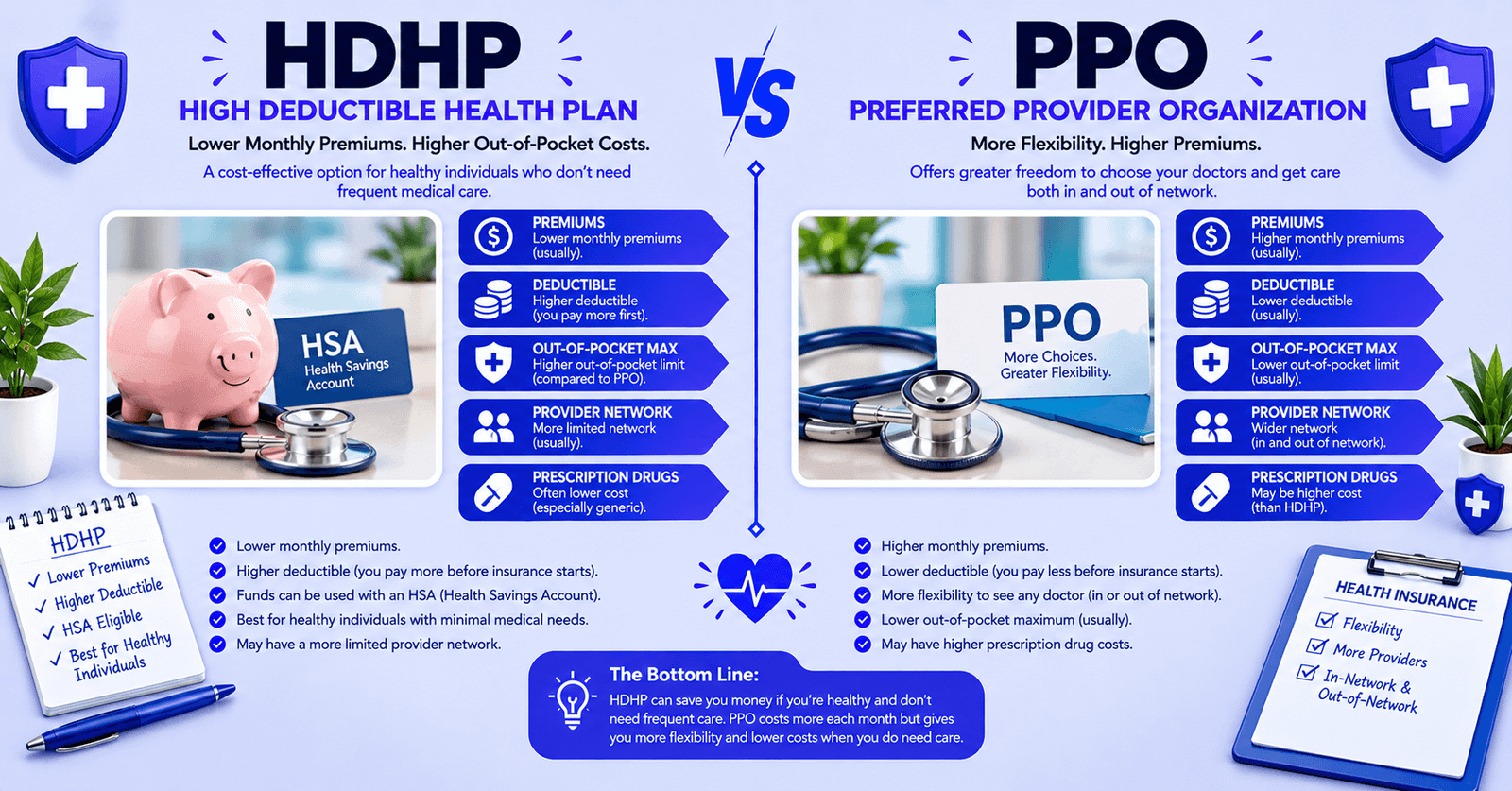
HDHP vs PPO at a Glance
| Feature | HDHP | Traditional PPO |
| Full name | High-Deductible Health Plan | Preferred Provider Organization |
| What the term primarily describes | Deductible/cost-sharing structure | Provider-network structure |
| Monthly premium | Often lower | Often higher |
| Deductible | Often higher | Often lower |
| HSA eligibility | May be HSA-eligible if requirements are met | Depends on the specific plan |
| In-network care | Depends on plan | Usually lower cost |
| Out-of-network care | Depends on plan | Generally available at a higher cost |
| Specialist referral | Depends on plan | Generally not required |
| Can the two overlap? | Yes | Yes |
| Main financial tradeoff | Lower premium vs. higher upfront cost | Higher premium vs. potentially lower cost when using care |
The exact benefits vary by plan, so this table describes common employer-plan patterns rather than universal rules.
What Is an HDHP?
HDHP stands for High-Deductible Health Plan.
An HDHP has to meet specific federal requirements when it is being used to establish eligibility for HSA contributions. For 2026, the IRS defines an HDHP for this purpose as having a minimum annual deductible of $1,700 for self-only coverage or $3,400 for family coverage. The applicable annual out-of-pocket limit is $8,500 for self-only coverage or $17,000 for family coverage.
The major attraction is usually the combination of:
- lower premiums than a comparable traditional plan
- potentially greater upfront medical costs
- HSA eligibility when the plan and individual meet the requirements
- the ability to use HSA funds for qualified medical expenses
For 2026, the HSA contribution limit is $4,400 for self-only coverage and $8,750 for family coverage.
An HDHP does not necessarily mean that every medical service is completely uncovered until the deductible is met. Preventive services may receive special treatment, and federal rules can permit certain services to be covered before the deductible.
What Is a PPO?
PPO stands for Preferred Provider Organization.
A PPO contracts with doctors, hospitals, and other healthcare providers to create a network. You generally pay less when you use providers inside the network. You can also generally receive care outside the network, but it usually costs more.
One of the major attractions of a PPO is flexibility.
For example, PPO plans generally allow you to see a specialist without first getting a referral from a primary care provider. However, exact rules can vary by plan.
A PPO therefore tells you primarily about how the plan organizes its provider network, not whether the deductible is high or low.
That distinction is important.
The Main Difference Between HDHP and PPO
The simplest accurate distinction is:
HDHP describes the plan’s deductible and cost-sharing structure, while PPO describes its provider-network structure.
This is why saying “HDHPs have high deductibles and PPOs have low deductibles” is an oversimplification.
A PPO can have a high deductible.
An HDHP can use a PPO network.
Cigna explicitly notes that an HDHP can be built around a PPO, HMO, or EPO network, while a PPO can have either a high or low deductible depending on how the plan is designed.
Think of the two terms as answering different questions:
HDHP:
“How is this plan’s deductible/cost-sharing structure designed, and is it potentially HSA-compatible?”
PPO:
“How does this plan’s provider network work?”
This is the single most important distinction to remember.
HDHP vs PPO: Premiums and Deductibles
When employers put an HDHP and traditional PPO side by side, the most noticeable difference is usually the relationship between the premium and deductible.
HDHP
You will often pay:
- less in premiums
- more when you receive covered care before reaching the deductible
Traditional PPO
You will often pay:
- more in premiums
- less upfront when receiving covered medical services because the deductible may be lower
This is why neither plan is automatically cheaper.
Suppose one plan saves you $150 per month in premiums but has substantially higher cost-sharing when you need medical care. If you rarely use healthcare, those premium savings may matter more. If you have frequent appointments, prescriptions, or planned treatment, the lower deductible and other cost-sharing features of the traditional PPO may offset its higher premium.
Current comparison guides increasingly recommend evaluating total annual cost rather than premium alone.
HDHP vs PPO: HSA Eligibility
The HSA is one of the biggest reasons people consider an HDHP.
An HSA is a tax-advantaged account that can be used for qualified medical expenses. To contribute to an HSA, you generally must have qualifying HDHP coverage and satisfy other eligibility requirements.
For 2026, the HSA contribution limits are:
- $4,400 for self-only coverage
- $8,750 for family coverage
Some employers also contribute money to employees’ HSAs.
That employer contribution can materially change the comparison.
For example, imagine:
- HDHP premium savings: $1,500 per year
- employer HSA contribution: $750
- additional HDHP cost exposure: potentially higher when you use care
The effective financial difference is not simply “the HDHP has a high deductible.”
You need to consider the entire package.
Important distinction
A PPO is not automatically incompatible with an HSA.
A PPO can be designed as an HSA-eligible HDHP. The determining factor is whether the specific plan meets the applicable requirements—not simply whether its network is called PPO.
HDHP vs PPO: Provider Networks
This is where many comparisons become misleading.
A PPO generally offers:
- an in-network provider network
- lower costs for in-network care
- access to out-of-network providers at a higher cost
- generally no specialist referral requirement
HealthCare.gov describes PPOs as plans where members pay less for in-network providers but can use out-of-network doctors and facilities for an additional cost.
An HDHP, however, does not by itself tell you exactly how the provider network works.
An HDHP might use:
- a PPO network
- an HMO network
- another network structure
So if provider flexibility matters to you, don’t decide based on the letters HDHP alone.
Look at the actual plan’s network.
When to Use an HDHP
An HDHP may be attractive when:
- you expect relatively low healthcare spending
- you want lower monthly premiums
- you value HSA eligibility
- your employer contributes to your HSA
- you can comfortably handle a higher deductible if medical needs arise
- you want to build HSA savings for future healthcare expenses
HealthCare.gov notes that people who don’t need many healthcare services may benefit from the lower monthly premium associated with an HSA-eligible plan.
However, “healthy” does not automatically mean “HDHP is best.”
A healthy person who cannot comfortably handle a large unexpected medical bill may prefer a plan with more predictable costs.
When to Use a Traditional PPO
A traditional PPO may be attractive when:
- you expect frequent healthcare visits
- you regularly use prescription medications
- you anticipate surgery or another major procedure
- you have predictable healthcare expenses
- you prefer a lower deductible
- you value broad provider flexibility
- you are willing to pay more in premiums for potentially lower costs when receiving care
The actual answer depends on the plan’s numbers.
A PPO with a very high premium and modest cost-sharing advantage may not be better than an HDHP. Conversely, a PPO with a manageable premium and substantially lower deductible may be valuable for someone who expects significant healthcare use.
How to Compare the Total Cost
One of the biggest mistakes people make is comparing only the monthly premium.
A better comparison starts with:
Annual premium + expected out-of-pocket medical costs − employer HSA contribution and applicable tax benefits
You should also consider the plan’s out-of-pocket maximum, because that can show how much financial exposure you could face during a high-cost year.
For example:
Plan A — HDHP
- Annual premium: $2,400
- Deductible: $3,500
- Employer HSA contribution: $1,000
Plan B — Traditional PPO
- Annual premium: $4,800
- Deductible: $1,000
- Employer HSA contribution: $0
The PPO costs $2,400 more in premiums before you receive care.
But that does not mean the HDHP automatically wins.
If you have significant medical expenses, the deductible, coinsurance, prescription costs, and out-of-pocket maximum can change the final result.
This is why current comparison tools increasingly use a break-even approach rather than relying on premiums alone.
Common Mistakes With HDHP and PPO
Incorrect:
“A PPO always has a low deductible.”
Correct:
“A traditional PPO often has a lower deductible than the HDHP it is being compared with.”
Why: PPO describes the provider-network structure. It does not automatically determine the deductible.
Incorrect:
“Every HDHP is an HMO.”
Correct:
“An HDHP can use different network structures, including a PPO network.”
Why: HDHP and PPO describe different characteristics of a health plan.
Incorrect:
“Every PPO is ineligible for an HSA.”
Correct:
“A PPO can be HSA-eligible if the specific plan meets the applicable HDHP requirements and other eligibility rules are satisfied.”
Why: PPO describes the network; HSA eligibility depends on the plan and individual eligibility requirements.
Incorrect:
“The plan with the lower premium is always cheaper.”
Correct:
“Compare premiums, healthcare spending, employer HSA contributions, and out-of-pocket exposure.”
Why: Premiums are only one component of your annual healthcare cost.
Common Collocations With HDHP and PPO
You will commonly see phrases such as:
HDHP
- HDHP plan
- HSA-eligible HDHP
- HDHP deductible
- HDHP premium
- HDHP coverage
- HDHP contribution
- HDHP out-of-pocket maximum
PPO
- PPO plan
- PPO network
- PPO provider
- PPO coverage
- PPO deductible
- PPO premium
- PPO insurance
- in-network PPO provider
- out-of-network PPO care
These combinations reflect how the terms are normally discussed in employer benefits and health-insurance materials.
Can an HDHP Be a PPO?
Yes.
This is one of the most important answers in the entire comparison.
An HDHP and PPO are not mutually exclusive classifications.
For example, an employer could offer an:
HSA-eligible HDHP with a PPO network
In that case, the plan has the cost-sharing characteristics required of an HDHP while using a PPO provider network.
Cigna explicitly describes HDHPs as capable of being paired with PPO, HMO, or EPO structures.
Therefore:
HDHP ≠ automatically HMO
and
PPO ≠ automatically low deductible.
How to Remember the Difference
Use this simple rule:
HDHP = how the plan handles deductibles and HSA eligibility.
PPO = how the plan handles provider networks.
Or remember:
HDHP → “High Deductible”
PPO → “Preferred Providers”
The first points you toward cost-sharing.
The second points you toward provider access.
Which One Should I Use?
Instead of asking only “Is HDHP or PPO better?”, ask these questions:
If you want lower monthly premiums:
An HDHP may be worth considering.
If your employer contributes substantially to an HSA:
An HDHP may become more attractive.
If you expect frequent medical care:
Compare the PPO’s lower cost-sharing against the HDHP’s premium savings.
If you expect major medical expenses:
Compare both plans’ out-of-pocket maximums, deductible, coinsurance, and premiums.
If provider flexibility matters:
Look at the actual network. A PPO generally provides out-of-network coverage at additional cost, but the details vary by plan.
If you are choosing between an HDHP and a traditional PPO:
Calculate the total yearly cost rather than comparing premiums alone.
HDHP or PPO? Practice Examples
Choose the plan that may make more sense in each situation based on the stated facts.
1. Rarely visits the doctor
You rarely need medical care, have substantial emergency savings, and the HDHP has significantly lower premiums plus an employer HSA contribution.
Likely choice: HDHP
2. Regular prescriptions and appointments
You have recurring medical expenses and expect to use healthcare throughout the year.
Likely choice: Compare the PPO carefully.
Its higher premium may be offset by lower deductibles and other cost-sharing.
3. Employer contributes heavily to HSA
Your employer contributes a significant amount to the HDHP’s HSA.
Likely choice: HDHP may have a strong financial advantage.
4. Planned surgery
You expect a major procedure during the plan year.
Likely choice: Compare total expected costs and out-of-pocket maximums.
Do not choose based on premium alone.
5. You want access to out-of-network providers
You regularly use providers outside your local network.
Likely choice: Examine the PPO network and out-of-network benefits.
A PPO generally provides out-of-network coverage at a higher cost, but the specific plan controls the details.
Answers
- HDHP may be attractive
- PPO may be attractive
- HDHP may be attractive
- Calculate both plans
- Review the PPO network and out-of-network benefits
These are decision examples, not universal recommendations. Your actual plan documents should determine the final comparison.
Frequently Asked Questions
What is the difference between HDHP and PPO?
An HDHP is a health plan characterized by a high deductible and specific federal requirements when used for HSA eligibility. A PPO is a provider-network arrangement that generally offers in-network savings and out-of-network coverage at a higher cost. They can overlap.
Is an HDHP the same as a PPO?
No. They describe different aspects of health insurance. An HDHP can, however, use a PPO network.
Is PPO better than HDHP?
Not automatically. A PPO may be more attractive for someone who expects substantial healthcare use, while an HDHP may be attractive for someone who wants lower premiums and HSA eligibility. The actual plan numbers matter more than the labels.
Can an HDHP be a PPO?
Yes. A plan can be both an HDHP and a PPO.
Is every PPO HSA eligible?
No. PPO status alone does not establish HSA eligibility. The specific plan must satisfy applicable HDHP requirements, and the individual must also meet HSA eligibility rules.
Is an HDHP always cheaper?
No. An HDHP often has a lower premium, but total annual cost depends on healthcare use, deductible, coinsurance, out-of-pocket maximum, HSA contributions, and other plan features.
What is better for someone who rarely goes to the doctor?
An HDHP may be attractive because of lower premiums and possible HSA benefits. However, you should still make sure you can comfortably handle the plan’s deductible and other potential out-of-pocket costs.
What is better for someone who uses healthcare frequently?
A traditional PPO may be worth considering if it offers substantially lower deductibles or more predictable cost-sharing. Compare the actual numbers rather than assuming the PPO will always be cheaper.
What are the 2026 HDHP limits?
For 2026, the IRS minimum annual deductible is $1,700 for self-only coverage and $3,400 for family coverage, with applicable out-of-pocket expense limits of $8,500 and $17,000, respectively.
What are the 2026 HSA contribution limits?
For 2026, the annual HSA contribution limit is $4,400 for self-only coverage and $8,750 for family coverage.
Conclusion
The biggest difference between HDHP and PPO is that they are not actually two opposite types of health insurance. HDHP primarily describes a high-deductible cost structure and, when eligibility requirements are met, access to HSA contributions. PPO describes a provider-network structure that generally offers in-network savings and out-of-network coverage at a higher cost.

Sajid Ali is an English language educator and content specialist with 7+ years of teaching experience. He holds master’s degrees in Information Technology and Education from the Virtual University of Pakistan and writes SEO-optimized, learner-friendly vocabulary content for diffari.com.