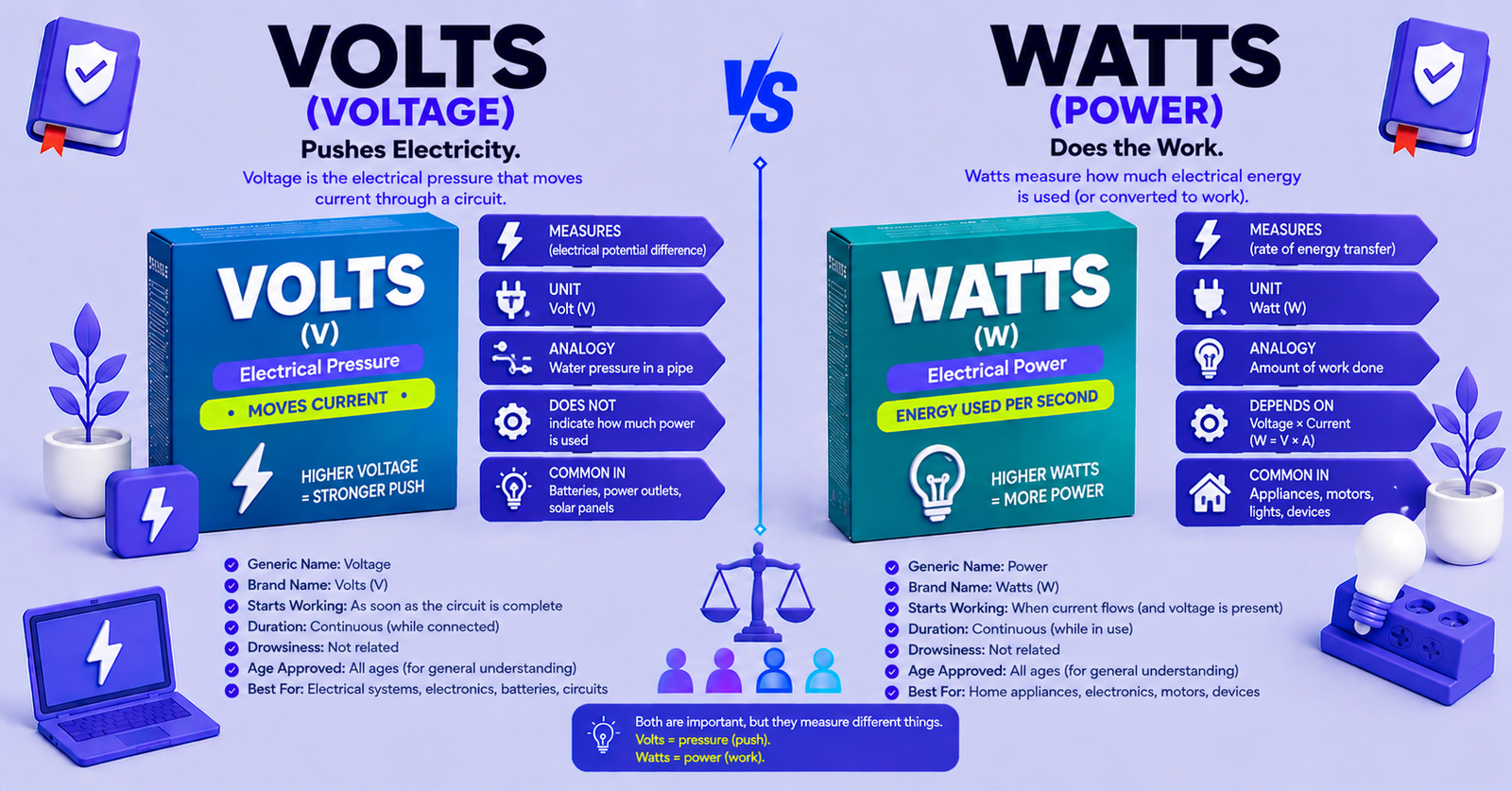
Volts and watts are not the same thing. A volt measures electrical potential difference, while a watt measures electrical power. They are closely related, but they describe different properties of an electrical system.
The easiest way to understand the distinction is to remember that voltage is one of the factors that determines power. In a simple DC circuit, power is calculated by multiplying voltage by current:
Watts = Volts × Amps
So, if you know only the voltage, you cannot determine the wattage unless you also know the current. NIST defines the volt as the SI unit of electric potential difference and the watt as the SI unit of power.
Quick Answer
Volts (V) measure electrical potential difference, or the electrical “push” between two points.
Watts (W) measure electrical power, meaning the rate at which electrical energy is transferred or used.
The main relationship is:
W = V × A
where W is watts, V is volts, and A is amps.
For example, a circuit operating at 120 volts and 10 amps has a power of 1,200 watts.
Volts vs. Watts at a Glance
| Feature | Volts | Watts |
|---|---|---|
| What it measures | Electrical potential difference | Electrical power |
| Symbol | V | W |
| Basic meaning | Electrical potential or “push” | Rate of energy transfer |
| Related quantity | Current | Voltage and current |
| Basic relationship | V = W ÷ A | W = V × A |
| Example | 120 V supply | 1,200 W load |
| Can it be determined alone? | Not enough to determine watts | Not enough to determine voltage |
The watt is equivalent to one joule per second, while the volt is the SI unit of electric potential difference.
What Does a Volt Mean?
A volt is the SI unit used to measure electric potential difference, commonly called voltage.
In simple terms, voltage describes the potential difference that can drive electric charge through a circuit.
For example, a power supply might be rated at 12 V, while another might provide 24 V. Those numbers describe their voltage, not their total power output.
Voltage is represented by the symbol V.
Example
Suppose you have a 12-volt battery.
The 12 V tells you the battery’s nominal voltage. It does not, by itself, tell you how many watts a connected device will use.
You would need additional information, particularly the current drawn by the load.
What Does a Watt Mean?
A watt is the SI unit of power.
Power describes the rate at which energy is transferred, converted, or used. One watt equals one joule per second.
For an electrical circuit, the basic relationship is:
P = V × I
or, using common unit symbols:
W = V × A
For example:
120 V × 10 A = 1,200 W
That means the circuit is operating at 1,200 watts under those conditions.
Important distinction
A watt measures power, not the total amount of energy used.
For example, a 1,000-watt appliance running for one hour uses:
1 kilowatt-hour (kWh)
of energy, assuming it operates continuously at that power level.
What Is the Difference Between Volts and Watts?
The fundamental difference is what they measure.
Volts measure electrical potential difference.
Watts measure electrical power.
They therefore cannot be compared as though one were simply a larger version of the other.
A useful way to remember the relationship is:
Voltage helps determine the electrical power available or delivered, while wattage tells you the rate of power involved.
In a simple circuit, current connects the two:
Watts = Volts × Amps
This is why a statement such as “How many watts are in 120 volts?” does not have one universal answer. The current must also be known.
How Volts, Amps, and Watts Are Related
Volts, amps, and watts describe different aspects of electricity.
- Volts (V) = electrical potential difference
- Amps (A) = electric current
- Watts (W) = electrical power
Their basic relationship is:
W = V × A
You can rearrange the formula to find the other quantities:
V = W ÷ A
A = W ÷ V
Example 1
A device uses:
- 120 V
- 5 A
Its power is:
120 × 5 = 600 W
So the device operates at 600 watts under those conditions.
Example 2
Another system operates at:
- 240 V
- 5 A
Its power is:
240 × 5 = 1,200 W
The voltage is twice as high, while the current is the same, so the calculated power is twice as high.
Example 3: Same watts, different voltage
Consider two systems:
120 V × 10 A = 1,200 W
240 V × 5 A = 1,200 W
Both produce 1,200 watts in this simplified calculation, despite having different voltage and current.
This demonstrates why voltage and wattage are not interchangeable measurements.
Can You Convert Volts Directly to Watts?
No, not by voltage alone.
You need the current as well.
The formula is:
Watts = Volts × Amps
So:
120 V × 10 A = 1,200 W
But:
120 V × 2 A = 240 W
Both circuits have 120 volts, yet their wattages are different because their currents are different.
This is one of the most important points to remember when comparing electrical specifications.
When Does Voltage Matter?
Voltage matters when determining whether electrical equipment is designed to operate with a particular electrical supply.
For example, a device designed for one voltage range may not be suitable for a substantially different supply without appropriate equipment.
Voltage ratings are therefore important when working with:
- power supplies
- batteries
- chargers
- appliances
- solar equipment
- motors
- electrical circuits
Electrical sources discussing equipment ratings similarly emphasize that voltage compatibility matters for safe and proper operation.
When Does Wattage Matter?
Wattage matters when you want to understand how much electrical power a device uses or delivers at a particular operating condition.
You commonly see watt ratings on:
- light bulbs
- heaters
- kitchen appliances
- power supplies
- computers
- chargers
- solar equipment
- power stations
For example, a 100 W light bulb has a power rating of 100 watts under its specified operating conditions.
A 1,500 W heater requires substantially more power while operating at its rated output than a 100 W bulb.
However, wattage alone does not tell you the voltage required by the device.
Common Mistakes With Volts and Watts
Incorrect: “120 volts equals 120 watts.”
Correct: Voltage and wattage measure different quantities.
Why: Watts depend on voltage and current.
Incorrect: “Higher volts always mean higher watts.”
Correct: Higher voltage can result in higher power if the current remains the same, but voltage alone does not determine wattage.
Why: The relationship is W = V × A.
Incorrect: “Watts measure how much energy a device uses.”
Correct: Watts measure the rate of energy transfer or use.
Why: Total energy depends on both power and time.
Incorrect: “You can convert any voltage directly into watts.”
Correct: You also need current for the basic calculation.
Why: A voltage value by itself is insufficient.
Common Collocations With Volts and Watts
Expressions with volts
- 12 volts
- 24 volts
- 120 volts
- 240 volts
- voltage rating
- input voltage
- output voltage
- voltage supply
- voltage level
Expressions with watts
- 60 watts
- 100 watts
- 1,000 watts
- watt rating
- power rating
- power output
- wattage
- electrical power
- power consumption
These expressions help distinguish how the two units are normally discussed in practical electrical contexts.
Are Volts and Watts Interchangeable?
No.
They represent different quantities.
You cannot replace “volts” with “watts” in an electrical specification without changing its meaning.
For example:
120 V tells you about voltage.
1,200 W tells you about power.
They can be mathematically related when current is known, but they remain different units measuring different quantities.
A Note About AC Power
For basic DC circuits, the relationship:
P = V × I
is the standard starting point.
For AC circuits, particularly systems involving reactive loads such as motors and transformers, the calculation of real power can also depend on power factor:
P = V × I × power factor
This distinction matters in electrical engineering because voltage multiplied by current can represent apparent power rather than real power in certain AC situations.
For everyday introductory questions about volts and watts, however, W = V × A is the essential relationship to understand.
How to Remember the Difference
Use this simple rule:
Volts = electrical potential. Watts = electrical power.
Then remember the connector:
Volts × Amps = Watts
A water analogy can make this easier:
- Voltage is often compared to pressure.
- Current is compared to flow.
- Power represents the rate at which useful electrical work is being done.
The analogy is only a teaching aid; the actual physical definitions are based on electrical quantities and their relationships.
Which One Should I Look At?
The right choice depends on what you are trying to determine.
For electrical potential difference, look at volts.
Power ratings are expressed in watts, so watts are the relevant measurement when you want to know how much power a device uses or produces.
Calculating power from voltage requires current as well. In that case, you need the amperage along with the voltage.
Simple decision guide
Need to know the supply or operating voltage?
→ Check V.
Need to know the device’s power rating?
→ Check W.
Need to calculate watts?
→ Use V × A.
Need to calculate amps?
→ Use W ÷ V.
Need to calculate volts?
→ Use W ÷ A.
X or Y? Practice Examples
Choose volts or watts.
- A device is labeled 120 ___.
- A light bulb is rated at 60 ___.
- An appliance has a power rating of 1,500 ___.
- A battery is described as a 12 ___ battery.
- An electrical system has a power output of 2,000 ___.
- A charger provides an output of 20 ___.
- A device consumes 100 ___ of power.
Answers
- Volts
- Watts
- Watts
- Volts
- Watts
- Volts
- Watts
The basic clue is simple: volts describe voltage, while watts describe power.
Frequently Asked Questions
What is the main difference between volts and watts?
Volts measure electrical potential difference, while watts measure electrical power. They are related through current: W = V × A.
Are volts and watts the same thing?
No. They measure different physical quantities. A volt measures potential difference, while a watt measures power.
Can you calculate watts from volts?
Yes, if you also know the current. Multiply volts by amps:
W = V × A
How many watts are in 120 volts?
There is no single answer. The wattage depends on the current. For example, 120 V at 5 A is 600 W, while 120 V at 10 A is 1,200 W.
Does higher voltage mean higher wattage?
Not necessarily. Wattage depends on both voltage and current. If current remains constant, increasing voltage increases calculated power, but voltage alone does not determine wattage.
What is the difference between watts and kilowatt-hours?
Watts measure power, while kilowatt-hours measure energy used over time. A kilowatt-hour is commonly used to describe electricity consumption.
Are volts, amps, and watts related?
Yes. In a basic electrical calculation:
Watts = Volts × Amps
Each unit nevertheless measures a different quantity.
Which is more important, volts or watts?
Neither is universally “more important.” Their importance depends on the question. Voltage is important for electrical compatibility and potential difference, while wattage describes power.
Conclusion
The difference between volts and watts is straightforward once you focus on what each unit measures. Volts measure electrical potential difference, while watts measure electrical power. They are connected, but they are not interchangeable.
The key formula is:
Watts = Volts × Amps