People often use hemp, weed, marijuana, and cannabis as though they were completely separate things—or completely interchangeable. Neither is quite right.
Hemp and the cannabis commonly called weed come from the same plant species, Cannabis sativa L., but generations of selective breeding have produced very different types of plants for different purposes. Hemp is generally associated with low-THC industrial, food, fiber, and cannabinoid uses, while “weed” is an informal term usually referring to cannabis used for its intoxicating effects.
The important distinction is therefore not simply what the plant looks like. It involves THC concentration, breeding purpose, product type, terminology, and local law.
Quick Answer
Hemp and weed come from the same cannabis species, but they are usually grown and classified differently.
Hemp generally refers to low-THC cannabis cultivated for products such as fiber, seeds, food, industrial materials, or certain cannabinoid products.
Weed is an informal term commonly used for cannabis cultivated or sold for its intoxicating, THC-rich flowers.
The key point is that hemp and weed are not separate plant species. They represent different types, uses, products, and—depending on the jurisdiction—legal categories of cannabis.
The exact THC threshold used to define hemp is a legal rule, not a universal botanical rule.
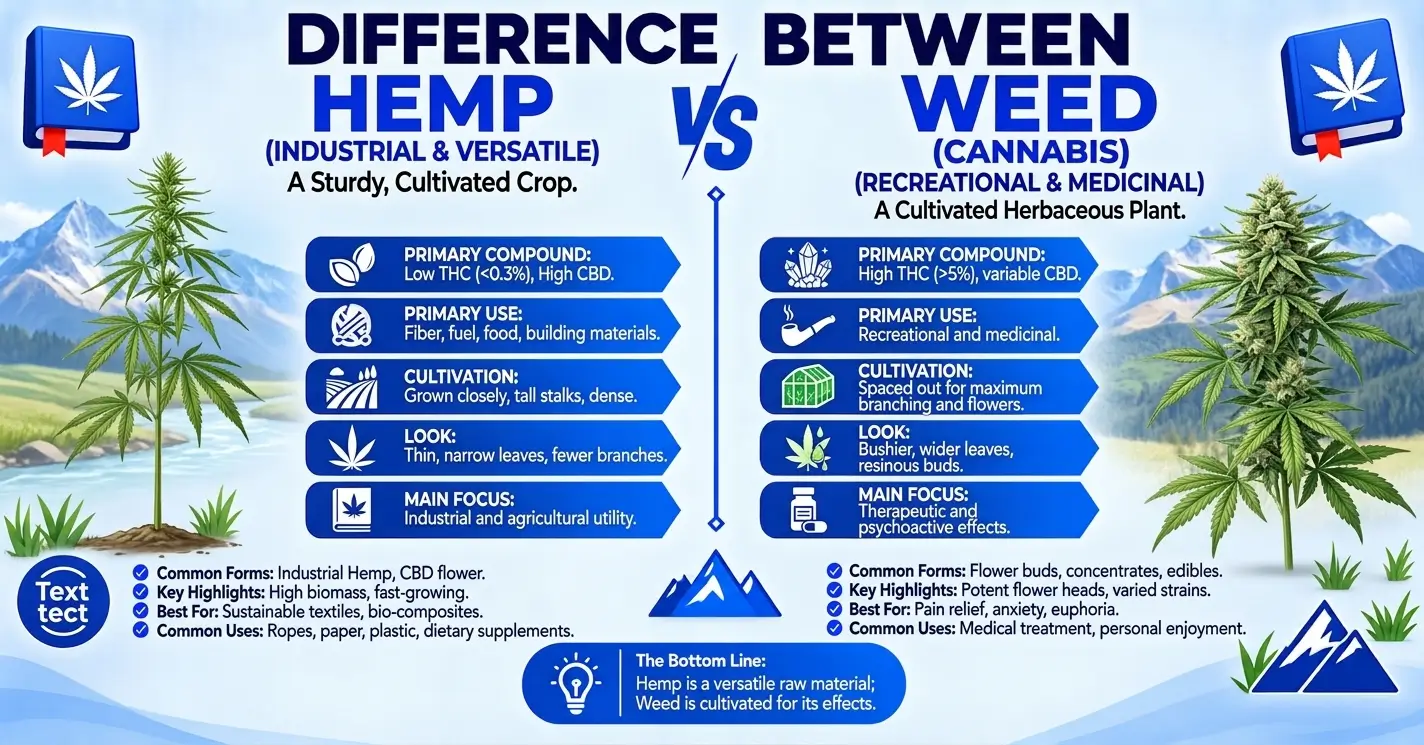
Hemp vs Weed at a Glance
| Hemp | Weed | |
|---|---|---|
| Botanical relationship | Cannabis, commonly Cannabis sativa L. | Cannabis, commonly Cannabis sativa L. |
| Common meaning | Low-THC cannabis used for industrial, food or cannabinoid purposes | Informal term for cannabis commonly used for intoxication |
| THC | Usually kept within a jurisdiction’s low-THC legal threshold | Usually cultivated for substantially higher THC |
| Main purpose | Fiber, seed, food, materials and some cannabinoid products | THC-rich flower and cannabis products |
| CBD | Often important in some hemp cultivars | Can be present, but THC is commonly the dominant cannabinoid of interest |
| Appearance | Varies considerably by cultivar and purpose | Varies considerably by cultivar and cultivation method |
| Can appearance prove the difference? | No | No |
| Legal status | Depends on jurisdiction and product | Depends on jurisdiction |
What Is Hemp?
Hemp is cannabis cultivated and classified for low-THC or industrial purposes.
Hemp has a long history as a crop for fiber, seed, oil and other materials. Modern hemp production can also focus on cannabinoids such as CBD. Scientific literature describes hemp-type Cannabis as having been selected for traits such as rapid growth, slender architecture, fiber or seed production, and particular cannabinoid profiles.
The term is therefore about more than one physical appearance.
A fiber hemp crop can look very different from hemp grown for flower. Fiber varieties may be tall and relatively slender, while cannabinoid-focused cultivars can be much more branched.
In the United States, the federal definition currently in effect on October 1, 2026, defines hemp using a delta-9 THC concentration of not more than 0.3% by dry weight. That is a U.S. legal definition, not a worldwide scientific rule.
What Does “Weed” Mean?
Weed is an informal term for cannabis.
Unlike “hemp,” it is not a precise botanical classification. In everyday English, people commonly use weed to mean cannabis intended for recreational intoxication, particularly THC-rich cannabis flower.
That means the comparison is slightly uneven:
Hemp is a classification/use term, while weed is primarily an informal common-language term.
Other words can overlap with “weed,” including marijuana, pot, and cannabis, although their legal and social meanings vary.
This is one reason a simple statement such as “hemp is one plant and weed is another” is misleading.
What Is the Difference Between Hemp and Weed?
The main differences are THC concentration, breeding purpose, typical use, and legal classification.
1. THC concentration
THC is the cannabinoid principally associated with cannabis intoxication.
Hemp is generally selected and regulated to remain within a low-THC threshold. Weed is commonly cultivated specifically to produce much higher levels of THC.
However, there is no universal worldwide “weed percentage.” THC levels vary between cultivars and products.
2. Breeding purpose
Hemp-type Cannabis has historically been selected for characteristics useful for fiber, seed, oil and other industrial or agricultural purposes.
Drug-type Cannabis has been selected toward cannabinoid-rich flowers, particularly higher THC production.
Research published in the Journal of Experimental Botany describes these as divergent usage types with differences in plant architecture, nutrient allocation and reproductive development, despite their shared species identity.
3. Typical use
Hemp can be processed into:
- textiles
- rope and other fiber products
- paper
- construction materials
- seed foods
- hemp seed oil
- other industrial products
- cannabinoid products
Weed is commonly associated with cannabis flower and other products intended to deliver THC and its intoxicating effects.
4. Legal classification
This is where the comparison becomes particularly important.
A legal definition of hemp can specify a THC limit, but the threshold and the products covered by the law depend on the jurisdiction.
For example, the European Union’s agricultural rules use a 0.3% THC threshold for qualifying hemp varieties in relevant contexts, while the UK’s industrial-hemp licensing framework has historically used a 0.2% threshold for approved seed types.
So it is incorrect to assume that one THC number automatically determines whether cannabis is legal everywhere.
THC, CBD and the Effects of Hemp and Weed
THC and CBD are both cannabinoids, but they should not be treated as opposites.
It is the cannabinoid most closely associated with cannabis intoxication.
CBD does not produce the same intoxicating effect as THC.
Many hemp cultivars are selected for relatively high CBD and low THC. Drug-type cultivars can contain much higher THC concentrations.
But the statement “hemp contains no THC” is inaccurate. Hemp can contain THC; the relevant question is how much and how the applicable law defines the product.
It is also too broad to say that every product sold as hemp is guaranteed to be non-intoxicating. Product chemistry and legal definitions can differ, particularly for newer cannabinoid products.
How Are Hemp and Weed Grown Differently?
The cultivation method often reflects the intended use.
Hemp for fiber
Fiber hemp is commonly grown densely so plants compete upward and produce long stalks suitable for fiber.
Hemp for seed
Seed hemp is cultivated to produce seeds containing oil, protein and other nutrients.
Hemp for cannabinoids
Cannabinoid-focused hemp can be cultivated for flowers rather than stalks and may therefore look more like drug-type cannabis.
Drug-type cannabis
Drug-type Cannabis has generally been selected for abundant female flowers and cannabinoid production, particularly THC.
This is why “hemp always looks tall and thin” is not a reliable rule. Some hemp cultivars can look much more like the cannabis that consumers call weed.
Can You Tell Hemp and Weed Apart by Looking?
Not reliably.
Industrial fiber hemp can be visually distinctive because of its tall, slender growth habit. But hemp cultivated for flower can resemble high-THC cannabis closely.
The reverse is also true: visual differences between particular cultivars do not prove their THC classification.
If a legal classification depends on THC concentration, laboratory testing is more reliable than looking at leaves, flowers, smell or plant height.
This is an important point that many simplified comparison articles miss.
What Are Hemp and Weed Used For?
Common hemp uses
Hemp has applications involving:
- fiber
- clothing and textiles
- paper
- rope
- construction materials
- hemp seeds
- hemp seed oil
- food products
- agricultural applications
- selected cannabinoid products
The European Commission identifies industrial uses including fiber and seed production and notes additional interest in hemp-derived products.
Common weed uses
The term “weed” generally refers to cannabis used for its THC-rich flowers or products derived from them.
Depending on the jurisdiction, cannabis may be used medically, recreationally, or both.
The exact legal status should always be checked locally rather than inferred from the word “weed.”
Hemp vs Weed: Is the 0.3% Rule Universal?
No.
The often-repeated 0.3% THC figure is not a universal scientific boundary between hemp and weed.
It is particularly important in U.S. federal hemp regulation. USDA describes hemp under the 2018 Farm Bill as Cannabis sativa L. and its derivatives containing no more than 0.3% delta-9 THC on a dry-weight basis.
But other jurisdictions use different frameworks.
For example:
- Relevant EU agricultural rules use a 0.3% THC threshold for qualifying hemp varieties.
- The UK’s industrial hemp licensing framework currently references approved seed types not exceeding 0.2% THC and has additional restrictions on which parts of the plant may be used.
A 2026 U.S. update
This distinction is especially important for an article published in late 2026.
U.S. federal law is scheduled to change the statutory hemp definition on November 12, 2026, replacing the current delta-9-only threshold with a total THC standard that includes THCA. Public Law 119-37 contains the amendment, and later legislation has created a temporary applicability provision for certain hemp-derived products through December 11, 2026.
Therefore, a page that simply says “hemp always means 0.3% delta-9 THC or less” can become outdated.
Common Mistakes About Hemp and Weed
Mistake 1: “Hemp and weed are different species.”
Correct: They can represent different types and uses of cannabis, but they are not separate species in the simplistic sense.
Modern research discusses hemp-type and drug-type Cannabis as divergent types within Cannabis sativa L. shaped by human selection.
Mistake 2: “Hemp contains zero THC.”
Correct: Hemp can contain THC. The amount is generally low and may be legally restricted.
Mistake 3: “All hemp looks tall and thin.”
Correct: Fiber hemp often does, but cannabinoid-focused hemp can look much more like drug-type cannabis.
Mistake 4: “0.3% is the worldwide hemp limit.”
Correct: THC thresholds are jurisdiction-specific.
Mistake 5: “Weed is a scientific plant classification.”
Correct: Weed is an informal term.
Mistake 6: “If it looks like weed, it must be weed.”
Correct: Appearance alone cannot reliably establish THC concentration or legal classification.
Common Terms That Cause Confusion
| Term | General meaning |
|---|---|
| Cannabis | Broad term for the cannabis plant/genus and its products |
| Hemp | Low-THC cannabis category, especially in legal/industrial contexts |
| Weed | Informal term commonly used for intoxicating cannabis |
| Marijuana | Common and legal/regulatory term whose exact meaning varies by jurisdiction |
| THC | Cannabinoid associated with cannabis intoxication |
| CBD | Cannabinoid that is not intoxicating in the same way as THC |
| Industrial hemp | Hemp cultivated primarily for fiber, seed and industrial purposes |
Can Hemp and Weed Be Used Interchangeably?
Usually not.
You can sometimes use “cannabis” as a broad term that covers both hemp-type and drug-type plants.
But hemp and weed communicate different ideas.
If you are talking about fiber, hemp seed, industrial hemp or a low-THC hemp crop, hemp is the more precise term.
If someone says they bought “weed,” they will usually mean cannabis intended to produce an intoxicating effect—not an industrial hemp crop.
So the terms overlap at the level of the plant, but they are not interchangeable in everyday usage.
How to Remember the Difference
Use this simple rule:
Hemp describes a low-THC type/use of cannabis; weed is an informal word usually used for intoxicating cannabis.
And remember:
Same plant species does not mean same type, chemistry, purpose or legal status.
Which One Should I Use?
The word you choose depends mainly on what you are talking about and the context in which you are using it. In everyday conversation, “weed” and “hemp” can refer to different types or uses of cannabis, while “Cannabis” is often the broader and more precise term.
If you are talking about fiber, seeds, industrial materials, or a low-THC crop, use “hemp.” For example, you would say that a company produces textiles from hemp or that hemp seeds are used in food products.
If you are talking about cannabis that people commonly consume for its intoxicating THC effects, “weed” is the informal everyday term. It is common in conversation, but it is not a precise botanical classification.
When the context is scientific or botanical, “Cannabis” or Cannabis sativa may be more precise. These terms allow you to discuss the plant without assuming a particular use, THC level, or legal classification.
Finally, if you are discussing laws or regulations, do not rely on everyday terms alone. Instead, use the exact legal definition that applies in the relevant jurisdiction, because the legal meaning of “hemp” and the THC limits used to classify cannabis can vary by location.
In short, use “hemp” for the low-THC/industrial context, “weed” for informal everyday references to intoxicating cannabis, “Cannabis” for broader scientific discussion, and the jurisdiction’s exact legal terminology when discussing regulations.
X or Y? Practice Examples
Choose hemp, weed, or cannabis.
- The farmer grows ___ for fiber.
- She bought ___ at a licensed cannabis retailer.
- ___ seed is used in foods and oils.
- Scientists studied different types of ___.
- The law defines ___ according to a THC threshold.
- “___” is an informal term rather than a botanical classification.
- The plant was cultivated specifically for high-THC flowers.
- The company manufactures textiles from ___ fiber.
Answers
- hemp
- weed or cannabis, depending on the intended wording
- hemp
- cannabis
- hemp
- weed
- cannabis / drug-type cannabis; “weed” works informally
- hemp
The key is not simply memorizing a word. Look at what the speaker means and what context they are describing.
Frequently Asked Questions
What is the main difference between hemp and weed?
Hemp and weed come from the same cannabis species, but hemp generally refers to low-THC cannabis used for industrial, agricultural or certain cannabinoid purposes, while “weed” is an informal term commonly used for intoxicating cannabis.
Are hemp and weed the same plant?
They can come from the same species, Cannabis sativa L., but they represent different types, breeding objectives, chemical profiles and uses. Scientific literature distinguishes hemp-type and drug-type Cannabis based on their contrasting traits and uses.
Can hemp get you high?
Traditional industrial hemp contains very little THC and is not cultivated to produce the same intoxicating effect as high-THC cannabis. However, “hemp” is a legal category in some jurisdictions, and hemp-derived products can have different cannabinoid profiles. The product and applicable law matter.
Does hemp contain THC?
Yes. Hemp is not necessarily THC-free. The relevant legal definition generally limits the permitted THC concentration.
Is weed the same as marijuana?
In everyday usage, “weed” commonly refers to marijuana/cannabis used for its intoxicating effects. However, terminology and legal definitions vary between jurisdictions.
Can you tell hemp from weed by looking at it?
Not reliably. Some industrial hemp has a distinctive tall, slender appearance, but flower-producing hemp can resemble drug-type cannabis. Laboratory analysis is more reliable than visual inspection.
Is hemp legal?
That depends on the country, the product, the THC concentration and sometimes the part of the plant involved. For example, the EU and UK have different hemp rules, while U.S. federal hemp regulation is also changing in late 2026.
Is the 0.3% THC limit the same everywhere?
No. The 0.3% threshold is used in important U.S. and EU regulatory contexts, but other jurisdictions use different limits or regulatory systems. The UK’s industrial hemp framework, for example, currently references 0.2% for approved seed types.
Conclusion
The difference between hemp and weed is more complicated than simply saying they are two different plants. Both can come from Cannabis sativa, but hemp generally refers to low-THC cannabis selected or regulated for industrial, agricultural or other specific uses, while “weed” is an informal term commonly used for intoxicating cannabis.
The most useful rule is:
Think of hemp as a low-THC cannabis category and weed as a common name for intoxicating cannabis—not as two separate species.
When legality matters, always check the current rules in the specific jurisdiction, because THC thresholds and product definitions can change.