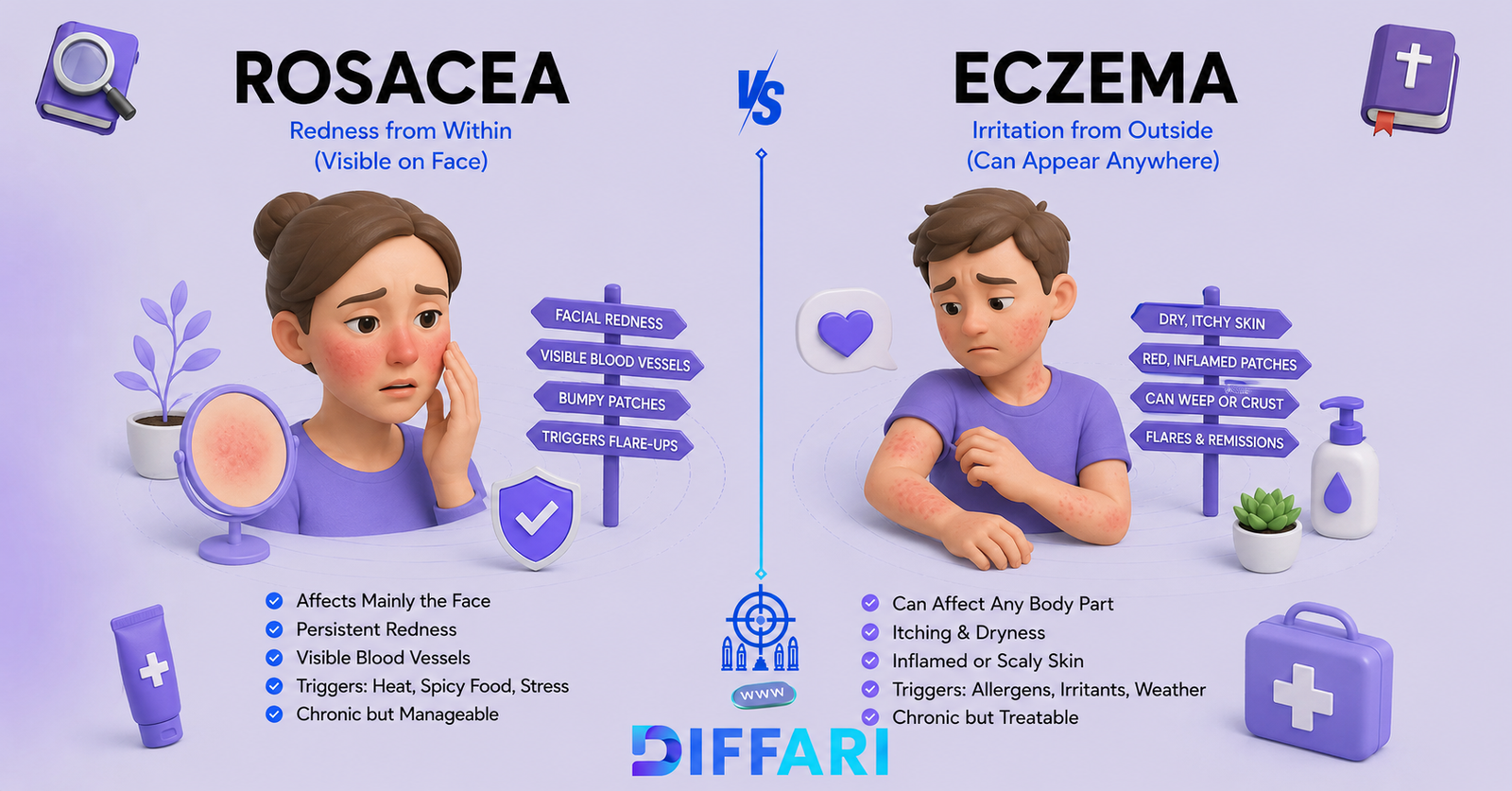
Rosacea and eczema can both make the skin look irritated, uncomfortable, or discolored, so it is easy to confuse them. The important difference is that they tend to produce different patterns.
Rosacea most often centers on the face and is associated with flushing, persistent facial discoloration, visible blood vessels, bumps, and sensations such as burning or stinging. Eczema, particularly atopic dermatitis, is more strongly associated with dry, itchy, inflamed skin and can affect many parts of the body.
The distinction is not always obvious, especially when eczema affects the face. Therefore, symptoms alone should not be treated as a definitive diagnosis. A dermatologist or other healthcare professional can evaluate the pattern and rule out other conditions.
Quick Answer
Rosacea is a chronic inflammatory skin condition that primarily affects the face, often causing flushing or persistent facial redness, visible blood vessels, burning or stinging, and sometimes acne-like bumps or pustules.
Eczema, particularly atopic dermatitis, usually causes dry, itchy, inflamed skin that may become scaly, cracked, thickened, crusted, or weepy. It can occur almost anywhere on the body.
The simplest distinction: rosacea is more strongly associated with facial flushing and persistent facial changes, while eczema is more strongly associated with itching, dryness, and an impaired skin barrier.
Rosacea vs Eczema at a Glance
| Feature | Rosacea | Eczema |
| Main pattern | Facial flushing/redness and inflammation | Dry, itchy, inflamed rash |
| Typical location | Central face | Can occur anywhere; often flexural areas in atopic dermatitis |
| Itching | May occur, but burning/stinging can be prominent | Often a major symptom |
| Burning/stinging | Common | Can occur with irritated skin |
| Dryness/scaling | Can occur, but not usually the defining feature | Common |
| Visible blood vessels | Characteristic feature | Not a typical defining feature |
| Papules/pustules | Can occur | Some eczema types can have bumps, but pustules are not characteristic |
| Flushing | Common | Not a defining feature |
| Eye involvement | Ocular rosacea can occur | Eyelid eczema can occur, but it is a different pattern |
| Common triggers | Sun, heat, hot drinks, alcohol, spicy foods, stress | Irritants, fragrances, dry skin, heat, sweat, stress, allergens |
| Typical course | Flares and periods of improvement | Flares and periods of improvement |
These are general patterns rather than diagnostic rules. Both conditions can vary by person and skin tone.
What Is Rosacea?
Rosacea is a chronic inflammatory skin condition that primarily affects the face. It commonly causes facial flushing or persistent discoloration, especially around the cheeks and nose. Over time, small facial blood vessels may become more visible. Some people also develop red bumps or pus-filled bumps that can resemble acne.
Rosacea can also cause:
- Burning or stinging
- Facial warmth or tenderness
- Eye and eyelid symptoms
- Swelling
- Thickening of the skin, particularly around the nose in some cases
Triggers vary, but common ones include sunlight, heat, hot drinks, spicy foods, alcohol, exercise, emotional stress, and certain skincare products.
An important point is that rosacea does not simply mean “red skin.” Dermatologists look at the overall pattern, including distribution, flushing, visible vessels, inflammatory lesions, and other symptoms.
What Is Eczema?
Eczema is a broad term used for several inflammatory skin conditions. When people use the word in a general medical comparison like this one, they often mean atopic dermatitis.
Atopic dermatitis commonly causes:
- Intense itching
- Dry skin
- Inflamed patches
- Cracking
- Scaling
- Oozing or crusting
- Thickened skin after repeated irritation or scratching
It can occur anywhere on the body. In many people, particularly children, it affects areas such as the inside of the elbows, behind the knees, and the neck.
Unlike rosacea, eczema is strongly associated with disruption of the skin barrier. When the barrier does not work properly, the skin can lose moisture more easily and become more vulnerable to irritants and environmental triggers.
What Is the Difference Between Rosacea and Eczema?
The biggest difference is the overall symptom pattern.
Rosacea tends to be:
Face-centered + flushing + persistent discoloration + visible vessels + burning/stinging ± bumps
Atopic eczema tends to be:
Dry + intensely itchy + inflamed + scaly/cracked ± oozing or crusting
Rosacea most commonly involves the central face, whereas eczema can affect many body areas. AAFP’s clinical comparison specifically identifies dryness and scaling, along with involvement of other body areas, as features that can distinguish atopic dermatitis from rosacea.
However, the distinction is not absolute. Facial eczema can look like rosacea, and rosacea can cause some dryness or itching.
Rosacea vs Eczema Symptoms
Symptoms More Characteristic of Rosacea
Look for a combination of:
- Repeated facial flushing
- Persistent facial discoloration
- Visible small blood vessels
- Central facial involvement
- Acne-like papules or pustules
- Burning or stinging
- Eye irritation or dryness
- Symptoms triggered by heat, sunlight, alcohol, or spicy foods
Mayo Clinic notes that rosacea can produce facial flushing, visible veins, bumps, burning, and eye problems.
Symptoms More Characteristic of Eczema
Eczema is more suggestive when the dominant pattern is:
- Persistent itching
- Dryness
- Scaling
- Cracking
- Rough or thickened skin
- Oozing or crusting during some flares
- Patches occurring beyond the central face
- Symptoms associated with irritants or allergens
Atopic dermatitis commonly produces dry, itchy, inflamed skin and may cause cracking, oozing, crusting, and thickening.
Where Does Rosacea Usually Appear?
Rosacea is predominantly a facial condition.
The central face is particularly important, including:
- Cheeks
- Nose
- Chin
- Forehead
Some people can develop related symptoms around the eyes, and certain rosacea manifestations can involve other areas.
Where Does Eczema Usually Appear?
Atopic dermatitis can occur almost anywhere, although the location varies with age and individual pattern.
Common areas include:
- Inside the elbows
- Behind the knees
- Neck
- Hands
- Face
- Other areas exposed to friction or irritation
Mayo Clinic notes that atopic dermatitis commonly affects skin where the body flexes, including the elbows, knees, and neck.
So if a rash repeatedly occurs in several body locations rather than primarily across the central face, eczema becomes an important possibility.
Itching vs Burning and Stinging
This is one of the most useful practical differences.
Eczema → itching tends to be the dominant sensation.
Rosacea → burning, stinging, warmth, or tenderness may be more characteristic.
That does not mean rosacea cannot itch or eczema cannot burn. Symptoms overlap. The useful point is which sensation dominates the overall pattern.
Severe, persistent itching is a classic feature of atopic dermatitis, while rosacea commonly produces burning or stinging sensations.
Common Triggers
Rosacea Triggers
Common reported triggers include:
- Sun exposure
- Hot weather
- Hot drinks
- Spicy foods
- Alcohol
- Exercise
- Emotional stress
- Extreme temperatures
- Some cosmetic or skincare products
Eczema Triggers
Atopic dermatitis triggers vary considerably, but can include:
- Dry skin
- Heat and sweating
- Stress
- Fragrances
- Cleaning products
- Rough fabrics such as wool
- Dust mites
- Pet dander
- Pollen
- Smoke
- Cold, dry air
There is some overlap. Heat and stress, for example, can aggravate both conditions. Therefore, a trigger by itself usually cannot tell you which condition you have.
Can Rosacea Look Like Eczema?
Yes.
Both conditions can produce facial irritation, discoloration, sensitivity, and inflammatory changes. Rosacea is also included among conditions that can be confused with eczema during clinical assessment.
The difference often becomes clearer when you consider the complete pattern.
For example:
Persistent central facial flushing + visible blood vessels + burning → rosacea becomes more characteristic.
Whereas:
Dry, scaly, intensely itchy patches + cracking → eczema becomes more characteristic.
Neither pattern should be used as a substitute for professional diagnosis.
Can You Have Rosacea and Eczema at the Same Time?
Yes, it is possible for the two conditions to coexist.
The relationship is more complicated than simply saying that one condition causes the other. Recent literature describes clinical overlap between rosacea and atopic dermatitis, particularly when facial symptoms are involved.
This is one reason why treating every facial rash as either “rosacea” or “eczema” can lead to confusion.
Treatment and Management Differences
The treatment approach depends on the actual diagnosis, severity, location, and individual circumstances.
For rosacea, management commonly focuses on identifying triggers, gentle skincare, sun protection, and appropriate medical treatment when needed.
For atopic dermatitis, regular moisturization, gentle skincare, trigger avoidance, and appropriate anti-inflammatory treatment are commonly part of management.
The distinction matters because treatments that are appropriate for one condition are not automatically appropriate for another. For example, unnecessary or prolonged use of topical corticosteroids on facial skin can cause adverse effects and may contribute to steroid-induced rosacea.
For that reason, persistent facial redness, recurrent rash, or symptoms involving the eyes are worth discussing with a healthcare professional.
Common Mistakes With Rosacea and Eczema
Mistake 1: Assuming every red face is rosacea
Why it’s incorrect:
Facial redness can occur with eczema, contact dermatitis, seborrheic dermatitis, lupus, and other conditions. Rosacea is diagnosed from the broader clinical pattern.
Mistake 2: Assuming every itchy rash is eczema
Why it’s incorrect:
Itching is common in many skin conditions. Rosacea can also cause itching in some people.
Mistake 3: Using “eczema” and “atopic dermatitis” as perfect synonyms
Why it’s incorrect:
Eczema is a broader term that includes several forms of dermatitis. Atopic dermatitis is one specific type.
Mistake 4: Relying only on skin color
Why it’s incorrect:
Rosacea-related redness and visible vessels can be less obvious on darker skin. Other symptoms and changes in pigmentation may provide important clues.
Can Rosacea and Eczema Be Used Interchangeably?
No.
Rosacea and eczema describe different skin conditions and should not be treated as interchangeable diagnoses.
They can share symptoms such as inflammation, discoloration, sensitivity, and sometimes itching. However, their characteristic patterns differ, and their management can also differ.
Also remember that eczema itself is a broad category, so saying “eczema” without specifying the type can sometimes make the comparison less precise.
Which One Should I Use as the Description?
When describing a symptom pattern, the most useful choice depends on the symptoms involved.
Rosacea may be more characteristic when the main pattern includes facial flushing, persistent central facial redness, visible blood vessels, or burning.
By contrast, atopic dermatitis may be more characteristic when the skin is dry, intensely itchy, scaly, cracked, or inflamed.
For an unusual, persistent, spreading, or painful rash—or one that looks infected or affects the eyes—seek professional evaluation rather than trying to diagnose it yourself.
Mayo Clinic recommends professional evaluation for ongoing rosacea-related facial or eye symptoms and for eczema symptoms that persist or cause significant discomfort.
Rosacea or Eczema? Practice Examples
Choose the condition that best matches the dominant pattern.
1. Repeated flushing across the cheeks after heat exposure
Answer: Rosacea
Flushing and central facial involvement are characteristic of rosacea.
2. Extremely itchy, dry patches behind the knees
Answer: Eczema
Flexural involvement with intense itching and dryness is characteristic of atopic dermatitis.
3. Facial redness accompanied by visible small blood vessels
Answer: Rosacea
Visible facial vessels are a characteristic rosacea feature.
4. Cracked skin that becomes scaly and crusted
Answer: Eczema
Dryness, cracking, scaling, oozing, and crusting can occur with atopic dermatitis.
5. Facial skin that repeatedly feels hot, burning, or stinging
Answer: Rosacea is a possibility
Burning and stinging are recognized rosacea symptoms, although they are not exclusive to rosacea.
Frequently Asked Questions
What is the main difference between rosacea and eczema?
Rosacea mainly affects the face and commonly causes flushing, persistent facial discoloration, visible blood vessels, and sometimes bumps. Eczema, particularly atopic dermatitis, is more strongly associated with dry, itchy, inflamed skin and can affect many parts of the body.
Is rosacea itchy like eczema?
Rosacea can itch, but burning, stinging, warmth, and facial sensitivity are also common. Intense persistent itching is more characteristic of atopic dermatitis.
Can eczema cause facial redness?
Yes. Eczema can affect the face and cause inflamed, discolored, dry, or itchy skin. Therefore, facial redness alone does not prove that someone has rosacea.
Can rosacea cause dry or flaky skin?
It can, but pronounced dryness and scaling are more characteristic of eczema and some other forms of dermatitis.
Are rosacea and eczema the same thing?
No. They are different inflammatory skin conditions, although their symptoms can overlap.
Can you have rosacea and eczema together?
Yes. Clinical overlap and coexistence can occur, particularly with facial inflammatory conditions.
Which is more likely to cause visible blood vessels?
Rosacea. Enlarged or visible small blood vessels are a recognized feature of rosacea and are not a defining feature of atopic dermatitis.
Which one usually causes more itching?
Atopic dermatitis is generally more strongly associated with intense itching.
Can rosacea affect the eyes?
Yes. Ocular rosacea can cause dry, irritated, swollen, or uncomfortable eyes and eyelids.
Conclusion
The difference between rosacea and eczema is easiest to understand by looking at the whole symptom pattern rather than redness alone. Rosacea is typically centered on the face and is associated with flushing, persistent facial changes, visible blood vessels, bumps, and burning or stinging. Eczema, especially atopic dermatitis, is more strongly associated with dry, intensely itchy, inflamed skin that may crack, scale, ooze, or crust.