Delta-8 and Delta-9 are two closely related forms of tetrahydrocannabinol (THC), the intoxicating cannabinoids associated with cannabis. Their names differ by only one number because their molecular structures are extremely similar. However, that small structural difference can affect how strongly they interact with the body’s cannabinoid receptors.
The most important practical distinction is that Delta-9 THC generally has greater psychoactive potency than Delta-8 THC, although the exact difference depends on the dose, product, route of administration, and individual response. Scientific reviews also emphasize that much more human research is needed on Delta-8, particularly its dose-response and pharmacokinetics.
Quick Answer
Delta-8 THC (D8) and Delta-9 THC (D9) are closely related THC isomers that differ mainly in the position of one carbon-carbon double bond.
D8 generally produces less potent intoxicating effects than D9, but the two compounds have many similarities in their pharmacology. Delta-8 is present naturally in cannabis only in very small amounts, so commercial Delta-8 products are commonly manufactured by converting other cannabinoids, such as CBD, into Delta-8. Delta-9 occurs naturally in substantially greater quantities in cannabis.
The important point is that D8 is not simply “non-intoxicating THC.” It is psychoactive, and the FDA warns that Delta-8 products sold commercially have not been evaluated or approved by the agency for safe use.
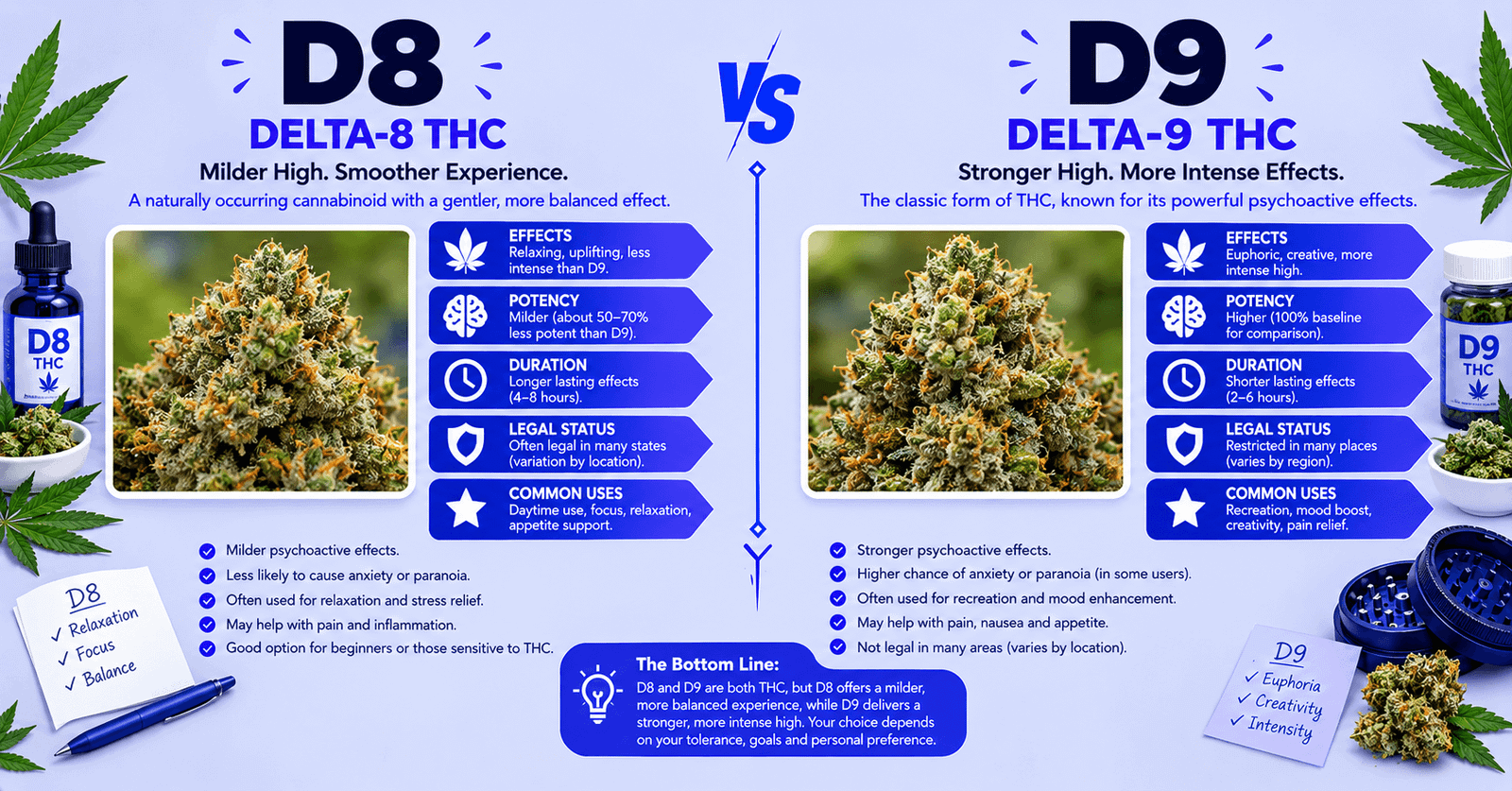
D8 vs. D9 at a Glance
| Feature | Delta-8 THC (D8) | Delta-9 THC (D9) |
| Full name | Delta-8-tetrahydrocannabinol | Delta-9-tetrahydrocannabinol |
| Chemical relationship | THC isomer | THC isomer |
| Main structural difference | Double bond at the Delta-8 position | Double bond at the Delta-9 position |
| Psychoactive? | Yes | Yes |
| Typical potency | Generally lower | Generally higher |
| Natural abundance | Present in very small amounts | Much more abundant in cannabis |
| CB1 activity | Partial agonist | Stronger interaction than D8 in many studies |
| Common products | Gummies, vapes, oils and other products | Flower, concentrates, edibles, oils and other products |
| FDA-approved consumer product? | No | Consumer cannabis products are not FDA-approved |
| Research base | More limited | Much more extensive |
The pharmacological relationship is close: a major review concluded that Delta-8 and Delta-9 have broadly similar pharmacokinetic and pharmacodynamic characteristics, while Delta-8 generally shows lower potency.
What Is Delta-8 THC?
Delta-8 THC is an intoxicating cannabinoid and a structural isomer of Delta-9 THC.
The “8” does not mean that Delta-8 contains eight carbon atoms or that it is a different class of cannabinoid. Instead, it identifies the location of a carbon-carbon double bond within the THC molecule.
Delta-8 occurs naturally in the cannabis plant, but generally only in very small quantities. Because the naturally occurring amount is low, concentrated commercial Delta-8 is commonly produced through chemical conversion of other cannabinoids, particularly hemp-derived CBD.
That manufacturing route is important because the final product can contain impurities or reaction by-products if the process is poorly controlled. The FDA has specifically raised concerns about potentially harmful chemicals and contaminants associated with the production of concentrated Delta-8 products.
What Is Delta-9 THC?
Delta-9 THC is the best-known intoxicating cannabinoid in cannabis and is commonly what people mean when they simply say “THC.”
Like Delta-8, Delta-9 interacts with cannabinoid receptors, particularly the CB1 receptor, and can alter mood, perception, cognition, and other functions.
Delta-9 is naturally present in cannabis at much higher concentrations than Delta-8. It is also substantially more extensively studied.
The FDA notes that Delta-9 THC is the psychoactive component associated with the intoxicating effects of cannabis. The agency has also approved specific prescription medicines containing synthetic Delta-9 THC, such as dronabinol, for particular medical indications. That does not mean ordinary cannabis or retail Delta-9 products are FDA-approved medicines.
What Is the Main Difference Between D8 and D9?
The fundamental difference is where the double bond occurs in the THC molecule.
In simplified terms:
- Delta-8 THC: the double bond is at the Delta-8 position.
- Delta-9 THC: the double bond is at the Delta-9 position.
That sounds like a tiny difference, and chemically it is. But molecular shape and bonding influence how a compound interacts with biological receptors.
Delta-8 and Delta-9 can both activate CB1 receptors, but research indicates that Delta-8 generally has weaker CB1 receptor affinity and lower potency in many experimental and clinical comparisons.
This is why it is more accurate to say “Delta-8 is generally less potent than Delta-9” rather than claiming that every Delta-8 product produces exactly a particular fraction of the effects of Delta-9.
D8 vs. D9 Potency
One of the most common questions is:
Is D8 weaker than D9?
Generally, yes.
A major pharmacological review found that Delta-8’s potency was lower than Delta-9’s in many studies, although the size of the difference varied. The available evidence does not justify treating a single multiplier as universally accurate for every product, person, dose, or method of administration.
Several factors can change the experience, including:
- dose
- method of administration
- product formulation
- individual metabolism
- tolerance
- whether the product is inhaled or eaten
- the presence of other cannabinoids
Therefore, statements such as “D9 is always exactly twice as strong” should be treated cautiously.
How Do D8 and D9 Effects Compare?
Both compounds can produce intoxicating effects.
Possible effects can include:
- euphoria
- altered perception
- changes in mood
- drowsiness
- impaired attention or coordination
- increased appetite
- anxiety or discomfort in some people
Delta-9 generally produces stronger intoxicating effects at comparable doses, while Delta-8 is often described as less potent.
However, subjective descriptions such as “clear-headed,” “smooth,” or “anxiety-free” should not be treated as guaranteed pharmacological properties. Individual experiences vary, and the scientific evidence does not support assuming that Delta-8 will be comfortable or risk-free for everyone.
A scientific review found that Delta-8 and Delta-9 have many similarities in human effects and pharmacology, while also identifying important gaps in the available human research.
Why Does D8 Feel Different From D9?
The answer begins with receptor activity.
Both compounds can interact with the body’s endocannabinoid system, including CB1 receptors. Because their molecular structures are slightly different, however, their receptor interactions are not identical.
Research suggests that Delta-8 has weaker affinity for human CB1 receptors than Delta-9, which is one plausible explanation for its generally lower potency.
The distinction is therefore not:
D8 = THC without a high
Instead:
D8 and D9 are closely related intoxicating cannabinoids with different molecular structures and generally different potency.
Production and Availability
Another important difference is how commonly each compound occurs naturally.
Delta-9 is naturally abundant enough in cannabis to be a major cannabinoid in many cannabis varieties.
Delta-8 occurs naturally at much lower levels. Consequently, concentrated Delta-8 products on the market are commonly manufactured through conversion of other cannabinoids.
The scientific literature has raised concerns about this manufacturing pathway because poorly controlled processes may leave residual chemicals, reaction by-products, or other contaminants in finished products.
This makes product quality and independent laboratory testing particularly important when evaluating commercial cannabinoid products.
Are D8 and D9 the Same?
No.
They are not the same molecule, but they are very closely related.
A useful way to remember the relationship is:
Same cannabinoid family, similar molecular structure, different double-bond position.
That small structural change is enough to produce measurable differences in receptor interactions and potency.
Are D8 and D9 Interchangeable?
No, not automatically.
Although both are THC isomers and can produce similar types of intoxicating effects, they should not be treated as identical substances.
A product containing Delta-8 should not automatically be assumed to produce the same intensity, duration, or response as a product containing an equivalent labeled amount of Delta-9.
Different products can also have different concentrations, formulations, routes of administration, and additional cannabinoids.
D8 vs. D9 and Edibles
Edibles deserve special attention because orally consumed THC is processed differently from inhaled THC.
The liver metabolizes Delta-9 THC into active metabolites, including 11-hydroxy-Delta-9-THC. Delta-8 also has an active 11-hydroxy metabolite.
Consequently, comparing edible products solely by looking at the number of milligrams on the package can be misleading.
The scientific review literature specifically identifies similarities in the metabolism of Delta-8 and Delta-9 while also noting that human pharmacokinetic information for Delta-8 remains limited.
For that reason, consumer claims about exactly how long one compound “always” lasts compared with the other should be treated cautiously.
Safety and Product Quality
Safety is one of the biggest areas where marketing pages can oversimplify the D8/D9 comparison.
The FDA states that Delta-8 products have not been evaluated or approved by the FDA for safe use in any context. It has also raised concerns about inconsistent formulations, variable concentrations, misleading labeling, and potentially harmful contaminants associated with manufacturing.
That does not mean every Delta-8 product contains contaminants. It means consumers should not assume that a product is safe simply because it is sold commercially or labeled “hemp.”
Delta-9 cannabis products also carry risks associated with THC intoxication and impairment. The fact that Delta-9 is more extensively studied does not make every consumer product automatically safe.
D8 and D9 Drug Testing
Another practical issue is drug testing.
A standard test looking for THC metabolites is generally not designed to distinguish the consumer’s experience as simply “Delta-8” versus “Delta-9.” Because these compounds are chemically related and metabolized into related compounds, using Delta-8 should not be assumed to protect someone from a THC-positive test.
Anyone subject to workplace, athletic, legal, or other drug testing should not assume that a product labeled Delta-8 will produce a negative result.
D8 vs. D9 Legality
Legality is more complicated than simply saying:
“D8 is legal and D9 is illegal.”
U.S. federal law has historically treated hemp differently from marijuana, with the 2018 Farm Bill defining hemp partly through its Delta-9 THC concentration. However, federal and state rules can differ, and the regulatory environment is changing.
The FDA also retains authority over products containing cannabis-derived compounds, even where a product may fall within a federal hemp definition.
There is an additional current-law complication: federal legislation is scheduled to change the definition of hemp on November 12, 2026, including restrictions affecting certain intoxicating hemp-derived cannabinoid products. Because the implementation date and subsequent legislative activity matter, legality should always be checked against the current federal and state rules rather than relying on an old “2018 Farm Bill” explanation.
Common Mistakes About D8 and D9
Mistake 1: “Delta-8 is non-psychoactive.”
Incorrect: Delta-8 does not cause a high.
Correct: Delta-8 is psychoactive and can produce intoxicating effects.
The FDA explicitly describes Delta-8 THC as a psychoactive substance.
Mistake 2: “Delta-9 and Delta-8 are completely different cannabinoids.”
Incorrect: They belong to unrelated cannabinoid families.
Correct: They are closely related THC isomers with a different double-bond position.
Mistake 3: “D9 is exactly three times stronger.”
Incorrect: The potency ratio is always exactly 3:1.
Correct: Delta-9 is generally more potent, but the measured difference varies between studies and circumstances.
Mistake 4: “Hemp means non-intoxicating.”
Incorrect: Anything labeled hemp cannot make you intoxicated.
Correct: Certain hemp-derived cannabinoid products can be intoxicating.
Mistake 5: “FDA approval and retail availability are the same thing.”
Incorrect: If a Delta-8 product is sold in a store, it must be FDA-approved.
Correct: The FDA specifically states that commercially sold Delta-8 products have not been evaluated or approved for safe use.
Common D8 and D9 Collocations
You will commonly encounter these combinations:
Delta-8 THC
- Delta-8 THC products
- Delta-8 THC gummies
- Delta-8 THC vape
- Delta-8 THC effects
- Delta-8 THC potency
Delta-9 THC
- Delta-9 THC products
- Delta-9 THC gummies
- Delta-9 THC concentration
- Delta-9 THC effects
- Delta-9 THC potency
Comparison language
- Delta-8 vs. Delta-9
- Delta-8 and Delta-9 THC
- D8 vs. D9
- Delta-8 compared with Delta-9
- Delta-8 and Delta-9 potency
How to Remember the Difference
Think of the numbers as molecular location labels.
D8 → double bond at position 8
D9 → double bond at position 9
Then remember the practical distinction:
D8 and D9 are close chemical relatives, but D9 is generally more potent.
This mnemonic is useful because it connects the number to the actual structural difference rather than treating “8” and “9” as arbitrary product names.
Which One Should I Use?
There is no scientifically sound universal answer that one is “better” for everyone.
Instead, understand the distinction:
For the more extensively studied, naturally abundant intoxicating THC, choose Delta-9 THC.
For the closely related THC isomer that is generally less potent, Delta-8 THC is the relevant comparison.
When evaluating a commercial Delta-8 product, consider product testing, labeling, manufacturing quality, local law, and the FDA’s safety concerns.
For a medical condition, do not assume that a retail D8 or D9 product is an FDA-approved treatment.
The FDA says it has not approved cannabis for the treatment of any disease or condition, although it has approved specific prescription medicines containing synthetic or cannabis-derived cannabinoids for particular indications.
D8 or D9? Practice Examples
Choose D8 or D9 based on the description.
- Which compound is generally more potent in comparable experimental conditions?
- Which compound occurs naturally in cannabis in much larger amounts?
- Which compound is typically present only in trace amounts naturally?
- Which two compounds are separated mainly by the position of a double bond?
- Which compound is commonly called Delta-9 THC?
- Which compound is psychoactive despite often being marketed as a hemp-derived cannabinoid?
- Which compound has been more extensively studied?
- Are D8 and D9 identical molecules?
Answers
- D9
- D9
- D8
- Both
- D9
- D8
- D9
- No
Frequently Asked Questions
What is the difference between D8 and D9?
D8 means Delta-8 THC, while D9 means Delta-9 THC. They are closely related THC isomers whose main structural difference is the position of a carbon-carbon double bond. Delta-9 generally has greater psychoactive potency.
Is D8 weaker than D9?
Generally, yes. Scientific research indicates that Delta-8 has lower potency than Delta-9 in many comparisons, but the exact difference varies by study, dose, administration route, and individual response.
Are D8 and D9 the same?
No. They are different THC isomers with very similar molecular structures.
Does D8 get you high?
Yes. Delta-8 THC is psychoactive and can produce intoxicating effects.
Which is stronger, D8 or D9?
Delta-9 is generally stronger or more potent than Delta-8, although a fixed potency ratio should not be assumed for every product or situation.
Is Delta-8 safer than Delta-9?
The evidence does not justify a simple “Delta-8 is safer” conclusion. Delta-8 has a more limited human evidence base, and the FDA has raised concerns about commercial Delta-8 products, including variable formulations and potential contaminants.
Are D8 and D9 legal?
The answer depends on the jurisdiction and the specific product. U.S. federal hemp rules, state laws, and changing regulations can produce different outcomes. The legal status should be checked using current federal and state rules.
Can Delta-8 cause a positive THC drug test?
Yes. Using Delta-8 should not be considered a reliable way to avoid a positive THC-related drug test.
Why is Delta-8 called Delta-8?
The “8” refers to the position of the molecule’s carbon-carbon double bond. Delta-9 uses a different position.
Conclusion
The difference between D8 and D9 is small at the molecular level but meaningful in practice. Delta-8 THC and Delta-9 THC are closely related isomers that differ primarily in the position of one double bond. Both can be intoxicating, but Delta-9 is generally more potent than Delta-8.
The safest way to understand the comparison is to avoid oversimplified potency claims. D8 and D9 share many pharmacological characteristics, yet they are not identical, and the evidence for Delta-8 remains more limited. Product quality, formulation, dose, individual response, and current laws can all affect the real-world comparison.