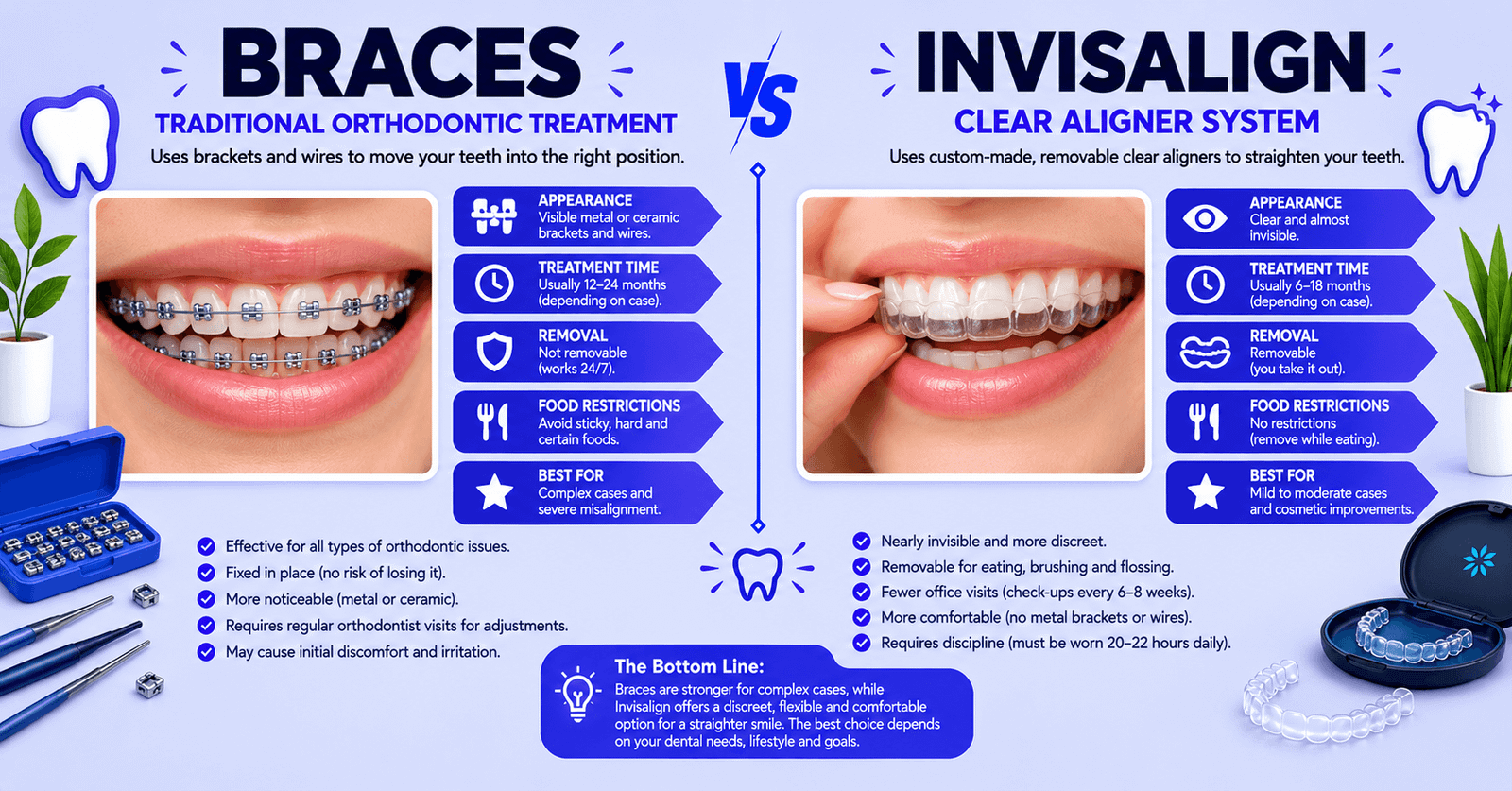

If you need orthodontic treatment, you may be wondering about the difference between braces and Invisalign. Both can straighten teeth and improve certain bite problems, but they use very different approaches. Traditional braces are fixed to the teeth with brackets and wires, while Invisalign uses a series of removable, clear aligners.
The important distinction is not simply that one is visible and the other is nearly invisible. The two treatments also differ in removability, daily responsibility, treatment mechanics, hygiene, eating, and how suitable they may be for particular orthodontic problems.
In many straightforward cases, both approaches can work well. For more complicated tooth movements, however, fixed appliances may offer advantages. The right choice depends on your diagnosis, treatment goals, lifestyle, and how consistently you can follow the treatment instructions.
Quick Answer
Braces use fixed brackets and wires attached to the teeth to apply controlled forces during orthodontic treatment.
Invisalign uses a series of removable, custom-made clear aligners that gradually move the teeth.
The main difference is that braces stay attached to your teeth and can provide highly controlled tooth movement, while Invisalign is removable, less noticeable, and gives you more flexibility with eating and oral hygiene—but requires consistent wear.
Neither is automatically better for everyone. The appropriate treatment depends on the specific orthodontic problem and treatment plan.
Braces vs Invisalign at a Glance
| Feature | Braces | Invisalign |
| Type | Fixed orthodontic appliance | Removable clear aligners |
| Appearance | Visible | Nearly invisible |
| Removable | No | Yes |
| Eating | Some food restrictions may be necessary | Remove aligners before eating |
| Oral hygiene | Requires cleaning around brackets and wires | Aligners are removed for brushing/flossing |
| Compliance | Less dependent on remembering to wear them | Requires consistent daily wear |
| Complex tooth movement | Often advantageous | Can treat many cases, but suitability varies |
| Comfort | Brackets/wires may irritate the mouth | Usually no brackets or wires, but pressure can cause discomfort |
| Adjustments | Wires/appliances adjusted by orthodontist | New aligners progressively move teeth |
| Best choice | Depends on diagnosis | Depends on diagnosis |
What Are Braces?
Traditional braces are fixed orthodontic appliances. They typically use brackets attached to the teeth and an archwire that connects the brackets. The orthodontist adjusts the appliance throughout treatment to guide the teeth toward their planned positions.
Braces have been used for decades and can address a broad range of orthodontic problems.
Their biggest practical advantage is that they are fixed. The patient cannot simply remove them when treatment becomes inconvenient. That can make adherence easier because the appliance remains active throughout the day.
Braces can also be useful when an orthodontist needs detailed control over particular tooth movements.
Research comparing fixed appliances with clear aligners does not show that braces are universally superior, but evidence suggests fixed appliances can have advantages for some movements, including certain forms of rotation and torque control.
What Is Invisalign?
Invisalign is a branded system of clear removable aligners. Instead of brackets and wires, the patient wears a sequence of custom-made plastic trays designed to progressively move the teeth.
The aligners can be removed for eating, brushing, and flossing.
That makes Invisalign attractive to people who want a less noticeable orthodontic treatment and more flexibility in their daily routine. However, removability also creates an important responsibility: the aligners must be worn as directed.
Invisalign’s own patient information recommends wearing the aligners for approximately 20–22 hours per day.
It is also important to understand that Invisalign is a brand of clear-aligner treatment, not a synonym for every clear aligner available.
What Is the Difference Between Braces and Invisalign?
The fundamental difference is how the orthodontic appliance applies force and how the patient interacts with it.
Braces are fixed directly to the teeth. Invisalign uses removable aligners that are replaced according to the treatment plan.
That produces several practical differences:
1. Fixed vs. removable
Braces remain on your teeth throughout treatment.
Invisalign aligners can be removed temporarily for eating and oral hygiene.
2. Visibility
Traditional metal braces are clearly visible.
Invisalign aligners are designed to be much less noticeable.
3. Patient responsibility
Braces do not depend on remembering to put them in.
Invisalign does. If aligners are repeatedly left out for too long, treatment may not progress as planned.
4. Eating
With braces, patients may need to avoid or modify certain hard or sticky foods.
With Invisalign, the aligners are removed before eating, so the patient can generally eat without the same appliance-related food restrictions.
5. Tooth movement
Both treatments can move teeth, but their mechanics are different. The best appliance depends on the specific movements required.
Current research suggests clear aligners can be effective for many cases, while some movements and complex cases may be more predictable with fixed appliances.
Invisalign vs Braces: Which Is More Effective?
This question needs a more careful answer than simply saying “braces are better” or “Invisalign is better.”
For straightforward orthodontic cases, research has found that clear aligners and fixed appliances can both produce good outcomes. A 2025 systematic review and meta-analysis involving 21 randomized studies found no significant difference in several primary measures of orthodontic treatment effectiveness. However, the researchers also noted that the overall quality of evidence was low.
For more complicated movements, the picture is less straightforward.
A 2026 systematic review found mixed evidence across different tooth movements, with fixed appliances appearing to have an advantage for some rotation and torque-control movements.
So the practical rule is:
Simple or moderate case → either option may work well.
Complex movement → braces may offer an advantage in certain situations.
That decision should be made after an orthodontic examination rather than from the appliance’s appearance alone.
Which Is Faster: Braces or Invisalign?
There is no universal treatment time that applies to every patient.
Some Invisalign sources report shorter average treatment times in selected patient groups, but treatment duration depends heavily on case complexity, treatment plan, wear compliance, and the movements required.
Research also does not support a simple rule that Invisalign is always faster.
For example, a systematic review of complicated extraction-based cases found that both clear aligners and fixed appliances could be effective, while fixed appliances had shorter treatment duration in the studied extraction cases.
Therefore:
Do not choose Invisalign simply because you assume it will always finish faster.
Your orthodontist should estimate the treatment time for your particular case.
Which Is More Comfortable?
Comfort varies from person to person.
Braces can cause irritation because brackets, wires, and other components are attached inside the mouth. Invisalign does not have conventional brackets and wires, which can make the appliance experience more comfortable for some patients.
However, Invisalign is not completely painless. The aligners apply pressure to move the teeth, so temporary tightness or discomfort can occur, especially when beginning a new aligner.
Research summarized in a 2025 systematic review found evidence favoring clear aligners for pain and some patient-reported quality-of-life outcomes, although the researchers cautioned that the overall evidence quality was limited.
Which Looks Better?
If appearance during treatment is your main concern, Invisalign generally has the advantage.
Traditional metal braces are highly visible because the brackets and wires sit on the teeth.
Invisalign aligners are transparent and designed to be much less noticeable. This is one of their major practical attractions, particularly for adults and people who are concerned about the appearance of orthodontic treatment.
Ceramic or tooth-colored braces can provide another less-visible fixed option, but they are still different from removable clear aligners.
Eating and Oral Hygiene
This is one of the biggest lifestyle differences.
With braces
You normally keep the appliance in while eating. Certain hard, sticky, or chewy foods may need to be avoided or handled carefully to reduce the risk of damaging brackets or wires.
Cleaning can also require additional effort because food and plaque can accumulate around the brackets.
With Invisalign
You remove the aligners before eating and drinking most beverages other than water.
Because the aligners are removable, brushing and flossing can be more straightforward. However, patients need to maintain good oral hygiene and clean the aligners appropriately.
A 2025 systematic review found lower plaque, gingival, and bleeding index scores with clear aligners than fixed appliances, although the evidence quality varied.
Which Is Better for Complex Cases?
This is one of the most important differences to understand.
Braces can be advantageous when an orthodontist needs precise control over complicated tooth movements.
Clear aligner technology has expanded substantially and can now be used for many types of orthodontic problems. However, evidence remains less certain for some complex movements.
A systematic review of complex extraction cases found both clear aligners and fixed appliances to be effective, but fixed appliances showed advantages in some aspects of tooth positioning and treatment duration.
A newer 2026 systematic review similarly found that the evidence varies according to the exact tooth movement being attempted.
Therefore, someone with severe crowding, complicated bite relationships, extraction requirements, or demanding tooth movements should not assume that Invisalign is automatically equivalent to braces for their specific treatment.
Common Mistakes About Braces and Invisalign
Mistake 1: “Invisalign works for everyone.”
Not necessarily.
Clear aligners can treat many orthodontic problems, but treatment suitability depends on the individual case.
Mistake 2: “Braces are always more effective.”
Also too broad.
Clear aligners can be effective, particularly for many straightforward cases. Research does not establish that fixed appliances are universally superior.
Mistake 3: “Invisalign means no discomfort.”
False.
Aligners can create pressure and temporary discomfort as teeth move.
Mistake 4: “Invisalign is faster in every case.”
Not necessarily.
Treatment time varies according to the problem being corrected and how well the patient follows the treatment plan.
Mistake 5: “If I can remove Invisalign, I can wear it whenever I want.”
No.
Removability does not mean unlimited flexibility. Invisalign guidance generally recommends approximately 20–22 hours of wear per day.
Common Collocations and Terms
You will commonly see these combinations when researching either treatment:
Braces
- traditional braces
- metal braces
- ceramic braces
- fixed braces
- orthodontic braces
- braces treatment
- braces adjustment
- braces brackets
- braces and wires
Invisalign
- Invisalign treatment
- Invisalign aligners
- clear aligners
- Invisalign trays
- Invisalign treatment plan
- Invisalign provider
- Invisalign attachments
- Invisalign refinement
One useful distinction is that “clear aligner” describes a category of orthodontic appliance, whereas “Invisalign” refers to a specific branded system.
Can Braces and Invisalign Be Used Interchangeably?
No—not in the sense that either treatment is automatically suitable for every patient.
Both are orthodontic treatment approaches designed to move teeth, but they are not mechanically identical.
For some patients, either option may be clinically reasonable. For others, the orthodontic problem or required tooth movement may make one approach more appropriate.
The AAO specifically notes that there is no single appliance that is inherently the best choice for every patient; diagnosis should come first.
How to Remember the Difference
Use this simple rule:
Braces = fixed. Invisalign = removable.
Then remember the lifestyle difference:
Braces stay on your teeth; Invisalign comes out when you eat and clean your teeth.
And remember the clinical difference:
The more important the specific tooth movement, the more important professional treatment planning becomes.
Which One Should I Use?
Think about the decision this way:
If your priority is a discreet, removable treatment → Invisalign may be attractive.
You want to eat without worrying about removing aligners → braces may be more convenient.
If remembering to wear removable appliances would be difficult → fixed braces may be easier to follow.
If your case requires complicated tooth movements → ask your orthodontist whether fixed appliances provide a clinical advantage.
Appearance during treatment is especially important → Invisalign or another clear-aligner option may be worth discussing.
If you want the cheapest option → compare the actual treatment plans and total fees rather than assuming one method is always cheaper.
The key point is that “better” depends on the patient’s orthodontic problem and priorities, not simply on whether the appliance is traditional or modern.
Braces or Invisalign? Practice Examples
Choose the option that best fits each situation.
1. Sara wants an orthodontic treatment that is difficult for other people to notice.
Answer: Invisalign
Its clear, removable aligners are designed to be much less noticeable than traditional metal braces.
2. David knows he would frequently forget to wear removable aligners.
Answer: Braces
Because braces are fixed, they do not depend on the patient remembering to insert them every morning.
3. Mia wants to remove her orthodontic appliance before eating.
Answer: Invisalign
The aligners are removable.
4. James has a complicated orthodontic problem requiring demanding tooth movements.
Answer: It depends on the diagnosis, but braces may offer an advantage.
Fixed appliances can provide strong control for certain complex movements.
5. Emma wants to brush and floss without brackets attached to her teeth.
Answer: Invisalign
The aligners can be removed for normal oral hygiene.
6. Alex assumes Invisalign is always faster than braces.
Answer: Incorrect assumption
Treatment duration depends on the individual case and treatment plan.
7. Noah wants the treatment that is automatically best for every orthodontic problem.
Answer: Neither
There is no universally superior appliance. Diagnosis and treatment goals determine the appropriate option.
Frequently Asked Questions
What is the main difference between braces and Invisalign?
Braces are fixed to the teeth using brackets and wires, while Invisalign uses removable clear aligners. The two approaches also differ in appearance, eating, hygiene, compliance, and suitability for certain tooth movements.
Is Invisalign better than braces?
Not universally. Invisalign may be preferable for people who value appearance and removability, while braces can be advantageous for certain complex orthodontic movements. Both can be effective depending on the case.
Are braces more effective than Invisalign?
Not in every case. Research suggests both can work well for many straightforward malocclusions, while fixed appliances may provide advantages for some complex movements.
Is Invisalign more comfortable than braces?
Many patients find clear aligners more comfortable because they do not have conventional brackets and wires. However, Invisalign can still cause pressure or temporary discomfort as the teeth move.
Do you have to wear Invisalign all day?
Invisalign’s patient guidance generally recommends wearing the aligners for about 20–22 hours each day, removing them primarily for eating, drinking certain beverages, brushing, and flossing.
Which is cheaper, braces or Invisalign?
Neither is universally cheaper. Costs vary according to location, provider, treatment complexity, treatment length, insurance, and the specific treatment plan. Current comparison sources show substantial overlap in reported costs.
Can Invisalign fix severe orthodontic problems?
Invisalign technology has expanded to treat increasingly complex cases, but suitability depends on the exact problem and required tooth movements. Some complex cases may be better managed with fixed appliances.
Which is better for adults?
Either can be appropriate. Adults who prioritize a discreet and removable appliance may prefer Invisalign, while those with complex treatment needs or concerns about compliance may benefit from fixed braces.
Are Invisalign and clear aligners the same thing?
Not exactly. Invisalign is a specific branded clear-aligner system, while “clear aligners” is the broader category.
Conclusion
The difference between braces and Invisalign comes down to more than appearance. Braces are fixed appliances that use brackets and wires, while Invisalign uses removable clear aligners. Invisalign offers advantages in discretion, removability, and everyday eating and hygiene, but it requires consistent wear. Braces can provide important advantages for certain complex tooth movements and do not depend on patient compliance in the same way.

Sajid Ali is an English language educator and content specialist with 7+ years of teaching experience. He holds master’s degrees in Information Technology and Education from the Virtual University of Pakistan and writes SEO-optimized, learner-friendly vocabulary content for diffari.com.