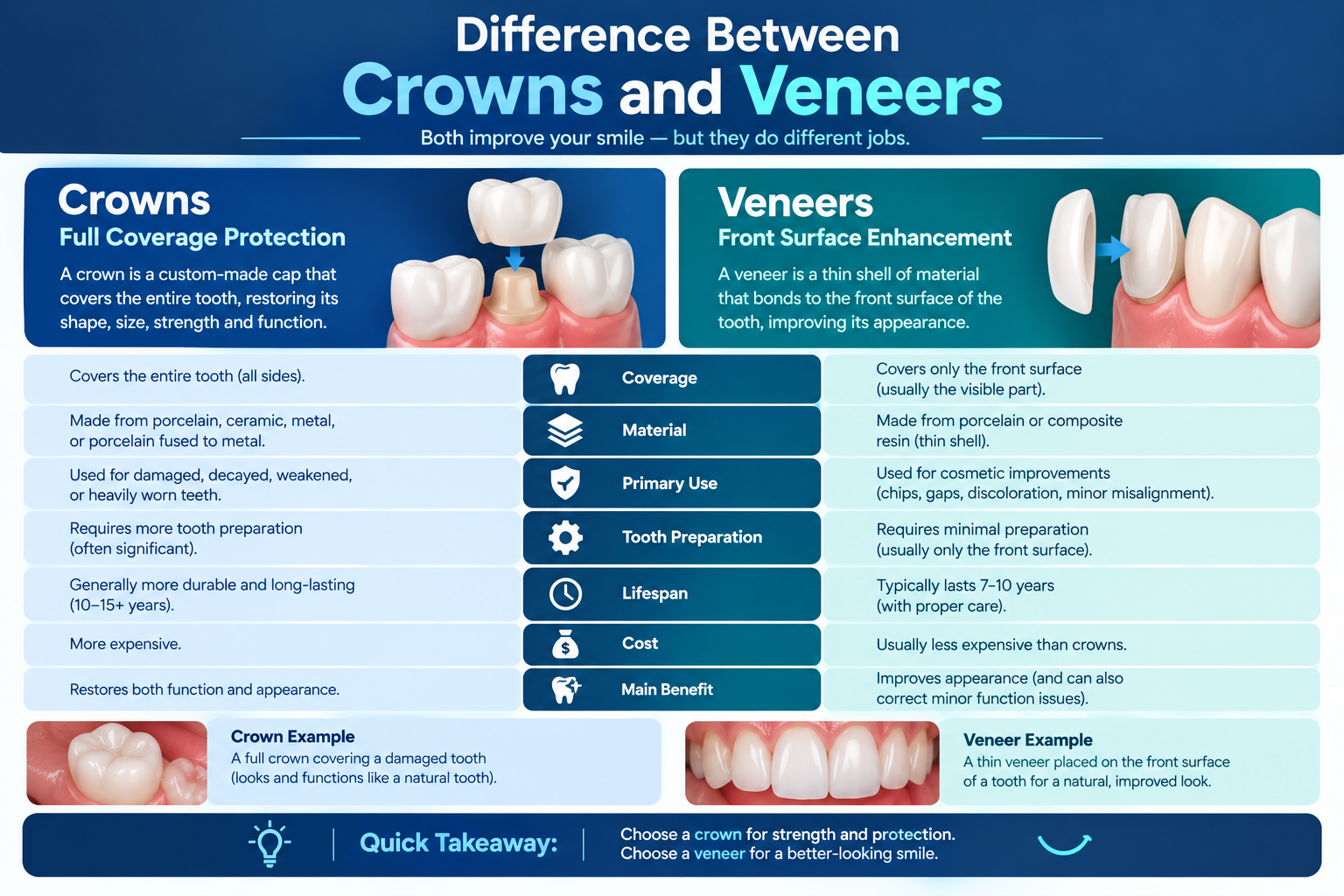
Crowns and veneers can both improve the appearance of teeth, but they are designed for different purposes. A dental crown covers the tooth extensively, while a veneer covers mainly the front surface. Crowns are commonly used when a tooth is damaged, weakened, heavily restored, or otherwise needs protection. Veneers are primarily used to change the appearance of teeth, such as their color, shape, or visible surface.
The important distinction is not simply which treatment looks better. It is how much of the tooth needs coverage and what problem the restoration is intended to address.
Quick Answer
A crown is a restoration that covers the tooth extensively and is commonly used to restore or protect a damaged or weakened tooth. A veneer is a thin covering bonded to the front surface of a tooth and is mainly used for cosmetic changes.
Both can improve appearance, but they are not interchangeable in every situation. The condition of the tooth, the amount of healthy structure remaining, and the treatment goal all matter.
Crowns vs Veneers at a Glance
| Feature | Dental Crown | Dental Veneer |
|---|---|---|
| Main purpose | Restore and protect a tooth | Improve appearance |
| Coverage | Covers the tooth extensively | Covers mainly the front surface |
| Common use | Damaged, weakened, broken, decayed, or heavily restored teeth | Discoloration, chips, shape concerns, and selected cosmetic issues |
| Tooth preparation | Usually more extensive | Usually more conservative |
| Main focus | Structure and function, with cosmetic benefits | Appearance, with limited functional protection |
| Common materials | Ceramic, zirconia, porcelain-fused-to-metal, metal and others | Porcelain/ceramic or composite resin |
| Reversibility | Generally not reversible once tooth structure is prepared | Traditional veneers are generally not reversible |
| Appropriate choice | Depends on tooth condition and clinical needs | Depends on tooth condition and cosmetic goals |
What Is a Dental Crown?
A dental crown is a tooth-shaped restoration that covers a tooth extensively. It is commonly used to restore teeth that are weakened, broken, decayed, worn, or otherwise unable to function reliably without additional protection.
Crowns can also be used with dental implants and in other restorative situations.
A crown may be considered when a tooth has:
- Significant decay
- A substantial crack or fracture
- Extensive previous dental work
- Major wear
- A large filling that leaves the remaining tooth structure vulnerable
- Been treated with a root canal
- Lost enough structure that a more limited restoration is unsuitable
Crowns can be made from several materials, including ceramic, porcelain-based materials, metal alloys, and zirconia.
The important point is that a crown is primarily a restorative treatment. Although it can dramatically improve the appearance of a tooth, its purpose can include protecting and restoring the tooth’s structure and function.
What Is a Dental Veneer?
A dental veneer is a thin covering bonded to the front surface of a tooth.
Veneers are mainly associated with cosmetic dentistry. They can change the visible appearance of teeth by modifying their:
- Color
- Shape
- Size
- Surface appearance
- Minor visible irregularities
Veneers may be made from porcelain or other ceramic materials, or from composite resin.
They can be used for selected cosmetic concerns such as discoloration, chips, small gaps, or misshapen teeth. However, a veneer is not simply a smaller version of a crown. Its limited coverage means it is designed for a different role.
For a veneer to be appropriate, the underlying tooth must generally have enough healthy structure to support the restoration.
What Is the Main Difference Between Crowns and Veneers?
The biggest difference is coverage.
A crown covers the tooth extensively, while a veneer covers mainly the visible front surface.
That difference affects nearly everything else:
- How much tooth structure is prepared
- What the restoration is designed to accomplish
- How much protection it provides
- What types of dental problems it can address
- Whether the tooth needs structural reinforcement or primarily cosmetic improvement
A simple way to remember the distinction is:
Crown = more extensive coverage for restoration and protection.
Veneer = front-surface coverage primarily for cosmetic improvement.
This does not mean every unattractive tooth needs a veneer or every damaged tooth automatically needs a crown. The actual condition of the tooth must be evaluated by a dentist.
Crown vs Veneer: Tooth Preparation
The amount of tooth preparation is another important difference.
A crown generally requires the tooth to be reshaped so the restoration can fit over it. Because the crown provides extensive coverage, preparation normally involves more of the tooth than preparation for a veneer.
A veneer is bonded to the front surface, so preparation can be more conservative in appropriate cases. However, traditional veneers still generally involve some removal of enamel, and the procedure is not automatically reversible.
The amount of preparation depends on factors such as the type of restoration, the material, the position of the tooth, the existing tooth structure, and the dentist’s technique.
Therefore, claims that every veneer requires exactly a particular amount of enamel removal should be avoided. Different veneer approaches do not all require identical preparation.
When Is a Crown Commonly Used?
A crown is generally considered when the tooth needs more extensive restoration or protection.
For example, a dentist may consider a crown for a tooth that is:
Severely damaged
If a tooth has lost substantial structure because of decay, fracture, wear, or previous dental work, a veneer may not provide enough coverage.
Weak after extensive dental treatment
Some teeth have relatively little remaining structure after large fillings or other procedures. A crown may be used to provide more complete protection.
Root-canal treated
A tooth that has undergone root canal treatment may require a restoration that provides substantial coverage, depending on the amount of remaining tooth structure and other clinical factors.
Broken or heavily worn
When significant tooth structure has been lost, restoring the shape and function of the tooth may require more than a front-surface cosmetic covering.
The exact treatment depends on the individual tooth. A crown should not be selected simply because it appears stronger.
When Are Veneers Commonly Used?
Veneers are generally considered when the main concern is the appearance of a tooth and the underlying tooth is suitable for this type of restoration.
Common cosmetic concerns include:
Discoloration
A veneer can mask certain types of discoloration that may not respond adequately to conventional whitening.
Minor chips
A veneer can alter the visible shape of a tooth when a relatively small cosmetic defect is present.
Shape concerns
Veneers can change the apparent shape or proportions of selected teeth.
Small visible gaps
In appropriate cases, veneers can help change the appearance of spaces between teeth.
Misshapen teeth
A veneer may be used to improve the visible contour of a tooth when sufficient healthy structure remains.
However, veneers are not a substitute for treating active decay or unhealthy gums. Oral health problems generally need to be addressed before cosmetic restoration is considered.
Crowns and Veneers in Real Situations
Example 1: A healthy front tooth is badly discolored
Suppose a front tooth is structurally healthy but has discoloration that the patient wants to conceal.
A veneer may be considered because the main objective is cosmetic improvement.
Example 2: A tooth has substantial decay
If a tooth has significant decay and has lost important structural support, the problem is no longer simply cosmetic.
A dentist may consider a crown or another restorative treatment depending on how much healthy structure remains.
Example 3: A front tooth has a small cosmetic chip
If the tooth remains structurally sound, a cosmetic restoration such as a veneer or bonding may be considered depending on the circumstances.
A crown would not automatically be necessary simply because a tooth has a chip.
Example 4: A tooth has extensive structural damage
If a tooth is badly weakened or extensively restored, a crown may provide the extensive coverage needed to restore and protect it.
The final choice depends on clinical examination rather than appearance alone.
Materials and Appearance
Both crowns and veneers can be made from tooth-colored materials, allowing dentists to match the restoration to surrounding teeth.
Common veneer materials
- Porcelain
- Ceramic
- Composite resin
Common crown materials
- Ceramic
- Zirconia
- Porcelain-fused-to-metal
- Metal alloys
- Resin in selected situations
Material selection affects appearance, strength, wear, cost, and other characteristics.
A front tooth may have different aesthetic requirements from a back tooth that experiences substantial chewing forces. The appropriate material therefore depends partly on where the restoration is being placed and what it needs to withstand.
Durability and Maintenance
Neither crowns nor veneers should be considered indestructible.
Their longevity depends on factors such as:
- Material
- Tooth location
- Bite forces
- Oral hygiene
- Dental habits
- Grinding or clenching
- Quality and fit of the restoration
- Regular dental care
Crowns are designed to provide extensive coverage and can protect compromised teeth, but they can still fracture, loosen, wear, or require replacement.
Veneers can also last for many years, particularly when properly maintained, but they can chip, crack, loosen, or require replacement.
Good oral hygiene and regular dental examinations remain important with either restoration.
Common Mistakes About Crowns and Veneers
Mistake 1: Assuming veneers and crowns are basically the same
They are not.
Both can improve appearance, but their coverage and primary purposes differ.
Mistake 2: Thinking a crown is only cosmetic
Crowns can improve appearance, but their major role is often restorative or protective.
Mistake 3: Assuming veneers are completely non-invasive
Traditional veneers generally require some preparation of the tooth, and once natural enamel has been removed, the treatment is generally not reversible.
Mistake 4: Choosing based only on appearance
A restoration must be appropriate for the condition of the tooth.
A visually attractive treatment is not necessarily an appropriate treatment for a structurally compromised tooth.
Mistake 5: Assuming a damaged tooth always needs a crown
Not every damaged tooth requires a crown. The extent and type of damage determine which treatment options are appropriate.
Mistake 6: Assuming the cheapest option is automatically the best option
Price is only one consideration. Material, tooth condition, expected function, preparation, maintenance, and clinical suitability also matter.
Common Terms and Phrases
Dental professionals may use terms such as:
Crown
- Dental crown
- Full-coverage restoration
- Tooth cap
Veneer
- Dental veneer
- Porcelain veneer
- Ceramic veneer
- Composite veneer
- Laminate veneer
The terminology can vary depending on the material and treatment technique.
Are Crowns and Veneers Interchangeable?
Usually not.
They can overlap in appearance-related goals, but they are designed for different levels of tooth coverage.
A veneer may be appropriate when a tooth is relatively healthy and the primary objective is to change its visible appearance.
A crown may be appropriate when a tooth needs more extensive restoration or protection because of structural damage or loss of tooth structure.
There can be gray areas. A tooth with both cosmetic and structural concerns may have several possible treatment options. The dentist has to determine which restoration can meet the functional and biological requirements of that particular tooth.
Can a Veneer Replace a Crown?
Not generally.
A veneer covers only the front surface, while a crown provides much more extensive coverage.
If a tooth needs substantial structural restoration, simply placing a veneer over the visible surface may not address the underlying problem.
If an existing crown needs replacement, a new crown or another appropriate restorative treatment may be considered rather than automatically replacing it with a veneer.
How to Remember the Difference
Use this simple rule:
Veneer = visible surface.
Crown = extensive coverage.
If the main issue is changing how a suitable tooth looks, think about the role of a veneer.
If the tooth has lost substantial structure and needs restoration or protection, think about the role of a crown.
This is a memory aid, not a substitute for a dental examination.
Which One Should I Use?
Instead of asking which treatment is universally better, start by identifying the dental problem that needs to be addressed.
For a generally healthy tooth where the main goal is cosmetic improvement, a veneer may be considered.
A significantly weakened, damaged, decayed, or structurally compromised tooth may require a crown or another restorative treatment.
When the concern is primarily cosmetic but underlying disease or structural damage is present, the dental problem should be evaluated before choosing a cosmetic restoration.
Anyone who is unsure about the appropriate option should ask a dentist to examine the tooth and explain the available alternatives.
The condition of the tooth is more important than choosing a treatment based solely on the name of the procedure.
Crown or Veneer? Practice Examples
Choose the restoration that best matches the situation based only on the information given.
1. A healthy front tooth has significant cosmetic discoloration.
Answer: Veneer may be considered.
The main concern is appearance rather than major structural damage.
2. A tooth has substantial decay and has lost a large amount of structure.
Answer: Crown may be considered.
The situation involves structural restoration, not simply cosmetic improvement.
3. A healthy tooth has a minor visible shape problem.
Answer: Veneer may be considered.
A cosmetic restoration may address the appearance when the tooth is otherwise suitable.
4. A tooth is badly broken and requires extensive restoration.
Answer: Crown may be considered.
More extensive coverage may be necessary to restore and protect the remaining tooth.
5. A person wants a cosmetic change but has untreated decay.
Answer: Treat the dental problem first.
A cosmetic restoration should not be viewed as a replacement for necessary treatment of active dental disease.
Frequently Asked Questions
What is the main difference between crowns and veneers?
A crown provides extensive coverage around a tooth and is commonly used for restoration and protection. A veneer is a thin covering bonded mainly to the front surface and is primarily used for cosmetic improvement.
Are crowns stronger than veneers?
Crowns are designed for more extensive coverage and structural restoration, while veneers are primarily designed for the visible front surface. However, strength depends on the material, design, tooth location, bite, and other factors.
Do crowns and veneers both change the appearance of teeth?
Yes. Both can improve the appearance of teeth, although appearance is usually a secondary benefit of a crown and a primary goal of a veneer.
Do crowns require more tooth preparation than veneers?
Generally, crown preparation is more extensive because the crown needs to fit over the tooth. Veneer preparation is usually more limited, although the exact amount varies by case and technique.
Are veneers reversible?
Traditional veneers generally are not considered reversible because some natural tooth structure may be removed during preparation.
Can veneers cover a damaged tooth?
They can be appropriate for certain minor cosmetic defects, but they are not a general substitute for treatment of a significantly weakened or damaged tooth.
Can crowns be used on front teeth?
Yes. Crowns can be used on front teeth when clinically appropriate. Modern tooth-colored crown materials can also provide an aesthetic result.
Which lasts longer, crowns or veneers?
There is no single lifespan that applies to every crown or veneer. Longevity varies with material, oral hygiene, bite forces, habits, tooth location, and other clinical factors.
Are crowns and veneers covered by dental insurance?
Coverage depends on the insurance plan and whether the procedure is considered medically necessary or cosmetic. Patients should check their specific plan rather than assuming either treatment is covered.
Conclusion
The difference between crowns and veneers mainly comes down to coverage and purpose. A veneer covers the front surface of a suitable tooth and is primarily used to improve appearance. A crown provides much more extensive coverage and is commonly used to restore or protect a tooth that has significant structural problems.
A simple rule is to think veneer for selected cosmetic concerns and crown for more extensive restorative needs. However, the same dental problem can sometimes have multiple treatment options, so the condition of the tooth and the dentist’s clinical assessment should guide the final decision.