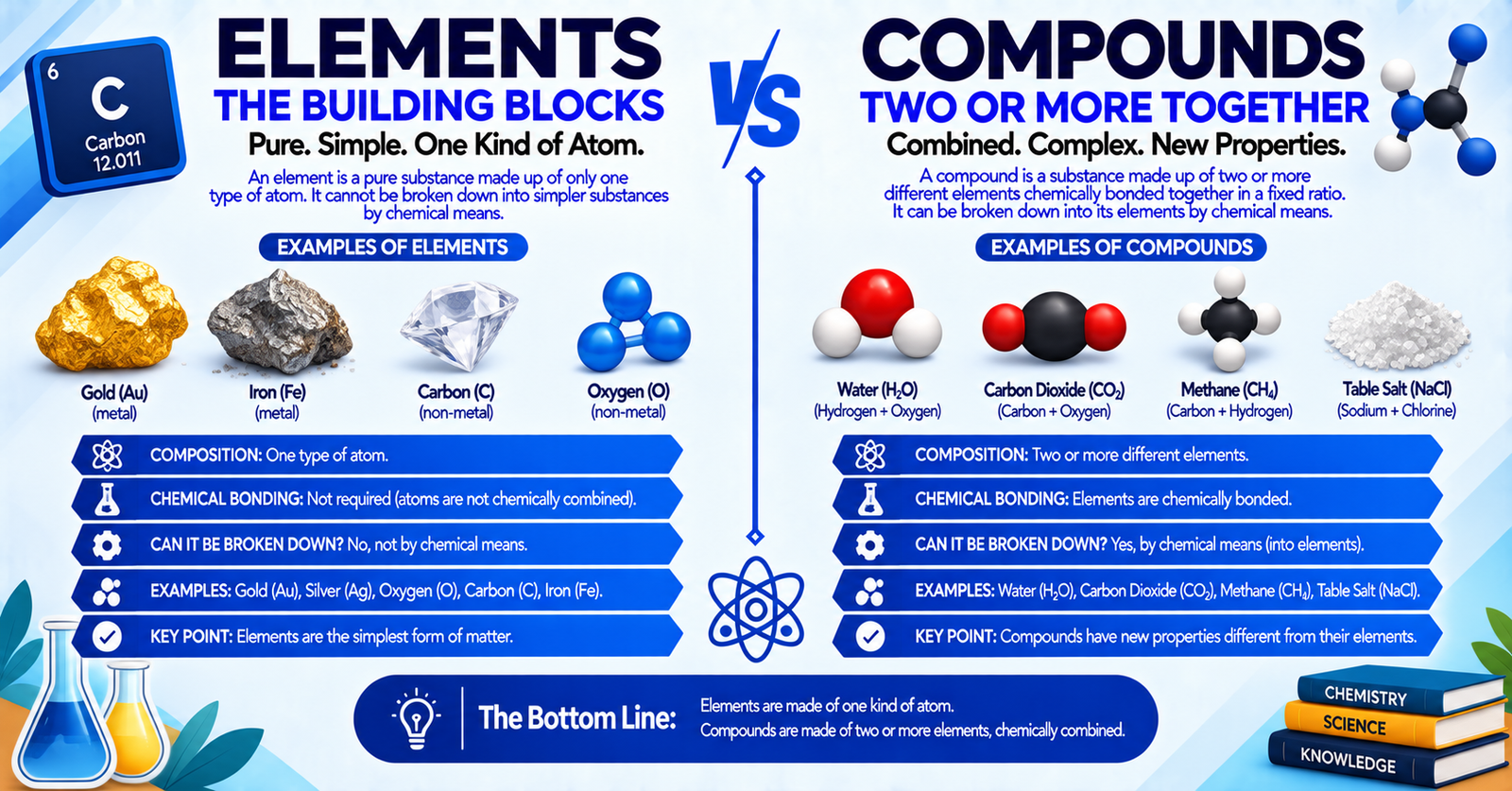
Elements and compounds are both fundamental types of matter, but they are not the same thing. The confusion often comes from the fact that an element can exist as individual atoms or as molecules such as O₂, while a compound contains atoms from two or more different elements.
The easiest way to understand the distinction is to look at what types of atoms are present and whether different elements are chemically combined. An element contains only one type of atom. A compound contains two or more different elements chemically combined in a definite composition.
Once you understand that difference, examples such as oxygen, iron, water, carbon dioxide, and sodium chloride become much easier to classify.
Quick Answer
An element is a pure substance consisting of only one type of atom, while a compound is a pure substance made from two or more different elements chemically combined.
For example, oxygen (O₂) is an element because both atoms are oxygen atoms. Water (H₂O) is a compound because it contains hydrogen and oxygen chemically combined in a fixed composition.
Elements vs. Compounds at a Glance
| Feature | Element | Compound |
|---|---|---|
| Basic composition | One type of atom | Two or more different elements |
| Chemical combination | Not applicable | Elements are chemically combined |
| Representation | Chemical symbol or formula | Chemical formula |
| Composition | One kind of atom | Definite composition |
| Chemical decomposition | Cannot be broken down into simpler substances by chemical change | Can be decomposed chemically |
| Examples | Fe, Au, O₂, H₂ | H₂O, CO₂, NaCl |
| Periodic table | Listed as an element | Not listed as a separate element |
The classification of elements and compounds as pure substances is a basic part of chemistry.
What Is an Element?
An element is a pure chemical substance associated with one type of atom. In modern chemical terminology, an element is defined by the number of protons in its atoms. IUPAC defines a chemical element as a species of atoms with the same number of protons in the nucleus.
Examples include:
- Hydrogen (H)
- Oxygen (O)
- Carbon (C)
- Iron (Fe)
- Gold (Au)
- Helium (He)
An important point is that an element does not necessarily have to exist as individual atoms.
Some elements naturally occur as molecules containing identical atoms. For example:
- O₂ contains two oxygen atoms.
- H₂ contains two hydrogen atoms.
- N₂ contains two nitrogen atoms.
These are still elements because there is only one type of atom present.
Can an Element Have More Than One Atom?
Yes.
This is one of the most common sources of confusion.
O₂ contains two atoms, but both are oxygen. Therefore, O₂ is an element, not a compound.
The number of atoms is not the deciding factor. The types of atoms present are what matter.
What Is a Compound?
A compound is a pure substance formed when atoms of two or more different elements are chemically combined.
For example, water is represented by H₂O. It contains hydrogen and oxygen, so it is a compound.
Other examples include:
- CO₂ — carbon dioxide
- NaCl — sodium chloride
- NH₃ — ammonia
- CH₄ — methane
- C₆H₁₂O₆ — glucose
Compounds have a definite composition. For example, water has hydrogen and oxygen in a consistent chemical composition represented by H₂O. OpenStax describes compounds as pure substances that can be broken down through chemical changes.
What Is the Difference Between Elements and Compounds?
The central difference is composition.
An element contains only one type of atom. A compound contains different elements that are chemically combined.
Consider these examples:
O₂
- Contains oxygen atoms only
- One type of element
- Therefore, it is an element
H₂O
- Contains hydrogen and oxygen
- Two different elements
- The atoms are chemically combined
- Therefore, it is a compound
CO₂
- Contains carbon and oxygen
- Two different elements
- Chemically combined
- Therefore, it is a compound
The distinction can therefore be reduced to a simple question:
How many different types of atoms are present?
One type → element
Two or more different types chemically combined → compound
This matches standard chemistry classifications used in introductory chemistry.
Why Is O₂ an Element and Not a Compound?
O₂ is one of the most important examples to understand.
The formula O₂ means that one oxygen molecule contains two oxygen atoms.
It does not mean that two different elements are present.
Both atoms are oxygen:
O + O → O₂
Because there is only one type of atom, O₂ is an elemental substance.
By comparison:
H + H + O → H₂O
H₂O contains two different elements, hydrogen and oxygen, so it is a compound.
This distinction between molecular elements and compounds is specifically recognized in introductory chemistry.
Why Is H₂O a Compound?
Water is a compound because it contains atoms from two different elements:
- Hydrogen
- Oxygen
The chemical formula H₂O indicates the composition of the substance.
The important point is not simply that water contains three atoms in its formula. Instead, it contains two different types of atoms that are chemically combined.
Water also demonstrates why compounds cannot simply be understood as mixtures of their ingredients. A compound is a chemically distinct substance with its own properties.
How to Identify an Element or Compound
When you are given a chemical symbol or formula, use this simple process.
Step 1: Look at the chemical symbols
If only one type of element appears, it may represent an element.
Examples:
- Fe → iron
- Au → gold
- O₂ → oxygen
- N₂ → nitrogen
If different element symbols appear together, you are looking at a compound.
Examples:
- H₂O → hydrogen + oxygen
- CO₂ → carbon + oxygen
- NaCl → sodium + chlorine
Step 2: Check whether different elements are chemically combined
The presence of different elements in a chemically combined substance indicates a compound.
Step 3: Remember that subscripts do not automatically mean “compound”
This is important.
O₂ has a subscript 2, but it is still an element.
H₂O has different element symbols, so it is a compound.
Therefore, don’t simply count the number of atoms. Identify the different types of atoms.
Common Examples of Elements
| Element | Symbol/Form | Why It Is an Element |
|---|---|---|
| Iron | Fe | Only iron atoms |
| Gold | Au | Only gold atoms |
| Carbon | C | Only carbon atoms |
| Oxygen | O₂ | Only oxygen atoms |
| Hydrogen | H₂ | Only hydrogen atoms |
| Nitrogen | N₂ | Only nitrogen atoms |
| Helium | He | Only helium atoms |
Elements are represented on the periodic table, while compounds are formed from combinations of elements.
Common Examples of Compounds
| Compound | Formula | Elements Present |
|---|---|---|
| Water | H₂O | Hydrogen + oxygen |
| Carbon dioxide | CO₂ | Carbon + oxygen |
| Sodium chloride | NaCl | Sodium + chlorine |
| Ammonia | NH₃ | Nitrogen + hydrogen |
| Methane | CH₄ | Carbon + hydrogen |
| Glucose | C₆H₁₂O₆ | Carbon + hydrogen + oxygen |
A compound can contain two, three, or more different elements. It is not limited to compounds containing exactly two elements.
Common Mistakes With Elements and Compounds
Mistake 1: Thinking O₂ is a compound
Incorrect:
O₂ is a compound because it has two atoms.
Correct:
O₂ is an element because both atoms are oxygen.
Why:
A compound requires different elements to be chemically combined.
Mistake 2: Thinking H₂O is an element
Incorrect:
Water is an element because it is a single pure substance.
Correct:
Water is a compound.
Why:
H₂O contains hydrogen and oxygen chemically combined.
Mistake 3: Assuming every molecule is a compound
Incorrect:
Every molecule is a compound.
Correct:
Some molecules are made from atoms of the same element.
Why:
O₂ is a molecule, but it is an element. H₂O is a molecule and a compound.
Mistake 4: Confusing compounds with mixtures
Incorrect:
A mixture and a compound are the same because both can contain multiple substances.
Correct:
A compound contains elements chemically combined in a definite composition. A mixture contains substances physically combined and can have variable composition.
The element/compound/mixture distinction is a standard classification framework in chemistry.
Elements vs. Compounds vs. Mixtures
A third category is important because it is often confused with compounds.
| Feature | Element | Compound | Mixture |
|---|---|---|---|
| Number of substances/components | One type of element | Two or more elements chemically combined | Two or more substances |
| Chemical bonding between components | Not applicable | Yes | No new chemical combination required |
| Composition | Fixed | Fixed | Can vary |
| Separation | Cannot be chemically decomposed into simpler substances | Can be separated by chemical changes | Components can often be separated physically |
| Example | O₂ | H₂O | Air |
For example, water is a compound, while air is a mixture. A compound has a definite composition, whereas mixtures can contain their components in varying amounts.
Can Elements and Compounds Be Broken Down?
An element cannot be broken down into simpler substances through ordinary chemical changes.
A compound can be decomposed chemically into simpler substances, including its constituent elements.
This is one of the fundamental ways chemistry distinguishes the two categories.
For example, water can undergo chemical decomposition to produce hydrogen and oxygen. The exact method is a chemical process rather than a simple physical separation.
Can Elements and Compounds Be Used Interchangeably?
No.
Element and compound describe different categories of pure substances.
For example:
- Oxygen is an element.
- Water is a compound.
- Iron is an element.
- Iron oxide is a compound.
However, an element can participate in the formation of many different compounds.
Carbon, for example, is an element, but it can chemically combine with other elements to form numerous compounds.
How to Remember the Difference
Use this simple rule:
Element = one type of atom.
Compound = different elements chemically combined.
Then remember the two classic examples:
O₂ → element
Both atoms are oxygen.
H₂O → compound
Hydrogen and oxygen are both present.
The easiest mental test is:
“Are all the atoms the same type?”
- Yes → element
- No, and they are chemically combined → compound
Which One Should I Use? Classification Guide
Use this quick decision process:
If there is only one type of atom → Element
Example: O₂
If there are different types of atoms chemically combined → Compound
Example: H₂O
If different substances are physically combined and their proportions can vary → Mixture
Example: Air
This three-way distinction is more useful than memorizing isolated examples.
X or Y? Practice Examples
Classify each substance as an element or compound.
- O₂
- H₂O
- Fe
- CO₂
- Au
- NaCl
- N₂
- CH₄
- C
- NH₃
Answers
- O₂ — Element
- H₂O — Compound
- Fe — Element
- CO₂ — Compound
- Au — Element
- NaCl — Compound
- N₂ — Element
- CH₄ — Compound
- C — Element
- NH₃ — Compound
The key is to identify the different element types rather than simply counting atoms.
Frequently Asked Questions
What is the main difference between an element and a compound?
An element contains only one type of atom. A compound contains two or more different elements chemically combined in a definite composition.
Is O₂ an element or a compound?
O₂ is an element. Although it contains two oxygen atoms, both atoms are the same type.
Is H₂O an element or a compound?
H₂O is a compound because it contains hydrogen and oxygen chemically combined.
Is CO₂ an element or a compound?
CO₂ is a compound because it contains carbon and oxygen.
Can an element contain molecules?
Yes. Some elements exist as molecules made of identical atoms. O₂ and H₂ are common examples.
Are elements and compounds both pure substances?
Yes. Both can be classified as pure substances. A pure substance has a constant composition; it can be an element or a compound.
Are all compounds made from exactly two elements?
No. Compounds can contain two or more different elements. Water contains two elements, while glucose contains carbon, hydrogen, and oxygen.
What is the difference between a compound and a mixture?
A compound contains different elements chemically combined with a definite composition. A mixture contains two or more substances that are physically combined and can have variable composition.
Conclusion
The difference between elements and compounds comes down to what kinds of atoms make up the substance. An element contains only one type of atom, even when those atoms form molecules such as O₂. A compound contains two or more different elements that are chemically combined, such as H₂O or CO₂.
The practical rule is simple: one type of atom means element; different elements chemically combined mean compound. Once you remember that rule, examples such as oxygen, iron, water, and carbon dioxide become much easier to classify.