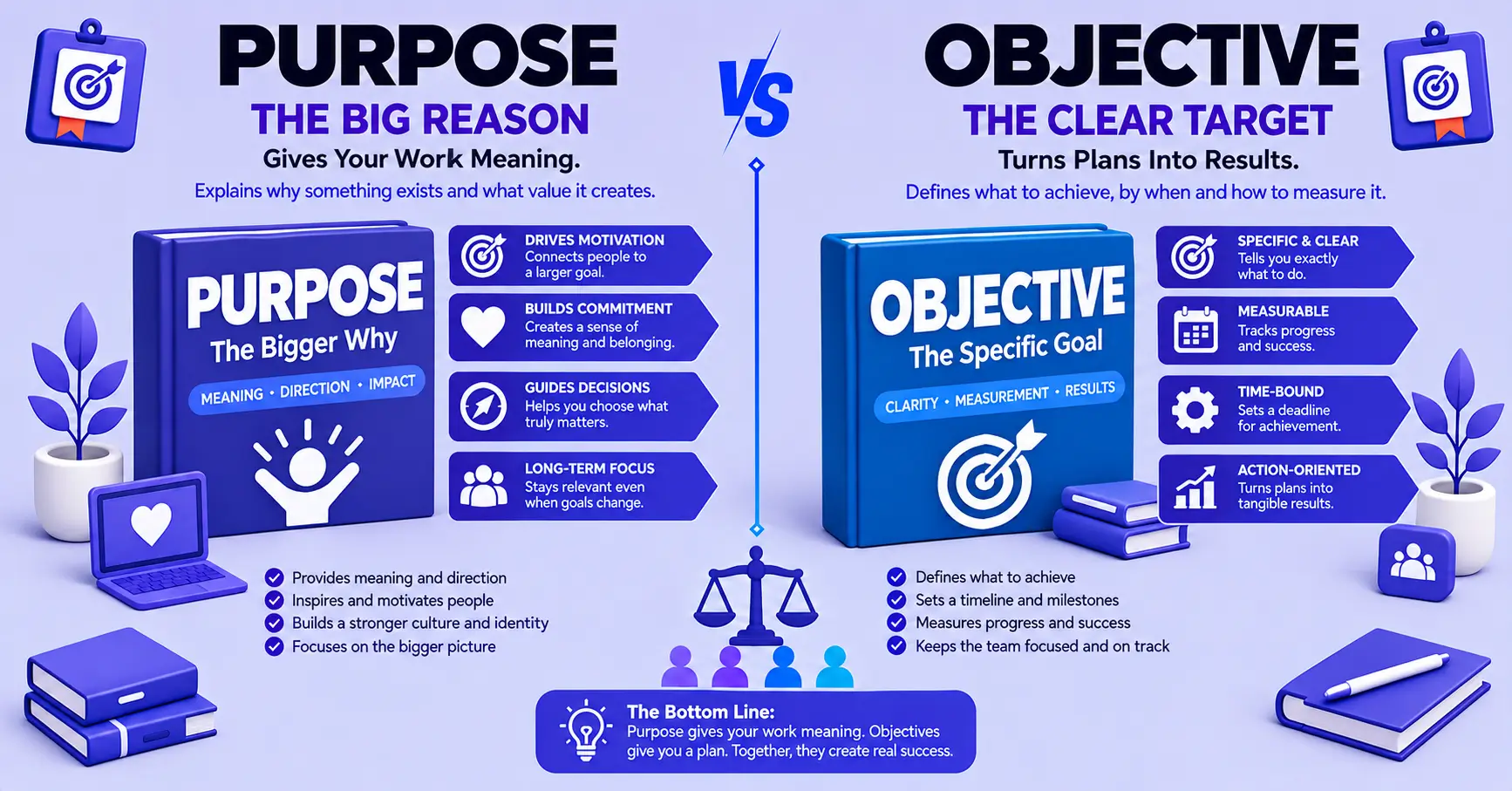
Purpose and objective are closely related because both describe what an action, project, or plan is intended to accomplish. However, they usually operate at different levels. Purpose explains the reason or broader intention behind something, while an objective is a specific result or target you intend to achieve.
The distinction becomes especially useful in business, education, research, project planning, and goal setting. In those contexts, a broad purpose can guide the work while specific objectives define the results that need to be achieved.
Quick Answer
Purpose is the reason, intention, or broader point behind something.
Objective is a specific result, target, or outcome that someone intends to achieve.
For example:
Purpose: To improve customer satisfaction.
Objective: Increase the customer satisfaction score from 80% to 90% by December.
So, the simplest distinction is:
Purpose explains why; an objective explains what specific result is intended.
However, this is a useful practical distinction rather than an absolute dictionary rule. In ordinary English, purpose can sometimes mean an aim or objective itself.
Purpose vs Objective at a Glance
| Purpose | Objective | |
|---|---|---|
| Basic meaning | Reason or intention | Specific result or target |
| Main question | Why? | What should be achieved? |
| Scope | Usually broader | Usually narrower |
| Specificity | Often general | Usually specific |
| Measurement | May be difficult to measure directly | Often measurable |
| Function | Provides direction | Defines an intended outcome |
| Typical use | Explaining why something exists or is done | Defining what needs to be achieved |
| Example | Improve public health | Reduce hospital readmissions by 10% |
In structured planning, objectives are often used to translate a broader purpose into concrete outcomes. Educational and organizational sources make a similar distinction between general intention and specific intended results.
What Does Purpose Mean?
Purpose is the reason something exists, happens, or is done. It can also refer to an intention or the desired point behind an action.
For example:
The purpose of this meeting is to discuss the new marketing strategy.
Here, purpose explains why the meeting is being held.
Other examples include:
The purpose of the training is to improve employee skills.
The purpose of this tool is to make data analysis easier.
What is the purpose of this exercise?
Purpose is often broader than a specific target. It gives an activity, project, organization, or decision its underlying direction.
Common collocations with purpose
- purpose of the project
- purpose of the meeting
- purpose of the study
- purpose of the research
- main purpose
- primary purpose
- intended purpose
- specific purpose
- common purpose
- serve a purpose
What Does Objective Mean?
As a noun, objective commonly means a specific result, target, or outcome that someone intends to achieve.
For example:
Our main objective is to increase sales by 15%.
The objective identifies the result the organization wants to achieve.
Other examples include:
The team’s objective is to complete the project by Friday.
One objective of the study is to identify the main causes of customer dissatisfaction.
The campaign has three main objectives.
In structured planning, objectives are often written so that progress toward them can be evaluated. Research guidance, for example, commonly describes objectives as specific outcomes that support a broader aim or purpose.
Common collocations with objective
- main objective
- primary objective
- specific objective
- project objective
- research objective
- business objective
- learning objective
- achieve an objective
- meet an objective
- define an objective
- set an objective
- measurable objective
What Is the Difference Between Purpose and Objective?
The central difference is level and function.
Purpose describes the broader reason or intention.
Objective describes a particular result that is intended to be achieved.
Consider a company that wants to improve customer service.
Purpose: To provide a better experience for customers.
Objective: Reduce average customer-response time to less than two hours within six months.
The purpose explains the reason and direction.
The objective provides a specific target.
Another way to think about it
Purpose = the broader “why.”
Objective = the specific “what.”
This distinction is particularly useful when planning a project. A purpose can remain relatively broad while several objectives define the concrete results that contribute toward it.
Are Purpose and Objective Always Different?
No.
This is an important point that many simplified explanations overlook.
In ordinary English, purpose can mean an aim, intention, or objective. Likewise, objective can sometimes be used broadly to refer to an intended aim or goal. Therefore, the words can overlap depending on context.
The distinction becomes clearer when they are deliberately separated in a planning framework.
For example:
The purpose of the program is to improve literacy.
Its objectives are to increase reading proficiency by 15%, provide weekly tutoring, and assess student progress each month.
Here, the terms have distinct jobs.
When to Use Purpose
Use purpose when you are explaining why something exists or why an action is being taken.
Use it for:
- the reason behind an activity
- the function of something
- the broader intention of a project
- the reason for a meeting
- the underlying intention of research
- an organization’s broader direction
Examples
The purpose of the meeting is to review the annual budget.
The purpose of the device is to measure air quality.
The purpose of the study is to examine how sleep affects memory.
A useful test is:
Am I explaining why this exists or is being done?
If yes, purpose is usually the better choice.
When to Use Objective
Use objective when you are referring to a particular result or target that someone intends to achieve.
It works especially well in:
- project planning
- business strategy
- education
- research
- performance management
- marketing
- organizational planning
Examples
Our objective is to finish the project by June.
The team’s objective is to reduce production costs by 8%.
One research objective is to identify the factors affecting employee retention.
A useful test is:
Am I describing a specific result that needs to be achieved?
If yes, objective is often the better choice.
Purpose and Objective in Real-World Contexts
Business
A company might have:
Purpose: To make affordable healthcare more accessible.
Its objectives might include:
Launch two new clinics this year.
Reduce average appointment waiting time by 20%.
Increase access in underserved areas.
The purpose establishes the broader direction; the objectives describe concrete targets.
Project Management
For a website redesign:
Purpose: To create a better online experience for customers.
Possible objectives:
- Reduce page-load time by 30%.
- Increase mobile conversion rates by 10%.
- Complete the redesign by September.
The purpose explains the reason for the project, while the objectives help define what successful completion looks like.
Research
In research, a broad purpose or aim can be followed by several specific objectives. Research guidance commonly treats the purpose/aim as the overall direction and objectives as specific outcomes or activities that support it.
For example:
Purpose: To investigate the effects of remote work on employee productivity.
Possible objectives:
- Measure productivity levels among remote employees.
- Compare productivity before and after remote work.
- Identify factors associated with higher productivity.
Meetings
For a meeting:
Purpose: To discuss the company’s new hiring strategy.
Possible objectives:
- Review current staffing requirements.
- Approve three new positions.
- Assign recruitment responsibilities.
A meeting can therefore have one broad purpose and several specific objectives. A practical meeting-planning source makes the same distinction between the general reason for a meeting and its desired outcomes.
Purpose vs Goal vs Aim vs Objective
These four words overlap, which is one reason the distinction can become confusing.
| Term | Typical role |
|---|---|
| Purpose | The reason or broader intention |
| Aim | The broad result or direction someone wants to achieve |
| Goal | A desired result |
| Objective | A specific target or intended result |
There is no universal hierarchy that every organization or discipline follows.
For example, some educational and research contexts use aim and purpose almost interchangeably, then use objectives for more specific outcomes. Other organizations may use goal and objective differently.
So, always consider the terminology used by your particular institution, organization, or field.
Common Mistakes With Purpose and Objective
Mistake 1: Treating purpose and objective as exact synonyms
Less precise:
The purpose of the project is to increase sales by 20% by December.
This sentence is grammatically correct. However, if you’re deliberately separating the broader purpose from measurable targets, the statement would be clearer as:
Better distinction:
The purpose of the project is to improve business performance.
The objective is to increase sales by 20% by December.
Mistake 2: Assuming every objective must be short-term
An objective is often specific and measurable, but short-term is not an essential part of the word’s meaning.
For example:
The organization’s objective is to eliminate the problem within five years.
The objective has a long timeframe but remains a specific intended result.
Mistake 3: Assuming every purpose must be long-term
Purpose can describe an immediate reason:
The purpose of this meeting is to approve the budget.
The meeting may last only an hour, so purpose does not inherently mean “long-term.”
Mistake 4: Confusing objective with the adjective “objective”
Objective has other meanings as an adjective.
She tried to remain objective when evaluating the evidence.
Here, objective means unbiased or based on facts, not a target.
As a noun:
Our objective is to reduce costs.
Here, it means a target or intended result.
Can Purpose and Objective Be Used Interchangeably?
Sometimes, but not always.
In ordinary English, they can overlap because purpose may mean an aim or intended end, while objective can refer broadly to an intended goal.
However, they are not interchangeable when a planning framework deliberately assigns them different roles.
For example:
The purpose is to improve employee well-being.
The objective is to reduce workplace injuries by 15%.
Replacing objective with purpose would weaken the intended distinction between the broader reason and the measurable target.
How to Remember the Difference
Use this simple rule:
Purpose = Why
Objective = What result
Imagine planning a trip.
Purpose: Why are you taking the trip?
To visit family.
Objective: What specific result do you want to achieve?
Arrive in Chicago by Friday evening.
The purpose gives the journey its reason. The objective gives you a concrete target.
Which One Should I Use?
Use this quick decision guide:
Choose purpose when you mean the reason something is done.
The purpose of the meeting is to discuss the budget.
Use objective when you mean a specific result that needs to be achieved.
Our objective is to approve the budget today.
For a broader intention or reason behind an action, purpose is usually the better choice.
When referring to a defined target or measurable result, objective is generally more appropriate.
Organizations and academic institutions may use these terms differently. Follow the terminology used by your specific organization or institution when it has its own definitions.
Purpose or Objective? Practice Examples
Choose purpose or objective.
- The ______ of the campaign is to raise awareness about recycling.
- Our main ______ is to increase website traffic by 25%.
- What is the ______ of this device?
- One ______ of the research is to compare the two treatments.
- The ______ of the meeting is to discuss the new policy.
- The team’s ______ is to complete the project by Friday.
- The ______ of the program is to improve access to education.
- One of our key ______ is to reduce customer complaints by 10%.
Answers
- purpose
- objective
- purpose
- objective
- purpose
- objective
- purpose
- objective
The pattern is straightforward: the broader reason is the purpose, while the specific intended result is the objective.
Frequently Asked Questions
What is the main difference between purpose and objective?
Purpose usually explains the reason or broader intention behind something, while an objective identifies a specific result or target that someone wants to achieve.
Is purpose the same as an objective?
Not always. The words can overlap in ordinary English, but structured planning often distinguishes purpose as the broader reason and objectives as specific intended outcomes.
Is purpose “why” and objective “what”?
That is a useful practical shortcut:
Purpose = why. Objective = what result.
It is not a complete dictionary rule, but it works well when distinguishing the terms in planning and goal-setting contexts.
Can a project have multiple objectives?
Yes. A project can have one broad purpose and several objectives that contribute to achieving that purpose. Organizational and educational planning commonly uses objectives in this way.
Is an objective always measurable?
Not necessarily in every use of the word. However, in structured planning, objectives are often written so that their achievement can be evaluated or measured.
Is an objective always short-term?
No. An objective can have a short, medium, or long timeframe. Specificity of the intended result is more important than duration.
What is the difference between a purpose and a goal?
A purpose generally explains why something is done or exists. A goal is a desired result. Depending on the field, goal, aim, and purpose may overlap considerably.
What is the difference between purpose and objective in research?
A research purpose states the study’s broad intention, while research objectives identify specific things the study intends to investigate, accomplish, or measure.
Conclusion
The clearest practical difference between purpose and objective is that purpose explains the broader reason or intention, while an objective identifies a specific result or target. Purpose answers the broader question of why, whereas an objective usually describes what needs to be achieved