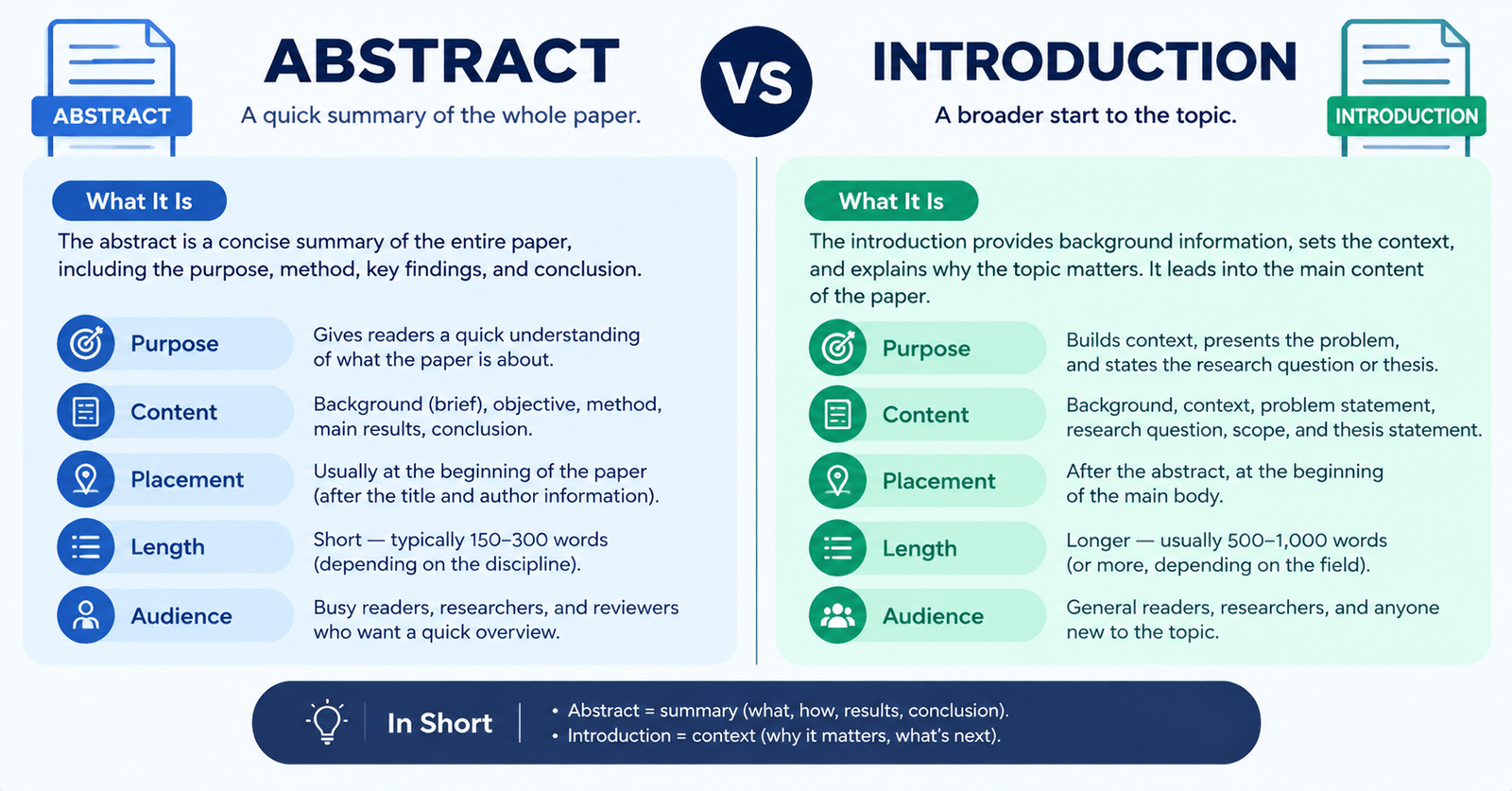

An abstract and an introduction both appear near the beginning of a research paper, so it is easy to assume they do roughly the same job. They do not. The abstract summarizes the entire study, including its main purpose, methods, findings, and conclusions, while the introduction builds the background and explains the research problem, rationale, and objectives.
The simplest way to remember the distinction is this: the abstract helps a reader quickly understand what the study did and found, while the introduction helps a reader understand why the study was needed and what question it addresses.
Quick Answer
The main difference between an abstract and an introduction is their purpose.
An abstract is a concise, self-contained summary of the entire research paper. It may briefly cover the research problem, purpose, methods, main findings, conclusions, and implications.
An introduction is the opening section of the main paper. It provides background and context, explains the research problem or gap, establishes why the topic matters, and leads the reader toward the research question or objectives.
In simple terms:
Abstract = What the study is about, what was done, and what was found.
Introduction = Why the study was needed and what it aims to investigate.
Abstract vs Introduction at a Glance
| Feature | Abstract | Introduction |
|---|---|---|
| Main purpose | Summarizes the whole study | Establishes the study’s background and rationale |
| Main question | What did the study do and find? | Why is this study needed? |
| Location | Usually before the main text | Beginning of the main text |
| Length | Short and concise | Usually much longer |
| Background | Brief | More detailed |
| Research purpose | Briefly stated | Developed and explained |
| Methods | Usually summarized | Usually limited or briefly mentioned |
| Results | Main findings may be summarized | Normally not presented as findings |
| Conclusion | May include the main conclusion | Usually does not give the study’s final conclusion |
| Citations | Often limited or absent, depending on style | Commonly used to establish context and prior research |
| Standalone? | Yes, it should make sense independently | No, it leads into the rest of the paper |
The exact requirements vary by discipline and publication or assignment guidelines. For example, Purdue notes that abstracts differ by field, although their general purpose remains to summarize the work concisely.
What Is an Abstract?
An abstract is a short summary of an academic paper, research study, thesis, dissertation, or similar scholarly work.
Its purpose is to give readers enough information to understand the study without immediately reading the entire paper. Purdue describes abstracts as brief summaries that help readers decide whether the article is relevant to their work.
A research abstract commonly includes:
- the research problem or topic
- the purpose or research question
- the methods or approach
- important findings or results
- the main conclusion
- implications or significance, where appropriate
A common scientific structure is based on Introduction, Methods, Results, and Discussion (IMRAD), condensed into a much shorter form.
Example
Imagine a study investigating whether a new teaching method improves vocabulary retention.
An abstract might briefly tell the reader:
The study examined whether spaced vocabulary practice improved retention among university students. Students completed a series of vocabulary tests over several weeks. The group using spaced practice showed greater retention than the comparison group. The findings suggest that repeated practice at spaced intervals may improve vocabulary learning.
Notice that this gives the reader an overview of the whole study, including the result.
What Is an Introduction?
An introduction is the opening section of the main body of a research paper.
Its purpose is to establish the context for the research and explain why the study deserves attention.
An introduction may:
- introduce the broader topic
- explain relevant background
- summarize important previous research
- identify a research problem or gap
- explain why the problem matters
- establish the study’s purpose
- present research questions or hypotheses
- introduce the objectives or scope of the study
- sometimes preview the structure of the paper
The introduction therefore moves from a broader context toward the specific problem the research addresses. Current academic-writing guidance similarly distinguishes the introduction from the abstract by emphasizing background, context, rationale, and the research question.
Example
For the vocabulary-learning study above, the introduction might explain:
Vocabulary retention is a persistent challenge for language learners. Previous studies have examined repetition as a way to strengthen memory, but questions remain about how the timing of repeated practice affects long-term retention among university students. This study therefore examines whether spaced vocabulary practice improves retention compared with more concentrated practice.
This does not summarize the study’s final findings. Instead, it explains why the research question matters.
What Is the Difference Between an Abstract and an Introduction?
The central difference is summary versus setup.
The abstract compresses the major elements of the entire study into a short, self-contained summary.
The introduction develops the information a reader needs to understand the problem behind the study.
Think of them this way:
Abstract:
“Here is the whole study in miniature.”
Introduction:
“Here is the background and reasoning that leads us to this study.”
This difference affects what information belongs in each section.
Results
The abstract can summarize the study’s major findings.
The introduction normally does not present the study’s findings as though the research has already been completed and interpreted.
Methods
The abstract may briefly identify the methods used.
The introduction normally provides only enough methodological information to establish the research context; detailed methods belong in the methods section.
Background
The abstract gives only enough background to orient the reader.
The introduction can develop the background much more fully.
Conclusion
An abstract can report the main conclusion.
The introduction generally leads into the study rather than giving its final conclusion.
These distinctions are consistent with academic-writing guidance from Purdue, Elsevier, and other current research-writing resources.
What Goes in an Abstract?
A useful abstract usually answers several questions quickly:
- What is the study about?
- Why does the study matter?
- What did the researchers do?
- What did they find?
- What do the findings mean?
Not every discipline uses exactly the same structure, but the abstract should remain concise and self-contained. Purdue’s current guidance describes approximately 150–200 words as a common range while emphasizing that requirements vary by field.
Abstract checklist
Before submitting an abstract, ask:
- Does it identify the research topic?
- Does it state the purpose or question?
- Does it briefly describe the approach?
- Does it report the important findings?
- Does it communicate the main conclusion?
- Can a reader understand it without reading the paper?
What Goes in an Introduction?
An introduction generally answers a different set of questions:
- What is the broader topic?
- What is already known?
- What problem or gap exists?
- Why does the problem matter?
- What question does this study address?
- What does the study aim to accomplish?
The introduction can therefore contain substantially more explanation and supporting evidence than the abstract.
In research writing, previous scholarship and citations often play an important role in establishing the context and research gap.
Abstract vs Introduction: Results, Methods, and Background
One of the easiest ways to distinguish the two sections is to examine three major categories.
Background
Abstract: Brief background.
Introduction: Detailed background and context.
Methods
Abstract: Brief summary of the research method.
Introduction: Usually only limited methodological information when needed to frame the study.
Results
Abstract: Main findings can be summarized.
Introduction: Normally does not present the study’s findings.
This is why an introduction should not simply be a longer version of the abstract.
Length and Placement
An abstract is normally much shorter than an introduction.
For example, Purdue’s APA guidance says an abstract should typically be no more than 250 words, while its broader graduate-writing guidance describes approximately 150–200 words as common. IEEE likewise describes roughly 200 words, with a range of about 150–250 words. These differences demonstrate why writers should follow the requirements of their specific journal, discipline, or institution rather than applying one universal word count.
The abstract generally appears before the main body of the paper.
The introduction begins the main discussion of the research.
Citations and References
The treatment of citations differs between the two sections.
An abstract is generally designed to function as a concise, self-contained summary, and many styles discourage or restrict citations there.
The introduction commonly uses citations because it establishes background, summarizes relevant previous research, and explains the context for the research problem.
However, citation requirements vary by discipline and publication. Always follow the relevant journal or style guide rather than assuming that one rule applies everywhere.
Common Mistakes With Abstract and Introduction
Mistake 1: Writing the same paragraph twice
Incorrect approach:
Copying the introduction and shortening it slightly to create the abstract.
Better approach:
The abstract should summarize the whole study, while the introduction should develop the reasoning and context behind the study.
Mistake 2: Leaving the results out of the abstract
For research papers, the abstract commonly summarizes the major findings.
If the abstract only describes the topic and research question, the reader does not get a complete picture of the study.
Mistake 3: Putting the study’s main findings in the introduction
The introduction should normally establish the research problem rather than report the final findings.
Save the detailed results for the appropriate section of the paper.
Mistake 4: Making the introduction too short
An introduction needs enough context for the reader to understand:
- the subject
- the problem
- relevant prior work
- the research gap
- the purpose of the study
A few sentences may not be sufficient for a complex research project.
Mistake 5: Treating word counts as universal rules
There is no single abstract or introduction length that applies to every academic discipline.
Journal requirements, institutional guidelines, research fields, and publication styles can differ.
Are Abstract and Introduction Interchangeable?
No.
They overlap in subject matter, but they perform different functions.
Both may mention:
- the research topic
- the research problem
- the purpose of the study
- why the topic matters
But the abstract summarizes the entire study, whereas the introduction develops the background and rationale that lead to the study.
The abstract can therefore contain information that the introduction should not, particularly a concise summary of the study’s findings and conclusions.
How to Remember the Difference
Use this simple rule:
Abstract = entire study in miniature.
Introduction = pathway into the study.
Or remember the two questions:
Abstract:
“What did this research do and find?”
Introduction:
“Why was this research needed?”
If you can answer those two questions, you can usually tell which section the information belongs in.
Which One Should I Use?
Use an abstract when you need to give readers a concise overview of the complete research.
Use an introduction when you need to establish the context and explain the problem that the research addresses.
Practical Decision Guide
Stating the study’s final conclusion? Summarize it in the abstract.
Summarizing the whole paper? Choose the abstract.
Explaining the background or context? Use the introduction.
Reporting the main findings briefly? Put them in the abstract.
Explaining the research gap? Include it in the introduction.
Describing the research methods briefly? Summarize them in the abstract.
Building the case for the research question? Develop that information in the introduction.
X or Y? Practice Examples
Choose Abstract or Introduction.
- This section summarizes the main findings of the research.
- This section explains why the research problem matters.
- This section provides background about previous studies.
- This section briefly describes the research method.
- This section gives the reader a concise overview of the entire study.
- This section develops the research gap.
- This section can summarize the study’s conclusion.
- This section normally begins the main body of the paper.
Answers
- Abstract
- Introduction
- Introduction
- Abstract
- Abstract
- Introduction
- Abstract
- Introduction
Frequently Asked Questions
What is the main difference between an abstract and an introduction?
An abstract summarizes the entire research study, including its purpose, methods, major findings, and conclusions. An introduction provides the background and context needed to understand the research problem and explains why the study is being conducted.
Is an abstract the same as an introduction?
No. They may discuss some of the same subject matter, but they serve different purposes. The abstract is a condensed overview of the entire study, while the introduction develops the context and rationale for the study.
Does an abstract include results?
For research papers, an abstract commonly includes a concise summary of the major findings or results. Purdue’s guidance specifically identifies findings or conclusions as a typical component of an abstract.
Does an introduction include results?
Normally, the introduction does not present the study’s final results. Its primary role is to establish context, explain the research problem, and lead to the study’s question or objective.
Which comes first, the abstract or introduction?
In a conventional research paper, the abstract appears before the main text, and the introduction begins the main body of the paper. Exact formatting can depend on the publication or institution.
How long should an abstract be?
There is no universal length. Around 150–250 words is common in several academic contexts, but requirements vary. For example, Purdue’s APA guidance says an abstract should typically be no more than 250 words, while other disciplines use different limits.
Should an abstract have citations?
Many academic styles prefer abstracts to remain self-contained and generally avoid citations, but requirements vary. Follow the instructions of the target journal, institution, or style guide.
Can the abstract and introduction contain the same information?
They can overlap in broad subject matter, research purpose, and background, but they should not simply repeat each other. The abstract condenses the whole study; the introduction develops the context and rationale.
Which should I write first?
There is no universal requirement, but many writers find it easier to draft the introduction and main paper first and write or revise the abstract after the study and its findings are fully established. This allows the abstract to accurately summarize the completed work.
Conclusion
The abstract and introduction both help readers understand a research paper, but they have different jobs. The abstract summarizes the entire study, including its purpose, approach, major findings, and conclusion. The introduction establishes the background, research problem, rationale, and objectives that lead into the stud

Sajid Ali is an English language educator and content specialist with 7+ years of teaching experience. He holds master’s degrees in Information Technology and Education from the Virtual University of Pakistan and writes SEO-optimized, learner-friendly vocabulary content for diffari.com.