
When preparing a place for a newborn to sleep, you may come across two common options: a bassinet and a crib. Although both are designed to provide a separate sleep space for a baby, they are not the same type of product.
A bassinet is generally smaller, lighter, and easier to move, making it particularly suited to the early months of infancy. A crib is larger and designed to provide a sleep space for a longer period, often extending into the toddler years.
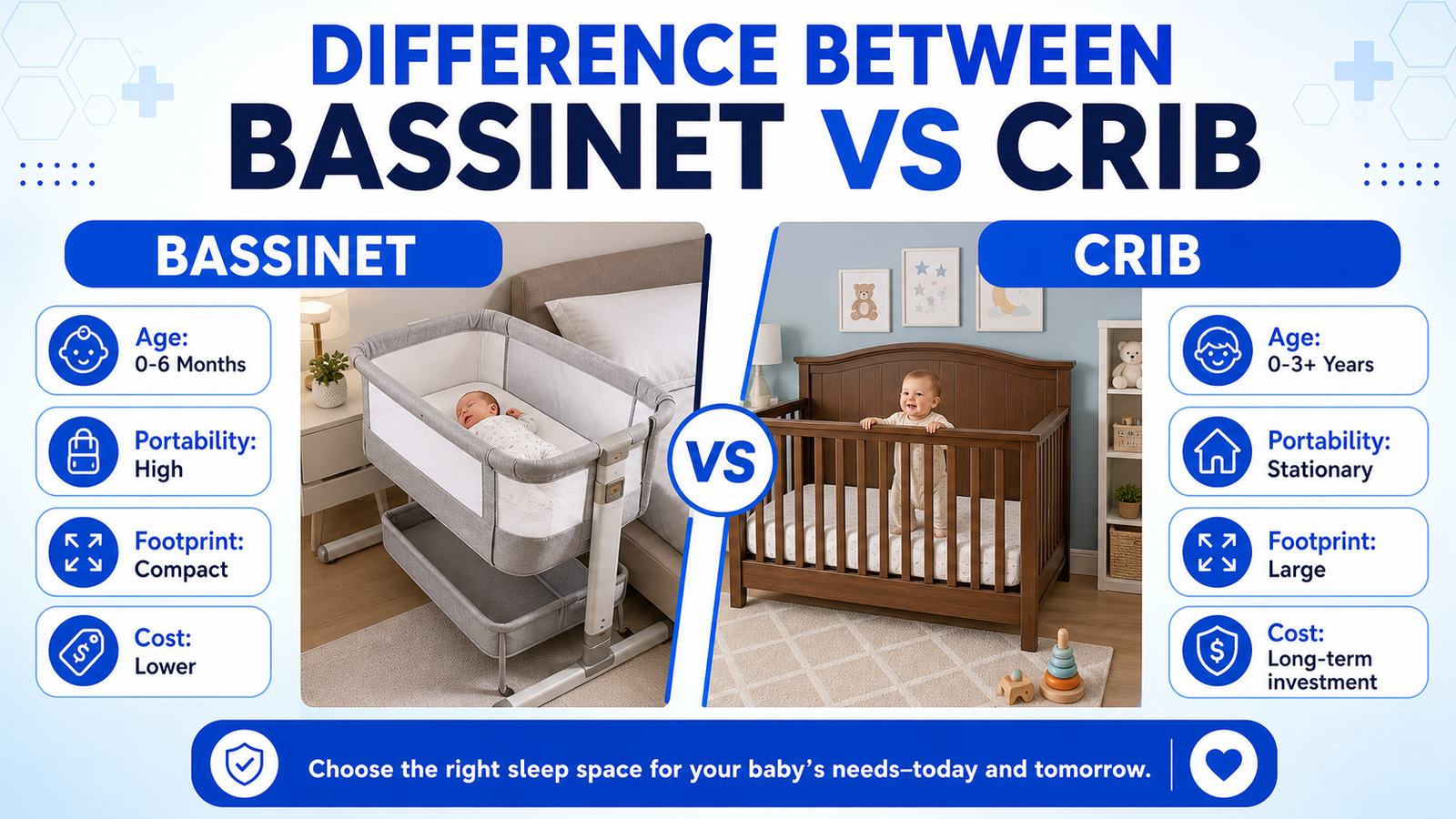
The biggest difference is therefore size, portability, and intended period of use. A bassinet is typically a compact, short-term infant sleep space, while a crib is a larger, longer-term sleep space.
Quick Answer
A bassinet is a small, portable sleep space designed primarily for young infants, while a crib is a larger, more permanent sleep space designed for infants and, depending on the model, toddlers.
The main difference is that bassinets prioritize compactness and portability during the early months, whereas cribs provide more space and a longer usable lifespan.
A baby may be able to sleep safely in either one when the specific product meets applicable safety requirements and is used according to its instructions.
Bassinet vs. Crib at a Glance
| Feature | Bassinet | Crib |
|---|---|---|
| Basic purpose | Sleep space for young infants | Longer-term infant sleep space |
| Size | Smaller | Larger |
| Portability | Usually easier to move | Usually less portable |
| Space needed | Small footprint | More floor space |
| Typical use | Early infancy | Infancy and often toddlerhood |
| Bedside use | Common | Possible with some setups, but not its defining feature |
| Lifespan | Usually shorter | Usually longer |
| Main advantage | Compact and convenient | Space and longevity |
The exact dimensions, weight limits, and permitted age or developmental stage vary by product, so those details should always be checked against the manufacturer’s instructions.
What Is a Bassinet?
A bassinet is a small bed designed for an infant. It is commonly smaller than a crib and may be supported by a frame, stand, casters, or another base.
One of its defining practical characteristics is portability. Because a bassinet generally takes up less space, it can be easier to position close to a parent’s bed or move between suitable locations.
Bassinets are particularly associated with the newborn period. However, there is no single universal age at which every baby must stop using every bassinet. The product’s stated limits and the baby’s developmental abilities matter.
For example:
The newborn slept in a bassinet beside the parents’ bed.
Here, bassinet refers to the compact infant sleep space rather than a full-size nursery crib.
What Is a Crib?
A crib is a larger bed designed for babies and young children. In American English, crib is the standard term for this type of infant bed; cot is commonly used in British English for the equivalent sleep furniture.
A crib normally takes up more floor space than a bassinet and is less convenient to move from room to room.
One important advantage of a crib is its longer potential period of use. Some cribs are designed to remain cribs, while convertible models can be adapted as a child grows.
For example:
We assembled the crib in the nursery before the baby arrived.
Here, crib describes the larger, more permanent sleep furniture.
What Is the Difference Between a Bassinet and a Crib?
The central difference is design and intended use.
A bassinet is a small, compact infant sleep space, often chosen for convenience during the early months. A crib is a larger sleep space that can remain useful for much longer.
The distinction becomes clearer when you compare their main characteristics:
1. Size
A bassinet generally has a much smaller sleeping area than a crib.
That smaller size can be useful when space is limited or when the sleep space needs to fit near an adult bed.
A crib requires more room but gives a growing baby more space.
2. Portability
Bassinets are generally easier to move.
Depending on the model, a bassinet may have wheels, a lightweight frame, or another design that makes relocation relatively simple.
Cribs are generally intended to remain in one location after assembly.
3. Period of Use
A bassinet is usually a short-term option for early infancy.
A crib is generally a longer-term option.
However, do not treat a specific age such as “four months” or “six months” as a universal expiration date for every bassinet. The manufacturer’s instructions and the baby’s developmental stage are more important than a generic number.
4. Space
A bassinet takes up less floor space.
A crib needs a larger dedicated area, which can make it less convenient in a small bedroom.
5. Purpose
The bassinet’s compact design makes it especially useful when the goal is to keep a young baby nearby.
The crib is better understood as the larger, longer-term sleep environment.
When to Use a Bassinet
A bassinet can be useful when you want a compact sleep space for a young baby.
It may be particularly convenient when:
- the baby’s sleep space needs to fit beside an adult bed
- floor space is limited
- you want a sleep space that can be moved more easily
- you want a smaller sleep environment during early infancy
The exact suitability depends on the individual bassinet and its instructions.
For example:
We kept the bassinet next to the bed during the baby’s early months.
The important idea is that the bassinet is being used for its compactness and convenience, not because the word itself guarantees a particular age limit.
When to Use a Crib
A crib is generally used when you want a larger, longer-term sleep space.
It may make sense when:
- you have enough room for a full-size sleep space
- you want a sleep surface that can remain in the nursery
- you want to use the same basic sleep furniture for a longer period
- you want a convertible model that can adapt as the child grows
A crib can also be used for a newborn when the particular crib meets applicable safety requirements and is used correctly.
For example:
The baby slept in a safety-compliant crib from the beginning.
The important distinction is that a newborn does not automatically require a bassinet simply because the baby is a newborn.
Bassinet and Crib in Real Sentences
Bassinet
The bassinet fit easily beside the parents’ bed.
The baby slept in the bassinet during the first few months.
We chose a portable bassinet because we had limited space.
Crib
We placed the crib in the nursery.
The baby eventually moved from the bassinet to the crib.
The convertible crib can be adapted as the child grows.
These examples show the normal functional distinction: bassinet emphasizes a smaller early-infant sleep space, while crib emphasizes a larger, longer-term sleep space.
Common Collocations With Bassinet and Crib
Phrases with “bassinet”
- bedside bassinet
- portable bassinet
- newborn bassinet
- bassinet mattress
- bassinet stand
- bassinet sheet
- bassinet sleeper
Phrases with “crib”
- baby crib
- full-size crib
- convertible crib
- crib mattress
- crib sheet
- crib rail
- crib bedding
- nursery crib
These combinations help show how the two words function in everyday English.
Common Mistakes With Bassinet and Crib
Mistake 1: Treating them as exact synonyms
Incorrect assumption:
A bassinet and a crib are simply two names for the same thing.
Correct:
A bassinet and a crib are related infant sleep products with different typical designs and uses.
Why:
Although both provide a sleep space for a baby, a bassinet is generally smaller and more portable, while a crib is larger and intended for longer-term use.
Mistake 2: Assuming every baby must leave a bassinet at exactly the same age
Incorrect assumption:
Every baby must move from a bassinet at exactly four months.
Correct:
The appropriate time to stop using a bassinet depends on the product’s limits and the baby’s development.
Why:
Different products have different specifications, and developmental milestones can affect when a particular bassinet is no longer appropriate.
Mistake 3: Assuming a crib cannot be used for a newborn
Incorrect assumption:
Newborns can only sleep in bassinets.
Correct:
A newborn can use an appropriate crib when it meets applicable safety requirements and is used according to safe-sleep guidance.
Why:
A bassinet is an option, not automatically a requirement.
Are Bassinets and Cribs Safe?
Safety depends on the specific product and how it is used, not simply on whether something is called a bassinet or crib.
For infant sleep, authoritative U.S. guidance emphasizes a firm, flat sleep surface, placing the baby on their back, and keeping loose bedding and soft objects out of the sleep area.
The product should also meet applicable safety requirements. Parents should follow the manufacturer’s instructions, including any weight, developmental, and usage limits.
Room sharing is also different from bed sharing: current safe-sleep guidance recommends keeping the baby’s separate sleep space in the same room as the parent for at least the first six months when possible.
When Should a Baby Move From a Bassinet to a Crib?
There is no single transition date that applies to every baby or every bassinet.
Instead, check:
- The bassinet’s manufacturer’s instructions.
- Its stated weight or other usage limits.
- Whether the baby has reached a developmental milestone that means the product should no longer be used.
- Whether the crib is ready and meets applicable safety requirements.
A common pattern is to use a bassinet during early infancy and transition to a crib later, but that is a practical pattern rather than a universal rule.
The key principle is:
Follow the bassinet’s limits and your baby’s developmental stage rather than relying on a calendar date alone.
Can a Newborn Sleep in a Crib?
Yes, an appropriate crib can be used for a newborn.
A newborn does not inherently need a bassinet.
What matters is whether the sleep space is designed and approved for infant sleep, meets applicable safety requirements, and is set up correctly.
For safe sleep, the surface should be firm and flat, the baby should be placed on their back, and the sleep area should be kept free of pillows, loose blankets, bumpers, stuffed toys, and other soft objects.
Can a Bassinet Replace a Crib?
Usually, not for the entire period during which a child needs an infant sleep space.
A bassinet is generally designed for early infancy and has a shorter useful lifespan. A crib provides a larger sleep space that can remain useful as the child grows.
However, whether you need to purchase both is a separate question.
You can use a crib from the beginning if you choose an appropriate, safety-compliant model. A bassinet is often purchased for convenience rather than because it is universally required.
Do You Need Both a Bassinet and a Crib?
Not necessarily.
Some families use a bassinet first and then transition to a crib. Others use a crib from the beginning.
The choice can depend on:
- available space
- room arrangement
- portability needs
- budget
- how close you want the baby’s sleep space to be to your bed
- the specific products available to you
So the distinction is:
A bassinet can provide early-stage convenience; a crib can provide a longer-term sleep space.
You do not need to interpret “bassinet vs. crib” as a requirement to purchase two products.
How to Remember the Difference
Use this simple rule:
Bassinet = small and portable.
Crib = larger and longer-term.
Think of a bassinet as the compact option associated with the early months, while a crib is the larger sleep space that can stay with the child for much longer.
Which One Should I Use?
The right choice depends on how you plan to use the baby’s sleep space.
A bassinet is a practical option when you want something small and easy to move during early infancy.
A crib may suit you better if you need a larger sleep space that can be used for a longer period.
For parents who prefer one sleep space from the beginning, an appropriate crib can also be an option.If you want the baby’s sleep space close to your bed → a suitable bassinet or other approved sleep space may be convenient.
The decision should be based on the specific product’s safety requirements, your available space, and your baby’s current stage.
X or Y? Practice Examples
Choose bassinet or crib in each sentence.
- The newborn’s small sleep space fit easily beside the parents’ bed: _____
- We assembled the larger nursery bed that the child could use for years: _____
- The family wanted a lightweight sleep space that was easy to move: _____
- The baby eventually transitioned to the larger sleep space: _____
- The parents wanted a compact option for the early months: _____
- The nursery had enough space for a permanent infant bed: _____
- They purchased a convertible model that could adapt as the child grew: _____
- The parents wanted a portable sleep space for their newborn: _____
Answers
- Bassinet
- Crib
- Bassinet
- Crib
- Bassinet
- Crib
- Crib
- Bassinet
Frequently Asked Questions
What is the main difference between a bassinet and a crib?
A bassinet is generally smaller and more portable, while a crib is larger and designed for longer-term use. Both can serve as infant sleep spaces when the specific products meet applicable safety requirements.
Is a bassinet the same as a crib?
No. They are related but distinct types of infant sleep products. A bassinet is generally smaller and intended primarily for early infancy, while a crib is larger and has a longer potential period of use.
Can a newborn sleep in a crib?
Yes. A newborn can sleep in an appropriate crib that meets applicable safety requirements and is set up according to safe-sleep guidance.
Does a newborn need a bassinet?
No. A bassinet can be convenient, particularly because of its compact size and portability, but it is not inherently required if an appropriate crib or another approved infant sleep space is available.
When should a baby move from a bassinet to a crib?
The transition depends on the bassinet’s instructions, its limits, and the baby’s development. Do not rely on a single universal age for every bassinet.
Is a crib safer than a bassinet?
Neither term by itself makes one automatically safer. Safety depends on the particular product, whether it meets applicable requirements, and whether it is used according to safe-sleep guidance.
Can a bassinet be used for a toddler?
Generally, bassinets are designed for much younger infants and have shorter usage periods than cribs. Always follow the specific product’s instructions and limits.
Are bassinet and crib interchangeable words?
No. Although both refer to places where babies can sleep, they describe different types of infant sleep products and are not exact synonyms.
Conclusion
The difference between a bassinet and a crib mainly comes down to size, portability, and intended period of use. A bassinet is generally a smaller, more portable sleep space associated with early infancy, while a crib is larger and designed to remain useful for a longer period.
A bassinet can be convenient when you want a compact sleep space close by. A crib can provide a larger, longer-term sleep environment. You do not necessarily need both.

Sajid Ali is an English language educator and content specialist with 7+ years of teaching experience. He holds master’s degrees in Information Technology and Education from the Virtual University of Pakistan and writes SEO-optimized, learner-friendly vocabulary content for diffari.com.