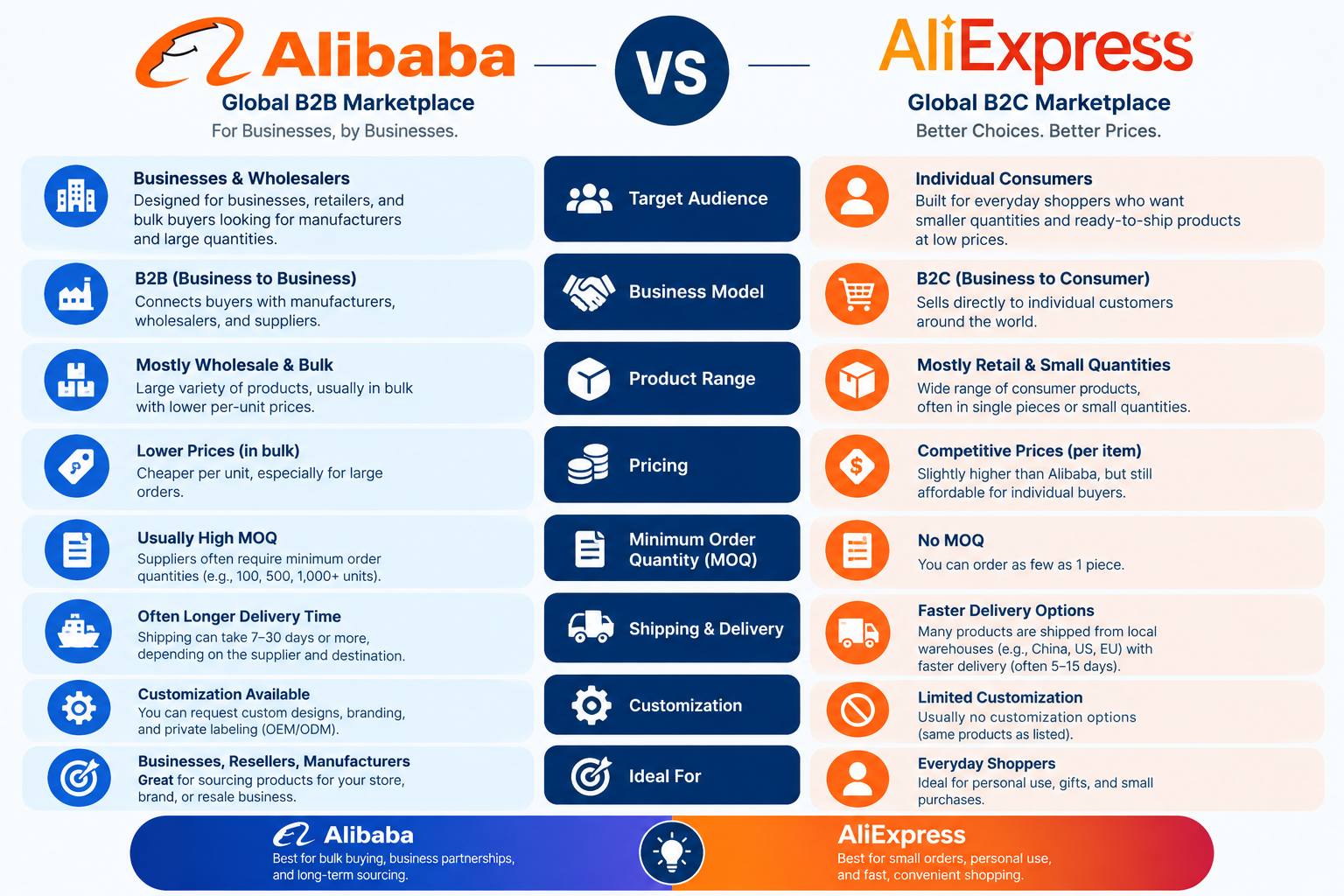
When comparing Alibaba.com and AliExpress, the biggest difference is not the products they sell. Both platforms connect buyers with a wide range of suppliers, but they are built around different purchasing models.
Alibaba.com is primarily a B2B wholesale sourcing marketplace, where businesses can contact suppliers, discuss quantities and specifications, request quotes, order samples, and arrange larger purchases. AliExpress is primarily a retail-style marketplace, where buyers can purchase finished products in small quantities through a more conventional checkout process.
That difference affects pricing, minimum order quantities, customization, shipping, supplier communication, and how each platform fits into an online business.
Quick Answer
Alibaba.com is mainly designed for wholesale and B2B sourcing, while AliExpress is mainly designed for retail-style purchases and smaller orders.
On Alibaba.com, buyers commonly communicate directly with suppliers, negotiate terms, discuss minimum order quantities, request samples, and arrange customized or branded products. On AliExpress, buyers generally select a ready-made product, pay the listed price, and order the quantity they need without negotiating a wholesale contract.
In simple terms:
Need one or a few ready-made products? → AliExpress
Need bulk quantities, customization, or a supplier for ongoing wholesale sourcing? → Alibaba.com
The exact MOQ, price, shipping method, and customization options still depend on the individual seller and product.
Alibaba vs AliExpress at a Glance
| Feature | Alibaba.com | AliExpress |
|---|---|---|
| Primary model | B2B wholesale sourcing | Retail-style marketplace |
| Typical buyer | Business buyer or reseller | Consumer or small-order buyer |
| Order quantity | Often bulk or supplier-defined MOQ | Usually small quantities, including single items |
| Pricing | Often quote-based and negotiable | Usually listed retail price |
| Customization | Stronger support for custom/OEM/ODM sourcing | Generally more limited and seller-dependent |
| Supplier communication | Usually important | Usually less negotiation required |
| Product testing | Possible through samples/small orders | Convenient for small-scale testing |
| Dropshipping | Available with some suppliers, but not the platform’s core model | Commonly used for dropshipping |
| Private labeling | Common sourcing use case | More limited |
| Shipping | Often arranged around the order and supplier terms | Usually selected during retail checkout |
| Buyer protection | Trade Assurance on eligible orders | Platform-specific buyer protections apply |
| Best suited to | Wholesale sourcing and scaling | Small orders, retail purchases, and product testing |
Alibaba.com describes itself as a wholesale marketplace serving B2B buyers and provides a sourcing workflow that includes finding suppliers, communicating with them, protecting an order, paying, and arranging shipping.
What Is Alibaba.com?
Alibaba.com is a global B2B wholesale marketplace operated within the Alibaba Group ecosystem. It connects business buyers with manufacturers, wholesalers, distributors, and other suppliers.
The platform is designed for sourcing rather than simply adding an item to a retail shopping cart.
A typical Alibaba.com purchasing process can involve:
- Searching for a product or supplier.
- Comparing suppliers.
- Contacting suppliers.
- Discussing quantity and specifications.
- Requesting samples when appropriate.
- Agreeing on price and order terms.
- Placing and protecting the order.
- Arranging payment and shipping.
Alibaba.com specifically recommends communicating with suppliers through its platform and offers tools such as Trade Assurance for eligible orders.
Alibaba.com is therefore particularly relevant when you need:
- Bulk inventory
- Wholesale sourcing
- Custom products
- Private-label products
- OEM or ODM manufacturing
- Long-term supplier relationships
- Business-to-business purchasing
However, MOQ is not a single fixed Alibaba rule. Requirements vary by supplier, product, customization, and order terms. Alibaba’s seller documentation treats MOQ as a product-specific listing field.
What Is AliExpress?
AliExpress is a global online marketplace that is much closer to a conventional retail shopping experience.
Instead of starting with a supplier negotiation, a buyer can generally:
- Find a product.
- Review the listing.
- Select a quantity.
- Pay through checkout.
- Receive the product.
AliExpress’s terms describe the platform as an intermediary between buyers and sellers rather than the seller of the products itself.
The platform is particularly useful for:
- Individual purchases
- Small quantities
- Ready-made products
- Product testing
- Low-inventory ecommerce models
- Some dropshipping workflows
A buyer does not normally need to negotiate a wholesale quotation before purchasing an ordinary AliExpress listing.
What Is the Main Difference Between Alibaba and AliExpress?
The fundamental distinction is how the transaction is structured.
Alibaba.com is centered on sourcing.
AliExpress is centered on shopping.
That difference explains many of the other distinctions.
On Alibaba.com, the buyer may be trying to establish a supply relationship: What is your MOQ? Can you change the product? Can you add my logo? What is the price for 500 units? How much will freight cost?
On AliExpress, the buyer is more likely to ask: Is this the product I need? What is the listed price? How many can I order? What delivery option is available?
Neither description applies to every transaction, but it captures the dominant purchasing model of each platform.
Pricing: Alibaba vs AliExpress
One of the most important differences is how prices are established.
Alibaba.com pricing
Alibaba.com commonly supports negotiated, volume-based pricing.
A supplier may quote different prices depending on:
- Quantity
- Product specifications
- Materials
- Packaging
- Customization
- Production requirements
- Shipping terms
Buying more units can therefore change the unit economics substantially.
AliExpress pricing
AliExpress generally works more like retail ecommerce.
The product page normally presents a listed price, and the buyer proceeds through checkout. Small orders are therefore much easier to place without first negotiating a wholesale deal.
Does Alibaba always have cheaper prices?
Not necessarily when comparing the complete cost of a purchase.
Alibaba can offer lower per-unit wholesale pricing at sufficient volume, but the buyer may also face:
- Higher upfront inventory costs
- MOQ requirements
- Freight costs
- Customs or import charges
- Inspection costs
- Packaging costs
- Production lead times
The meaningful comparison is therefore landed cost, not simply the price displayed beside the product.
Minimum Order Quantity: Alibaba vs AliExpress
MOQ means minimum order quantity.
This is a major distinction for buyers.
On Alibaba.com, suppliers frequently specify a minimum quantity because they are dealing with manufacturing or wholesale economics. The MOQ can vary significantly from one supplier or product to another.
AliExpress is generally more convenient for small orders because buyers can commonly purchase individual finished products rather than committing to a supplier’s wholesale MOQ.
For example:
Need 1 phone accessory to test its quality? → AliExpress may offer a simpler purchasing route.
Need 500 customized accessories for your brand? → Alibaba.com is more aligned with that sourcing requirement.
Customization and Private Label
Alibaba.com has a major advantage in situations where the product itself needs to be changed or branded.
Depending on the supplier, buyers may be able to discuss:
- Logo placement
- Packaging
- Materials
- Colors
- Dimensions
- Product specifications
- Custom designs
- OEM manufacturing
- ODM manufacturing
Alibaba.com explicitly promotes both ready-to-ship products and opportunities to work with suppliers on customized products.
AliExpress is primarily oriented toward ready-made products. Some individual sellers may offer customization, but it should not be assumed that a standard listing supports the same level of product development or private labeling as a dedicated wholesale sourcing relationship.
Alibaba vs AliExpress for Dropshipping
This is where the distinction becomes less absolute.
AliExpress is widely used for dropshipping because its retail-style model makes it possible to order products individually rather than purchasing large amounts of inventory first. Current comparison sources consistently identify dropshipping and product testing as major AliExpress use cases.
Alibaba.com, meanwhile, is primarily a wholesale sourcing platform, but dropshipping is not impossible. Some Alibaba suppliers offer dropshipping services, and Shopify’s current Alibaba guide specifically notes that some suppliers support this model.
The practical difference is:
AliExpress → easier for small-order, ready-made dropshipping workflows.
Alibaba.com → more relevant when you want supplier relationships, customization, branding, or larger-volume sourcing.
Product Testing
AliExpress can be useful when you want to test whether a product has potential before committing to substantial inventory.
For example, suppose you want to launch an online store selling a particular kitchen accessory.
You could first purchase a small number of units and evaluate:
- Product quality
- Packaging
- Delivery experience
- Customer interest
- Return issues
- Actual selling margin
If demand becomes consistent, a wholesale supplier may become more attractive because bulk purchasing and customization can change the economics.
This “test first, scale later” pattern is also reflected in recent comparison content about Alibaba and AliExpress.
Shipping and Logistics
Shipping is another area where the platforms differ because the purchasing process is different.
With AliExpress, shipping is generally integrated into the retail purchase. The buyer selects from the shipping options available for that particular listing and destination.
With Alibaba.com, shipping can be part of a larger sourcing discussion involving:
- Product quantity
- Production time
- Freight method
- Destination
- Packaging
- Customs
- Incoterms
- Supplier arrangements
Alibaba.com also provides logistics services and order-protection mechanisms for eligible purchases.
For large orders, do not compare only the supplier’s product price. Ask for the total delivered or landed cost.
Buyer Protection
Both platforms provide mechanisms intended to help buyers, but their systems operate within different purchasing environments.
Alibaba.com’s Trade Assurance can protect eligible orders against issues such as specified product-quality problems and late shipping, provided the transaction follows the program’s requirements. Alibaba states that payments and order terms are part of its protection framework.
For Alibaba.com purchases, keeping relevant communication and order terms on the platform is important because Alibaba specifically advises buyers to use its messaging and payment processes to maintain applicable protection.
AliExpress also operates with buyer-protection mechanisms under its platform terms, although the precise protections and eligibility depend on the transaction and applicable terms.
Buyer protection should therefore be treated as a transaction-specific feature, not a guarantee that every dispute will have the same outcome.
Common Mistakes With Alibaba and AliExpress
Mistake 1: Assuming Alibaba is only for huge corporations
Incorrect assumption:
“I cannot use Alibaba unless I own a large company.”
Better understanding:
Individuals can order through Alibaba.com, but the platform is primarily structured around wholesale sourcing and supplier relationships.
Mistake 2: Assuming every Alibaba product has the same MOQ
Incorrect assumption:
“Alibaba always requires hundreds or thousands of units.”
Better understanding:
MOQ varies by supplier and product. Always check the specific listing and confirm the quantity directly with the supplier.
Mistake 3: Assuming AliExpress is only for personal shoppers
Incorrect assumption:
“Businesses cannot use AliExpress.”
Better understanding:
Businesses and resellers can use AliExpress, particularly for small orders, product testing, and certain dropshipping models.
Mistake 4: Comparing only the advertised product price
A $3 product is not necessarily cheaper than a $4 product if the first one has significantly higher shipping, customs, or other landed costs.
Mistake 5: Assuming the same supplier relationship exists on both platforms
A product may look almost identical on both websites, but the purchasing relationship can be very different. On Alibaba.com, the transaction may involve supplier negotiation, production specifications, and a formal wholesale order. On AliExpress, it may simply be a retail checkout.
Common Terms You Should Know
MOQ
Minimum Order Quantity — the smallest quantity a supplier agrees to sell under specified terms.
OEM
Original Equipment Manufacturer. In sourcing, this often refers to products made to a buyer’s specifications or branding requirements.
ODM
Original Design Manufacturer. The supplier provides a product design or manufacturing solution that can be adapted or branded by the buyer.
Private Label
A product manufactured by a supplier and sold under the buyer’s own brand.
Dropshipping
A business model in which the seller does not necessarily hold the product in inventory and the supplier ships the order to the customer.
These terms are especially relevant when comparing Alibaba.com’s sourcing model with AliExpress’s retail-style model.
Can Alibaba and AliExpress Be Used Interchangeably?
Not usually.
Both can provide access to products from suppliers, but the purchasing experience is different.
AliExpress is generally more convenient when you need:
- Small quantities
- Ready-made products
- Simple checkout
- Product testing
- Retail-style purchasing
Alibaba.com is generally more relevant when you need:
- Bulk quantities
- Supplier negotiation
- Customization
- Private labeling
- Manufacturing relationships
- Wholesale sourcing
There can be overlap. For example, some Alibaba suppliers offer ready-to-ship products, and some AliExpress purchases can be made by businesses. The distinction is therefore about the dominant use case and transaction structure, not an absolute rule about who may buy.
How to Remember the Difference
Use this simple rule:
AliExpress = buy products.
Alibaba.com = source products.
Think of AliExpress as the simpler retail-style route for obtaining finished products in small quantities.
Think of Alibaba.com as the supplier-sourcing route when you need volume, customization, or a more direct business relationship.
Which One Should I Use?
Instead of asking which platform is universally better, match the platform to your purchasing situation.
For one or a few ready-made products, AliExpress is usually more suitable.
AliExpress can also work well when you want to test a product without committing to large inventory quantities.
Wholesale buyers may find Alibaba.com more appropriate, especially when they need larger quantities.
For custom packaging, product branding, or private-label products, Alibaba.com offers more suitable supplier options.
Buyers who want to negotiate pricing, minimum order quantities, or supplier terms can also use Alibaba.com.
For a simple retail-style shopping experience, AliExpress provides a straightforward checkout process.
When your goal is to build a private-label product line, Alibaba.com is generally the more relevant platform.
To test demand before purchasing in bulk, you can consider AliExpress or request a sample from an Alibaba supplier, depending on the product and supplier.
Ultimately, your choice should depend on several factors, including order quantity, customization needs, budget, supplier relationship, and total landed cost.
Alibaba or AliExpress? Practice Examples
Choose the platform that best matches each scenario.
- You want to buy two phone cases for personal use.
- You want 1,000 custom boxes with your company logo.
- You want to test whether a new kitchen product sells before buying inventory in bulk.
- You need a manufacturer to modify a product’s dimensions.
- You want to buy a single ready-made accessory.
- You want to negotiate a large order with a supplier.
- You need products manufactured under your own brand.
- You want to compare suppliers for a long-term wholesale relationship.
Answers
- AliExpress — a small personal order fits its retail-style model.
- Alibaba.com — bulk custom production is a typical wholesale sourcing requirement.
- AliExpress or an Alibaba sample — the appropriate route depends on the product and supplier.
- Alibaba.com — supplier communication and customization are central to the requirement.
- AliExpress — a single ready-made item fits the retail purchasing model.
- Alibaba.com — supplier negotiation and volume purchasing fit the B2B model.
- Alibaba.com — private-label sourcing is a major use case.
- Alibaba.com — its supplier-sourcing structure is designed for this type of relationship.
Frequently Asked Questions
What is the main difference between Alibaba and AliExpress?
Alibaba.com is primarily a B2B wholesale sourcing marketplace, while AliExpress is primarily a retail-style marketplace for consumers and small-order buyers.
Is Alibaba cheaper than AliExpress?
Alibaba.com can provide lower per-unit pricing for sufficiently large wholesale orders, but the total cost depends on MOQ, shipping, customization, customs, and other expenses. A simple product-price comparison is not enough.
Can I buy one item from Alibaba?
Yes, an individual can order through Alibaba.com, but the specific supplier may impose a minimum quantity or other purchasing requirements. Alibaba.com is primarily designed around wholesale sourcing.
Does AliExpress have a minimum order quantity?
AliExpress generally allows buyers to purchase small quantities, including individual items, although product and seller conditions can vary.
Which is better for dropshipping?
AliExpress is commonly used for small-order and ready-made dropshipping workflows. Alibaba.com can also support dropshipping through some suppliers, particularly when a business needs more customization or a direct supplier relationship.
Can I private-label products from Alibaba?
Alibaba.com is commonly used for private-label and customized sourcing, although the exact branding and production options depend on the supplier and product.
Are Alibaba and AliExpress owned by the same company?
Yes. Both platforms are part of the broader Alibaba Group ecosystem.
Are Alibaba and AliExpress the same website?
No. They are separate marketplaces serving different primary purchasing models.
Which platform is better for wholesale?
Alibaba.com is structured primarily around B2B wholesale sourcing and supplier relationships.
Which platform is better for buying a small quantity?
AliExpress is generally structured for small retail-style orders, making it a convenient option when you do not want to commit to wholesale quantities.
Conclusion
The difference between Alibaba and AliExpress comes down primarily to how you want to buy. Alibaba.com is built around B2B sourcing, wholesale quantities, supplier communication, and opportunities for customization. AliExpress is built around retail-style purchasing, smaller quantities, ready-made products, and straightforward checkout.
A useful rule is simple: use AliExpress when you need small quantities or want to test ready-made products; consider Alibaba.com when you need wholesale volume, customization, private labeling, or a longer-term supplier relationship. Always compare the complete cost and terms of the specific transaction rather than assuming one platform is universally cheaper.